
Zapier

Search documents
两次拿到陆奇投资,张浩然这次想用 Agencize AI 干掉所有工作流 Agent
Founder Park· 2026-01-06 07:38
Core Viewpoint - The article emphasizes the need for AI-native workflows that eliminate the requirement for users to pre-construct workflows, allowing for real-time generation of personalized software based on user intent [3][12][22]. Group 1: AI-Native Workflow Concept - Agencize AI aims to create a system where users only need to describe their intentions, enabling the software to automate 95% of their tasks without requiring pre-defined workflows [7][10]. - The founder believes that traditional SaaS will not disappear but will serve as the infrastructure for AI, allowing for seamless integration and automation of tasks across various applications [3][11]. - The product is designed to cater to knowledge workers, providing a new productivity tool that operates similarly to how Excel transformed digital office work [8][10]. Group 2: User Experience and Interaction - A typical user scenario involves a psychologist who previously struggled with manual tasks, now able to automate them through Agencize AI by simply stating their needs [8][10]. - Users experience an "aha moment" when they provide vague instructions and receive results that exceed their expectations, showcasing the AI's capabilities [13][14]. - The interaction model allows users to give high-level goals without detailing every step, making the process intuitive and user-friendly [15][19]. Group 3: Product Differentiation and Market Position - The product differentiates itself by not requiring users to understand or construct workflows, instead allowing AI to handle the structuring of tasks [22][23]. - The founder argues that the traditional concept of workflows is outdated and that AI should facilitate natural human-like interactions [20][22]. - The market opportunity is significant, with the productivity market valued at over $60 billion, and the potential to disrupt the software labor market, which is estimated to be in the trillions [48][49]. Group 4: Future Vision and Development - The vision for the future includes creating a system where software is generated in real-time based on user intent, fundamentally changing how work is executed [35][36]. - The company aims to build a personalized software experience that learns from user interactions, creating a unique dataset that enhances the AI's capabilities over time [38][39]. - The founder emphasizes the importance of quickly launching products to validate market needs, rather than waiting for perfection [56][57].


AI自动化工程师:人工智能为人类创造的新工作
3 6 Ke· 2025-11-17 23:17
Core Insights - The role of AI Automation Engineer is emerging, focusing on enhancing team efficiency through AI workflows without requiring programming skills [3][4][10] - AI Automation Engineers bridge the gap between understanding AI potential and implementing it effectively within teams [4][10] - The position is expected to become more common across various sectors, with a shift in hiring practices towards candidates with AI automation skills [3][4] Group 1: Role Definition - AI Automation Engineers identify opportunities to improve team efficiency and create AI workflows to capitalize on these opportunities [3] - The role involves analyzing existing processes, quantifying costs, and prioritizing optimization opportunities [5][11] - Responsibilities include building reusable HR workflows and ensuring they benefit global HR teams [4][10] Group 2: Importance of AI Automation Engineers - Many teams struggle to translate AI concepts into actionable solutions, highlighting the need for AI Automation Engineers [4] - These engineers utilize tools like Zapier and ChatGPT to quickly prototype and develop reliable internal tools [4][10] - Their work not only enhances internal processes but also provides insights that can improve client operations [4][10] Group 3: Skills and Qualities Required - A background in technology is not necessary; curiosity and problem-solving skills are more critical for success in this role [8][10] - Key skills include prompt engineering, responsible AI practices, and the ability to select appropriate AI tools for specific tasks [9][10] - The focus remains on empowering team members to maximize the use of AI systems [10] Group 4: Practical Applications and Outcomes - AI Automation Engineers engage in hands-on collaboration to test prototypes in real workflows, adjusting as needed [11] - They track metrics such as time savings, error reduction, and improved business outcomes, demonstrating the effectiveness of AI implementations [11] - Successful workflows are packaged for sales teams to showcase to potential clients, emphasizing their impact on efficiency and problem-solving [11][12] Group 5: Industry Examples - Remote's IT department utilized AI to automate 27.5% of IT tickets, saving over 2,200 workdays and $500,000 in hiring costs [12] - Vendasta's marketing operations expert saved 282 workdays annually through AI automation in sales processes, recovering $1 million in revenue [12] - ActiveCampaign's product education manager implemented AI-driven solutions that allowed sales teams to focus on high-value activities [12]

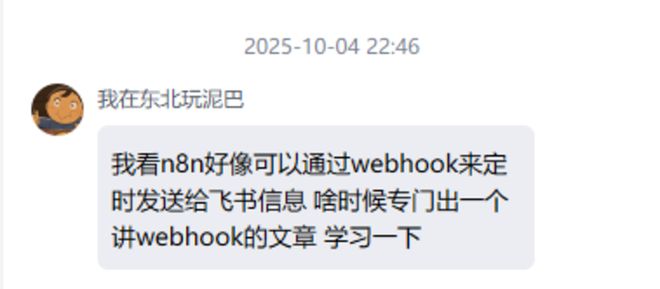
一篇搞懂:飞书多维表格、n8n、Dify 等自动化工作流里的 Webhook 到底是个啥
Tai Mei Ti A P P· 2025-10-11 03:27
Core Insights - The article explains the concept of Webhook in simple terms, comparing it to a "doorbell" for systems to notify each other in real-time, eliminating the need for constant polling [2][10][12]. Group 1: Understanding Webhook - Webhook is described as a "reverse" API that allows systems to send notifications to each other without the need for constant inquiries [10][12]. - The traditional API method requires users to actively check for updates, which is inefficient and resource-consuming [6][7]. - Webhook simplifies this process by allowing systems to push notifications when specific events occur, such as payment confirmations [12][14]. Group 2: Installation and Functionality - Setting up a Webhook involves three main steps: providing a Callback URL, specifying the events to subscribe to, and handling incoming notifications [17][20][23]. - The Callback URL acts as the "address" where notifications will be sent, and it must be configured in the system that will send the notifications [18][19]. - The system sends an HTTP POST request containing a Payload with relevant information when an event occurs [24][26]. Group 3: Common Pitfalls - Security is a major concern, as the Webhook URL is publicly accessible, making it vulnerable to unauthorized requests [29][30]. - Implementing signature verification is crucial to ensure that notifications are legitimate and from trusted sources [33][35]. - Handling duplicate notifications is necessary to prevent processing the same event multiple times, which can lead to errors [39][40]. Group 4: Practical Implementation - The article provides a step-by-step guide for setting up a Webhook receiver using Python and Flask, including code examples [26][50][56]. - It emphasizes the importance of using tools like Ngrok to expose local servers to the internet for testing purposes [62][63]. - Postman is recommended for sending test requests to verify the Webhook functionality [70][73]. Group 5: Automation with n8n - The article concludes by demonstrating how to integrate Webhook functionality into n8n for automated workflows, allowing for seamless communication between systems [75][88]. - It highlights the shift from a "pull" model to a "push" model in system interactions, enhancing efficiency and responsiveness [85].
X @Ansem
Ansem 🧸💸· 2025-07-02 19:56
AI Learning Resources - AI For Everyone (Coursera) is recommended as a starting course for individuals with no technical background to learn AI basics [1] - ChatGPT, Notion AI, Zapier, Claude, and Perplexity are suggested as essential AI tools to learn [1] Influencers and Platforms - YouTube channels like Jeff Su, The AI Advantage, Futurepedia, Jordan Harrod, Skill Leap AI, and AI Master are valuable resources for learning about AI [1] Personal Recommendation - RT Vonn (@itsthewealth4me) shares a recommendation for learning AI basics in 2025 [1]