
e6

Search documents
独家专访比亚迪CTO孙华军:反超特斯拉,藏着“死磕”磷酸铁锂的20年
21世纪经济报道· 2026-01-13 09:18
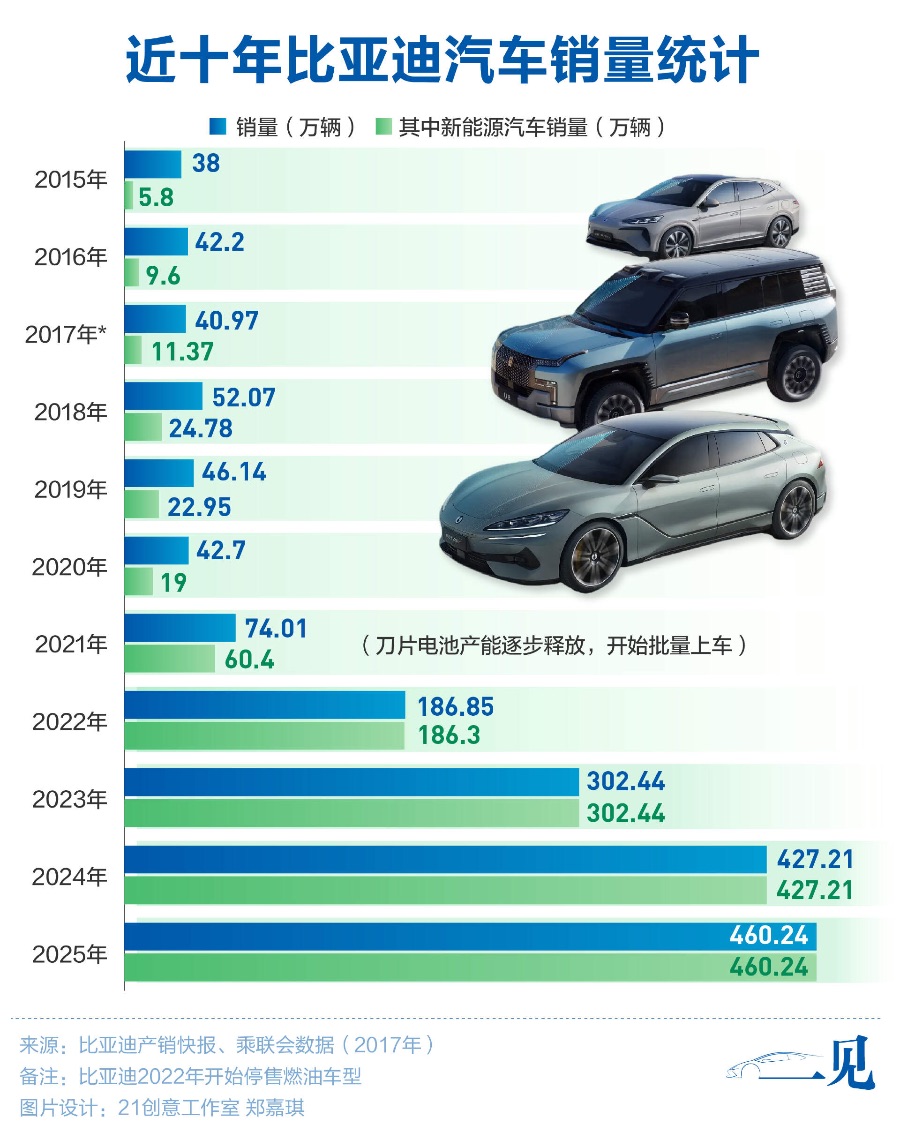
Core Viewpoint - BYD has surpassed Tesla in pure electric vehicle sales for the first time, achieving a total of 2.2567 million units in 2025, marking a year-on-year growth of 27.86% [5] Group 1: Historical Development - The journey of BYD began 23 years ago with a focus on lithium iron phosphate (LFP) batteries, which were initially deemed unsuitable for electric vehicles due to low energy density [5][7] - In 2002, BYD's chairman Wang Chuanfu decided to pursue the LFP route, prioritizing safety and resource independence over higher energy density alternatives like nickel-cobalt-aluminum batteries [7][9] - BYD launched its first plug-in hybrid model, the F3DM, in 2008, featuring self-developed LFP batteries, which laid the foundation for subsequent models [8][9] Group 2: Market Challenges and Strategic Decisions - Between 2017 and 2019, the electric vehicle market faced challenges, leading to a temporary shift in focus towards high-energy-density ternary lithium batteries [8][9] - In 2019, during a critical period for the company, BYD made two key strategic decisions: shifting focus from commercial to passenger vehicles and continuing to refine the LFP battery technology despite market pressures [10][11] - The "Qinghai Conference" in 2018 was pivotal in reaffirming the commitment to LFP batteries, focusing on achieving longer ranges [10][19] Group 3: Technological Innovations - The development of the "blade battery" was a significant breakthrough, allowing for improved space utilization and safety, which ultimately enabled LFP batteries to achieve a range of 600 kilometers [10][11][23] - The blade battery's design involved a long, flat structure that increased energy density and safety, overcoming previous limitations of traditional battery shapes [10][24] - BYD's commitment to R&D is evident, with a team of around 10,000 dedicated to battery technology, ensuring a competitive edge in the electric vehicle market [12][27] Group 4: Future Directions - BYD plans to enhance its LFP battery technology further, focusing on safety and charging efficiency, with the introduction of a "megawatt fast-charging battery" expected by 2025 [12][30] - The company aims to maintain its leadership in LFP technology while adapting to new industry standards and safety regulations [30][31] - Future iterations of the blade battery will prioritize faster charging speeds and improved performance in extreme conditions [29][30]



比亚迪孙华军:反超特斯拉,藏着死磕磷酸铁锂的20年
2 1 Shi Ji Jing Ji Bao Dao· 2026-01-09 15:00
Core Viewpoint - BYD has surpassed Tesla in pure electric vehicle sales for the first time, achieving a total of 2.2567 million units sold in 2025, marking a year-on-year growth of 27.86% [1] Group 1: Historical Context and Technological Development - The journey of BYD from being overtaken by Tesla in 2019 to reclaiming the top position in 2025 began with a long exploration of battery technology, particularly focusing on lithium iron phosphate (LFP) batteries, which were initially deemed unsuitable for electric vehicles [2][3] - The decision to pursue LFP technology was made by BYD's chairman Wang Chuanfu in 2002, prioritizing safety and resource availability over energy density [3][4] - BYD's first plug-in hybrid model, the F3DM, launched in 2008, utilized self-developed LFP batteries, setting the foundation for future models [4] Group 2: Market Challenges and Strategic Decisions - Between 2017 and 2019, the electric vehicle market faced challenges, leading to a shift towards high-energy-density ternary lithium batteries, which dominated the market during that period [4][5] - In 2019, BYD faced significant difficulties, prompting a strategic pivot from commercial vehicles to passenger vehicles and a renewed focus on LFP battery technology [5][6] Group 3: Innovations and Product Launches - The "Blade Battery" was developed as a result of internal discussions aimed at improving the range of LFP batteries, achieving over 600 kilometers of range by enhancing space utilization in battery packs [6][7][8] - The introduction of the Blade Battery in 2020 marked a turning point for BYD, leading to a resurgence in sales, with 190,000 electric vehicles sold that year [8][11] Group 4: Competitive Advantages and Future Directions - BYD's vertical integration in the supply chain became a significant advantage during the global semiconductor shortage, allowing the company to maintain production and growth [11] - As the industry shifts towards ultra-fast charging and solid-state batteries, BYD plans to continue investing in LFP technology while also developing a "megawatt fast-charging battery" capable of providing 400 kilometers of range in just five minutes [11][32] - The company remains committed to enhancing the safety and performance of LFP batteries, with ongoing investments in research and development [33]
21对话|比亚迪孙华军:反超特斯拉,藏着死磕磷酸铁锂的20年
2 1 Shi Ji Jing Ji Bao Dao· 2026-01-09 14:52
Core Insights - BYD has surpassed Tesla in global electric vehicle sales for the first time, achieving a total of 2.2567 million pure electric vehicles sold in 2025, marking a year-on-year growth of 27.86% [2] - The foundation of BYD's success lies in the development of lithium iron phosphate (LFP) batteries, which were initially considered unsuitable for electric vehicles due to their lower energy density [2][3] - The strategic decision to focus on LFP batteries was driven by safety concerns and the availability of raw materials in China, as opposed to the reliance on cobalt and nickel used in ternary batteries [3][4] Development Timeline - BYD began exploring LFP technology in 2002, with the first LFP battery used in a plug-in hybrid model, the F3DM, launched in 2008 [4] - The company faced challenges between 2017 and 2019 when the electric vehicle market cooled, leading to a temporary shift in focus towards ternary batteries due to their higher energy density [5][6] - In 2019, BYD made a pivotal decision to refocus on LFP technology, leading to the development of the "blade battery" which improved space utilization and safety [6][7] Technological Innovations - The blade battery design allowed for a higher space utilization rate of over 60%, enabling a range of 600 kilometers, which was a significant improvement over previous designs [6][18] - The manufacturing process for the blade battery involved overcoming significant engineering challenges, including precision in stacking and cutting the battery cells [20][21] - BYD's commitment to LFP technology has resulted in a robust R&D team of approximately 10,000 members, emphasizing the company's dedication to innovation in battery technology [21] Market Position and Future Outlook - BYD's sales began to recover in the latter half of 2020, with total electric vehicle sales reaching 190,000 units that year, and over 600,000 units sold in 2021 [7] - The company has established a competitive edge through vertical integration of its supply chain, which became particularly advantageous during global shortages of chips and batteries [7][8] - Looking ahead, BYD plans to continue investing in LFP technology while also addressing challenges such as charging speed and safety standards in response to new regulations [24][25]

比亚迪近八年研发费1812亿超利润 廉玉波造车38年当选中国工程院院士
Chang Jiang Shang Bao· 2025-11-24 00:33
Core Viewpoint - The recent election of Lian Yubo as an academician of the Chinese Academy of Engineering highlights the significant contributions of BYD in the electric vehicle sector, particularly in technological innovation and research investment [1][4]. Company Overview - Lian Yubo, the newly elected academician, has been with BYD for over 20 years, leading the development of key technologies such as the world's first plug-in hybrid vehicle F3DM and China's first pure electric vehicle e6 [5][6]. - BYD has maintained a strong focus on research and development, with R&D expenses consistently exceeding net profits since 2018 [1][6]. Financial Performance - From 2018 to the first three quarters of 2025, BYD's cumulative net profit reached 136.32 billion yuan, while R&D expenses totaled approximately 181.2 billion yuan [2][6]. - In 2021, BYD reported a net profit of 3.045 billion yuan, a year-on-year decrease of 28.08%, while R&D expenses increased by 7.05% to 7.991 billion yuan [6]. R&D Investment and Growth - BYD's R&D personnel count is projected to reach 121,600 by the end of 2024, an increase of 18.24% from the previous year, with a strong emphasis on innovation and patent applications [7]. - The company has adopted a "technology first, innovation-based" philosophy, leading to significant advancements in the industry, including the launch of the "Super e-platform" and the "Universal Intelligent Driving" strategy [7]. Sales Performance - In the first ten months of 2025, BYD's sales reached 3.7019 million units, reflecting a year-on-year growth of 13.88% [7].
刚刚,比亚迪出了个中国院士!
Xin Lang Ke Ji· 2025-11-21 03:09
Core Points - The article highlights the recognition of Lian Yubo, the chief scientist of BYD, who has been elected as an academician of the Chinese Academy of Engineering, underscoring his significant contributions to the rise of China's automotive industry and BYD's leadership in the electric vehicle sector [1][12] - Lian Yubo is credited with developing BYD's comprehensive new energy technology, which has positioned the company as a leader in the global automotive market [1][10] Group 1: Background of Lian Yubo - Lian Yubo was born in 1964 in Yizheng, Jiangsu, and initially aspired to work in aviation, studying at Nanjing University of Aeronautics and Astronautics [1] - After being redirected to the automotive industry, he spent years acquiring automotive knowledge and skills, eventually becoming the deputy chief engineer at Yizheng Automobile Factory [1][3] - Lian Yubo joined BYD in 2004, where he established the company's R&D center in Shanghai and began building a team of engineers [1][4] Group 2: Contributions to BYD - Lian Yubo played a crucial role in developing BYD's first widely recognized compact car, the F3, which sold over 100,000 units in less than a year, marking a significant achievement for the brand [4][6] - Under his leadership, BYD launched several successful models, including the F0 and F6, while also focusing on the development of new energy vehicles [4][5] - Lian Yubo was instrumental in the creation of BYD's DM-i hybrid technology and the e6 electric vehicle, which validated the company's self-developed technologies [5][6][9] Group 3: Technological Innovations - Lian Yubo's engineering team at BYD has introduced several advanced technologies, including silicon carbide power control, blade batteries, and innovative vehicle architectures [9][10] - His leadership has been pivotal in transforming BYD from a secondary player in the automotive market to the largest car manufacturer in China, with an annual production and sales volume of 4 million vehicles [8][10] - The recognition of Lian Yubo as an academician reflects the broader advancements in China's new energy and smart automotive sectors, highlighting the importance of technological leadership in the industry [11][12]