工程机械杂志

Search documents
「新能源+AI」技术驱动!宏英智慧矿山方案驱动高效运营
工程机械杂志· 2026-01-13 09:48
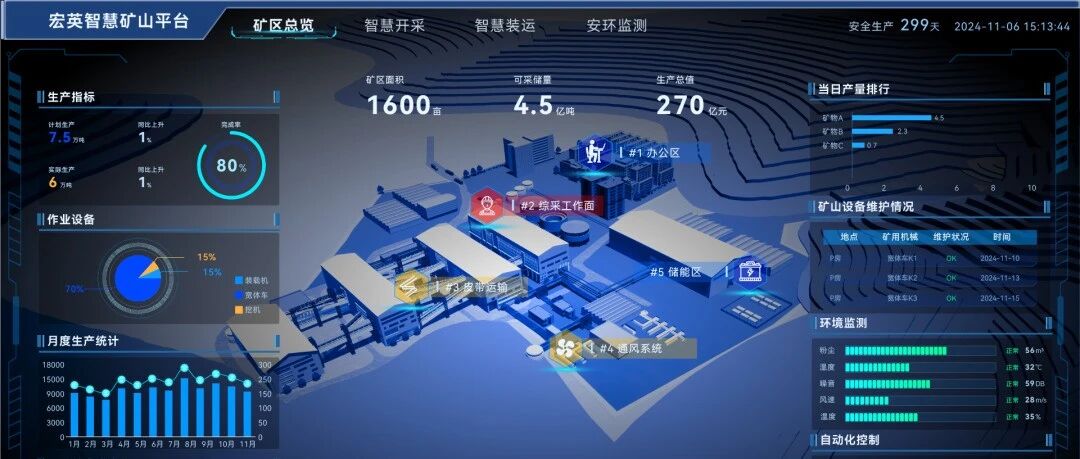
以下文章来源于宏英智能 ,作者小宏 宏英智能 . 宏英智能总部位于中国上海。2005年创立,深圳主板上市企业。作为一家融合研发、生产和销售的高新 技术企业,近二十年专注技术创新,在智能控制、新能源、汽车电子、三电系统、机器人领域不断深耕 和探索,致力于成为值得信赖的数智生态伙伴。 双碳战略纵深推进,矿山运营面临日益迫切的转型压力。作业效率瓶颈、安全生产要求以 及 绿 色 建 设 趋 势 , 均 促 使 行 业 不 断 思 考 : 该 如 何 突 破 " 高 能 耗 、 高 风 险 、 低 效 率 " 的 困 局? 2 0 2 4年4月,自然资源部等七部门联合印发《关于进一步加强绿色矿山建设的通知》,明 确 2 0 2 8年底前持证在产的9 0%大型矿山、8 0%中型矿山要达到绿色矿山标准要求 。 在 此 背 景 下 , 宏 英 智 能 ( 以 下 简 称 " 宏 英 " ) 依 托 电 子 电 气 智 能 控 制 与 新 能 源 领 域 技 术 积 淀 , 推 出 智 慧 矿 山 解 决 方 案 —— 以 " 绿 色 + 智 能 " 双 核 驱 动 , 深 度 融 合 新 能 源 、 人 工 智 能、物联网技 ...

太重集团换帅:太重集团总经理陶家晋接棒
工程机械杂志· 2026-01-12 11:40
Core Viewpoint - The leadership transition at Taiyuan Heavy Industry Group (Tai Heavy Group) is significant, with Tao Jiajin officially taking over as the chairman, marking a new phase in the company's development and reform efforts [1][3][6]. Group 1: Leadership Transition - Tao Jiajin has been appointed as the chairman of Tai Heavy Group, succeeding Han Zhentang, who has reached retirement age at 60 [2][3]. - Tao Jiajin previously held multiple roles within the company, including vice chairman and general manager, and is expected to further enhance the company's strategic direction [6]. - The transition is seen as a precursor to broader changes within the organization, particularly with Tao set to take over as chairman of Taiyuan Heavy Industry, the group's only publicly listed company, in May 2025 [6]. Group 2: Company Background - Tai Heavy Group was established in 1950 and is recognized as the first heavy machinery manufacturing enterprise designed and built independently in New China, contributing significantly to the national economy [6]. - The company has achieved over 500 national and global firsts, earning the title of "pioneer of the national economy" [6]. - Since 2020, Tai Heavy Group has embarked on a new phase of reform, innovation, and development, indicating a shift towards transformation and modernization [6][8]. Group 3: Industry Context - The engineering machinery industry is showing signs of recovery, with expectations of improved performance in 2025, particularly in excavator sales and overall market conditions [9][12]. - The industry is transitioning to the "National IV" emission standards, which began on December 1, indicating regulatory changes that may impact production and sales [9]. - There is a notable increase in exports, with a reported rise of over 70% this year, despite a continuous decline in domestic sales for 13 months [9].

2025年12月挖掘机国内销量10331台,同比增长10.9%
工程机械杂志· 2026-01-10 01:04
Core Viewpoint - The excavator market in China is showing significant growth, with total sales reaching 23,095 units in December 2025, representing a year-on-year increase of 19.2% [1][2]. Sales Data Summary - In December 2025, domestic sales of excavators were 10,331 units, up 10.9% from the previous year, while exports totaled 12,764 units, marking a 26.9% increase [1][2]. - For the entire year of 2025, a total of 235,257 excavators were sold, reflecting a 17% year-on-year growth. Domestic sales accounted for 118,518 units (up 17.9%), and exports reached 116,739 units (up 16.1%) [2]. Electric Excavator Market - In December 2025, 39 electric excavators were sold, categorized by weight as follows: under 6 tons (11 units), 6-10 tons (7 units), 10-18.5 tons (2 units), 18.5-28.5 tons (19 units), and 28.5-40 tons (1 unit) [3]. Monthly Sales Review - Monthly domestic sales data for excavators in 2025 shows fluctuations, with notable sales in March (19,517 units, up 28.5%) and February (11,640 units, up 99.4%). However, May saw a decline with 8,392 units sold, down 1.48% [4][7]. Industry Trends - The engineering machinery industry is experiencing a recovery, with expectations of improved performance as indicated by various market dynamics, including a significant increase in exports and a shift to "National IV" standards starting December 1, 2025 [8].

2025年12月装载机国内销量5291台,同比增长17.6%
工程机械杂志· 2026-01-09 00:47
Core Viewpoint - The Chinese loader market is experiencing significant growth, with total sales of various types of loaders reaching 12,236 units in December 2025, marking a year-on-year increase of 30% [2][3]. Group 1: Market Overview - In December 2025, domestic sales of loaders were 5,291 units, up 17.6% year-on-year, while exports reached 6,945 units, up 41.5% [2][3]. - For the entire year of 2025, total loader sales amounted to 128,067 units, reflecting an 18.4% increase compared to the previous year. Domestic sales were 66,330 units (up 22.1%), and exports were 61,737 units (up 14.6%) [3]. Group 2: Electric Loader Market - In December 2025, 2,722 electric loaders were sold, with specific breakdowns: under 3 tons (72 units), 3 tons (181 units), 4 tons (10 units), 5 tons (1,499 units), 6 tons (820 units), 7 tons (129 units), and above 8 tons (6 units) [4]. Group 3: Monthly Sales Trends - Monthly domestic sales data for loaders in 2025 shows a consistent upward trend, with notable increases in sales from January to December, including a peak in November with 5,671 units sold, representing a 29.4% year-on-year growth [6].

2025年工程机械主要产品平均工作时长为926小时,同比下降6.15%
工程机械杂志· 2026-01-08 09:16
Core Viewpoint - The engineering machinery industry is experiencing a decline in average working hours and operating rates for major products in 2025, indicating potential challenges ahead for the sector [1][3]. Working Hours and Operating Rates - The average working hours for major engineering machinery products in 2025 is projected to be 926 hours, a decrease of 6.15% year-on-year [1]. - Specific working hours for key machinery include: - Excavators: 815 hours - Loaders: 1088 hours - Truck Cranes: 1228 hours - Crawler Cranes: 1056 hours - Tower Cranes: 550 hours - Rollers: 390 hours - Pavers: 461 hours - Rotary Drilling Rigs: 812 hours - Off-road Mining Dump Trucks: 1716 hours - Concrete Pump Trucks: 484 hours - Concrete Mixers: 724 hours - Forklifts: 1116 hours [1]. - The operating rate for major products is expected to be 55.4%, down by 5.77 percentage points year-on-year [1]. - Specific operating rates include: - Excavators: 56.9% - Loaders: 57.2% - Truck Cranes: 71% - Crawler Cranes: 57.7% - Tower Cranes: 38.1% - Rollers: 42.1% - Pavers: 50.7% - Rotary Drilling Rigs: 43% - Off-road Mining Dump Trucks: 43.9% - Concrete Pump Trucks: 35.7% - Concrete Mixers: 31.5% - Forklifts: 57.5% [1]. Monthly Working Hours Review for 2025 - Monthly average working hours for engineering machinery products in 2025 show a downward trend: - November: 84.2 hours, down 13% year-on-year - October: 80.9 hours, down 9.03% year-on-year - September: 78.1 hours, down 13.3% year-on-year - August: 78.4 hours, down 9.45% year-on-year - July: 80.8 hours, down 6.91% year-on-year - June: 77.2 hours, down 9.11% year-on-year - May: 84.5 hours, down 3.86% year-on-year - April: 90.1 hours, up 3.20% year-on-year - March: 90.1 hours, up 6.53% year-on-year - February: 46.4 hours, up 70.3% year-on-year - January: 74.6 hours, up 3.61% year-on-year [4]. Industry Trends - The engineering machinery industry is anticipated to be on a recovery path, with signs of performance improvement [6]. - The transition to "National IV" emission standards is set to begin on December 1, 2024, which may impact the industry [6]. - Domestic sales have been declining for 13 consecutive months, while exports have surged over 70%, indicating a shift in market dynamics [7]. - There are expectations of improved operating rates in February, suggesting a warming outlook for the engineering machinery sector [11].

2025年12月工程机械主要产品月平均工作时长为76.5小时,同比下降18.6%
工程机械杂志· 2026-01-08 09:16
Core Viewpoint - The construction machinery industry is experiencing a decline in average working hours and operating rates, indicating potential challenges ahead for the sector in 2025 [1][3]. Monthly Working Hours Summary - In December 2025, the average working hours for major construction machinery products was 76.5 hours, a year-on-year decrease of 18.6% and a month-on-month decrease of 9.19% [1]. - Specific working hours for various machinery in December 2025 included: excavators at 69.3 hours, loaders at 80.4 hours, and concrete mixing trucks at 53.8 hours [1]. Monthly Operating Rate Summary - The operating rate for major construction machinery products in December 2025 was 51.8%, down 12.5 percentage points year-on-year and down 4.72 percentage points month-on-month [1]. - Operating rates for specific machinery in December 2025 included: excavators at 52.6%, loaders at 46.5%, and concrete mixing trucks at 26.5% [1]. Historical Data Review - The average working hours for major construction machinery products showed a consistent decline from 90.1 hours in April 2025 to 76.5 hours in December 2025, with various monthly year-on-year decreases ranging from 3.61% to 70.3% [4]. - The operating rates have also shown a downward trend, with December 2025's rate of 51.8% reflecting a significant drop compared to earlier months [1][4]. Industry Trends - The construction machinery industry is anticipated to face challenges due to the continuous decline in domestic demand, as indicated by a 13-month consecutive drop in internal sales [8]. - Despite the downturn, there are expectations for improvement in the industry, with potential recovery signals noted in early 2025 [8][12].

观点 | 挖掘机市场技术革命与产业重构下的增长新范式
工程机械杂志· 2026-01-06 09:32
Core Viewpoint - The global infrastructure construction model is undergoing a fundamental shift from traditional extensive development to precise and sustainable operations, driving the evolution of the excavator industry from a mere earth-moving tool to a core execution unit of intelligent construction systems [1] Industry Underlying Logic Reconstruction - The value creation logic in the industry has fundamentally changed, with clients focusing more on the comprehensive value derived from efficiency improvements, cost reductions, and carbon emission reductions through intelligent and electrified technologies rather than just equipment performance [1] - Three core driving forces are identified: rising global labor costs and skilled labor shortages, increasing complexity of construction scenarios, and the accelerated elimination of high-emission old equipment under global carbon neutrality goals [1] Technological Revolution Electrification - Electric excavators are rapidly penetrating markets due to their core advantages of zero emissions, low noise, and low maintenance costs, with a projected market share exceeding 30% by 2030 for electric excavators [2] - Technological advancements in battery energy density and fast-charging technology are addressing range anxiety, while next-generation storage technologies like solid-state and hydrogen fuel cells are paving the way for electrification of larger equipment [2] Intelligentization - Intelligent technologies are redefining excavator operation modes, enabling basic functions like automatic slope repair and collision prevention, significantly lowering operational thresholds [3] - Leading companies are accelerating the development of Level 4 autonomous driving technology, allowing equipment to replace human labor in high-risk scenarios [3] - The shift towards a "product + service" business model is anticipated to create continuous value-added revenue for companies [3] Digitalization - Digital technologies are breaking down information silos between equipment, creating an intelligent construction ecosystem that covers the entire chain from design to operation and maintenance [4] - The transformation towards flexible manufacturing models driven by demand for on-demand production is expected to enhance operational efficiency [4] Regional Market Dynamics - There is a notable regional differentiation in global infrastructure construction demand, with emerging markets becoming the core growth engine due to urbanization and infrastructure needs, while mature markets focus on equipment upgrades and green transitions [5] - Companies are adjusting their market strategies to cater to these regional differences, enhancing service responsiveness in emerging markets and providing customized solutions in mature markets [5] Demand Structure - The diversification of downstream application scenarios is driving excavator demand towards specialization and segmentation, with new growth points emerging in sectors like renewable energy infrastructure and urban renewal [6] - This demand differentiation is reshaping product strategies, leading to a dual-track model of standardized general models and customized professional models [6] Competitive Focus - The industry is shifting from price competition to value competition, with clients evaluating equipment based on total lifecycle costs, efficiency improvements, and environmental compliance [7] - Companies are required to build competitive barriers through technology, service, and ecosystem collaboration to enhance customer experience and expand value creation boundaries [7] Future Outlook - From 2026 to 2030, the excavator industry is expected to enter a new phase of high-quality development driven by technological revolutions and industry restructuring, with growth primarily stemming from technological upgrades and demand structure optimization [8] - Strategic focus areas for companies include accelerating electrification and intelligent technology deployment, deepening digital transformation, and expanding overseas markets through localized operations [8]

中国工程机械类产品进出口数据看板(2025年1-11月)
工程机械杂志· 2026-01-04 09:54
Core Viewpoint - The import and export data for China's machinery and equipment industry shows a positive trend, with significant growth in exports across various categories, indicating a recovery in market demand and potential investment opportunities [1][3][4][5][6][7]. Group 1: Overall Import and Export Data - From January to November 2025, China's engineering machinery equipment and parts had a total export value of $56.24 billion, representing a year-on-year increase of 11.9% [1]. - The total import value during the same period was $2.44 billion, remaining stable compared to the previous year, resulting in a trade surplus of $51.37 billion [1]. - The main export markets showed robust growth, with significant increases in exports to various regions [1]. Group 2: Excavator Import and Export Data - The total import and export value of excavators reached $9.59 billion, with exports amounting to $9.44 billion, a year-on-year increase of 26.1% [3]. - Imports of excavators were $1.5 billion, reflecting a decline of 19.8%, leading to a trade surplus of $9.28 billion [3]. - Market demand for excavators is recovering, with notable growth in specific markets despite some declines in others [3]. Group 3: Loader and Transport Machinery Data - The total import and export value of loader and transport machinery was $6.99 billion, with exports of $6.81 billion, marking a 6.4% increase year-on-year [5]. - Imports decreased by 23.4%, resulting in a trade surplus of $6.62 billion [5]. - The overall trend in this category remains stable, with consistent export performance [5]. Group 4: Crane Machinery Data - The total import and export value of crane machinery was $5.23 billion, with exports of $5.13 billion, showing a year-on-year increase of 15.7% [4]. - Imports were $0.1 billion, down by 1.8%, leading to a trade surplus of $5.03 billion [4]. - The market for crane machinery is experiencing fluctuations, with some regions showing declines in demand [4]. Group 5: Industrial Vehicles Data - The total import and export value of industrial vehicles was $8.17 billion, with exports of $8.03 billion, reflecting a 1.8% increase [5]. - Imports were $1.4 billion, with a slight increase of 1.7%, resulting in a trade surplus of $7.89 billion [5]. - The trend towards electrification is providing support for exports in this category [5]. Group 6: Road Construction Machinery Data - The total import and export value of road construction machinery was $1.59 billion, with exports of $1.58 billion, indicating an 11.7% increase [6]. - Imports were $0.01 billion, down by 16.9%, leading to a trade surplus of $1.57 billion [6]. - The industry is showing stable export performance, with various markets contributing positively [6]. Group 7: Mixing and Stirring Machinery Data - The total import and export value of mixing and stirring machinery was $2.19 billion, with exports of $2.2 billion, a 22% increase year-on-year [6]. - Imports were $0.2 billion, down by 14.4%, resulting in a trade surplus of $2.17 billion [6]. - The export growth is supported by strong demand in several international markets [6]. Group 8: Elevator and Escalator Data - The total import and export value of elevators and escalators was $2.45 billion, with exports of $2.41 billion, reflecting a 13% increase [7]. - Imports were $0.04 billion, up by 10.3%, leading to a trade surplus of $2.37 billion [7]. - The market is experiencing growth, particularly in specific regions, despite some fluctuations [7].

加速产业出海,锚定中高端 | 工程机械或延续内外销共振
工程机械杂志· 2026-01-04 09:54
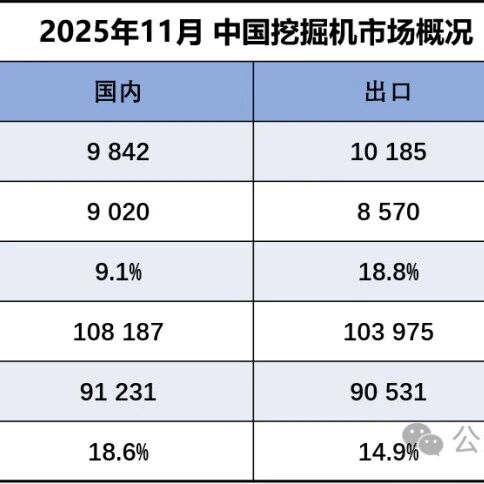
Core Viewpoint - The article highlights the increasing overseas revenue share and the expansion of product offerings in the engineering machinery sector, indicating a shift towards globalization and improved profitability for leading companies by 2025 [1][5]. Group 1: Market Trends - By 2025, the share of overseas revenue for leading engineering machinery companies is expected to continue rising, with major manufacturers accelerating the establishment of overseas sales networks and production capacity [1]. - The domestic market is anticipated to recover as the renewal cycle begins in 2025, while "going abroad" remains a key strategy for domestic manufacturers to capture profits [1][5]. - The demand for engineering machinery is projected to maintain a steady upward trend in 2026 as large projects commence, supported by a gradual recovery in demand from Europe and the U.S. [1][5]. Group 2: Sales and Profitability - In the first eleven months of the year, a total of 212,162 excavators were sold, representing a year-on-year increase of 16.7%, with domestic sales up by 18.6% and exports by 14.9% [2]. - The engineering machinery industry saw total operating revenue and net profit attributable to shareholders grow by 8.69% and 18.87% year-on-year, respectively, in the first three quarters [2]. - Major companies like SANY Heavy Industry, XCMG, and Zoomlion reported significant net profit growth rates of approximately 47%, 12%, and 25%, respectively, in the same period [2][3]. Group 3: Strategic Developments - Companies are transitioning from "product export" to "industrial export," establishing overseas centers and local operations, with cumulative export value expected to reach or exceed $59 billion in 2025 [5]. - SANY Heavy Industry has allocated about 45% of its fundraising for global sales and service network expansion, aligning with its strategy of globalization and digitalization [6]. - The demand for mining machinery is expected to rise due to increased capital expenditure in the mining sector, with a positive outlook for equipment upgrades and replacements [6]. Group 4: Future Outlook - The engineering machinery sector is predicted to enter a new cycle starting in 2025, with a longer duration expected, particularly in emerging industries like new energy machinery [6]. - The overseas markets, especially in Latin America, Africa, and the Middle East, are anticipated to show strong demand, particularly in mineral development and energy infrastructure [6].




亿纬锂能与杭叉集团深化战略合作 共拓工程机械电动化新篇章
工程机械杂志· 2025-12-31 09:26
Core Viewpoint - The strategic partnership between EVE Energy and Hangcha Group has been upgraded to focus on "ecological symbiosis," aiming to lead the electrification of construction machinery [1][3]. Group 1: Partnership Details - EVE Energy and Hangcha Group have been collaborating for three years and are now deepening their cooperation in three dimensions: "joint technology research, capacity co-construction, and scenario co-creation" [1]. - The partnership aims to integrate advanced battery technology with intelligent equipment to provide higher value green logistics solutions for global customers [3]. Group 2: Industry Context - Hangcha Group is a leading manufacturer with nearly 70 years of history, offering a full range of forklifts and intelligent logistics equipment [2]. - EVE Energy has empowered over 100,000 units of new energy construction machinery with its next-generation open-source battery technology, widely used in critical scenarios such as ports, mines, and warehouses [3]. Group 3: Future Directions - The collaboration will focus on four key areas to promote the electrification of construction machinery vehicles in China, representing a significant step in the transformation of the manufacturing industry towards efficiency, sustainability, and intelligence [3].