中关村储能产业技术联盟

Search documents
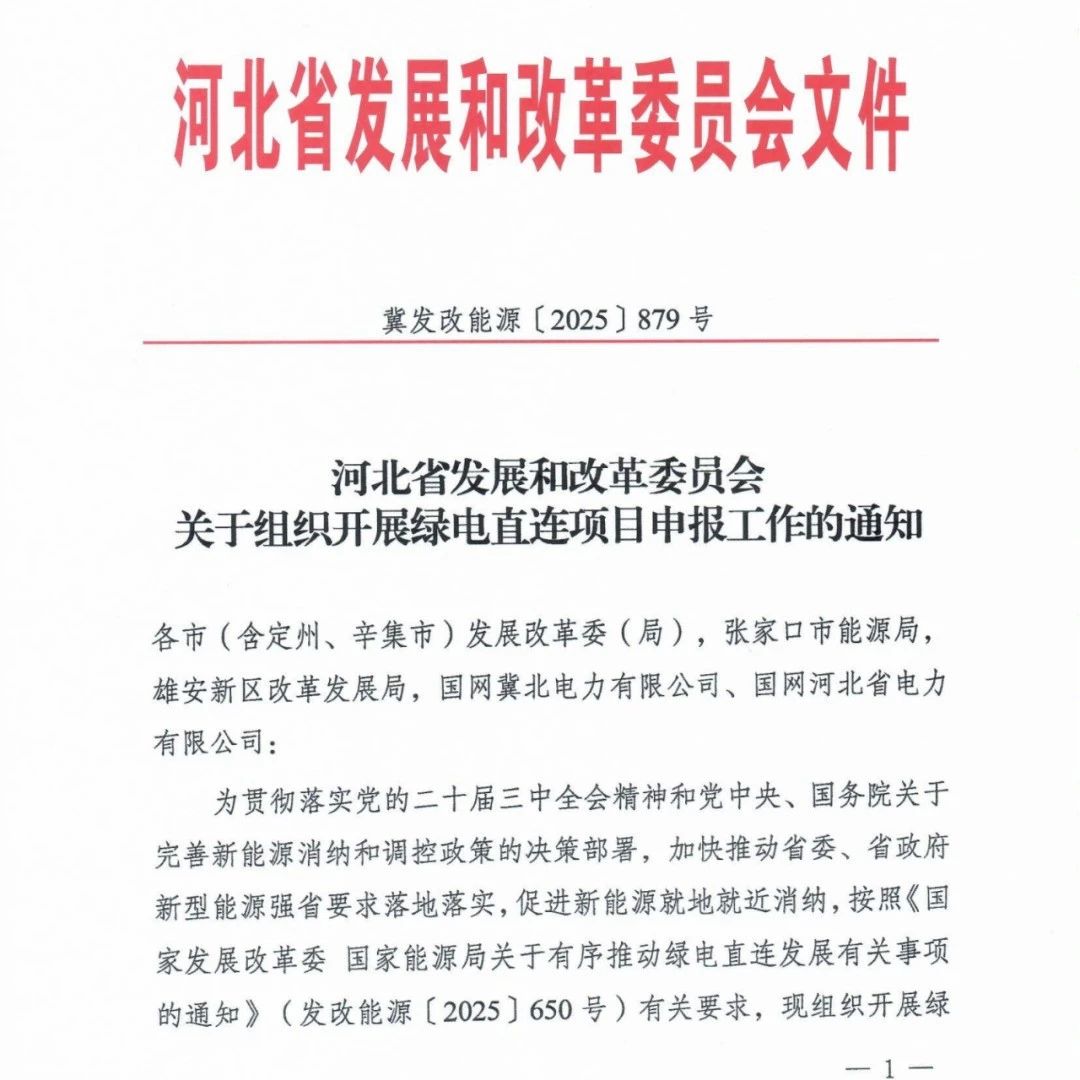
河北:绿电直连项目申报启动,优先支持三类项目
中关村储能产业技术联盟· 2025-08-05 10:56
Core Viewpoint - The article outlines the guidelines for the application of green electricity direct connection projects in Hebei Province, emphasizing the support for key industries and the streamlined approval process to enhance renewable energy consumption and efficiency [11][13]. Group 1: Project Support and Prioritization - The Hebei Development and Reform Commission prioritizes applications from key industries such as computing power, steel, cement, chemicals, hydrogen production, lithium-ion battery manufacturing, and biomedicine [2][3]. - Projects already included in the wind and solar project reserve library are also prioritized for green electricity direct connection applications [3]. - New energy projects that have not yet started grid connection construction or are unable to connect to the grid due to renewable energy consumption limitations are encouraged to apply after completing necessary changes [3][4]. Group 2: Project Implementation and Management - Green electricity direct connection projects will not occupy the provincial annual indicators, and third-party organizations will review implementation plans and construction conditions [5]. - Projects must match new or existing loads promptly in case of load interruption, with a limit on the grid-connected electricity proportion during interruption [6][21]. - Projects must commence construction within one year of approval and be operational within three years [8][16]. Group 3: Technical and Safety Requirements - Projects must connect at a voltage level not exceeding 220 kV, with necessary assessments conducted if higher voltage connections are required [9][16]. - A "one-stop" service is encouraged to expedite the approval process for project permits, planning, land use, environmental assessments, and grid connections [10][19]. Group 4: Economic and Social Benefits - Projects should demonstrate good economic and social benefits, effectively reducing electricity costs for enterprises and promoting local green economic development [17][25]. - The projects are expected to adopt advanced technologies to improve energy efficiency and reduce environmental pollution [17][25].

出海+5!储能龙头国际合作新突破
中关村储能产业技术联盟· 2025-08-05 06:42
Core Viewpoint - Chinese energy storage leaders are achieving significant breakthroughs in overseas markets, with multiple projects in Europe and North America showcasing their technological advancements and market expansion efforts [2]. Group 1: European Market Developments - Sungrow Power Supply is assisting in the establishment of a 73MW/147MWh grid-connected energy storage project in Spain and Portugal, with a total capacity of 74MW/147MWh across five projects [3]. - The projects in Portugal will receive part of a €100 million (approximately $115.6 million) government subsidy from the EU Recovery and Resilience Fund [3]. - Trina Storage is deploying a 65MWh battery storage project in Romania, which is part of a larger initiative supported by the EU Recovery and Resilience Fund [4][5]. - Shanghai CaiRi Energy Technology has secured a 430+MWh energy storage procurement project in Bulgaria, highlighting its global competitiveness in market layout and delivery capabilities [7][8]. Group 2: Japanese Market Developments - Guoxuan High-Tech has launched Japan's largest energy storage station on Miyako Island, with a capacity of 12MW/48MWh, utilizing its liquid cooling energy storage system [6]. - The company is expanding its presence in the Japanese energy storage market, focusing on renewable energy integration and virtual power plant applications [6]. Group 3: North American Market Developments - Baichuang New Energy is entering the North American market with its innovative carbon dioxide energy storage technology, having signed a cooperation memorandum with Zeo Energy to explore applications in the U.S. [9][10]. - The company holds over 70 unique patents in the carbon dioxide storage field and aims to enhance its competitive edge through collaboration in the North American energy storage sector [10].



海博思创在人工智能领域又有新动作!瞄准电力交易、储能电站资产运营管理
中关村储能产业技术联盟· 2025-08-05 06:42
Core Viewpoint - The collaboration between Haibo Sichuang and Fan Shi Group aims to integrate AI technology with energy storage systems, marking a significant advancement in the "AI + Energy Storage" sector, which is expected to enhance technological innovation and application scenarios [2][4][10]. Group 1: Partnership Details - Haibo Sichuang and Fan Shi Group have established a joint venture to explore the integration of AI and energy storage technologies [2][4]. - The partnership will focus on areas such as power trading and asset management of energy storage stations, leveraging both companies' strengths in their respective fields [4][8]. - The collaboration is expected to create a synergistic effect, enhancing the capabilities of both companies in the energy sector [4][10]. Group 2: Strategic Importance - Energy storage is identified as a core application scenario for AI in the energy revolution, highlighting its strategic significance [8]. - Haibo Sichuang aims to transform into a comprehensive energy service provider by utilizing AI for intelligent operation and management throughout the entire lifecycle of energy storage systems [8][10]. - The partnership is positioned to provide innovative AI solutions for the energy sector, contributing to the industry's digital transformation and sustainable development [8][10]. Group 3: Leadership Insights - Dr. Zhang Jianhui, CEO of Haibo Sichuang, emphasized the importance of AI technology in driving energy transformation and the compatibility of both companies' visions [4][10]. - Dr. Dai Wenyuan, founder of Fan Shi Group, highlighted the dual-core approach of energy storage and AI as essential for overcoming challenges in the renewable energy sector [6][10]. - The collaboration is expected to significantly increase the value generated in the "AI + Energy" field, potentially exceeding current outputs by several times [6].

宁德时代/阳光电源/远景能源/天合储能/比亚迪/东方日升等领衔英国大储市场
中关村储能产业技术联盟· 2025-08-04 09:43
Core Insights - The article discusses the supply relationships between battery storage suppliers and project owners/operators in the UK, highlighting the current operational capacity of grid-scale battery storage systems at approximately 7GW/10GWh [2][4]. Group 1: Market Overview - According to the report by Solar Media, the current operational capacity of grid-scale battery storage systems in the UK is around 7GW/10GWh [2]. - The database includes long-term battery storage projects that are under construction, have submitted planning applications, or have received planning permission, totaling a capacity of 63,243MW/131,834MWh [7]. Group 2: Key Suppliers - Leading suppliers by project deployment volume include BYD Energy, Canadian Solar, CATL, Samsung, GE, LONGi Green Energy, Fluence, LG Energy, Sungrow, Wärtsilä, Trina Storage, Korea's Hyosung Heavy Industries, Envision Energy, Tesla, and NHOA Group [4]. - The infographic in the article illustrates the relationships between suppliers, system integrators, and end developers, covering operational projects with a capacity of 49MWh and above [3]. Group 3: Data Sources - The research data is sourced from news announcements, specific documents in planning application files, and non-public information obtained through industry relationships [7]. - The report does not include projects that battery storage system suppliers/integrators have not publicly disclosed, nor those that could not be obtained through special research by Solar Media analysts [6].




深度分析 | 储能电芯大容量化最新趋势,这篇文章说透了
中关村储能产业技术联盟· 2025-08-04 09:43
Core Viewpoint - The article discusses the rapid development and challenges of large-capacity battery cells in the energy storage industry, emphasizing the need for cost reduction and efficiency improvement as the global energy structure shifts towards renewable sources [2] Group 1: Large Cell Layout - Nearly 20 battery cell companies have launched or planned 500Ah+ large cell products, with the iteration process accelerating significantly [3] - The transition from 280Ah to 300+Ah took about 3 years, while the leap to 500Ah and 600Ah occurred in just 2 years [3] - Companies like CATL and Sungrow are leading the market with innovative designs and high-capacity standards, but market validation of large cells is still needed [3][4] Group 2: Reasons for Large Cells - Large battery cells are crucial as they represent the highest value segment of the energy storage system, directly impacting system configuration and integration [3] - Increasing cell capacity reduces the number of batteries and components needed, thereby lowering overall investment costs for energy storage stations [3][4] Group 3: Technical Challenges of Large Cells - As cell capacity exceeds 500Ah, technical challenges arise, such as increased thickness of electrode sheets and potential safety risks like thermal runaway [6] - Manufacturing challenges include the need for high precision in coating and welding processes, which can affect the consistency and reliability of large cells [6][7] Group 4: Manufacturing Processes - Two main manufacturing processes for 500Ah+ cells are winding and stacking, each with its own advantages and disadvantages [8][9] - Stacking offers higher energy density and better safety but requires more precise equipment, while winding is simpler and cheaper but may compromise performance [8][9] Group 5: Specification Unification vs. Differentiation - The market is moving towards a unified framework for battery specifications while allowing for differentiated innovations [10] - Different market demands are leading to a competitive landscape where various capacities coexist, with 314Ah and 392Ah cells dominating shorter-duration storage and 500Ah+ cells focusing on longer-duration applications [10][11] Group 6: Future Trends - The development of large cells must consider investor acceptance and should focus on reducing Levelized Cost of Storage (LCOS) through technological innovations [12] - The future of large-capacity cells remains uncertain, as the industry must navigate technical limits and market needs to determine which cell types will prevail [12]

全国统一电力市场“1+6”基础规则体系初步建成
中关村储能产业技术联盟· 2025-08-04 09:43
Core Viewpoint - The article discusses the newly issued "Basic Rules for Metering and Settlement in the Electricity Market," which aims to enhance the management of metering and settlement in the national unified electricity market, ensuring fair and accurate transactions among market participants [3][8]. Summary by Sections General Principles - The rules are established to implement the central government's directives for deepening electricity system reform and building a unified national market [8]. - Metering is defined as the measurement and recording of electricity data to meet settlement needs [9]. - The rules apply to all types of electricity markets and emphasize the importance of accurate and timely settlement [9][10]. Overall Requirements - Electricity market settlement includes energy trading, ancillary services trading, and capacity trading, with settlements generally conducted on a natural month basis [11][12]. - In continuous operation of the electricity spot market, a "daily clearing and monthly settlement" model is adopted [12]. - The rules require that all market participants adhere to the established metering and settlement processes [9][10]. Rights and Obligations - Market participants must participate in the electricity market according to the rules and provide necessary data for settlement [15]. - The electricity trading institution is responsible for compiling settlement data and ensuring its accuracy [17]. - The grid enterprises must issue electricity bills based on the settlement basis provided by the trading institution [18]. Metering Management - Market participants must install metering devices that meet national standards and undergo regular calibration [20]. - The grid enterprises are responsible for ensuring that metering devices are installed and maintained properly [20][21]. Settlement Management - Settlement preparation involves collecting and summarizing the necessary data within specified timeframes [27]. - The electricity trading institution compiles settlement bases based on market rules and foundational data [33]. - Electricity bills must be issued by grid enterprises within specified deadlines, ensuring timely payment to generation companies [42][43]. Supervision and Management - Disputes regarding metering and settlement can be resolved through mediation or legal channels [41]. - Regulatory bodies will address any non-compliance with the metering and settlement rules [41]. Implementation - The rules will take effect on October 1, 2025, and will be valid for five years [43][44].
年产5GWh!晶科储能与亿纬锂能联合电芯工厂正式量产
中关村储能产业技术联盟· 2025-08-04 09:43
Core Viewpoint - The joint battery cell factory established by Jinko ESS and EVE Energy has officially entered mass production, marking a significant step in vertical integration within the energy storage industry [2][3]. Group 1: Joint Factory Production - The joint factory completed equipment debugging in May 2025 and began full operation in June, with an annual supply capacity of 5GWh of 314Ah energy storage cells for Jinko ESS [2]. - The 314Ah energy storage cells are specifically designed for commercial and large-scale energy storage systems, optimizing the entire process from material selection to quality control, thereby enhancing energy density and system integration efficiency [2]. - The CEO of Jinko ESS stated that the mass production of the joint factory signifies the company's vertical extension from system integration to core battery cells, providing excellent energy storage solutions [2]. Group 2: Market Growth and Strategic Partnership - The global energy storage market is growing at an annual rate exceeding 30%, with expectations that the new installed capacity will surpass 200GWh by 2025 [2]. - EVE Energy's General Manager emphasized the importance of the joint battery cell factory as a result of vertical integration and technological collaboration, aiming to explore battery iteration and intelligent system solutions [3]. - The partnership between Jinko ESS and EVE Energy is expected to leverage their complementary advantages in battery cells, systems, and market access to drive industry upgrades [3].


0.49~0.52元/Wh!新华三/比亚迪/远景能源预中标山东高速390MWh储能设备采购
中关村储能产业技术联盟· 2025-08-03 15:35
Core Viewpoint - The article discusses the procurement of lithium iron phosphate energy storage systems by Shandong High-speed Energy Development Co., Ltd., highlighting the competitive bidding process and the selected candidates for the project [2]. Group 1: Procurement Details - The total capacity for the procurement is 195MW/390MWh, with candidates including Xinhua San, BYD, and Envision Energy [2]. - The first candidate, Xinhua San, quoted 197.73 million yuan with a unit price of 0.507 yuan/Wh [3]. - The second candidate, BYD, quoted 191.1 million yuan with a unit price of 0.490 yuan/Wh [3]. - The third candidate, Envision Energy, quoted 202.8 million yuan with a unit price of 0.520 yuan/Wh [3]. Group 2: Company Performance - Xinhua San has secured multiple contracts, including a 50MWh storage system in Hubei and a 390MW photovoltaic storage equipment procurement [3]. - BYD's notable projects include a 50MW/1000MWh shared storage demonstration project in Xinjiang and a 162.5MW/650MWh integrated project with wind power [6]. - Envision Energy has been involved in significant projects such as a 100MW/400MWh new storage power station in Inner Mongolia and a 500MW wind power project in Gansu [8]. Group 3: Battery Cell Performance - Xinhua San has also engaged in battery cell procurement, including contracts for 314Ah storage cells [4]. - BYD's battery cell projects include a 300MW/1200MWh storage system equipment and service project in Xinjiang [7]. - Envision Energy has secured contracts for various battery cell orders, including a significant number of 305Ah cells [9].

首个省级容量电价机制出台
中关村储能产业技术联盟· 2025-08-03 15:35
Core Viewpoint - Gansu Province has introduced a capacity pricing mechanism for power generation, marking the first provincial-level independent capacity pricing policy in China, aimed at supporting the transformation of coal power and promoting the orderly development of new energy storage [2][3]. Group 1: Capacity Pricing Mechanism - The capacity price for coal power units and new energy storage on the grid side is set at 330 yuan per kilowatt per year, with a two-year implementation period [2]. - The mechanism includes full capacity compensation for coal power, increasing the fixed cost recovery ratio from 30% to 100%, and incorporates various energy sources like hydropower, wind, and solar into the compensation framework [3][4]. - The introduction of a capacity pricing mechanism is expected to stabilize investment returns and promote the development of energy storage, especially in the context of high penetration of renewable energy [3][4]. Group 2: Flexibility and Resource Demand - Gansu's energy resources are abundant, but the high proportion of renewable energy requires flexible adjustment resources to ensure reliable power supply during peak demand [3]. - The new pricing mechanism aims to decouple capacity pricing from energy pricing, providing a clearer boundary between energy, auxiliary services, and capacity pricing [3][4]. Group 3: Impact on Users and Market Dynamics - The capacity pricing mechanism is designed to have a minimal impact on downstream electricity costs for industrial and commercial users, as the overall electricity price is expected to decrease due to the introduction of this mechanism [6][7]. - The capacity fee will be allocated based on the monthly electricity consumption of all industrial and commercial users, with the State Grid Gansu Electric Power Company responsible for monthly calculations [5][6]. Group 4: Future Market Developments - The capacity pricing mechanism is seen as a transitional measure, with plans to establish a capacity market in the long term, allowing for better resource allocation and price discovery [8][9]. - The mechanism will encourage the participation of diverse resources in the capacity market, with a focus on effective capacity assessment and fair compensation [9][10].

一般工商业不纳入机制电价范围,首次竞价8月组织,山东机制电价竞价公开征求意见!
中关村储能产业技术联盟· 2025-08-02 13:08
Core Viewpoint - The article discusses the implementation details of the "Shandong Province New Energy Mechanism Electricity Price Bidding Implementation Rules (Draft for Comments)" aimed at promoting the market-oriented reform of new energy pricing and ensuring high-quality development in the sector [8]. Group 1: Bidding Subject - The bidding subjects include new energy projects that have been put into operation and those planned to be operational by December 31 of the following year, specifically those not previously included in the mechanism price execution range [15]. - Exceptions to the bidding subjects include distributed photovoltaic projects for general and large-scale commercial use, which will participate in electricity market trading for all grid-connected electricity except for self-consumed electricity [15][12]. - Distributed bidding agents can participate in bidding on behalf of household distributed photovoltaic projects, with a total capacity not exceeding 100,000 kW per bidding session [15][12]. Group 2: Bidding Quantity - The total scale of bidding electricity is determined based on the annual completion of non-hydropower renewable energy electricity consumption responsibility weight and user affordability [23]. - Bidding organization will categorize projects by technology type, such as photovoltaic and offshore wind, and will merge categories if competition is insufficient [23]. - The bidding declaration sufficiency rate is calculated as the sum of the declared mechanism electricity of participating subjects divided by the total scale of that type of mechanism electricity [23]. Group 3: Bidding Process - Bidding activities are generally organized in October each year, with the first bidding scheduled for August 2025 [31]. - The provincial development and reform commission is responsible for issuing annual bidding notifications, which include details such as bidding subjects, organization categories, and execution periods [32]. - After the bidding results are announced, projects that did not win can continue to participate in future bidding and engage in electricity market trading [38].