具身智能之心

Search documents
具身智能之心运营实习生招募来啦!合伙人1v1培养
具身智能之心· 2025-08-09 00:48
Group 1 - The company aims to connect academia and industry through technical content, focusing on cutting-edge AI fields such as autonomous driving, embodied intelligence, and large models [1] - The team has established deep collaborations with mainstream companies and relevant universities in the fields of autonomous driving and embodied intelligence, while rapidly building partnerships in the large model sector [1] - The company provides a variety of content including academic paper interpretations, industry production solutions, large model evaluations, business dynamics, industry recruitment, and open-source projects [1] Group 2 - The company is looking for interns to assist in academic paper selection, interpretation, and summarization in the fields of large models, autonomous driving, and embodied intelligence [3] - Interns are expected to have a strong passion for research and sharing knowledge related to technological advancements and events [3] - The internship offers a combination of salary, one-on-one mentorship, industry resource recommendations, and internal job referrals [5]


近2000人了,这个具身领域的黄埔军校有哪些料?
具身智能之心· 2025-08-08 16:02
Core Viewpoint - The article emphasizes the value of a community that provides solutions to problems in the field of embodied intelligence, facilitating knowledge sharing and job opportunities in various sectors related to robotics and AI [3][17]. Group 1: Community and Resources - The community has established a closed loop in various fields including industry, academia, job seeking, and Q&A exchanges, providing timely solutions and research insights [3][5]. - It offers a comprehensive collection of over 30 technical routes, benchmarks, and learning paths to help users quickly find relevant information [5][12]. - The community invites industry experts to answer questions and share insights through roundtable forums and live broadcasts, covering a wide range of topics from data to algorithms [5][18]. Group 2: Job Opportunities and Networking - The community has set up a job referral mechanism with multiple leading companies in the field of embodied intelligence, facilitating direct connections between job seekers and employers [11][18]. - Members can share their resumes and receive job recommendations in real-time, enhancing their chances of finding suitable positions [11][18]. Group 3: Educational Support - For beginners, the community provides structured technical stacks and learning paths to ease their entry into the field [12][14]. - For those already engaged in research, valuable industry frameworks and project proposals are available to support their work [14][18]. Group 4: Research and Development - The community has compiled a wealth of resources including open-source projects, datasets, and research reports related to embodied intelligence, aiding in the development and application of new technologies [17][24][31]. - It covers various research directions and provides insights into the latest advancements in the field, helping members stay updated on industry trends [21][24][37].
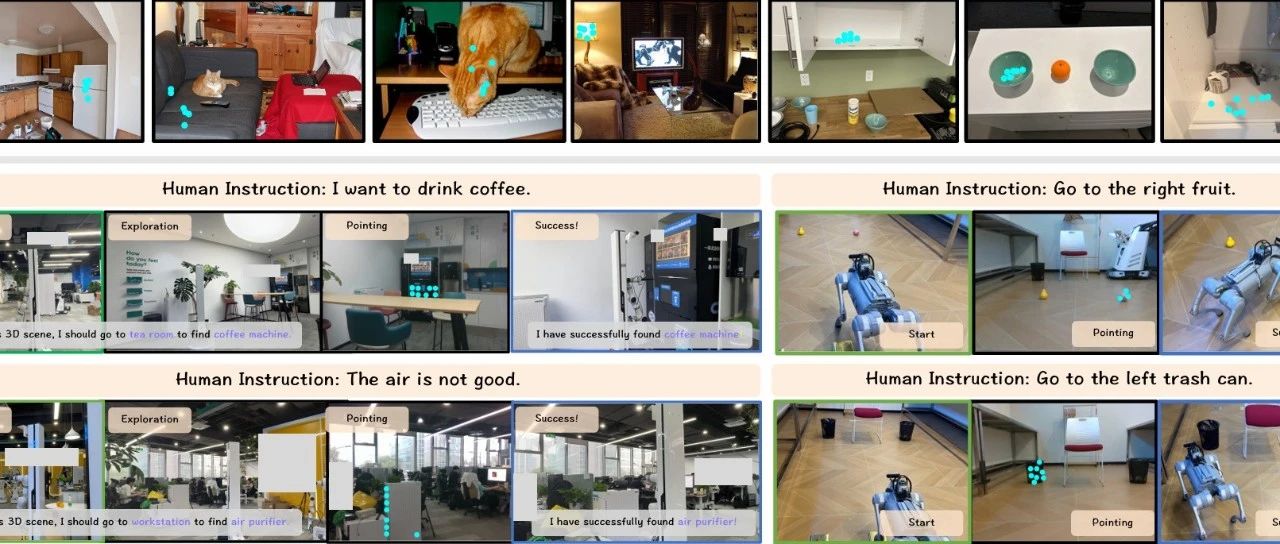
NavA3框架:理解任何指令,导航到任何地方找任何目标(清华大学)
具身智能之心· 2025-08-08 00:08
Core Insights - The article introduces the concept of embodied navigation, emphasizing the gap between current research and the complex, open-ended navigation tasks that humans perform in real environments [3][4] - A new long-range navigation task is proposed, requiring agents to understand advanced human instructions and navigate in real-world settings, leading to the development of a hierarchical framework called NavA³ [4][6] Research Background and Motivation - Embodied navigation is essential for agents to move and interact within physical environments, but existing studies focus on predefined object navigation or instruction following, which do not meet the nuanced demands of human navigation [3] Key Contributions - A challenging long-range navigation task is introduced, requiring agents to comprehend advanced human instructions and locate objects with complex spatial relationships in indoor environments [6] - The NavA³ framework is designed to combine global and local strategies for understanding diverse high-level instructions, cross-region navigation, and object localization [11] - A dataset containing 1 million samples of spatial perception object affordance is constructed to train the NaviAfford model, enabling it to understand complex spatial relationships and achieve precise object pointing [11] Methodology Framework: NavA³ - NavA³ employs a "global to local" hierarchical strategy, integrating semantic reasoning with precise spatial localization to tackle long-range navigation tasks [9] - The global strategy involves parsing instructions and determining target areas using a Reasoning-VLM model, which translates high-level human instructions into executable navigation goals [12] - The local strategy focuses on exploration within the target area and precise object localization, utilizing the NaviAfford model trained on the spatial perception dataset [17] Experimental Validation - Experiments were conducted across five scenarios with 50 tasks, evaluating performance through navigation error (NE) and success rate (SR), with NavA³ outperforming existing methods [22] - NavA³ achieved an average success rate of 66.4%, significantly higher than the best baseline method, MapNav, which had a success rate of 25.2% [23] Ablation Studies - The impact of annotations was significant, with complete annotations improving success rates in specific areas by 28.0% and 36.0% [26] - The Reasoning-VLM model demonstrated a substantial increase in average success rates when using advanced reasoning capabilities compared to open-source models [27] Qualitative Analysis - NavA³ effectively understands spatial relationships and can navigate from complex instructions, showcasing adaptability across different robotic platforms [34]
万字长文聊具身智能“成长史”:具身智能跨越了哪些山海,又将奔向哪里
具身智能之心· 2025-08-08 00:08
Core Viewpoint - The forum emphasizes the rapid advancements in embodied intelligence and robotics, highlighting the need for a unique computational brain that can translate computational power into physical capabilities, addressing the gap between AI's performance in games like Go and its struggles with simple physical tasks [4]. Group 1: Evolution of Embodied Intelligence - Over the past decade, embodied intelligence has evolved significantly, with robotics being a closed-loop system that integrates perception, action, and the physical world, emphasizing the importance of adhering to physical laws [5][6]. - The gap between research prototypes and practical applications is highlighted, with the Technology Readiness Level (TRL) being a key metric for assessing the maturity of robotic applications, where levels 8 to 9 are crucial for industry acceptance [6]. Group 2: Opportunities and Challenges in Robotics - The forum discusses the historical context of machine learning's impact on robotics, noting that advancements in sensors, algorithms, and deep learning have led to significant progress, but achieving high performance in the physical world remains a challenge [9][13]. - The importance of scalable learning systems is emphasized, with a shift from small-scale learning to large-scale applications being crucial for overcoming challenges in robotics [15]. Group 3: Specialized vs. General Intelligence - The discussion contrasts Artificial Specialized Intelligence (ASI) with Artificial General Intelligence (AGI), suggesting that while ASI focuses on high performance in specific tasks, AGI aims for broader capabilities [23][25]. - The advantages of specialized models include efficiency, robustness, and suitability for real-time applications, while general models offer greater flexibility but are more complex and resource-intensive [27][30]. Group 4: Future Directions in Robotics - The emergence of visual-language-action (VLA) models, such as RT-2, represents a significant step forward, allowing robots to execute tasks through internet-based API calls, indicating a trend towards more versatile robotic capabilities [39][40]. - The development of the second-generation VLA model, PI-Zero, showcases advancements in continuous action generation, enabling robots to perform complex tasks with higher efficiency [46][48]. Group 5: Data and Performance in Robotics - The forum highlights the necessity of large-scale data collection for training robotic models, with the RTX dataset being a pivotal resource for developing cross-embodied models that outperform specialized counterparts [42][43]. - The importance of performance metrics is underscored, with a focus on achieving high reliability and robustness in robotic systems to ensure practical deployment in real-world scenarios [58][65].
这个2000人的具身社区,帮助大家解决了各种各样的难题!
具身智能之心· 2025-08-08 00:08
Core Viewpoint - The article emphasizes the value of a community that provides solutions to problems in the field of embodied intelligence, facilitating knowledge sharing and job opportunities for its members [2][15]. Group 1: Community and Resources - The Embodied Intelligence Knowledge Planet has established a comprehensive platform for technical exchange, covering various fields such as industry, academia, job hunting, and Q&A [2][15]. - The community has compiled over 30 technical routes, including benchmarks and learning paths, to help members quickly find relevant information [4][15]. - Members can access a wealth of resources, including open-source projects, datasets, and industry reports, to support their research and development efforts [15][22][29]. Group 2: Job Opportunities and Networking - The community has set up a job referral mechanism with multiple embodied intelligence companies, allowing members to submit their resumes directly to desired employers [9][16]. - Members are encouraged to engage with industry leaders through roundtable discussions and live broadcasts, enhancing their networking opportunities [4][16][76]. Group 3: Learning and Development - The community offers tailored learning paths for beginners and advanced researchers, covering various aspects of embodied intelligence, including perception, interaction, and reinforcement learning [10][12][43]. - Members can participate in discussions and seek advice on career transitions and skill development, particularly in areas like visual SLAM and multi-sensor fusion [81][82].
具身智能之心运营实习生招募来啦!合伙人1v1培养(只有1个名额哦)
具身智能之心· 2025-08-07 12:00
Group 1 - The company aims to connect academia and industry through technical content, focusing on cutting-edge AI fields such as autonomous driving, embodied intelligence, and large models [1] - The team is committed to providing the latest and most authoritative technical information, including academic paper interpretations, industry production solutions, large model evaluations, business dynamics, industry recruitment, and open-source projects [1] - The company has established deep collaborations with mainstream companies and relevant universities in the fields of autonomous driving and embodied intelligence, while rapidly building partnerships in the large model sector [1] Group 2 - The company is looking for interns to assist in academic paper selection, interpretation, and summarization in the fields of large models, autonomous driving, and embodied intelligence [3] - Interns will also be responsible for building knowledge platforms, creating original videos, writing original articles, and managing data reviews [3] - Candidates are expected to have a strong passion for research and sharing in technical advancements, with a preference for those with technical, product, or operational backgrounds [3][5]

具身智能之心项目与论文辅导来了!
具身智能之心· 2025-08-07 12:00
好消息来了,具身智能之心正式推出了项目与论文指导系列课程了!方向涉及大模型、VLA、VLN、强化学 习、DP、sim2real、仿真等多个方向。如果您真的需要项目辅导、论文辅导、求职辅导,欢迎联系我们。 专业的学术资源,一线的工程算法人员助力解决各种问题。如果有需要,欢迎添加微信oooops-life做进一步咨 询。 具身智能之心项目与论文辅导来了! 你是否经常遇到各类奇葩问题而不知道找谁交流?是否几个月在一个卡点上一直跳不出来?不知道怎么写代码 和debug?求职的时候简历不知道怎么写?不知道如何面试...... ...
具身智能之心技术交流群成立了!
具身智能之心· 2025-08-07 02:38
Group 1 - The establishment of the Embodied Intelligence Heart Technology Exchange Group focuses on various advanced technologies including VLA, VLN, remote operation, Diffusion Policy, reinforcement learning, VLA+RL, sim2real, multimodal large models, simulation, motion control, target navigation, mapping and localization, and navigation [1] - Interested individuals can add the assistant's WeChat AIDriver005 to join the community [2] - To expedite the joining process, it is recommended to include a note with the institution/school, name, and research direction [3]
国内首个具身大脑+小脑算法实战全栈教程
具身智能之心· 2025-08-07 02:38
Core Insights - The exploration towards Artificial General Intelligence (AGI) highlights embodied intelligence as a key direction, focusing on the interaction and adaptation of intelligent agents within physical environments [1] - The development of embodied intelligence is marked by the evolution of technology from low-level perception to high-level task understanding and generalization [6][9] Industry Analysis - In the past two years, numerous star teams in the field of embodied intelligence have emerged, establishing valuable companies such as Xinghaitu, Galaxy General, and Zhujidongli, transitioning from laboratories to commercial and industrial applications [3] - Major domestic companies like Huawei, JD, Tencent, Ant Group, and Xiaomi are actively investing and collaborating to build an ecosystem for embodied intelligence, while international players like Tesla and investment firms support advancements in autonomous driving and warehouse robotics [5] Technological Evolution - The evolution of embodied intelligence technology has progressed through several stages: - The first stage focused on grasp pose detection, which struggled with complex tasks due to a lack of context modeling [6] - The second stage involved behavior cloning, allowing robots to learn from expert demonstrations but revealing weaknesses in generalization and performance in multi-target scenarios [6] - The third stage introduced Diffusion Policy methods, enhancing stability and generalization through sequence modeling [7] - The fourth stage, emerging in 2025, explores the integration of VLA models with reinforcement learning and tactile sensing to overcome current limitations [8] Product Development and Market Growth - The advancements in embodied intelligence have led to the development of various products, including humanoid robots, robotic arms, and quadrupedal robots, serving industries such as manufacturing, home services, and healthcare [9] - The demand for engineering and system capabilities is increasing as the industry shifts from research to deployment, necessitating higher engineering skills [13] Educational Initiatives - A comprehensive curriculum has been developed to assist learners in mastering the full spectrum of embodied intelligence algorithms, covering topics from basic tasks to advanced models like VLA and its integrations [9][13]

谷歌“世界模拟器”深夜上线!一句话生成3D世界,支持分钟级超长记忆
具身智能之心· 2025-08-07 00:03
刚刚,谷歌DeepMind发布了 新一代通用世界模型Genie 3 。 性能上,Genie 3相比上一代大幅升级,支持 720P画质,每秒24帧实时导航,以及分钟级的一致性保持 。 | Genie 2 | Genie 3 | | --- | --- | | 360p | 720p | | 3D Environments | General | | Limited keyboard / mouse actions | Navigation; Promptable world events | | 10-20 seconds | Multiple minutes | | Not real time | Real time 益公众号 | 编辑丨量子位 点击下方 卡片 ,关注" 具身智能之心 "公众号 >> 点击进入→ 具身 智能之心 技术交流群 更多干货,欢迎加入国内首个具身智能全栈学习社区 : 具身智能之心知识星球 (戳我) , 这里包含所有你想要的。 只需一句话,就能生成可实时交互的3D世界。 前DeepMind科学家、AI 3D生成创业者Tejas Kulkarni受邀体验了Genie 3。 他使用Genie ...