
KINGDEE INT'L(00268)

Search documents
港股25年收官:科指全年累涨23.45%创历史最佳,成份股中芯国际大涨124.69%
Ge Long Hui· 2025-12-31 08:02
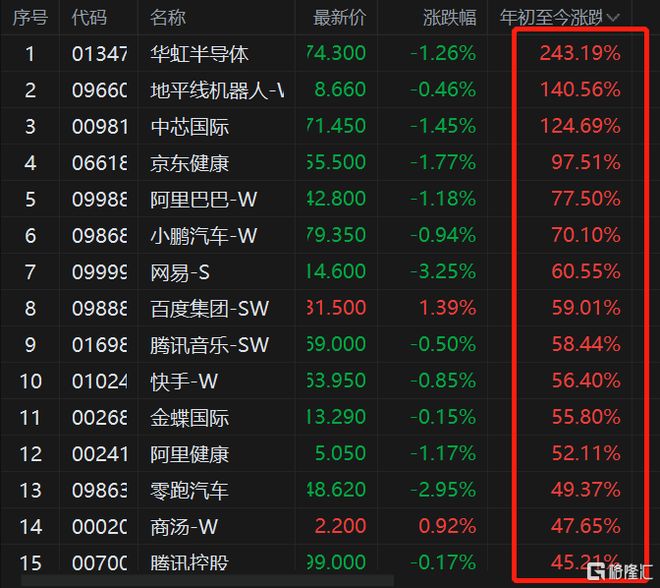
Core Viewpoint - The Hong Kong stock market's Hang Seng Technology Index achieved a remarkable annual increase of 23.45% in 2025, marking its best performance since 2020, with 22 out of 30 constituent stocks rising [1] Group 1: Stock Performance - Among the 30 constituent stocks, notable performers included Hua Hong Semiconductor, which surged by 243.19%, Horizon Robotics with a rise of 140.56%, and SMIC increasing by 124.69% [1] - Other significant gainers were JD Health at 97.51%, Alibaba-W at 77.50%, Xpeng Motors-W at 70.10%, Baidu Group-SW at 59.01%, and Tencent Music-SW at 58.44% [1][2] Group 2: Investment Preferences - The first tier of investment preference is in semiconductor manufacturing (Hua Hong, SMIC) and core AI chips (Horizon Robotics), reflecting a strong focus on hard technology and domestic substitution logic [1] - The second tier includes growth sectors such as smart electric vehicles (Xpeng, Li Auto), AI applications (Baidu, SenseTime), and digital health (JD Health), which benefit from industry trends but still face competitive and profitability uncertainties [1] - The third tier consists of value recovery in platform internet giants (Alibaba, Tencent) and mature applications (NetEase, Kuaishou, Tencent Music), with gains primarily driven by profit realization and value reassessment through dividends and buybacks, categorized as "high-quality mature assets" [1]


ST远智(002689.SZ):拟3000万元设立全资子公司

Ge Long Hui A P P· 2025-12-30 14:23
Group 1 - The core point of the article is that ST YuanZhi (002689.SZ) plans to invest 30 million yuan to establish a wholly-owned subsidiary named Chengdu Yuanda Intelligent Industrial Co., Ltd. [1] - The investment is based on the company's strategic planning and business development needs [1] - The company's board of directors has authorized the management team to handle all matters related to this external investment [1]
2025 ToB 产品:消失的边界
3 6 Ke· 2025-12-30 00:47
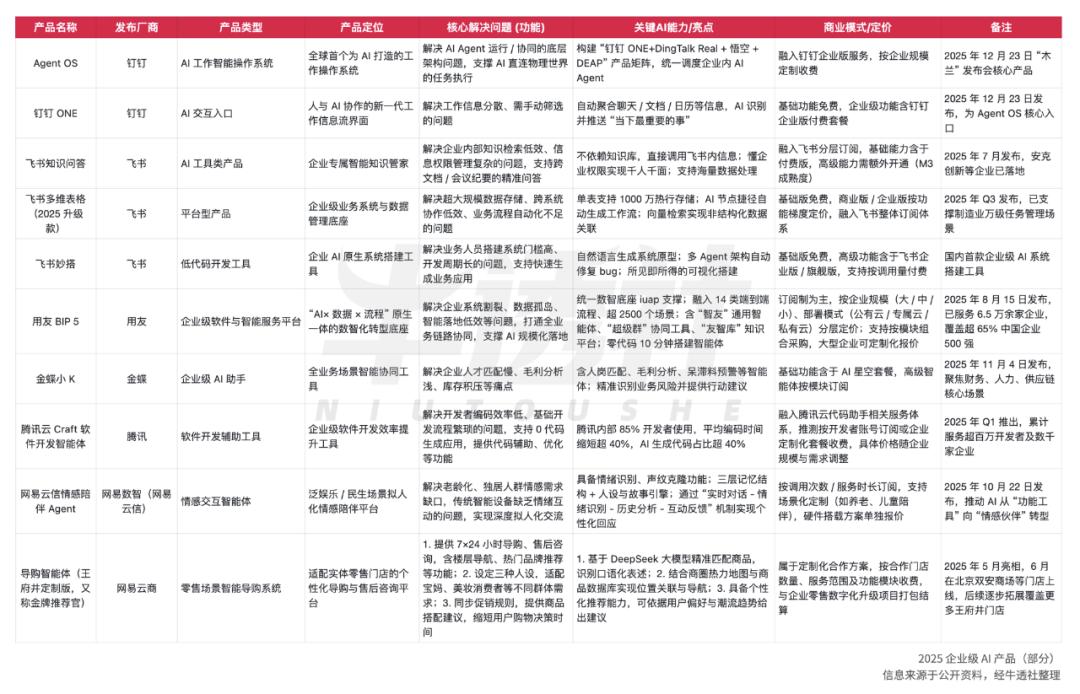
Core Insights - The enterprise AI product market is expected to experience explosive growth by 2025, with SaaS companies and AI-native firms reshaping the industry landscape. The focus has shifted from trial use to large-scale implementation, integrating AI into core business processes such as finance, sales, supply chain, and customer service [4][13][41] - The boundaries of enterprise software are becoming increasingly blurred, as traditional classifications like CRM, OA, and ERP fail to accurately describe the emerging products and their functionalities [2][13][42] - AI is transitioning from a supportive role to a more active role in executing tasks, with products allowing AI to directly participate in business processes and decision-making [20][22][24] Group 1: Product Types and Features - Four core types of enterprise AI products have emerged, covering the entire application ecosystem from foundational capabilities to vertical scenarios [5][6] - AI Agent platforms serve as the foundation for developing, deploying, and operating enterprise AI agents, addressing challenges such as high development barriers and poor system integration [6][7] - Vertical AI products focus on specific job functions, providing ready-to-use tools that enhance efficiency by automating repetitive tasks [8][10] Group 2: Changes in Business and Responsibility Boundaries - The traditional business boundaries of enterprise software are diminishing, with companies increasingly organizing work around tasks rather than systems [13][17][18] - The responsibility of AI in products is shifting forward, with AI now taking on execution roles and being held accountable for outcomes, which raises questions about risk management and accountability [19][20][22] - The convergence of AI-native companies and traditional SaaS firms is leading to similar product paths, as both seek to integrate AI deeply into their core workflows [24][25] Group 3: Business Models and Market Dynamics - The commercial model for enterprise AI products is shifting from selling tools to delivering value, with a focus on measurable outcomes and task completion [26][27] - AI products are increasingly being designed for private and controllable deployment, addressing concerns about data sovereignty and transparency [28][29][30] - The role of product managers is evolving to focus on creating collaborative frameworks among humans, AI, and existing systems, rather than merely optimizing tool functionalities [31][32][34] Group 4: Unresolved Issues and Challenges - Trust barriers remain as enterprises are hesitant to allow AI to autonomously execute core tasks, often preferring a model of AI assistance with human oversight [36] - The cost of AI errors is a significant concern, as companies currently bear the full responsibility for any mistakes made by AI systems [37][38] - The risk of over-platformization in AI products could lead to complexity and inefficiency, potentially alienating users who require simpler solutions [39][40]



金蝶国际_原生 AI 智能体上线;特定业务场景 AI 功能升级;买入评级
2025-12-29 15:51
Summary of Kingdee's Conference Call Company Overview - **Company**: Kingdee International Software Group Company Limited (0268.HK) - **Industry**: Technology, specifically focusing on AI and SaaS (Software as a Service) Key Points AI-native Agent Launch - Kingdee launched an AI-native agent named "Little K" during the Global Changemakers Conference, which enhances its AI SaaS platform and transitions from a general platform to multiple AI agents tailored for specific business scenarios [1][2] Revenue and Growth Projections - Contracts from AI-native products exceeded Rmb150 million by the end of 1H25, indicating initial monetization from enterprise clients [2] - Management aims for AI revenues to contribute over 30% of total revenues by 2030, with expectations that more clients will be empowered by AI [2] AI Features and Integration - "Little K" integrates over 20 AI agents covering various business functions such as recruitment, procurement risk control, and contract review, enhancing capabilities across marketing, supply chain, HR, and finance [5][7] - The AI platform is designed for human-agent collaboration, with built-in AI modules to support both large-scale and mid-scale enterprise clients [5] Partnerships and Client Engagement - Kingdee is expanding partnerships for AI deployment with notable clients including Tongwei and Hisense, leveraging AI features to enhance workforce capabilities [5] Financial Outlook - The 12-month price target for Kingdee is set at HK$18.98, representing a potential upside of 42.1% from the current price of HK$13.35 [10] - Revenue projections for the next few years are as follows: - 2024: Rmb6,255.7 million - 2025E: Rmb7,044.0 million - 2026E: Rmb8,742.6 million - 2027E: Rmb10,729.7 million [10] Risks - Key downside risks include: 1. Weaker-than-expected demand for ERP digitization 2. Slower-than-expected product development 3. Increased talent and labor costs [9] Valuation Methodology - The valuation methodology incorporates a WACC of 11.5% and a terminal growth rate of 2% in the DCF valuation, reflecting the company's diverse customer base and strong customer relationships [8] Additional Insights - The integration of AI features is expected to enhance client productivity, which is crucial for scaling up AI revenues [2] - The company is transitioning from basic data visualization to data-driven processes, indicating a strategic shift towards more advanced analytics capabilities [5] This summary encapsulates the essential insights from Kingdee's conference call, highlighting the company's strategic initiatives, financial outlook, and associated risks.
我为什么不投中国的软件公司?
虎嗅APP· 2025-12-25 12:30
Core Viewpoint - The article emphasizes the importance of having a competitive moat in business, arguing that industries with low barriers to entry and high competition are difficult to succeed in, as profits can be easily eroded by new entrants [6][12]. Group 1: Industry Analysis - The distinction between software companies and internet companies is highlighted, with software companies typically providing B2B services (SaaS) and internet companies focusing on B2C services [7]. - The profitability of China's SaaS industry is discussed, noting that while gross margins are around 55%-60%, net profit margins have been nearly negative over the past three years [11]. - The article points out that the software industry has high fixed costs and low marginal costs, leading to initial losses, while internet companies can achieve higher net profit margins due to customer retention [11][12]. Group 2: Competitive Landscape - The article mentions that industries like retail and soft drinks can produce billionaires due to their ability to monopolize the market, while sectors like restaurants and fashion struggle to generate significant wealth [8][9]. - It is noted that the Chinese SaaS market is characterized by intense competition, which drives down profits, making it difficult for companies to maintain high net profit margins [17]. - The article argues that the entry barriers in the software industry are relatively low, leading to a flood of competitors that can erode profits [12][13]. Group 3: Market Dynamics - The article discusses the difference in demand between B2C and B2B products, stating that B2C internet products thrive on fulfilling enjoyment needs, while B2B software products must demonstrate significant efficiency improvements to be adopted by businesses [16]. - It is highlighted that the Chinese SaaS market is only 1%-5% of the global market, indicating limited growth potential compared to more mature markets [15]. - The article concludes that the essence of successful business models lies in having a strong competitive moat, rather than merely being labeled as high-tech [19].


聚水潭如何自动同步销售出库单到金蝶云星空?购销业务集成
Sou Hu Cai Jing· 2025-12-25 04:13
Core Insights - The integration of front-end e-commerce platforms like JuShuiTan and back-end financial systems like Kingdee Cloud is crucial for operational efficiency and data accuracy in businesses [1][18] - The article emphasizes the need for seamless collaboration between purchasing and sales processes to enhance business performance and reduce risks associated with manual data handling [1][18] Integration Challenges - Many companies initially rely on manual data export and import, which is time-consuming and prone to errors, leading to data chaos [3] - Scheduled API polling for data synchronization results in poor real-time performance and resource wastage, especially during peak sales periods [4] - Custom point-to-point development for each document type increases maintenance complexity and costs, as changes in one system require adjustments in multiple interfaces [5] Ideal Integration Capabilities - Effective integration should focus on "process fusion" rather than just "data transfer," ensuring that business workflows are streamlined [6] - KPaaS integration platform enables efficient document flow by automating processes such as purchase order creation and sales order confirmation, ensuring real-time updates across systems [6][18] Event-Driven Synchronization - KPaaS allows for immediate synchronization of document status changes, reducing delays and ensuring timely financial entries [11] - The platform supports two-way status synchronization, enabling feedback from Kingdee to JuShuiTan, which helps in error handling and alerts [7] Visual Workflow Design - KPaaS provides a graphical process designer that allows users to easily create and manage cross-system workflows, reducing the need for extensive coding [8] - The platform supports customizable data mapping and validation rules to ensure accurate document processing [10][13] Monitoring and Maintenance - KPaaS includes features for document tracking and operational support, allowing administrators to monitor processing status and manage exceptions effectively [16] - The system can send alerts for overdue tasks, enhancing operational efficiency and responsiveness [16] Conclusion - The integration between JuShuiTan and Kingdee Cloud should focus on achieving consistency in business actions, real-time financial data, and reliable management decision-making [18] - The KPaaS platform transforms complex system interactions into configurable and observable business process assets, essential for digital transformation in the e-commerce and manufacturing sectors [18]
智链全球,蝶变未来:华为云助力金蝶构建敏捷智能全球化供应链
Xin Lang Cai Jing· 2025-12-23 12:26
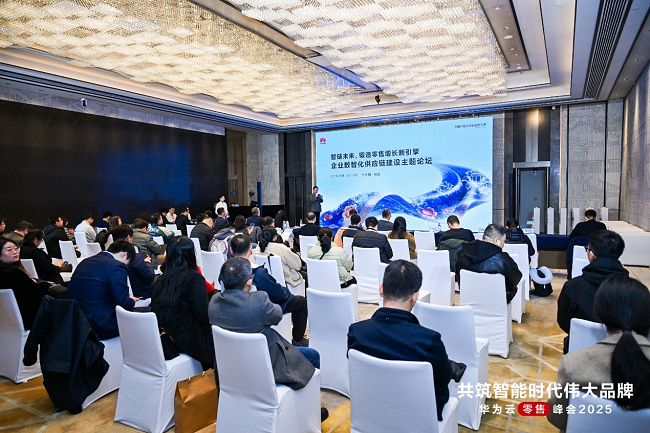
Core Insights - The digital economy is reshaping global supply chains, making the construction of an agile, compliant, and intelligent global supply chain system essential for companies to overcome growth bottlenecks and succeed in international competition [1][9]. Group 1: Challenges Faced by Companies - Companies face complex compliance and regulatory requirements across different countries, leading to high risks of violations [4][12]. - Cross-border logistics increase supply chain costs while decreasing agility due to extended supply chain links [4][12]. - Weak logistics infrastructure in emerging markets affects fulfillment and reverse logistics experiences [4][13]. - Localization challenges arise from misalignment between product specifications and local demands, along with competition from local brands [4][14]. Group 2: Solutions and Collaborations - Kingdee and Huawei Cloud have formed a comprehensive partnership to create a global intelligent management foundation, addressing the need for an integrated platform that combines global compliance, supply chain collaboration, and data intelligence [4][14]. - Kingdee's cloud services reach 172 countries and regions, serving over 7.4 million enterprises and institutions, necessitating a highly reliable, secure, and intelligent underlying technology platform [4][14]. - The collaboration leverages Huawei's Ascend AI cloud services and GaussDB database to provide robust engines for global operations and deep intelligent analysis [6][16]. Group 3: Practical Outcomes - The partnership has successfully assisted over a thousand outbound enterprises across various industries, including manufacturing, home furnishings, and building materials [8][17]. - Many international companies utilize the platform to support multiple languages and accounting standards, ensuring compliance and collaboration among global employees [8][17]. - Domestic enterprise groups have established online global sales processes and financial accounting systems, enhancing supply chain visibility and operational efficiency across multiple countries [8][17].
2025年金蝶国际公司研究报告:企业SaaS服务领军者,AI赋能重构管理软件(附下载)
Xin Lang Cai Jing· 2025-12-23 12:15
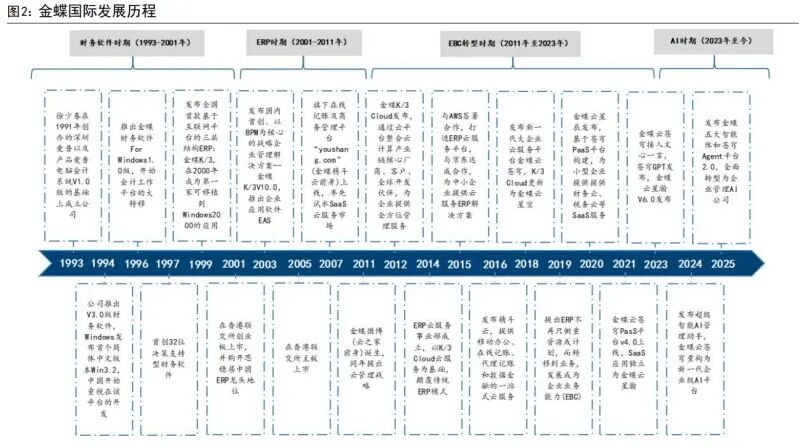
Company Overview - Kingdee International, founded in 1993 in Shenzhen, is a leading global provider of enterprise management cloud SaaS services, leveraging technologies such as cloud computing, big data, and AI to create digital solutions covering the entire lifecycle of enterprises, serving over 7.4 million businesses and government organizations globally across more than 20 industries [1][23] - The company ranks first in the Chinese market for SaaS EA, SaaS ERM, financial cloud, EPM, and PLM, and is the only enterprise management vendor in the top 10 of the generative AI model market in China, maintaining a leading market share in the growth enterprise application software sector for 20 consecutive years [1][23] Company Development Stages - The company's development has gone through four stages: 1. Financial software period (1993-2001): Established with the launch of Kingdee financial software in 1995 and the first internet-based ERP system in 1999 [2][24] 2. ERP period (2001-2011): Introduced BPM-based strategic management solutions and launched the EAS software for large enterprises [2][24] 3. Cloud service transformation period (2011-2023): Released Kingdee K/3 Cloud in 2012, marking a shift from traditional ERP models [2][24] 4. AI era (2023-present): Launched Cangqiong GPT in 2023 and plans to fully transform into an enterprise management AI company by 2025 [2][24] Shareholding Structure - The founder, Xu Shaochun, holds a total of 19.81% of the shares, making him the largest shareholder. The management team has extensive industry experience, with most members having over five years of tenure in the company [4][26] Main Business - Kingdee's main business includes enterprise-level cloud services and digital management solutions, forming a diverse product matrix that includes a cloud-native PaaS platform and layered SaaS management clouds [5][27] - The company’s flagship products include the Kingdee Cloud Cangqiong AI platform and SaaS management clouds such as Xinghan, Xingkong, and Xingchen, catering to different enterprise needs [5][27] Financial Performance - The company has seen significant growth in cloud service revenue, which accounted for 83.74% of total revenue in the first half of 2025, with cloud service revenue reaching 2.673 billion yuan, a year-on-year increase of 11.9% [6][28] - Total revenue for the first half of 2025 was 3.192 billion yuan, a year-on-year increase of 11.24%, with a net profit of -98 million yuan, reflecting a 55.14% year-on-year improvement [7][29] Profitability and Cost Management - The company’s gross margin and net margin have shown recovery, with a gross margin of 65.63% and a net margin of -3.42% in the first half of 2025, indicating improvements in profitability [10][31] - The company has also seen a decrease in expense ratios, with sales, management, and R&D expense ratios at 39.59%, 10.84%, and 24.4% respectively [11][31] Cloud Transformation Impact - The shift to a SaaS subscription model has enhanced customer retention and revenue stability, with renewal rates for large, growing, and small enterprises reaching 108%, 95%, and 93% respectively [17][18] - The company’s annual recurring revenue (ARR) reached 3.73 billion yuan in the first half of 2025, a year-on-year increase of 18.5%, contributing to 54.83% of total revenue [17][18] Market Trends and Future Outlook - The transition from traditional ERP to cloud-native EBC (Enterprise Business Capability) is essential for AI deployment, with predictions indicating that AI will add approximately $13 trillion to the global economy by 2030 [15][36] - The adoption of cloud-native technologies is rapidly increasing, with a projected 89% global adoption rate by 2024, indicating a significant shift in enterprise software architecture [14][35]
金蝶国际(00268.HK)获富国基金增持815.2万股
Ge Long Hui· 2025-12-21 23:27
Group 1 - The core point of the article is that Franklin Templeton Investments has increased its stake in Kingdee International Software Group Company Limited (stock code: 00268.HK) by purchasing 8.152 million shares at an average price of HKD 13.8259 per share, totaling approximately HKD 113 million [1] - Following this acquisition, Franklin Templeton's total shareholding in Kingdee International has risen to 217,574,000 shares, increasing its ownership percentage from 5.90% to 6.13% [1][3] Group 2 - The transaction took place on December 17, 2025, and the updated shareholding percentage reflects the latest disclosure from the Hong Kong Stock Exchange [1][2] - The increase in shareholding indicates a positive outlook from Franklin Templeton regarding Kingdee International's future performance [1]

富国基金管理有限公司增持金蝶国际(00268)815.2万股 每股作价13.8259港元
Zhi Tong Cai Jing· 2025-12-19 11:43
Group 1 - The core point of the article is that Franklin Templeton Investments has increased its stake in Kingdee International Software Group Company Limited by acquiring 8.152 million shares at a price of HKD 13.8259 per share, totaling approximately HKD 113 million [1] - After the acquisition, Franklin Templeton's total shareholding in Kingdee International is approximately 218 million shares, representing a holding percentage of 6.13% [1]