HKEX(00388)

Search documents
港交所与阿布扎比证券交易所签署合作备忘录
Xin Hua Cai Jing· 2025-09-18 08:25
Core Viewpoint - Hong Kong Exchanges and Clearing Limited (HKEX) has signed a memorandum of understanding with Abu Dhabi Securities Exchange (ADX) to explore collaboration opportunities in capital markets and enhance connections between the two exchanges [1] Group 1: Collaboration Details - The memorandum outlines plans for cooperation in market promotion, exchange-traded funds (ETFs), ESG-related products, cross-listing, and other areas of mutual interest [1] - HKEX CEO Charles Li stated that since last year, ADX has been included in the list of recognized exchanges, and this memorandum will further strengthen cross-market connections and promote capital flow between Hong Kong and the Middle East [1] Group 2: Market Opportunities - The collaboration aims to create new investment opportunities and enhance market infrastructure to respond to the evolving needs of global issuers and investors [1] - ADX CEO Abdulla Salem Alnuaimi emphasized that this agreement will solidify the relationship between the Abu Dhabi and Hong Kong markets, reflecting ADX's commitment to integrating into the global market [1] - Both exchanges will explore cross-listing of products and the development of innovative financial products, including ETFs and indices, to facilitate investor participation in both markets and increase investment opportunities and market liquidity [1]

港交所与阿布扎比证券交易所签署合作备忘录 增强两地市场联系
Ge Long Hui A P P· 2025-09-18 06:16
格隆汇9月18日丨香港交易所宣布,已与阿联酋的阿布扎比证券交易所签署合作备忘录,探索两地资本 市场合作机遇并增强双方的联系。根据合作备忘录,香港交易所将与阿布扎比证券交易所探讨在市场推 广、交易所买卖基金、ESG(环境、社会及管治)相关产品、互挂上市及其他共同关注的领域上合作, 一同实践双方在建构更紧密融合的全球金融生态圈的承诺。 ...
香港交易所与阿布扎比证券交易所签署合作备忘录,增强两地市场联系
Zheng Quan Shi Bao Wang· 2025-09-18 06:15
Core Viewpoint - Hong Kong Exchanges and Clearing Limited (HKEX) has signed a memorandum of understanding with Abu Dhabi Securities Exchange (ADX) to explore collaboration opportunities in capital markets and enhance connections between the two exchanges [1] Group 1: Collaboration Areas - The memorandum outlines potential cooperation in market promotion, exchange-traded funds, ESG-related products, cross-listing, and other areas of mutual interest [1]
香港证监会、港交所、香港保监局等重磅发声!
中国基金报· 2025-09-18 05:51
Core Viewpoint - The Hong Kong government, led by Chief Executive John Lee, has introduced the "2025 Policy Address," which has received strong support from various regulatory bodies and institutions in Hong Kong, emphasizing measures to strengthen Hong Kong's position as a leading international financial center [2]. Group 1: Hong Kong Securities and Futures Commission (SFC) - The SFC welcomes measures in the Policy Address aimed at reinforcing Hong Kong's status as a global preferred listing venue and enhancing the stock market and listing system [4]. - Suggestions to include RMB counters and real estate investment trusts in the Stock Connect are expected to deepen ties between Hong Kong and mainland markets [4]. - The SFC highlights the importance of promoting bond issuance and establishing a commercial repurchase market to further develop the fixed income and currency markets, enhancing Hong Kong's attractiveness to global investors [4][5]. Group 2: Hong Kong Exchanges and Clearing (HKEX) - HKEX leadership expresses support for the Policy Address, noting that initiatives covering both primary and secondary markets will help sustain Hong Kong's development as an international financial center [6][7]. - The HKEX aims to enhance the diversity of financial products available in the market, including securities, fixed income, currency, commodities, and carbon markets [7]. Group 3: Hong Kong Insurance Authority - The Insurance Authority supports measures in the Policy Address that aim to enhance Hong Kong's status as an international financial center, particularly in specialized insurance and reinsurance [8][9]. - The establishment of a shipping risk pool is seen as a way to create new opportunities and improve resilience against emergencies [9]. Group 4: Hong Kong Chinese Fund Industry Association - The Association praises the Policy Address for its focus on strengthening the stock market and developing a leading bond market, which will attract global capital to Hong Kong [10]. - Proposals to shorten the stock settlement cycle to "T+1" and facilitate the return of Chinese concept stocks are expected to broaden investment channels for Chinese funds [11]. Group 5: Hong Kong Cyberport - Cyberport welcomes the Policy Address's emphasis on advancing artificial intelligence (AI) and data industries, aiming to position Hong Kong as an international hub for these sectors [12][13]. - Cyberport plans to support the development of an AI ecosystem and attract innovative enterprises to enhance Hong Kong's status as a technology center [13]. Group 6: Hong Kong Financial Development Council - The Financial Development Council supports the Policy Address's initiatives aimed at enhancing the competitiveness of Hong Kong's financial markets, including the promotion of reinsurance and the inclusion of real estate investment trusts in the connectivity mechanism [14]. Group 7: Hong Kong University of Science and Technology - The University expresses encouragement regarding the Policy Address's focus on AI development and plans to establish an AI research institute by 2026 [15][16]. - The University aims to collaborate with the government to enhance AI education and contribute to the development of the AI ecosystem [16].

智通ADR统计 | 9月18日




智通财经网· 2025-09-17 22:38
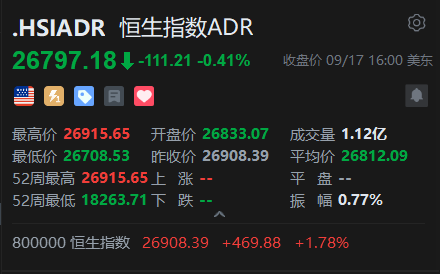
Market Overview - The Hang Seng Index (HSI) closed at 26,797.18, down by 111.21 points or 0.41% on September 17 [1] - The index reached a high of 26,915.65 and a low of 26,708.53 during the trading session, with a trading volume of 112 million shares [1] Major Blue-Chip Stocks Performance - HSBC Holdings closed at HKD 108.373, up by 1.66% compared to the Hong Kong close [2] - Tencent Holdings closed at HKD 661.407, down by 0.01% compared to the Hong Kong close [2] Stock Price Movements - Tencent Holdings (00700) saw an increase of HKD 16.500, or 2.56%, with an ADR price of HKD 661.407, showing a slight decline of HKD 0.093 compared to the Hong Kong market [3] - Alibaba Group (09988) increased by HKD 8.100, or 5.28%, with an ADR price of HKD 161.550, down by HKD 0.050 [3] - Other notable movements include: - Meituan (03690) up by HKD 4.900, or 4.89% [3] - Baidu Group (09888) up by HKD 17.800, or 15.72% [3] - Kuaishou (01024) up by HKD 2.650, or 3.51% [3]
港股市场将迎来更多改革创新举措 涵盖上市、交易、结算、产品及资金流动等多个维度
Shang Hai Zheng Quan Bao· 2025-09-17 19:28
Group 1 - The Hong Kong government aims to enhance the competitiveness of the stock market through various measures, including the introduction of a "T+1" settlement cycle, support for mainland tech companies, and improvements to listing mechanisms [2][3] - The proposed "T+1" settlement cycle would allow investors to receive cash or complete payments the day after trading, significantly improving market efficiency and reducing counterparty risks [2] - The establishment of a "Tech Enterprise Express" service will assist mainland tech companies in financing in Hong Kong, reducing communication costs and accelerating the financing process for high-growth, innovative firms [3] Group 2 - The report emphasizes the importance of building a diversified product ecosystem in Hong Kong's capital market, with initiatives to issue more RMB bonds and develop offshore government bond futures [4] - The creation of a "Commodity Strategy Committee" aims to enhance the trading ecosystem for commodities in Hong Kong, optimizing international commodity trading processes through financial innovation [4] - The establishment of an international gold trading market and the expansion of gold investment tools are also highlighted as key initiatives to diversify investment products [4]
香港证监会、港交所回应施政报告将推动资本市场长期稳健发展
Zheng Quan Shi Bao· 2025-09-17 18:08
Group 1 - The core viewpoint of the news is that the Hong Kong government’s 2025 policy address aims to enhance the financial and capital markets, with measures expected to solidify Hong Kong's position as a leading global listing venue [1][2] - The Hong Kong Securities and Futures Commission (SFC) believes that the proposed measures to strengthen the stock market and optimize the listing system will reinforce Hong Kong's status as a preferred listing location globally [1] - Suggestions to include Renminbi counters and Real Estate Investment Trusts (REITs) in the Stock Connect program are expected to deepen the connection between Hong Kong and mainland markets [1] Group 2 - The policy address emphasizes the development of fixed income and money markets through initiatives such as promoting bond issuance, establishing a commercial repurchase market, and launching government bond futures [1] - The SFC views these measures as a significant boost for the diversification of Hong Kong's market and its attractiveness to global investors [1] - The SFC Chairman, Huang Tianyou, stated the commitment to consolidating Hong Kong's traditional advantages in financing and connectivity, while pursuing innovation and diversification for future success [2]
香港特区政府:推动发展香港大宗商品交易生态圈
Qi Huo Ri Bao Wang· 2025-09-17 16:08
Group 1 - The Hong Kong government will establish a "Commodity Strategy Committee" led by the Financial Secretary to enhance the top-level design and long-term strategy formulation for commodity policies [1] - The government aims to develop a commodity trading ecosystem in Hong Kong, including supporting the establishment of more recognized warehouses and providing tax incentives for commodity traders [1] - The initiative is expected to strengthen Hong Kong's position as an international financial, shipping, and trading center, integrating existing advantages and creating new economic growth points [1] Group 2 - Guangdong Province and Guangzhou have expressed support for cross-border cooperation between the Guangzhou Futures Exchange and the Hong Kong Stock Exchange [2] - The collaboration is seen as a practical measure to enhance the influence of Hong Kong's capital market and promote the integration of financial resources in the Guangdong-Hong Kong-Macao Greater Bay Area [2] - Strengthening cooperation between the two exchanges is crucial for the development of the Greater Bay Area and will facilitate efficient allocation of production factors [2]
香港证监会、港交所回应!
证券时报· 2025-09-17 09:46
Core Viewpoint - The 2025 Policy Address by Hong Kong Chief Executive John Lee emphasizes measures to enhance Hong Kong's status as a leading international financial center, with a focus on strengthening the stock market, optimizing listing systems, and promoting innovation in digital assets [1][2]. Group 1: Financial Market Development - The Hong Kong Securities and Futures Commission (SFC) welcomes the measures in the Policy Address aimed at supporting Hong Kong's continuous development as a leading international financial center [2]. - Suggestions to include Renminbi counters and Real Estate Investment Trusts (REITs) in the Stock Connect program are expected to deepen ties between Hong Kong and mainland markets [2]. - The SFC believes that promoting bond issuance, establishing a commercial repurchase market, and launching government bond futures will inject vitality into the fixed income and currency markets, enhancing Hong Kong's attractiveness to global investors [2]. Group 2: Collaboration and Innovation - The SFC Chairman emphasizes the commitment to maintaining Hong Kong's traditional advantages in fundraising and connectivity while pursuing innovation and diversification for future success [3]. - The Hong Kong Exchanges and Clearing Limited (HKEX) expresses support for the measures in the Policy Address, which cover both primary and secondary markets, and aim to broaden Hong Kong's financial ecosystem [3][4]. - HKEX's CEO highlights the importance of building a diverse asset ecosystem in Hong Kong to connect capital with opportunities, supported by the government's ongoing initiatives [4]. Group 3: SME Financing Support - Following the Policy Address, the Hong Kong Monetary Authority (HKMA) introduced new measures under the "SME Financing Guarantee Scheme," extending the application period for 80% credit guarantee products until March 2028 [4]. - The total credit guarantee amount will increase by HKD 20 billion to HKD 310 billion, and the "interest-only" repayment arrangement will be extended for another year [4].

OSTTRA Adds Compression For USD/CNH Swaps At HKEX OTC Clear
FinanceFeeds· 2025-09-17 06:43
OSTTRA, the global post-trade solutions provider, has completed its inaugural portfolio compression run for USD/CNH cross currency swaps (CCS) cleared through Hong Kong Exchanges and Clearing’s (HKEX) OTC Clear. The exercise, conducted on August 28, involved five financial institutions including Bank of China (Hong Kong) and Crédit Agricole CIB. In total, $5.8 billion in notional value was compressed, providing market participants with meaningful cost and risk reduction.The service was carried out via OSTTR ...