PETROCHINA(00857)

Search documents
中国石油化工股份11月10日回购1779.63万港元,年内累计回购10.25亿港元
Zheng Quan Shi Bao· 2025-11-10 14:36
Core Points - China Petroleum & Chemical Corporation (Sinopec) has been actively repurchasing its shares, with a total of 4.072 million shares bought back on November 10 at prices ranging from 4.300 to 4.400 HKD, amounting to 17.7963 million HKD [1] - The stock has seen a cumulative increase of 4.03% during the recent buyback period starting from October 30, with a total of 30.396 million shares repurchased for a total of 128 million HKD [1] - Year-to-date, Sinopec has conducted 33 buybacks, repurchasing a total of 223 million shares for a total expenditure of 1.025 billion HKD [1] Buyback Details - On November 10, 2025, Sinopec repurchased 407.20 thousand shares at a maximum price of 4.400 HKD and a minimum price of 4.300 HKD, totaling 17.7963 million HKD [1] - The company has consistently repurchased shares over the past eight days, with the highest buyback occurring on August 22, 2025, where 6.762 million shares were repurchased at a maximum price of 4.430 HKD, totaling 297.7214 million HKD [1] - The buyback activity reflects a strategic move by Sinopec to enhance shareholder value amidst market fluctuations [1]
中国石油化工股份(00386.HK)11月10日回购1779.63万港元,年内累计回购10.25亿港元
Zheng Quan Shi Bao Wang· 2025-11-10 14:00
Core Points - China Petroleum & Chemical Corporation (Sinopec) has been actively repurchasing its shares, with a total of 4.072 million shares bought back on November 10 at a price range of HKD 4.300 to HKD 4.400, amounting to HKD 17.7963 million [2] - The stock price closed at HKD 4.390 on the same day, reflecting a 2.33% increase, with a total trading volume of HKD 780 million [2] - Since October 30, the company has conducted share repurchases for eight consecutive days, totaling 30.396 million shares and a cumulative repurchase amount of HKD 12.8 million, with the stock rising 4.03% during this period [2] Repurchase Summary - In 2023, Sinopec has executed 33 share repurchase transactions, totaling 223 million shares and a cumulative repurchase amount of HKD 1.025 billion [2] - Detailed repurchase data includes: - November 10: 407.20 thousand shares at a maximum price of HKD 4.400 and a minimum price of HKD 4.300, totaling HKD 17.7963 million [2] - November 7: 317.20 thousand shares at a maximum price of HKD 4.300 and a minimum price of HKD 4.250, totaling HKD 13.5673 million [2] - November 6: 239.80 thousand shares at a maximum price of HKD 4.230 and a minimum price of HKD 4.200, totaling HKD 10.1066 million [2] - November 5: 292.80 thousand shares at a maximum price of HKD 4.220 and a minimum price of HKD 4.170, totaling HKD 12.2721 million [2] - November 4: 514.80 thousand shares at a maximum price of HKD 4.280 and a minimum price of HKD 4.200, totaling HKD 21.8435 million [2] - November 3: 425.00 thousand shares at a maximum price of HKD 4.230 and a minimum price of HKD 4.150, totaling HKD 17.8364 million [2] - October 31: 365.20 thousand shares at a maximum price of HKD 4.170 and a minimum price of HKD 4.110, totaling HKD 15.1248 million [2] - October 30: 477.60 thousand shares at a maximum price of HKD 4.220 and a minimum price of HKD 4.100, totaling HKD 19.7230 million [2]

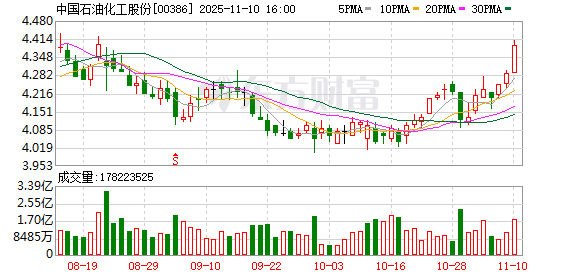
中国石油化工股份11月10日斥资1779.63万港元回购407.2万股
Zhi Tong Cai Jing· 2025-11-10 11:58
Core Viewpoint - China Petroleum & Chemical Corporation (Sinopec) announced a share buyback plan, indicating confidence in its financial health and future prospects [1] Group 1 - The company will spend HKD 17.7963 million to repurchase 4.072 million shares [1]
今晚调油价!92号汽油每升上调0.15元
Sou Hu Cai Jing· 2025-11-10 11:28
Core Viewpoint - The price of gasoline and diesel in Harbin has been increased as per the notice from the National Development and Reform Commission, effective from 11th of the month [1] Price Adjustments - The price of 92 gasoline has been raised from 8994 yuan/ton to 9127 yuan/ton, an increase of 133 yuan/ton, resulting in a retail price increase from 6.81 yuan/liter to 6.96 yuan/liter, up by 0.15 yuan [1] - The price of 95 gasoline has been increased by 0.14 yuan/liter, now priced at 7.43 yuan/liter [1] - The price of 98 gasoline has been raised by 0.17 yuan/liter, now at 8.43 yuan/liter [1] - The price of 0 diesel has been increased by 0.14 yuan/liter, now priced at 6.43 yuan/liter [1] - The price of -35 diesel has been raised by 0.13 yuan/liter, now at 7.38 yuan/liter [1]
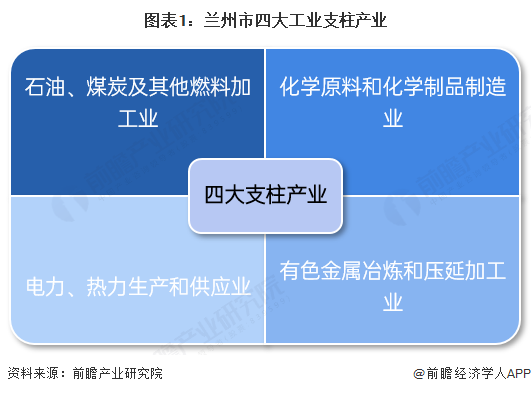
2025年兰州市产业结构之四大支柱产业全景图谱(附产业空间布局、产业增加值、各区域发展差异等)
Qian Zhan Wang· 2025-11-10 09:55
Core Viewpoint - Lanzhou is actively developing four major industrial pillar industries, which significantly contribute to the city's economic output, accounting for over 50% of the industrial output value in 2023 [1][4]. Group 1: Overview of Major Industries - The four pillar industries in Lanzhou include petroleum, coal and other fuel processing, chemical raw materials and chemical products manufacturing, electricity and heat production and supply, and non-ferrous metal smelting and rolling [1][4]. - In 2023, the output value of the petroleum, coal, and other fuel processing industry reached 546 billion yuan, projected to increase to approximately 563 billion yuan in 2024, representing about 37% of Lanzhou's total industrial output [7][10]. Group 2: Distribution of Industries - The four major industries are primarily concentrated in specific districts: non-ferrous metal smelting in Yongdeng County and Honggu District, petroleum and coal processing in Xigu District, chemical manufacturing in Gaolan County, and electricity and heat supply in Gaolan County and Qilihe District [4][10]. Group 3: Industry-Specific Developments - The chemical raw materials and chemical products manufacturing industry maintained an output value above 200 billion yuan since 2021, with 2023 figures at 247 billion yuan and a projected 252 billion yuan for 2024 [12][15]. - The electricity and heat production and supply industry achieved an output value of 314 billion yuan in 2023, with an 11% year-on-year growth, and is expected to reach around 345 billion yuan in 2024 [16][18]. - The non-ferrous metal smelting and rolling industry saw a significant growth rate of 18.9%, with an output value of 248 billion yuan in 2023, and is projected to exceed 300 billion yuan in 2024 [22][23].
中国石油化工股份(00386.HK)11月10日耗资1779.63万港元回购407.2万股
Ge Long Hui· 2025-11-10 09:47
Group 1 - The company, China Petroleum & Chemical Corporation (Sinopec), announced a share buyback plan, intending to repurchase 4.072 million shares at a cost of HKD 17.7963 million [1] - The buyback price is set between HKD 4.3 and HKD 4.4 per share, indicating a strategic move to enhance shareholder value [1]
中国石油化工股份(00386)11月10日斥资1779.63万港元回购407.2万股
智通财经网· 2025-11-10 09:45
Core Viewpoint - China Petroleum & Chemical Corporation (Sinopec) announced a share buyback plan, indicating confidence in its financial health and future prospects [1] Summary by Categories Company Actions - The company plans to repurchase 4.072 million shares at a total cost of HKD 17.7963 million, scheduled for November 10, 2025 [1]
港股主要指数高开高走 恒指涨1.55% 科指涨1.34%




Xin Hua Cai Jing· 2025-11-10 09:35
Group 1 - The Hong Kong stock market saw significant gains on November 10, with the Hang Seng Index rising by 1.55% to close at 26,649.06 points, the Hang Seng Tech Index increasing by 1.34% to 5,915.56 points, and the National Enterprises Index up by 1.90% to 9,443.24 points [1] - The Hang Seng Index opened at 26,319.40 points, fluctuated around this level in the morning, and surged in the afternoon, ultimately gaining 407.23 points with a total turnover exceeding 214.7 billion HKD [1] - The southbound trading under the Stock Connect saw a net inflow of over 6.6 billion HKD on the same day [1] Group 2 - Most sectors experienced upward movement, including biopharmaceuticals, technology, real estate, gold, banking, insurance, brokerage, and new consumption, while sectors like coal, lithium batteries, and building materials showed mixed results, and chips and electricity sectors mostly declined [1] - Notable individual stock performances included Pop Mart rising by 8.11%, China Resources Land increasing by 4.45%, BYD gaining 3.98%, and Ideal Auto up by 2.39%, while SMIC fell by 0.99% [1] - Among the top three stocks by trading volume, Tencent Holdings rose by 2.44% with a turnover exceeding 9.3 billion HKD, Alibaba increased by 2.06% also with over 9.3 billion HKD in turnover, and Xiaomi Group saw a slight increase of 0.28% with a turnover exceeding 6.9 billion HKD [2]
智通港股52周新高、新低统计|11月10日



智通财经网· 2025-11-10 08:42
Core Insights - As of November 10, a total of 108 stocks reached their 52-week highs, with notable performers including Taijin Holdings (08321), OKURA HOLDINGS (01655), and Hejia Holdings (00704) achieving high rates of 125.00%, 84.90%, and 53.57% respectively [1] Summary by Category 52-Week Highs - Taijin Holdings (08321) closed at 0.620 with a peak price of 0.900, marking a 125.00% increase - OKURA HOLDINGS (01655) reached a closing price of 0.280 and a high of 0.355, reflecting an 84.90% rise - Hejia Holdings (00704) had a closing price of 0.345 and a peak of 0.430, showing a 53.57% increase - Other notable stocks include Sanhe Chemical (00301) with a 41.67% increase and Aide New Energy (02623) with a 36.25% rise [1] 52-Week Lows - Wangshan Wangshui-B (02630) recorded a closing price of 52.850 and a low of 51.000, resulting in a -21.84% decrease - Eight Horses Tea (06980) had a closing price of 52.850 and a low of 51.100, reflecting a -10.98% decline - New Enjoy Times (08519) reached a low of 0.270, marking a -10.00% drop - Other significant declines include Jiujiang Bank (06190) at -8.99% and Kun Group (00924) at -6.98% [3][4]
PetroChina's Yunnan petrochemical unit overhaul to shut plant for two months
Reuters· 2025-11-10 08:16
Core Viewpoint - PetroChina will shut down its entire Yunnan petrochemical plant for maintenance from November 15, 2025, to January 15, 2026 [1] Company Summary - The maintenance shutdown will last for a total of two months [1] Industry Summary - This maintenance period may impact the supply chain and production capacity in the petrochemical sector during the specified timeframe [1]