PETROCHINA(00857)

Search documents
Hermes Investment Management Ltd减持中国石油化学约2.54亿股 每股均价2.48港元
Zhi Tong Cai Jing· 2025-11-11 11:30
Group 1 - Hermes Investment Management Ltd reduced its stake in China Petroleum & Chemical Corporation (03983) by approximately 254 million shares at an average price of HKD 2.48 per share, totaling around HKD 630 million [1] - After the reduction, Hermes Investment Management's latest holding is approximately 248 million shares, representing a holding ratio of 13.82% [1]
Hermes Investment Management Ltd减持中国石油化学(03983)约2.54亿股 每股均价2.48港元
智通财经网· 2025-11-11 11:21
Core Viewpoint - Hermes Investment Management Ltd has reduced its stake in China Petroleum & Chemical Corporation (Sinopec) by approximately 254 million shares at an average price of HKD 2.48 per share, totaling around HKD 630 million, resulting in a new holding of approximately 248 million shares, representing 13.82% ownership [1] Summary by Category Shareholding Changes - Hermes Investment Management Ltd has decreased its holdings in Sinopec by about 254 million shares [1] - The average selling price per share was HKD 2.48, leading to a total divestment amount of approximately HKD 630 million [1] - Following the reduction, Hermes now holds approximately 248 million shares, which corresponds to a 13.82% ownership stake in the company [1]
中国石油化工股份(00386.HK)11月11日耗资1861.28万港元回购425.6万股
Ge Long Hui· 2025-11-11 09:50
格隆汇11月11日丨中国石油化工股份(00386.HK)发布公告,2025年11月11日耗资1861.28万港元回购 425.6万股,回购价格每股4.34-4.41港元。 ...
港股通红利低波ETF(159117)涨0.09%,成交额979.85万元
Xin Lang Cai Jing· 2025-11-11 07:16
Core Viewpoint - The Penghua Hong Kong Stock Connect Low Volatility Dividend ETF (159117) has shown a slight increase in its closing price and has a total trading volume of approximately 9.8 million yuan as of November 11, 2023 [1]. Group 1: Fund Overview - The Penghua Hong Kong Stock Connect Low Volatility Dividend ETF was established on September 30, 2025, with an annual management fee of 0.30% and a custody fee of 0.10% [1]. - The fund's performance benchmark is the S&P Hong Kong Stock Connect Low Volatility Dividend Index, adjusted for exchange rates [1]. - As of November 10, 2023, the fund has a total of 175 million shares and a total size of 185 million yuan [1]. Group 2: Fund Management - The current fund managers are Yan Dong and Yu Zhanchang, both of whom have managed the fund since its inception, achieving a return of 5.37% during their tenure [1]. Group 3: Top Holdings - The ETF's top holdings include: - Hang Lung Properties: 1.08% holding, valued at approximately 4.07 million yuan [2]. - Jiangxi Copper: 1.08% holding, valued at approximately 4.06 million yuan [2]. - China Shenhua: 1.05% holding, valued at approximately 3.97 million yuan [2]. - Far East Horizon: 0.99% holding, valued at approximately 3.72 million yuan [2]. - CNOOC: 0.96% holding, valued at approximately 3.62 million yuan [2]. - Sino Land: 0.94% holding, valued at approximately 3.54 million yuan [2]. - China Petroleum: 0.87% holding, valued at approximately 3.29 million yuan [2]. - Hengan International: 0.87% holding, valued at approximately 3.26 million yuan [2]. - Henderson Land: 0.81% holding, valued at approximately 3.05 million yuan [2]. - Bank of China Hong Kong: 0.81% holding, valued at approximately 3.06 million yuan [2].



我国最大储气库开启今冬采气
Xin Hua She· 2025-11-11 06:50
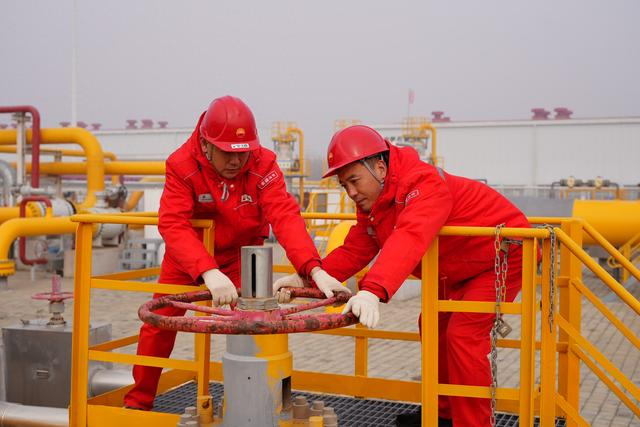
Core Points - The Hutu Bi Gas Storage Facility in Xinjiang, China's largest gas storage site, has officially commenced its 13th gas extraction cycle on November 10, ensuring natural gas supply for the upcoming winter and spring seasons [1][2] - The facility has a storage capacity exceeding 10 billion cubic meters and plays a dual role in seasonal peak regulation and emergency gas supply for northern Xinjiang, as well as supplying gas to major cities along the West-to-East Gas Transmission Project [1] Summary by Sections - **Gas Storage and Supply** - The Hutu Bi Gas Storage Facility has completed over 3 billion cubic meters of gas storage this year, reaching a historical high to ensure sufficient supply for winter and spring [2] - Since its operation began in June 2013, the facility has successfully completed 13 gas injection cycles and 12 extraction cycles, accumulating a total gas injection and extraction volume of over 47 billion cubic meters [2] - **Facility Advantages** - The underground gas storage facility offers significant advantages, including large storage capacity, high gas regulation capability, enhanced safety, and lower costs [2]

中国石油11月10日获融资买入2.47亿元,融资余额22.44亿元
Xin Lang Cai Jing· 2025-11-11 03:36
Core Viewpoint - China National Petroleum Corporation (CNPC) shows a mixed performance in financing activities, with a slight increase in stock price and notable changes in margin trading data [1][2]. Financing Activities - On November 10, CNPC's stock price increased by 1.65%, with a trading volume of 1.443 billion yuan. The financing buy-in amount was 247 million yuan, while the financing repayment was 137 million yuan, resulting in a net financing buy-in of 110 million yuan [1]. - As of November 10, the total margin trading balance for CNPC was 2.27 billion yuan, with the financing balance at 2.44 billion yuan, accounting for 0.14% of the circulating market value, which is below the 20th percentile level over the past year [1]. Short Selling Activities - On the same day, CNPC had a short selling repayment of 399,100 shares and a short selling amount of 85,800 shares, amounting to 846,800 yuan based on the closing price. The remaining short selling volume was 2.6489 million shares, with a short selling balance of 26.1446 million yuan, exceeding the 90th percentile level over the past year [1]. Company Overview - CNPC, established on November 5, 1999, and listed on November 5, 2007, is involved in the exploration, development, production, transportation, and sales of crude oil and natural gas, as well as renewable energy [2]. - The company's revenue composition includes refining products (69.64%), crude oil (43.27%), natural gas (39.98%), chemical products (8.78%), and other segments [2]. Financial Performance - For the period from January to September 2025, CNPC reported a revenue of 2.169256 trillion yuan, a year-on-year decrease of 3.86%, and a net profit attributable to shareholders of 126.279 billion yuan, down 4.71% year-on-year [2]. Dividend Distribution - Since its A-share listing, CNPC has distributed a total of 875.28 billion yuan in dividends, with 247.08 billion yuan distributed over the past three years [3]. Institutional Holdings - As of September 30, 2025, CNPC's top ten circulating shareholders include China Securities Finance Corporation, holding 1.02 billion shares, and Hong Kong Central Clearing Limited, holding 521 million shares, which decreased by 336 million shares compared to the previous period [3].
我国最大储气库“开仓放粮”
Xin Lang Cai Jing· 2025-11-11 03:25
Core Viewpoint - The largest gas storage facility in China, the Hutu Bi gas storage facility in Xinjiang, has officially commenced its 13th gas extraction cycle, ensuring natural gas supply for the upcoming winter and spring seasons [1] Group 1 - The gas extraction operation has started with the opening of gas extraction valves, allowing over 5 million cubic meters of natural gas to enter the pipeline network [1] - This initiative aims to provide natural gas to households, enhancing energy security during the winter months [1]
智通港股沽空统计|11月11日
智通财经网· 2025-11-11 00:23
Core Insights - The article highlights the top short-selling ratios and amounts for various companies, indicating significant market sentiment against these stocks [1][2]. Short-Selling Ratios - Lenovo Group-R (80992) has the highest short-selling ratio at 89.80% with a short-selling amount of 194.85 thousand [2]. - JD Group-SWR (89618) follows with a short-selling ratio of 82.03% and an amount of 18.12 thousand [2]. - Xiaomi Group-WR (81810) ranks third with a short-selling ratio of 69.31% and a short-selling amount of 150.53 thousand [2]. Short-Selling Amounts - Tencent Holdings (00700) leads in short-selling amount with 1.774 billion, representing a short-selling ratio of 18.90% [2]. - Alibaba-SW (09988) is second with a short-selling amount of 1.675 billion and a ratio of 17.89% [2]. - Pop Mart (09992) ranks third with a short-selling amount of 869 million and a ratio of 15.69% [2]. Deviation Values - Xiaomi Group-WR (81810) has the highest deviation value at 37.71%, indicating a significant difference from its past average short-selling ratio [2]. - Wynn Macau (01128) follows with a deviation value of 30.40% [2]. - Midea Group (N23078) ranks third with a deviation value of 23.49% [2].





俄罗斯石油降价卖,我国中石油为何不买?有这3大原因?
Sou Hu Cai Jing· 2025-11-10 23:12
Core Viewpoint - The article discusses why China National Petroleum Corporation (CNPC) has reduced its procurement of discounted Russian oil despite the attractive pricing, highlighting the complexities of international oil trade and the strategic considerations involved in energy security. Group 1: Reasons for Reduced Procurement - The first reason is the risk of U.S. sanctions, which have led several Chinese state-owned oil companies, including CNPC, to suspend purchases of Russian oil to avoid potential penalties and disruptions in their operations [3][4]. - The second reason is the strategy of supply diversification, as CNPC aims to reduce reliance on a single source of oil to ensure long-term stability and security in energy supply [5][6]. - The third reason is the difference between land pipeline transportation and maritime oil supply, with pipeline deliveries from Russia remaining unaffected while maritime purchases have been halted [6][12]. Group 2: Strategic Implications - CNPC is actively seeking alternative suppliers, including Saudi Arabia, Iraq, and other non-sanctioned countries, to enhance its energy security and reduce dependency on Russian oil [5][10]. - The company has been stockpiling oil strategically, with estimates indicating that China has around 1.25 billion barrels in inventory, which provides leverage in negotiations and helps mitigate price fluctuations [7][9]. - The decision to halt purchases of Russian maritime oil reflects a broader strategy to balance short-term economic benefits with long-term energy security, ensuring that CNPC can adapt to changing geopolitical landscapes [10][16]. Group 3: Market Dynamics - The global energy market is undergoing significant changes, with traditional consumption patterns shifting due to the rise of electric vehicles and sustainable fuels, while demand for petrochemical products continues to grow [10][12]. - The pricing of Russian ESPO crude has dropped significantly due to reduced demand from buyers, indicating market concerns over sanctions and geopolitical risks [12]. - The evolving trade dynamics between China, India, and Russia suggest that the reliance on Russian oil may decrease further, depending on the outcomes of international negotiations and sanctions policies [11][12].

热点观察 | 共建公正、韧性、可持续的全球能源合作新范式
Sou Hu Cai Jing· 2025-11-10 17:52
Core Insights - The China International Import Expo (CIIE) has been held for eight consecutive years, promoting global cooperation and open development in the energy sector [1] - The China Petroleum International Cooperation Forum has also been held for eight years, serving as a crucial platform for energy cooperation and addressing global energy security and climate change [1][3] Forum Themes and Developments - The forum has evolved its themes over the years, focusing on high-quality development, international cooperation, and the impact of global events such as the COVID-19 pandemic [3][4] - The 2023 forum emphasized building a new paradigm for global energy cooperation, highlighting fairness, resilience, and sustainability as core principles [5][7] Key Proposals for Energy Cooperation - The forum's proposals include promoting bilateral and multilateral cooperation through the Belt and Road Initiative, enhancing energy technology innovation, and accelerating the transition to green and low-carbon energy [7][8] - There is a strong consensus among participants on the need for deepened trust and mutual benefits in energy cooperation to facilitate a green and low-carbon transition [7][8]