
CNOOC(00883)

Search documents
北水动向|北水成交净买入31.31亿 内资全天抢筹南方恒生科技近16亿港元
智通财经网· 2026-02-24 10:09
Group 1: Market Overview - The Hong Kong stock market saw a net inflow of 31.31 billion HKD from northbound trading, with 9.6 billion HKD from Shanghai and 21.7 billion HKD from Shenzhen [1] - The most bought stocks included Southern Hang Seng Technology (03033), Meituan-W (03690), and Xiaomi Group-W (01810) [1] - The most sold stocks were CNOOC (00883), Tencent (00700), and Alibaba-W (09988) [1] Group 2: Stock Performance - Southern Hang Seng Technology (03033) received a net inflow of 15.84 billion HKD, supported by positive sentiment in the tech sector [5] - Meituan-W (03690) saw a net inflow of 6.87 billion HKD, with a report indicating a 79% year-on-year increase in travel spending during the Spring Festival [5] - Xiaomi Group-W (01810) had a net inflow of 4.37 billion HKD, with plans to focus on core technologies like chips and AI over the next five years [5] Group 3: Individual Stock Insights - Tencent Holdings (00700) had a total trading volume of 54.62 billion HKD, with a net inflow of 3.93 billion HKD [2] - Alibaba-W (09988) experienced a net outflow of 651.785 million HKD, with total trading of 40.66 billion HKD [2] - SMIC (00981) received a net inflow of 2.2 billion HKD, with expectations of sales growth exceeding industry averages by 2026 [6][7]





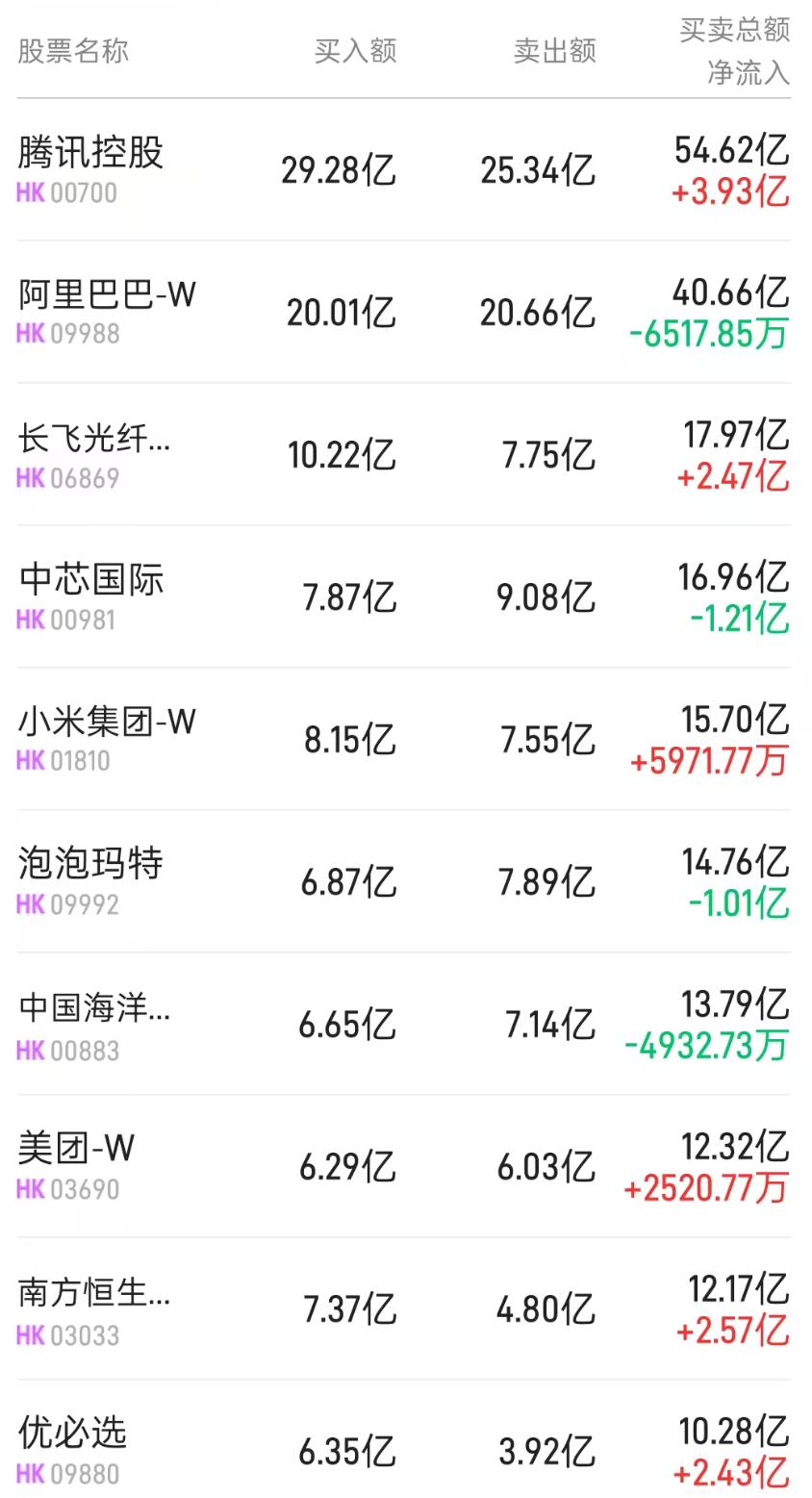
北水动向|北水成交净买入31.31亿 内资全天抢筹南方恒生科技(03033)近16亿港元
智通财经网· 2026-02-24 09:57
Group 1: Market Overview - The Hong Kong stock market saw a net inflow of 31.31 billion HKD from northbound trading, with 9.6 billion HKD from Shanghai and 21.7 billion HKD from Shenzhen [1] - The most bought stocks included Southern Hang Seng Technology (03033), Meituan-W (03690), and Xiaomi Group-W (01810) [1] - The most sold stocks were CNOOC (00883), Tencent (00700), and Alibaba-W (09988) [1] Group 2: Individual Stock Performance - Southern Hang Seng Technology (03033) received a net inflow of 15.84 billion HKD, with analysts suggesting that the tech sector remains a long-term investment focus due to reduced valuation pressure and accelerating AI applications [4] - Meituan-W (03690) saw a net inflow of 6.87 billion HKD, with a report indicating a 79% year-on-year increase in tourism spending during the Spring Festival [5] - Xiaomi Group-W (01810) had a net inflow of 4.37 billion HKD, with plans to focus on core technologies like chips and AI over the next five years [5] - SMIC (00981) received a net inflow of 2.2 billion HKD, with positive signals for 2026 sales growth expected to exceed industry averages [6] - CNOOC (00883) faced a net outflow of 998.9 million HKD amid geopolitical risks affecting the oil market [6] - Tencent (00700) and Alibaba-W (09988) experienced net outflows of 867.7 million HKD and 690.1 million HKD, respectively [6]



港股通央企红利ETF天弘(159281)涨2.85%,成交额1.19亿元
Xin Lang Cai Jing· 2026-02-24 09:47
Core Viewpoint - The Tianhong CSI Hong Kong Stock Connect Central State-Owned Enterprises Dividend ETF (159281) has shown a positive performance with a closing increase of 2.85% and a trading volume of 119 million yuan on February 24, 2025 [1] Group 1: Fund Overview - The Tianhong CSI Hong Kong Stock Connect Central State-Owned Enterprises Dividend ETF was established on August 20, 2025, with an annual management fee of 0.50% and a custody fee of 0.10% [1] - As of February 13, 2025, the fund's latest share count was 345 million shares, with a total size of 352 million yuan, reflecting a 2.54% decrease in shares and a 0.57% increase in size since December 31, 2025 [1] Group 2: Liquidity and Trading Activity - Over the last 20 trading days leading up to February 24, 2025, the cumulative trading amount for the ETF was 1.311 billion yuan, with an average daily trading amount of 65.57 million yuan [1] Group 3: Fund Management - The current fund manager, He Yuxuan, has managed the fund since its inception, achieving a return of 2.96% during the management period [1] Group 4: Top Holdings - The ETF's top holdings include: - COSCO Shipping Holdings (4.11% holding, 1.441 million yuan market value) - China Shenhua Energy (2.68% holding, 939.20 thousand yuan market value) - CNOOC (2.56% holding, 898.44 thousand yuan market value) - Sinopec Engineering (2.56% holding, 895.97 thousand yuan market value) - China National Offshore Oil Corporation (2.52% holding, 882.26 thousand yuan market value) - China Merchants Energy Shipping (2.45% holding, 857.72 thousand yuan market value) - PetroChina (2.37% holding, 829.56 thousand yuan market value) - China Coal Energy (2.37% holding, 829.50 thousand yuan market value) - CITIC International (2.34% holding, 819.88 thousand yuan market value) - China Construction Bank (2.28% holding, 797.37 thousand yuan market value) [2]
港股通红利低波ETF基金(159118)涨1.76%,成交额1803.28万元
Xin Lang Cai Jing· 2026-02-24 07:16
Group 1 - The core viewpoint of the news is the performance and characteristics of the Huaxia S&P Hong Kong Stock Connect Low Volatility Dividend ETF (159118), which has seen a significant decrease in both share count and total assets since the beginning of the year [1][2] - As of February 13, 2025, the fund's latest share count was 132 million, with a total size of 136 million yuan, reflecting a 57.06% decrease in shares and a 54.36% decrease in size compared to December 31, 2025 [1] - The fund's management fee is 0.15% annually, and the custody fee is 0.05% annually, with its performance benchmark being the S&P Hong Kong Stock Connect Low Volatility Dividend Index adjusted for valuation exchange rates [1] Group 2 - The current fund manager is Yan Xiaoxian, who has managed the fund since its inception on November 17, 2025, achieving a return of 3.06% during her tenure [2] - The fund's top holdings include Far East Horizon, China Shenhua, China Petroleum, CNOOC, Jiangxi Copper, Hang Lung Properties, Hengan International, Sino Land, PCCW, and Sinopec, with each holding representing a small percentage of the total portfolio [2] - The cumulative trading amount for the fund over the last 20 trading days was 297 million yuan, with an average daily trading amount of 14.87 million yuan [1]

港股央企红利50ETF(520990)涨3.17%,成交额2.48亿元
Xin Lang Cai Jing· 2026-02-24 07:10
Group 1 - The Invesco Great Wall CSI National New Hong Kong Stock Connect Central Enterprise Dividend ETF (520990) closed up 3.17% on February 24, with a trading volume of 248 million yuan [1] - The fund was established on June 26, 2024, with a management fee of 0.50% and a custody fee of 0.10% [1] - As of February 13, 2025, the fund's latest share count was 5.775 billion shares, with a total size of 6.032 billion yuan, reflecting a 1.65% increase in shares and a 6.18% increase in size year-to-date [1] Group 2 - The current fund managers are Gong Lili and Wang Yang, with returns of 24.16% and 9.85% respectively during their management periods [2] - The fund's top holdings include China National Offshore Oil Corporation, China Shenhua Energy, China Petroleum & Chemical Corporation, and China Mobile, with respective holding percentages [2][3] - The top holdings by percentage are as follows: CNOOC (10.04%), China Shenhua (9.99%), China Petroleum (9.82%), and China Mobile (9.65%) [3]


油气ETF汇添富(159309)涨7.21%,半日成交额7925.84万元
Xin Lang Cai Jing· 2026-02-24 03:42
Group 1 - The core viewpoint of the article highlights the significant performance of the oil and gas ETF, Huatai Fu (159309), which rose by 7.21% to 1.472 yuan with a trading volume of 79.2584 million yuan as of the midday close [1] - Major holdings in the oil and gas ETF include China National Petroleum Corporation, which increased by 5.88%, China National Offshore Oil Corporation by 8.20%, and Sinopec by 3.45% [1] - The ETF's performance benchmark is the CSI Oil and Gas Resource Index return rate, managed by Huatai Fund Management Co., Ltd., with a return of 36.67% since its inception on May 31, 2024, and a return of 10.97% over the past month [1]



中国海油创历史新高
Ge Long Hui· 2026-02-24 01:49
Group 1 - China National Offshore Oil Corporation (CNOOC) shares increased by 7.41%, reaching a price of 36.940 yuan, marking a historical high for the stock [1] - The total market capitalization of CNOOC is now 175.5757 billion yuan [1]
能源ETF广发(159945)开盘涨1.15%,重仓股中国神华涨0.68%,中国石油涨3.42%
Xin Lang Cai Jing· 2026-02-24 01:39
Group 1 - The core viewpoint of the article highlights the performance of the Energy ETF Guangfa (159945), which opened with a gain of 1.15% at 1.321 yuan on February 24 [1] - The major holdings of the Energy ETF include China Shenhua, which rose by 0.68%, China Petroleum by 3.42%, China Petrochemical by 1.57%, Shaanxi Coal and Chemical by 1.14%, China National Offshore Oil by 4.10%, Jereh Group which fell by 0.41%, Yanzhou Coal Mining by 2.02%, China Coal Energy by 1.04%, Guanghui Energy by 2.22%, and Shanxi Coking Coal by 0.57% [1] - The performance benchmark for the Energy ETF Guangfa is the CSI All Share Energy Index, managed by Guangfa Fund Management Co., with a return of 30.72% since its establishment on June 25, 2015, and a return of 7.72% over the past month [1]

两大交易所集中释放利好
2 1 Shi Ji Jing Ji Bao Dao· 2026-02-20 13:07
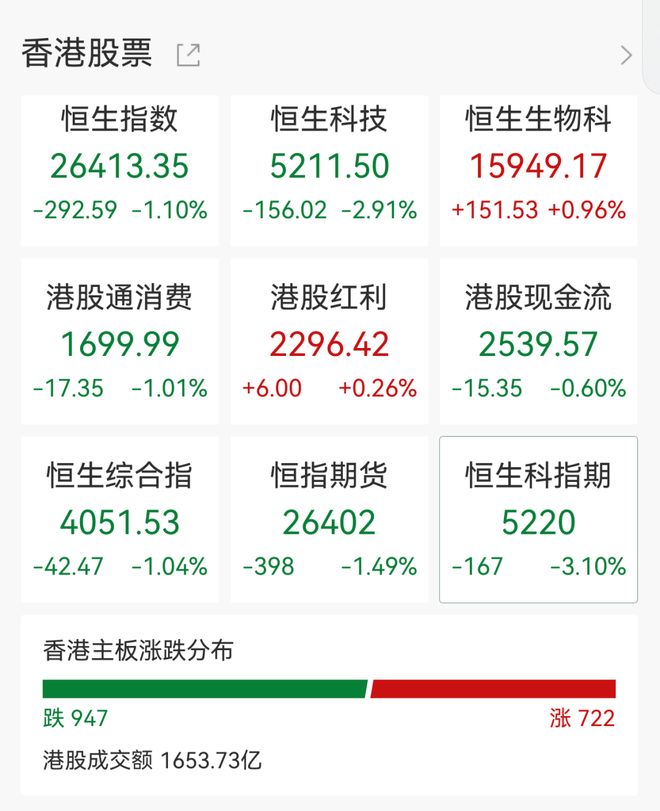
Market Overview - The Hong Kong stock market opened on February 20, 2023, with the Hang Seng Index closing down by 1.10% and the Hang Seng Tech Index down by 2.91% [1][8] - Despite the overall market decline, several robotics concept stocks rose significantly, indicating a "Spring Festival effect" [3][11] IPO and Market Activity - As of the new year, 24 new stocks have been listed on the Hong Kong Stock Exchange, raising over 87 billion HKD, with 488 companies currently waiting to go public [4][15] - The average daily trading volume in January exceeded 278 billion HKD, reflecting the effectiveness of liquidity enhancement measures [15] Sector Performance - The technology sector faced pressure, with major internet stocks like JD Health, Baidu, Alibaba, and Tencent experiencing declines ranging from 2.06% to 6.27% [9][10] - In contrast, the robotics sector saw notable gains, with stocks such as Yujian up by 21.4%, Sutech up by 9.24%, and Ubtech up by 4.71% [11][12] Gold Market - The Hong Kong gold market also performed well, with gold prices rising to 46,685 HKD per tael, an increase of over 200 HKD from the previous trading day [17][18] - The Hong Kong government aims to establish the city as an international gold trading center, targeting over 2,000 tons in gold storage within three years [16][17] Index Adjustments - The Hang Seng Index will increase its constituent stocks from 88 to 90, adding companies like CATL and Luoyang Molybdenum, effective March 9, 2023 [18][19] - The adjustments in the Hong Kong Stock Connect are expected to lead to significant trading activity, particularly for newly included stocks in the healthcare and technology sectors [19]

港股午评|恒生指数早盘跌0.61% 机器人板块逆市走高
智通财经网· 2026-02-20 04:08
Group 1: Market Overview - The Hang Seng Index fell by 0.61%, down 161 points, closing at 26,544 points, while the Hang Seng Tech Index dropped by 2.28% [1] - The Hong Kong stock market saw a morning trading volume of HKD 91.7 billion [1] Group 2: Robotics Sector - The robotics sector performed well, with First Journey Holdings (00697) rising over 11% as three invested robotics companies were featured in the 2026 Spring Festival Gala [1] - SUTENG (02498) saw a morning increase of over 9%, achieving its first quarterly profit in Q4 due to strong growth in its robotics business [1] - Hesai Technology (02525) rose by 6.7%, with two humanoid robots featured in the Spring Festival Gala equipped with Hesai's JT128 lidar [1] - Yuejiang (02432) surged by 19%, and UBTECH (09880) increased by 6.9% [1] Group 3: Oil Sector - Oil stocks were among the top gainers, driven by concerns over the Middle East situation potentially disrupting shipping in the Strait of Hormuz, with international oil prices reaching a six-month high [1] - PetroChina (00857) rose by 4.58%, CNOOC (00883) increased by 3.34%, and CNOOC Services (02883) gained 3.92% [1][2] Group 4: Semiconductor Sector - The semiconductor sector faced declines, with Hua Hong Semiconductor (01347) falling by 3.8% and SMIC dropping over 1.65% [7] Group 5: AI and Technology Sector - Zhiyuan (02513) surged by 19% after SothisAI, a subsidiary of Zhongke Shuguang, integrated with Zhiyuan's GLM-5 [3] - Aixin Yuanzhi (00600) rose over 19%, being the world's largest provider of high-end visual edge AI inference chips [4] - MiniMax (00100) increased by over 10% [3] - Extreme Intelligence (02590) saw a reverse market trend, rising over 3% after Zhao Hao, one of Tsinghua's "Five Outstanding Figures," was appointed as Chief Scientist [5] Group 6: Other Notable Movements - Stone Pharmaceutical Group (02005) fell by 5.96%, with an expected profit decline of approximately 45% to 60% year-on-year for the fiscal year 2025 [6]
