
CNOOC(00883)

Search documents
石油股逆势走强,中国石油股份涨超4%
Ge Long Hui· 2026-02-20 03:39
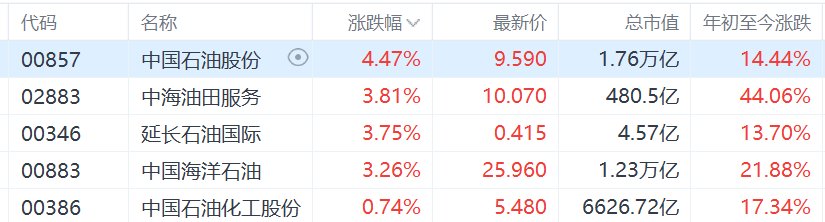
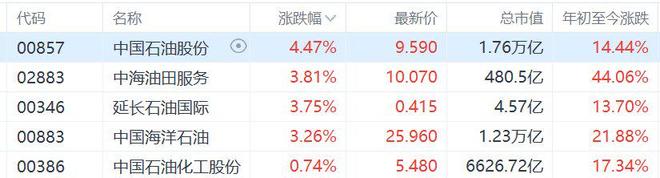
Core Viewpoint - Hong Kong oil stocks have shown strong performance against the market trend, driven by rising international oil prices and escalating tensions between the US and Iran in the Middle East [1] Group 1: Stock Performance - China Petroleum & Chemical Corporation (00857) increased by 4.47%, reaching a latest price of 9.590 with a total market capitalization of 1.76 trillion, marking a year-to-date increase of 14.44% [2] - CNOOC Services (02883) rose by 3.81%, with a latest price of 10.070 and a market cap of 48.05 billion, reflecting a year-to-date increase of 44.06% [2] - Yanchang Petroleum International (00346) saw a 3.75% increase, with a latest price of 0.415 and a market cap of 0.457 billion, showing a year-to-date increase of 13.70% [2] - China National Offshore Oil Corporation (00883) increased by 3.26%, with a latest price of 25.960 and a market cap of 1.23 trillion, resulting in a year-to-date increase of 21.88% [2] - China Petroleum & Chemical Corporation (00386) had a modest increase of 0.74%, with a latest price of 5.480 and a market cap of 662.67 billion, reflecting a year-to-date increase of 17.34% [2]




港股异动丨石油股逆势走强,中国石油股份涨超4%
Ge Long Hui· 2026-02-20 02:47
Group 1 - The core viewpoint of the news is that Hong Kong oil stocks are performing strongly against the market trend, driven by rising international oil prices and escalating tensions between the US and Iran in the Middle East [1] Group 2 - China Petroleum & Chemical Corporation (00857) saw a price increase of over 4.47%, with a latest price of 9.590 and a total market capitalization of 1.76 trillion, reflecting a year-to-date increase of 14.44% [2] - CNOOC Services (02883) rose by 3.81%, reaching a price of 10.070 and a market cap of 48.05 billion, with a year-to-date increase of 44.06% [2] - Yanchang Petroleum International (00346) increased by 3.75%, with a latest price of 0.415 and a market cap of 0.457 billion, showing a year-to-date increase of 13.70% [2] - China National Offshore Oil Corporation (00883) experienced a 3.26% rise, with a price of 25.960 and a market cap of 1.23 trillion, marking a year-to-date increase of 21.88% [2] - Sinopec Limited (00386) had a modest increase of 0.74%, with a latest price of 5.480 and a market cap of 662.672 billion, reflecting a year-to-date increase of 17.34% [2]
石油股早盘涨幅居前 中国石油及中海油服均涨逾4%
Xin Lang Cai Jing· 2026-02-20 02:33
Group 1 - Oil stocks showed significant gains in early trading, with China Petroleum (00857) rising by 4.14% to HKD 9.56 [1] - CNOOC Services (02883) increased by 3.61% to HKD 10.05 [1] - CNOOC (00883) saw a rise of 3.18% to HKD 25.94 [1] - Sinopec (00386) experienced a smaller increase of 0.92% to HKD 5.49 [1]

港股异动 | 石油股涨幅居前 中东局势或扰乱霍尔木兹海峡航运 国际油价站上六个月高位
智通财经网· 2026-02-20 02:25
Core Viewpoint - Oil stocks are experiencing significant gains, driven by geopolitical tensions and military deployments in the Middle East, particularly concerning Iran's nuclear program [1] Group 1: Company Performance - PetroChina (00857) increased by 3.81%, trading at HKD 9.53 [1] - CNOOC (00883) rose by 2.94%, trading at HKD 25.88 [1] - China Oilfield Services (02883) saw a rise of 3.2%, trading at HKD 10.01 [1] - Sinopec (00386) experienced a modest increase of 0.55%, trading at HKD 5.47 [1] Group 2: Market Impact - International oil prices are stabilizing near six-month highs, with WTI crude oil futures slightly below USD 67 per barrel, having increased approximately 7% over the past two trading days [1] - Brent crude oil futures closed around USD 72 per barrel [1] - Analysts from ANZ Bank highlighted concerns that escalating tensions could disrupt shipping through the Strait of Hormuz, a critical route for approximately 20% of global oil consumption [1]
智通港股通资金流向统计(T+2)|2月19日
智通财经网· 2026-02-18 23:32
Key Points - Tencent Holdings (00700), Yingfu Fund (02800), and Shandong Gold (01787) ranked the top three in net inflow of southbound funds, with net inflows of 736 million, 423 million, and 393 million respectively [1] - Alibaba-W (09988), SMIC (00981), and Hua Hong Semiconductor (01347) ranked the top three in net outflow of southbound funds, with net outflows of -524 million, -391 million, and -199 million respectively [1] - In terms of net inflow ratio, Nanhua Futures (02691), Southern East Select (03441), and Oculent (00501) led the market with ratios of 70.54%, 59.14%, and 56.33% respectively [1] - In terms of net outflow ratio, Zhengzhou Bank (06196), China Energy Construction (03996), and Hongye Futures (03678) had the highest ratios at -50.51%, -49.70%, and -48.03% respectively [1] Top 10 Net Inflow Stocks - Tencent Holdings (00700) had a net inflow of 736 million with a net inflow ratio of 5.67% and a closing price of 548.000 [2] - Yingfu Fund (02800) recorded a net inflow of 423 million with a net inflow ratio of 5.13% and a closing price of 27.480 [2] - Shandong Gold (01787) saw a net inflow of 393 million with a net inflow ratio of 31.27% and a closing price of 40.180 [2] - Bilibili-W (09626) had a net inflow of 335 million with a net inflow ratio of 27.53% and a closing price of 252.800 [2] - China National Offshore Oil Corporation (00883) recorded a net inflow of 301 million with a net inflow ratio of 22.88% and a closing price of 24.800 [2] Top 10 Net Outflow Stocks - Alibaba-W (09988) experienced a net outflow of -524 million with a net outflow ratio of -6.30% and a closing price of 160.100 [2] - SMIC (00981) had a net outflow of -391 million with a net outflow ratio of -6.39% and a closing price of 70.000 [2] - Hua Hong Semiconductor (01347) recorded a net outflow of -199 million with a net outflow ratio of -15.56% and a closing price of 99.600 [2] - Changfei Optical Fiber (06869) saw a net outflow of -172 million with a net outflow ratio of -5.33% and a closing price of 107.500 [2] - WISCO (01208) had a net outflow of -168 million with a net outflow ratio of -32.19% and a closing price of 10.160 [2] Top 10 Net Inflow Ratios - Nanhua Futures (02691) had a net inflow ratio of 70.54% with a net inflow of 5.40 million and a closing price of 11.230 [3] - Southern East Select (03441) recorded a net inflow ratio of 59.14% with a net inflow of 5.74 million and a closing price of 11.650 [3] - Oculent (00501) had a net inflow ratio of 56.33% with a net inflow of 1.45 million and a closing price of 103.900 [3] Top 10 Net Outflow Ratios - Zhengzhou Bank (06196) had a net outflow ratio of -50.51% with a net outflow of -3.13 million and a closing price of 1.150 [3] - China Energy Construction (03996) recorded a net outflow ratio of -49.70% with a net outflow of -16.96 million and a closing price of 1.180 [3] - Hongye Futures (03678) had a net outflow ratio of -48.03% with a net outflow of -5.22 million and a closing price of 3.220 [3]



新春走基层 | 深海一号海底钻云上算
Xin Lang Cai Jing· 2026-02-18 23:26
Core Viewpoint - The article highlights the advancements and operational efficiency of the "Deep Sea One" gas field platform, emphasizing the importance of domestic technology and innovation in enhancing energy security and production capabilities in China's deep-sea oil and gas sector [1][2][4]. Group 1: Technology and Innovation - The "Deep Sea One" platform utilizes 16 mooring lines, each enduring a pull of 300 to 400 tons, ensuring stability in the ocean [2]. - The platform has achieved complete domestic production of mooring cables, which were previously imported, showcasing significant advancements in local manufacturing capabilities [2]. - The team has developed a fully autonomous system for monitoring and managing hydrate blockages, enhancing operational efficiency [3]. Group 2: Operational Efficiency - The platform has supplied over 14 billion cubic meters of gas since its inception, contributing to both the Hainan Free Trade Port and the Guangdong-Hong Kong-Macao Greater Bay Area [4]. - The implementation of "smart completion" technology has improved drilling efficiency by 30%, allowing for real-time monitoring and remote control of drilling operations [3]. - The integration of digital twin technology and AI algorithms has led to a 40% reduction in energy consumption per unit of output [3]. Group 3: Strategic Importance - The development of the "Deep Sea One" gas field is positioned as a strategic initiative to enhance China's energy self-sufficiency and security [2]. - The platform is recognized as the starting point for China's deep-sea oil and gas exploration, marking a significant milestone in the industry [4].

深海一号海底钻云上算(新春走基层·开局之年新气象)
Ren Min Ri Bao· 2026-02-17 22:32
Core Insights - The article highlights the advancements and operational efficiency of the "Deep Sea No. 1" gas field platform, showcasing its strategic importance in China's energy security and self-sufficiency [2][3][5]. Group 1: Operational Efficiency - The "Deep Sea No. 1" platform is stabilized by 16 mooring cables, each enduring a pull of 300 to 400 tons, ensuring its stability in the ocean [3]. - The platform has successfully transitioned to fully domestically produced mooring cables, which were previously reliant on imports, enhancing the country's energy independence [3]. - The platform's operations include real-time monitoring of 23 deep-water wells, allowing for immediate response to any anomalies detected [4]. Group 2: Technological Innovations - The platform employs advanced technologies such as digital twins and artificial intelligence algorithms, resulting in a 40% reduction in energy consumption per unit of output [4]. - The introduction of "smart completion" technology has improved drilling efficiency by 30%, allowing for maintenance of underwater equipment without interrupting production [4]. - The platform has developed a self-sustaining system to manage hydrate blockages, ensuring uninterrupted energy flow [4]. Group 3: Production and Supply - Since its inception, the "Deep Sea No. 1" gas field has supplied over 14 billion cubic meters of gas, contributing to both the Hainan Free Trade Port and the Guangdong-Hong Kong-Macau Greater Bay Area [5]. - The platform is recognized as the starting point for China's deep-sea oil and gas development, emphasizing its significance in the national energy landscape [5].
智通港股通持股解析|2月17日
智通财经网· 2026-02-17 01:44
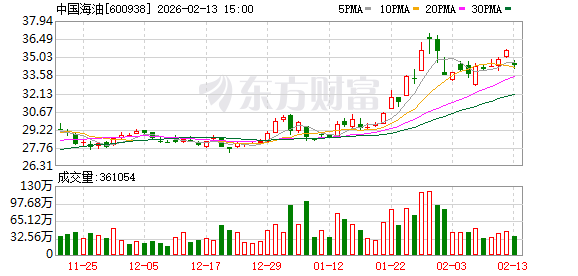
Group 1 - The top three companies by Hong Kong Stock Connect holding ratios are China Telecom (71.26%), Haotian International Investment (70.78%), and Green Power Environmental (68.78%) [1][2] - In the last five trading days, the companies with the largest increase in holding amounts are China National Offshore Oil (CNOOC) (+764 million), Meituan (+652 million), and Bilibili (+400 million) [1][2] - The companies with the largest decrease in holding amounts in the last five trading days are Tencent Holdings (-644 million), China Mobile (-377 million), and Alibaba-W (-351 million) [1][3] Group 2 - The latest holding ratios for the top 20 companies in Hong Kong Stock Connect show significant ownership, with China Telecom leading at 71.26% and others like Tianjin Chuangye Environmental and China Shenhua also above 66% [2] - The increase in holdings for the top 10 companies in the last five trading days indicates strong investor interest, particularly in CNOOC and Meituan, suggesting potential growth opportunities [2] - The decrease in holdings for Tencent, China Mobile, and Alibaba may indicate a shift in investor sentiment or profit-taking strategies [3]


刚刚,港股V型反转!科技股走强,MINIMAX涨超24%
Xin Lang Cai Jing· 2026-02-16 04:55
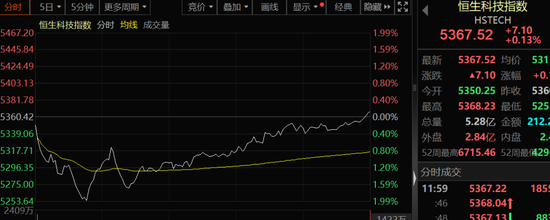
Market Overview - On February 16, the last trading day before the Spring Festival, Hong Kong stocks experienced a V-shaped rebound, with the Hang Seng Index rising by 0.52% after a drop of over 0.6% during the session [1][11] - The Hang Seng Technology Index increased by 0.13%, recovering from a decline of more than 1.9%, while the National Enterprises Index rose by 0.42% after a drop of over 0.8% [1][11] - Resource stocks led the gains, with Luoyang Molybdenum rising over 6%, and Zijin Mining and Ganfeng Lithium both increasing by over 4% [1][11] AI Application Sector - The AI application sector saw significant gains, with Haizhi Technology Group rising nearly 30%, MINIMAX-WP increasing by over 24%, and Maiyue Technology up by over 10% [3][13] - Other notable performers included Fubo Group, which rose by over 8%, and Zhipu, which increased by 4.74% [3][13] Precious Metals Sector - The precious metals sector, particularly gold stocks, showed strong performance, with Luoyang Molybdenum and Laopu Gold both rising over 6%, and Lingbao Gold increasing nearly 5% [6][16] - The international gold price rebounded above $5,000 per ounce after a significant drop the previous week [17][18] Oil and Gas Sector - The oil and gas sector also performed well, with CNOOC rising nearly 4%, and Sinopec Oilfield Services and CNOOC Services both increasing by over 2% [19][20] - The recent fluctuations in international oil prices are influenced by geopolitical tensions, particularly between the US and Iran, which have led to a premium on oil prices [20][21] Summary of Key Stocks - Notable stocks in the AI sector include: - Haizhi Technology Group: 29.59% increase [4][14] - MINIMAX-WP: 24.56% increase [4][14] - Maiyue Technology: 10.11% increase [4][14] - In the precious metals sector: - Luoyang Molybdenum: 6.35% increase [7][17] - Laopu Gold: 6.64% increase [7][17] - In the oil sector: - CNOOC: 4.21% increase [20]

港股收盘(02.16) | 蛇年收官日恒指涨0.52% 有色金属、AI概念股走强 多股刷新上市新高
智通财经网· 2026-02-16 04:49
Market Overview - The Hong Kong stock market experienced a half-day trading session on February 16, with all three major indices opening lower but recovering. The Hang Seng Index closed up 0.52% at 26,705.94 points, with a total turnover of 849.97 billion HKD. The Hang Seng Tech Index rose 0.13%, while the Hang Seng China Enterprises Index increased by 0.42% [1] - For the year of the Snake, the Hang Seng Index has gained over 32%, the Hang Seng Tech Index has risen over 13%, and the China Enterprises Index has increased by over 23% [1] Blue Chip Performance - Zijin Mining (02899) led the blue-chip stocks, rising 4.67% to 43.52 HKD, contributing 18.71 points to the Hang Seng Index. Citigroup raised its target prices for Zijin's A-shares and H-shares by over 30% due to increased gold and lithium price forecasts and higher gold sales [2] - Other notable blue-chip performers included China Hongqiao (01378) up 3.92%, CNOOC (00883) up 3.71%, while HSBC Holdings (00005) fell 1.11% [2] Sector Highlights - The technology sector showed mixed results, with Alibaba down 0.45%, Baidu up over 1%, and Tencent up 0.19%. The storage chip sector saw significant price increases, with companies like Lianqi Technology and Zhaoyi Innovation reaching new highs [3] - The storage chip price surge is expected to improve profitability across the NAND industry, with Kioxia projecting a 50% increase in average selling prices starting Q1 2026. Morgan Stanley estimates Kioxia's adjusted gross margin will reach 66% in Q1 [3] - The large model AI sector also saw significant gains, with MINIMAX (00100) up 24.56% and Zhipu AI (02513) up 4.74%. MINIMAX launched a new flagship programming model, while Zhipu announced a price increase for its AI programming subscription [4] Commodity and Energy Stocks - The non-ferrous metals sector experienced broad gains, with Luoyang Molybdenum (03993) up 6.35%, China Nonferrous Mining (01258) up 5.55%, and Zijin Mining (02899) also contributing to the sector's performance [4] - The oil and shipping sectors remained active, with rising sentiments among shipowners due to geopolitical tensions, leading to higher freight rates [10] Recent Developments - The Hang Seng Index Company announced its quarterly review results, with companies like CATL, Luoyang Molybdenum, and Laopuhuang being added to the Hang Seng Index, increasing the number of constituent stocks from 88 to 90 [7] - Haizhi Technology Group (02706) saw a significant rise of 29.59% on its second day of trading, attributed to its focus on AI solutions and rapid revenue growth [8] - Fubo Group (03738) also experienced an 8.22% increase, driven by the popularity of its new copyright management platform [9]