CNOOC(00883)

Search documents
地缘紧张局势持续,通胀担忧导致美债转跌



工银国际· 2026-03-16 12:30
Report Industry Investment Rating - There is no information about the report industry investment rating in the provided content. Core Viewpoints of the Report - The geopolitical tensions persist, and concerns about inflation have led to a decline in US Treasuries. The yields of 10 - year and 2 - year US Treasuries have risen significantly, with the 2 - year yield rising more, reflecting concerns about limited Fed rate - cut space due to rising inflation expectations. The situation's uncertainty remains high, and the duration of the Holmuiz Strait's navigation restrictions is crucial [1][2]. - Affected by the sharp rise in US Treasury yields, Chinese - funded US dollar bonds have declined for two consecutive weeks, with the Bloomberg Barclays Chinese - funded US dollar bond total return index falling 0.5% last week [1][3]. - In the on - shore market, the yields of 3 - year and 10 - year government bonds have risen. Factors such as improved inflation expectations, good industrial production and export performance, improved fixed investment data, and reduced expectations of future monetary policy easing have jointly promoted the rise in government bond yields. However, overall, monetary policy will remain supportive, and there is no basis for a continuous rise in interest - rate bond yields [1][4]. Summary According to Relevant Catalogs Off - shore Market - There were 3 new issuances of Chinese - funded US dollar bonds exceeding $100 million last week, totaling $1.45 billion, mainly financial bonds; about 17.5 billion RMB of off - shore RMB bonds were newly issued, also mainly financial bonds [2]. - The yields of 10 - year and 2 - year US Treasuries rose 14 and 16 basis points respectively to 4.28% and 3.72% last week, mainly due to market concerns about potential inflation problems caused by the continuous high oil price [1][2]. - Key - term US Treasuries have fully reversed all their gains this year. The yields of 10 - year and 2 - year US Treasuries have risen 11 and 24 basis points respectively compared to the end of 2025 [1][2]. - Affected by the sharp rise in US Treasury yields, Chinese - funded US dollar bonds have declined for two consecutive weeks. The Bloomberg Barclays Chinese - funded US dollar bond total return index fell 0.5% last week, and the spread narrowed by 2 basis points. Among them, the high - rating index fell 0.5%, and the spread narrowed by 3 basis points; the high - yield index fell 0.4%, and the spread widened by 3 basis points [1][3]. On - shore Market - The People's Bank of China net - withdrew 10.11 billion RMB of short - term liquidity through reverse repurchase operations last week, and inter - bank funding rates rebounded. The weighted average interest rates of 7 - day deposit - type institutional pledged repurchase and 7 - day inter - bank pledged repurchase rose 5 and 1 basis points respectively to 1.46% and 1.50% [4]. - The yields of 3 - year and 10 - year government bonds rose 1 and 3 basis points respectively to 1.37% and 1.81% last week [4]. - February's inflation data showed improved price pressure, and the continuous geopolitical tensions pushed up oil prices, improving market expectations of subsequent inflation. The macro data from January to February showed good industrial production and export performance, improved fixed investment data, and although retail data was still weak, it was better than market expectations. Coupled with the guidance of the People's Bank of China, market expectations of future monetary policy easing have weakened, jointly promoting the rise in government bond yields. However, overall, monetary policy will remain supportive, and there is no basis for a continuous rise in interest - rate bond yields [4]. Recent Newly Issued Chinese - funded US Dollar Bonds - Beijing Construction Engineering (Hong Kong) Co., Ltd. issued bonds with a coupon rate of 4.10%, an issue amount of $300 million, and a maturity date of March 19, 2029 [5]. Appendix: List of Chinese - funded US Dollar Bonds - The appendix provides a detailed list of various Chinese - funded US dollar bonds, including information such as the issuer, guarantor, coupon rate, issue amount, maturity date, and ratings from Moody's, S&P, and Fitch [17][19][21].
南下资金净买入腾讯、阿里和比亚迪
Ge Long Hui· 2026-03-16 10:34
Group 1 - Southbound funds recorded a net sell of HKD 1.25 billion in Hong Kong stocks on March 16, with notable net purchases in Tencent Holdings (HKD 2.287 billion), Alibaba-W (HKD 706 million), BYD Company (HKD 586 million), and Geely Automobile (HKD 442 million) [1] - The net sell was primarily driven by the iShares Asia 50 ETF, which saw a net sell of HKD 3.574 billion, and Xiaomi Group-W with HKD 844 million [1][3] - Southbound funds have consistently net bought China National Offshore Oil Corporation (CNOOC) for four consecutive days, totaling HKD 3.38424 billion [1] Group 2 - Tencent Holdings experienced a price increase of 2.0% with a net buy of HKD 4.21 billion, while Alibaba-W saw a 1.1% increase with a net buy of HKD 3.55 billion [3] - BYD Company had a significant price increase of 7.8% with a net buy of HKD 4.37 billion, and Geely Automobile increased by 3.6% with a net buy of HKD 4.42 billion [3] - The overall trading volume for the stocks mentioned indicates a mixed performance, with some stocks like Xiaomi Group-W and SMIC showing negative net buy figures [3]



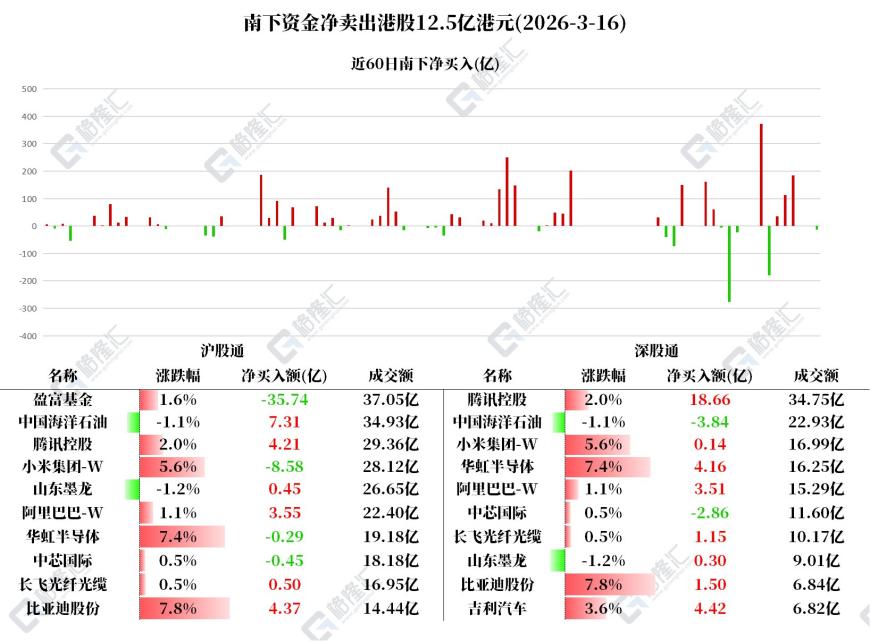
图解丨南下资金净买入腾讯、阿里和比亚迪
Ge Long Hui A P P· 2026-03-16 10:01
Group 1 - Southbound funds recorded a net sell of HKD 1.25 billion in Hong Kong stocks today [1] - Notable net purchases included Tencent Holdings at HKD 2.287 billion, Alibaba-W at HKD 706 million, BYD Company at HKD 586 million, Geely Automobile at HKD 442 million, Hua Hong Semiconductor at HKD 387 million, China National Offshore Oil Corporation at HKD 347 million, and Yangtze Optical Fibre and Cable at HKD 165 million [1] - Significant net sells were observed in the Tracker Fund of Hong Kong at HKD 3.574 billion, Xiaomi Group-W at HKD 844 million, and Semiconductor Manufacturing International Corporation at HKD 330 million [1] Group 2 - Southbound funds have continuously net bought China National Offshore Oil Corporation for four consecutive days, totaling HKD 3.38424 billion [2]
港股如何在地缘与估值优势间博弈?
Zhong Guo Yin He Zheng Quan· 2026-03-15 07:50
Market Performance - The Hang Seng Index fell by 1.13% to 25,465.6 points, while the Hang Seng Tech Index rose by 0.62% to 4,978.08 points, and the Hang Seng China Enterprises Index increased by 0.50% to 8,671.48 points during the week from March 9 to March 13, 2026[4]. - Among the sectors, Energy rose by 4.77%, Industrial by 3.87%, and Information Technology by 2.15%, while Real Estate fell by 3.79%, Materials by 3.17%, and Consumer Staples by 2.22%[6]. Liquidity and Fund Flows - The average daily trading volume on the Hong Kong Stock Exchange was HKD 2,934.26 billion, a decrease of HKD 481.59 billion from the previous week[12]. - Southbound capital saw a net inflow of HKD 524.40 billion, an increase of HKD 605.34 billion compared to the previous week[12]. - Over the past week, global active foreign funds experienced a net outflow of USD 4.59 million, while passive foreign funds saw a net outflow of USD 6.05 million[17]. Valuation and Risk Premium - As of March 13, 2026, the PE and PB ratios of the Hang Seng Index were 12.33 times and 1.27 times, respectively, placing them at the 80% and 64% percentile levels since 2010[27]. - The risk premium for the Hang Seng Index was calculated at 3.83%, which is at the 3% percentile level since 2010[29]. Geopolitical Impact - The ongoing conflict in the Middle East poses significant risks to the Hong Kong market, primarily due to potential disruptions in oil transport through the Strait of Hormuz, which could lead to increased inflation and operational costs for companies[48]. - A strong US dollar driven by market risk aversion may lead to reduced allocations to risk assets, further pressuring the Hong Kong market[48]. Investment Strategy - The report highlights that the greatest advantage for Hong Kong stocks is their valuation discount, but not all undervalued sectors are recommended for investment[49]. - Key sectors for potential investment include Consumer Discretionary, Financials, and Communication Services, which are expected to benefit from performance and valuation support[49].

——石油化工行业周报第442期(20260309—20260315):锚定供应链安全,筑牢能源安全底线-20260315
EBSCN· 2026-03-15 05:56
Investment Rating - The report maintains an "Overweight" rating for the petrochemical industry [5] Core Views - The ongoing US-Iran conflict highlights the importance of energy security, with the "14th Five-Year Plan" emphasizing the need for energy resource supply guarantees [1][10] - The "Three Oil Giants" (China National Petroleum, Sinopec, and CNOOC) are positioned as key players in domestic energy supply, with plans for significant capital expenditures and production increases [2][11] - The conflict threatens the supply of petrochemical raw materials, necessitating attention to state-owned refining enterprises like Huajin [3][13] - The rise in agricultural product prices due to the conflict underscores the importance of agricultural chemical products like methionine and vitamins [2][12] - The coal chemical industry is highlighted as a core direction for growth, benefiting from the current high oil prices [3][14] Summary by Sections Energy Security and Supply Chain - The US-Iran conflict continues to disrupt global energy supply chains, particularly affecting oil prices, which have seen significant increases [1][9] - The "14th Five-Year Plan" stresses the need for a robust energy supply system, focusing on domestic production and strategic reserves [10] Domestic Energy Supply - The "Three Oil Giants" are expected to maintain high capital expenditures, with planned upstream capital expenditures of CNY 210 billion for China National Petroleum, CNY 72.9 billion for Sinopec, and CNY 130 billion for CNOOC in 2025 [2][11] - Production plans for 2025 indicate a year-on-year increase of 1.6% for China National Petroleum, 1.5% for Sinopec, and 5.9% for CNOOC [2][11] Petrochemical Raw Material Supply - The conflict has led to decreased transportation efficiency through the Strait of Hormuz, impacting the supply of petrochemical raw materials [3][13] - State-owned refining enterprises are expected to leverage their integrated supply chain advantages to ensure stable resource availability [3][13] Agricultural Chemical Products - The rise in food prices due to the conflict has elevated the importance of agricultural security, with a focus on chemical products like methionine [2][12] Coal Chemical Industry - The coal chemical sector is positioned as a key growth area, with advantages in cost and resource availability highlighted amid rising oil prices [3][14]

原油行业分析框架
Guoxin Securities· 2026-03-13 11:09
Investment Rating - The report suggests a positive investment outlook for the oil industry, particularly highlighting companies like China National Petroleum Corporation and CNOOC as key players in the sector [6]. Core Insights - The oil market is influenced by three main attributes: commodity characteristics, geopolitical factors, and financial aspects. The price formation mechanism is complex, with supply and demand, geopolitical events, and dollar interest rates playing significant roles. The report indicates that the oil price has been trending downward in 2023 due to a loosening supply-demand balance [4]. - Supply is heavily concentrated in the Middle East, which holds nearly 60% of global reserves. Major suppliers include Saudi Arabia, the United States, and Russia. The report notes that OPEC plays a crucial role in controlling international oil prices through production management [4][5]. - Demand for oil is closely tied to global economic growth, with the U.S., Europe, China, and India being the primary consumers. The report forecasts that by 2024, the demand shares will be 19.7% for the U.S., 15.9% for China, and 13.8% for Europe [5]. - The Strait of Hormuz is highlighted as a critical chokepoint for global oil transport, with potential disruptions leading to significant production cuts in Gulf countries. The report emphasizes that if the Strait remains blocked, the scale of production cuts and the difficulty of resuming production will increase rapidly [5]. Summary by Sections Geopolitical and Financial Impact on Oil Prices - The report discusses how geopolitical tensions and financial factors significantly influence oil prices, with recent conflicts causing rapid price increases. It emphasizes that while short-term fluctuations are common, the long-term price trends are primarily driven by supply-demand fundamentals [21][24]. Oil Supply Situation - The global distribution of oil reserves is uneven, with the Middle East holding a significant portion. The report states that as of 2024, OPEC countries will control 79.2% of global oil reserves, with Saudi Arabia, Iran, and Venezuela being the top three countries [33]. - The U.S. has become the largest oil producer due to the shale oil revolution, but production growth is slowing as companies focus on investment returns rather than volume [36][51]. Oil Demand Situation - The report indicates that oil demand is expected to grow primarily in developing countries, with projections for 2025 showing an increase in global oil demand. The U.S. and China are expected to remain the largest consumers, with significant shifts in consumption patterns due to economic and structural changes [87][93]. - The report also notes that the refining capacity in Europe is declining, while the U.S. maintains a stable demand for refined products, indicating a shift in the global refining landscape [93].

媒体报道︱深海油气成我油气产量重要增长极
国家能源局· 2026-03-13 04:50
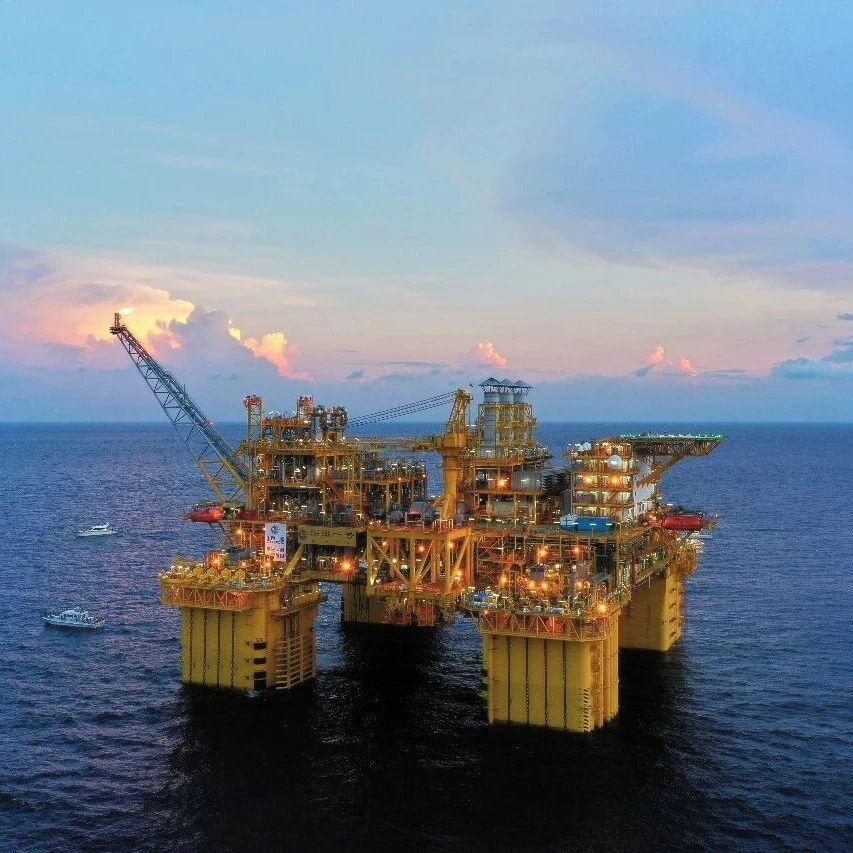
Core Viewpoint - The recent data from China's offshore oil and gas sector indicates significant potential in deep-sea oil and gas production, with projections for substantial increases in output by 2025 [2][3]. Group 1: Production Projections - By 2025, China's largest offshore gas field, "Deep Sea No. 1," is expected to exceed an oil equivalent production of 4.5 million tons, comparable to medium-sized onshore oil fields, with advanced production operation and maintenance technologies [2]. - The cumulative oil and gas production from the offshore gas fields around Hainan Island, including "Deep Sea No. 1," is projected to surpass 10 million tons of oil equivalent by 2025, doubling the production compared to the end of the 13th Five-Year Plan, with deep-sea fields contributing over 90% of the new production in the region [2]. - The Bohai Oilfield, China's largest offshore oil field, is anticipated to achieve a cumulative oil and gas production of over 40 million tons of oil equivalent by 2025, marking a historical high [2]. Group 2: Exploration and Development Efforts - According to the "China Marine Energy Development Report 2025," China's offshore oil production is expected to reach approximately 6.8 million tons, reflecting a year-on-year increase of about 250,000 tons, accounting for 80% of the national oil production increase [2]. - As of the end of Q3 2025, China has made five new discoveries in its maritime areas, successfully evaluated 22 oil and gas structures, and launched 11 new projects, indicating a robust exploration effort [2]. - Significant breakthroughs have been achieved in the Beibu Gulf Basin, including the discovery of China's first deep and ultra-deep clastic rock oil field with a billion-ton capacity, the Huizhou 19-6 oil field [2]. Group 3: Technological Advancements - "Deep Sea No. 1" is noted for being the most challenging offshore gas field developed by China, with a maximum operational water depth exceeding 1,500 meters and a geological temperature reaching 138 degrees Celsius, boasting proven geological reserves of over 150 billion cubic meters of natural gas [3]. - The field's core facilities, including the "Deep Sea No. 1" energy station and the "Four Stars in a Row" platform group, possess the capability for deep-sea oil and gas processing, enabling on-site separation and transportation of natural gas and crude oil [3]. - Daily production from "Deep Sea No. 1" includes 15 million cubic meters of natural gas and over 1,600 tons of condensate oil, with plans to achieve an annual natural gas production of 5 billion cubic meters by 2025, surpassing the designed capacity peak [3].
港股开盘丨恒指跌0.52% 理想汽车、宁德时代跌幅靠前


Sou Hu Cai Jing· 2026-03-13 02:39
Market Performance - The Hang Seng Index decreased by 0.52% [1] - The Hang Seng Tech Index fell by 0.42% [1] Company Movements - Li Auto, CATL, and Horizon Robotics experienced significant declines [1] - China Shenhua Energy rose by over 2% [1] - NetEase increased by nearly 2% [1] - CNOOC and PetroChina both saw gains of over 1% [1]

中国海洋石油(00883) - 董事会会议召开日期
2026-03-12 08:40
(根據公司條例在香港註冊成立的有限責任公司) 股票代號:00883(港幣櫃台)及 80883(人民幣櫃台) 中國海洋石油有限公司(「本公司」)董事會(「董事會」)宣佈將於二零二六年三月二十六日 (星期四)召開董事會會議,董事會將於會議上通過議案,其中包括批准本公司及其附屬公司截 至二零二五年十二月三十一日止年度的全年業績,以及考慮派發末期股息之建議。 承董事會命 中國海洋石油有限公司 徐玉高 聯席公司秘書 香港,二零二六年三月十二日 董事會會議召開日期 香港交易及結算所有限公司及香港聯合交易所有限公司對本公告的內容概不負責,對其準確性 或完整性亦不發表任何聲明,並明確表示,概不對因本公告全部或任何部分內容而產生或因依 賴該等內容而引致的任何損失承擔任何責任。 於本公告刊發日期, 董事會由以下成員組成: 非執行董事 張傳江 (董事長) 王德華 執行董事 閻洪濤 穆秀平 獨立非執行董事 邱致中 林伯強 李淑賢 ...
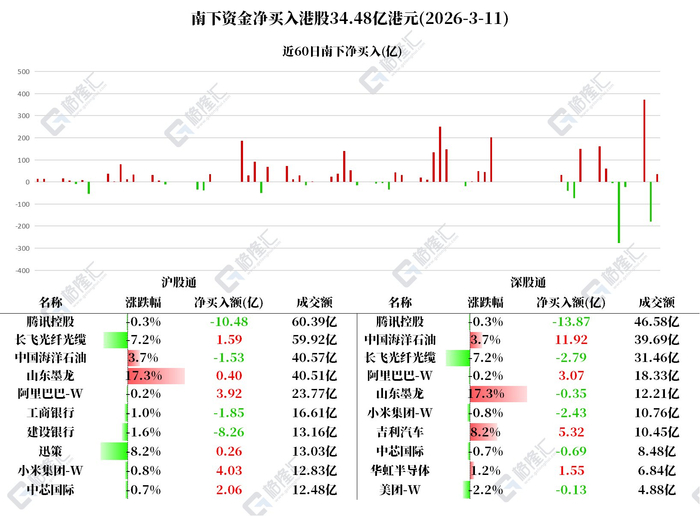
图解丨南下资金净买入中海油、阿里和吉利汽车,大肆抛腾讯



Ge Long Hui A P P· 2026-03-11 14:32
Group 1 - Southbound funds net purchased Hong Kong stocks amounting to 34.48 billion HKD on March 11 [1][3] - The top net purchases included China National Offshore Oil Corporation (10.39 billion HKD), Alibaba-W (6.98 billion HKD), Geely Automobile (5.31 billion HKD), Xiaomi Group-W (1.59 billion HKD), Hua Hong Semiconductor (1.55 billion HKD), and SMIC (1.37 billion HKD) [1] - Notable net sales were observed in Tencent Holdings (24.35 billion HKD), ending its previous eight-day net buying streak, as well as China Construction Bank (8.26 billion HKD), Industrial and Commercial Bank of China (1.85 billion HKD), and Yangtze Optical Fibre and Cable (1.2 billion HKD) [1][4] Group 2 - Southbound funds have net purchased Alibaba for three consecutive days, totaling 20.3096 billion HKD [1]