CCB(00939)

Search documents
【上新】运通白金汽车卡 一卡畅享车生活
中国建设银行· 2026-03-03 01:58
Core Viewpoint - The article introduces the China Construction Bank's Dragon Card Auto American Express Platinum Card, highlighting its benefits and promotional offers aimed at enhancing the travel and lifestyle experience for cardholders [6][26]. Group 1: Card Benefits - Cardholders can enjoy a 50% discount on charging fees when using the card for payments on Alipay, with a maximum discount of 10 RMB per transaction, limited to four times per month [8][9]. - The card offers three free chauffeur services for trips within 30 kilometers in the same city, valid until the end of 2026 [11]. - Cardholders can receive one free premium car wash at designated locations within half a year, also valid until the end of 2026 [13]. - A 1% cashback on overseas transactions is available, with a maximum of 300 RMB cashback per month, subject to a total cashback pool of 3.48 million RMB [16]. Group 2: Promotional Offers - New cardholders who spend a total of 666 RMB within 90 days of card activation can receive a customized travel suitcase, limited to the first 10,000 participants [18][19]. - Customers applying for car financing and simultaneously obtaining the card can earn 100,000 Dragon Points by making three transactions of at least 99 RMB each [21]. - Additional Dragon Points can be earned for customers meeting specific criteria, such as maintaining a financial asset balance above 200,000 RMB or having a salary deposited through the bank [24]. Group 3: Travel and Insurance Benefits - Cardholders are eligible for up to 5 million RMB in aviation accident insurance when purchasing tickets with the card [31]. - In case of card loss abroad, cardholders can receive compensation for unauthorized transactions within 48 hours of reporting the loss, with a maximum annual coverage of 20,000 RMB [33]. Group 4: Fees and Points Policy - The annual fee for the card is 580 RMB, charged upon activation, with no fee for unactivated cards [36]. - Dragon Points are earned at a rate of 1 point per 1 RMB spent, with a maximum validity of five years, and can be used to waive the annual fee [39].



支付赢好礼 抽至高1998元立减金
中国建设银行· 2026-03-03 01:58
Group 1 - The article outlines various promotional activities by a bank, including cash rewards and discounts for using specific payment methods during the promotional period from January 1, 2026, to March 31, 2026 [3][7][10]. - Customers can participate in a lottery by meeting certain spending thresholds with their bank cards on WeChat, with prizes including cash discounts and vouchers [4][6]. - The bank offers a special promotion for first-time card binders, providing up to 406 yuan in benefits, including discounts on WeChat and Alipay [12]. Group 2 - There are specific promotions for WeChat transfers, where users can receive rewards for transferring amounts over 3888 yuan during February 2026 [6]. - The bank is also promoting discounts on transportation vouchers through Alipay, allowing customers to purchase multiple tickets at a reduced price [7]. - A campaign called "Douyin Payment Rewards" is available, offering various cash rewards and vouchers for users who participate during the promotional period [9][10].

固收周报:避险情绪主导债市,美债收益率显著回落-20260302



工银国际· 2026-03-02 11:58
Report Summary 1. Investment Rating The provided content does not mention the investment rating of the industry. 2. Core View - The market sentiment is dominated by risk - aversion, leading to a significant decline in US Treasury yields. The 10 - year and 2 - year US Treasury yields decreased by 15 and 10 basis points respectively last week to 3.94% and 3.37%. Although recent data shows a rebound in US inflation pressure, risk - aversion sentiment has overshadowed this, causing the yields to drop [1][2][3]. - The geopolitical conflict between the US, Israel and Iran has escalated, with the US and Israel launching military actions against Iran and Iran counter - attacking and blocking the Strait of Hormuz. This has led to a sharp rise in crude oil prices, which may affect inflation. The military action may last for four weeks, and in the short term, US Treasuries may remain volatile under the resonance of risk - aversion and rising inflation expectations. Higher - than - expected inflation data and the rise in energy prices triggered by geopolitical conflicts have further reduced the possibility of the Fed cutting interest rates in March [1][3]. - Driven by the significant decline in US Treasury yields, Chinese dollar - denominated bonds performed well last week, with the Bloomberg Barclays Chinese dollar - denominated bond total return index rising 0.4% for the week. Among them, the high - rating index rose 0.5% and the high - yield index rose 0.2% [1][3]. - In the on - shore market, after the Spring Festival, the central bank net - withdrew short - term liquidity of 611.4 billion RMB through reverse repurchase operations and net - injected long - term funds of 300 billion RMB through MLF over - renewal. Bank - to - bank funding rates have rebounded significantly compared to before the Spring Festival. The 3 - year and 10 - year Treasury yields were flat and up 2 basis points respectively compared to before the Spring Festival, reaching 1.38% and 1.82%. The domestic interest - rate bond market was also boosted by risk - aversion sentiment on Monday, with yields on Treasury bonds of various maturities generally declining. The Two Sessions will be held this week, and the 2026 economic targets, fiscal support, and possible release of more monetary policy signals will be priced in the bond market [1][4]. 3. Summary by Category Off - shore Market - The issuance of Chinese dollar - denominated bonds remained light, with only one new issuance of over $100 million for the whole week. In contrast, the issuance of off - shore RMB bonds was quite active, with a total issuance of 65.5 billion RMB for the whole week, mainly driven by the issuance of 50 billion RMB central bank bills by the People's Bank of China [2]. - The significant decline in US Treasury yields was due to the market being dominated by risk - aversion sentiment. Although recent inflation data in the US has rebounded, the geopolitical risk has significantly escalated, and the US Treasury market has priced in the war risk in advance [2][3]. On - shore Market - After the Spring Festival, funds flowed back to the banking system. The central bank adjusted the liquidity through reverse repurchase operations and MLF. Bank - to - bank funding rates increased, and the yields of 3 - year and 10 - year Treasury bonds changed compared to before the Spring Festival. The domestic interest - rate bond market was affected by risk - aversion sentiment, and the yields of Treasury bonds of various maturities declined. The upcoming Two Sessions may bring new economic and policy signals to the bond market [1][4]. List of Chinese Dollar - denominated Bonds The documents provide a detailed list of Chinese dollar - denominated bonds, including information such as issuers, guarantors, coupon rates, issuance amounts, maturities, and ratings [7][17][23].
建设银行(00939) - 截至2026年2月28日止股份发行人的证券变动月报表
2026-03-02 10:21
FF301 股份發行人及根據《上市規則》第十九B章上市的香港預託證券發行人的證券變動月報表 截至月份: 2026年2月28日 狀態: 新提交 致:香港交易及結算所有限公司 公司名稱: 中國建設銀行股份有限公司 呈交日期: 2026年3月2日 I. 法定/註冊股本變動 | 1. 股份分類 | 普通股 | 股份類別 | H | | 於香港聯交所上市 (註1) | | 是 | | | --- | --- | --- | --- | --- | --- | --- | --- | --- | | 證券代號 (如上市) | 00939 | 說明 | | | | | | | | | | 法定/註冊股份數目 | | | 面值 | | 法定/註冊股本 | | | 上月底結存 | | | 240,417,319,880 | RMB | | 1 RMB | | 240,417,319,880 | | 增加 / 減少 (-) | | | 0 | | | RMB | | 0 | | 本月底結存 | | | 240,417,319,880 | RMB | | 1 RMB | | 240,417,319,880 | | 2. 股份分類 ...
汇率政策组合拳如何影响流动性?
GF SECURITIES· 2026-03-02 03:26
Investment Rating - The industry investment rating is "Buy" [2] Core Insights - The central theme of the report discusses the impact of recent currency policies on liquidity, specifically focusing on the People's Bank of China's (PBOC) measures to adjust the foreign exchange risk reserve ratio and its implications for cross-border liquidity [13][22] - The report highlights that the PBOC's recent policies aim to stabilize the RMB's exchange rate and enhance the liquidity of the offshore RMB market, which is expected to support the internationalization of the RMB [16][22] Summary by Sections 1. Current Observations: How Currency Policies Affect Liquidity - The PBOC introduced two key policies: a notification regarding RMB cross-border interbank financing and a reduction of the foreign exchange risk reserve ratio for forward foreign exchange transactions from 20% to 0% [13][18] - RMB cross-border interbank financing is crucial for providing RMB liquidity to offshore markets, with the potential net outflow limit estimated at approximately 1.79 trillion CNY, significantly higher than the current balance of about 1,942 billion CNY [16][17] 2. Forward Foreign Exchange Business - The adjustment of the foreign exchange risk reserve ratio is designed to lower the costs associated with forward foreign exchange transactions, thereby increasing demand in the forward market and countering expectations of RMB appreciation [18][19] 3. Outlook on Cross-Border Liquidity - The report anticipates that while speculative inflows may slow down, the demand for foreign investment in RMB-denominated assets will remain robust, driven by fundamentals, returns, and safety differentials [22][23] - It is expected that the increase in interbank lending will tighten liquidity in the banking sector, prompting the PBOC to potentially implement additional liquidity measures through government bond transactions and open market operations [23]


银行资负跟踪20260302:月末票据利率反弹,大行净买入同比增量回落
GF SECURITIES· 2026-03-02 03:06
Investment Rating - The industry investment rating is "Buy" [2] Core Views - The report highlights a rebound in month-end bill rates, with a significant decrease in net purchases by major banks year-on-year [1][14] - The central bank's operations included a total of CNY 16,410 billion in 7-day reverse repos at a rate of 1.40%, with a net withdrawal of CNY 4,614 billion [14] - The report anticipates continued flexibility in central bank operations to stabilize liquidity fluctuations, especially with important meetings approaching [14][21] Summary by Sections Section 1: Month-End Bill Rate Rebound - The overall liquidity in the market is balanced due to post-holiday fund recovery and tax payments [14] - Major banks' net purchases of bills have significantly decreased, with only an increase of approximately CNY 320 billion year-on-year as of February 27 [17] Section 2: Central Bank Dynamics and Market Rates - The central bank's MLF (Medium-term Lending Facility) increased by CNY 6,000 billion, continuing to inject long-term liquidity into the market [14] - The end-of-period rates for DR001 and DR007 were 1.32% and 1.50%, reflecting increases of 0.68bp and 18.23bp respectively [15] Section 3: Bank Financing Tracking - The total outstanding amount of interbank certificates of deposit (NCD) reached CNY 18.77 trillion, with a weighted average issuance rate of 1.59% [19] - The issuance of interbank certificates of deposit for the period was CNY 4,545 billion, with a completion rate of 93.3% [19]
流动性观察第 122 期:当同业存款定价再自律
EBSCN· 2026-03-01 10:58
Investment Rating - The report maintains a "Buy" rating for the banking industry, indicating an expected investment return exceeding the market benchmark index by over 15% in the next 6-12 months [1]. Core Insights - The report discusses the implementation of a self-regulatory mechanism for interbank deposit pricing, which aims to manage liquidity and stabilize the banking sector's cost of liabilities. The focus has shifted from merely controlling the scale of interbank liabilities to regulating pricing behavior [4][5][6]. - The introduction of self-regulation for non-bank interbank demand deposit rates is expected to enhance the efficiency of monetary policy transmission and alleviate pressure on bank interest margins [6][9]. - The report highlights the historical evolution of interbank liability management, emphasizing the transition from risk prevention to cost control, and outlines the regulatory framework established over the past decade [4][5][6]. Summary by Sections Regulatory History Review - The regulatory framework for interbank liabilities has evolved through three main phases: establishing a risk prevention framework, deepening regulation to reduce leverage and prevent fund turnover, and focusing on cost control through pricing management [4][5][6]. Cost Management of Interbank Liabilities - The report notes that the cost of interbank liabilities remains relatively high, with significant room for further reduction. The average cost of interbank liabilities for state-owned banks was reported at 2.01%, compared to 1.52% for deposits, indicating a 48 basis point spread [13][20]. - The report emphasizes the need for enhanced management of interbank deposit pricing, particularly for time deposits, which currently do not fall under self-regulatory constraints [20][21]. Future Pathways for Self-Regulation - The report suggests that future regulatory measures may include setting upper limits on the scale of interbank demand deposits priced above self-regulatory levels and implementing self-regulation for time deposit rates [22][25]. - Preliminary estimates indicate that the self-regulation of interbank time deposits could lead to a reduction in interest expenses for banks, improving net interest margins by approximately 2 basis points [25][29]. Impact on Wealth Management Products - The report assesses the impact of interbank deposit self-regulation on wealth management products, indicating that the influence on net asset values is relatively limited due to the diverse nature of interbank deposit configurations [34][37]. - It highlights that wealth management products will continue to maintain a strong allocation to deposit-like assets, with expected fluctuations in allocation ratios [34][37].


金融行业周报(2026、03、01):外资机构座谈会召开,坚定金融市场改革决心-20260301
Western Securities· 2026-03-01 09:06
Investment Rating - The report does not explicitly state an investment rating for the non-bank financial sector, but it provides insights into various segments such as insurance, brokerage, and banking, indicating potential investment opportunities and strategies [1][2][3]. Core Insights - The non-bank financial index decreased by 1.18% this week, underperforming the CSI 300 index by 2.26 percentage points. The insurance sector saw a decline of 3.74%, while the brokerage sector fell by 0.39%. In contrast, the diversified financial index increased by 3.90% [1][10]. - The insurance sector is experiencing a short-term adjustment due to profit-taking, a shift of funds towards growth sectors, and a lack of policy and earnings reports. However, the medium-term outlook remains positive as insurance companies are expected to increase equity allocations in 2026, supported by economic recovery and low valuations [2][14]. - The brokerage sector is expected to benefit from the recent capital market planning discussions, which emphasize market openness and reform. The report suggests that leading brokerages with strong cross-border capabilities will likely gain from these developments [2][16]. - The banking sector is viewed as a potential investment opportunity, particularly as macroeconomic conditions improve. The report recommends focusing on banks with high earnings elasticity, high dividend yields, and those expected to benefit from convertible bond catalysts [3][19]. Summary by Sections Insurance Sector - The insurance sector's index fell by 3.74%, underperforming the CSI 300 index by 4.82 percentage points. The decline is attributed to profit-taking and a shift in market sentiment towards growth sectors [2][13]. - Despite the short-term pullback, the long-term outlook for the insurance sector is optimistic, with expectations of increased equity allocations and a favorable economic environment supporting valuation recovery [14][15]. - Recommended stocks include New China Life Insurance, China Pacific Insurance, China Ping An, and China Life Insurance [15]. Brokerage Sector - The brokerage sector index decreased by 0.39%, underperforming the CSI 300 index by 1.47 percentage points. The sector's price-to-book (PB) ratio is currently at 1.33x, indicating a mismatch between earnings and valuations [2][16][17]. - The report highlights the importance of selecting brokerages based on their strengths and potential for mergers and acquisitions, recommending firms like Guotai Junan and Huatai Securities [17][18]. - The recent discussions by the China Securities Regulatory Commission signal a commitment to market reform and openness, which could benefit leading brokerages [16]. Banking Sector - The banking sector index fell by 0.92%, underperforming the CSI 300 index by 2.00 percentage points. The sector's PB ratio is at 0.50x, suggesting potential undervaluation [3][18]. - The report emphasizes the banking sector's resilience and potential for recovery as macroeconomic conditions improve, recommending banks with strong earnings potential and high dividend yields [19]. - Suggested banks for investment include Hangzhou Bank, Ningbo Bank, and China Merchants Bank, among others [19].




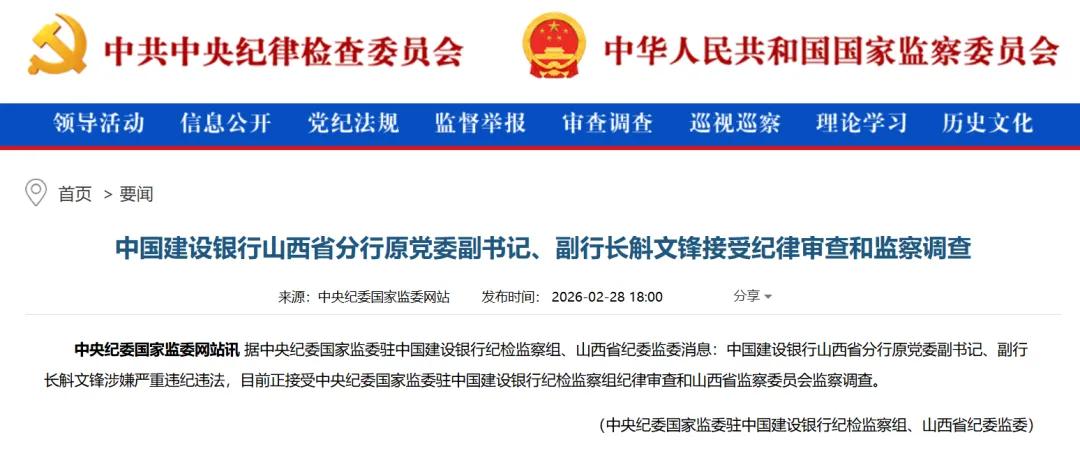
中国建设银行山西省分行原党委副书记、副行长斛文锋被查
Xin Lang Cai Jing· 2026-03-01 01:27
Group 1 - The former Deputy Party Secretary and Vice President of China Construction Bank's Shanxi Province branch, Hu Wenfeng, is under investigation for serious violations of discipline and law [1] - The investigation is being conducted by the Central Commission for Discipline Inspection and the National Supervisory Commission, along with the Shanxi Provincial Supervisory Commission [1]
建设银行山西分行原党委副书记、副行长斛文锋接受纪律审查和监察调查
Xin Lang Cai Jing· 2026-02-28 15:04
Group 1 - The Central Commission for Discipline Inspection and the National Supervisory Commission announced that Hu Wenfeng, the former Deputy Secretary of the Party Committee and Vice President of China Construction Bank's Shanxi Branch, is under investigation for serious violations of discipline and law [1] - Hu Wenfeng has held various positions within China Construction Bank, including President of the Luliang Central Sub-branch and Vice President of the Shanxi Branch [2][3]