
CHINA MOBILE(00941)

Search documents
中国移动与中国石油集团交叉持股 深化AI与能源数字化战略协同
Zhong Guo Zheng Quan Bao· 2025-11-03 22:14
Core Viewpoint - The strategic share transfer between China Mobile and China National Petroleum Corporation (CNPC) aims to deepen cooperation and enhance collaboration in technology and energy sectors, with both companies emphasizing the potential for mutual benefits and development opportunities [2][4]. Group 1: Share Transfer Details - China Mobile announced the transfer of 41.9813 million A-shares to CNPC, which represents 0.19% of its total shares. Following the transfer, China Mobile Group's ownership will decrease from 69.05% to 68.85% [3]. - CNPC will hold 0.19% of China Mobile's total shares after the transfer, which is subject to approval from the State-owned Assets Supervision and Administration Commission [3]. Group 2: Strategic Cooperation - The share transfer is intended to strengthen strategic collaboration between China Mobile and CNPC, particularly in areas such as information technology and smart energy, aiming to unlock new potential in digital integration [4]. - In September, CNPC announced a similar transfer of 541 million A-shares to China Mobile, representing 0.30% of its total shares, with the goal of enhancing strategic cooperation and optimizing the shareholding structure [4]. Group 3: AI and Digital Transformation Initiatives - In May, China Mobile and CNPC, along with Huawei and iFlytek, signed an agreement to promote the development and application of large AI models in the energy and chemical industries [5]. - A strategic cooperation agreement was signed in January 2024, focusing on integrating new information technologies with the energy sector, covering areas such as digital transformation, 5G applications, and financial services [5]. - China Mobile views AI as a key growth driver, with plans to increase investment in AI initiatives, expecting a rise in direct revenue from AI solutions, including those tailored for CNPC [5][6]. Group 4: Market Implications and Benefits - The share transfer is expected to yield dual benefits of strategic synergy and market value management, enhancing the financial stability and market vitality of both companies [6]. - The cross-holding model is seen as a stabilizing factor, reducing the likelihood of share sell-offs and improving the companies' financing capabilities [6].



中国移动与中国石油集团交叉持股
Zhong Guo Zheng Quan Bao· 2025-11-03 20:11
Core Viewpoint - China Mobile and China National Petroleum Corporation (CNPC) are engaging in a mutual share transfer to deepen their strategic cooperation, particularly in information technology and smart energy sectors, with the aim of enhancing collaboration and unlocking new potential in digital integration [1][2]. Group 1: Share Transfer Details - China Mobile announced the transfer of 41.9813 million A-shares to CNPC, which represents 0.19% of its total shares. Post-transfer, China Mobile Group's shareholding will decrease from 69.05% to 68.85%, while CNPC will hold 0.19% of China Mobile's shares [1]. - In a prior announcement, CNPC stated its intention to transfer 541 million A-shares to China Mobile Group, accounting for 0.30% of its total shares, aimed at optimizing the shareholding structure and achieving mutual benefits [2]. Group 2: Strategic Cooperation Initiatives - The share transfers are part of a broader strategy to enhance collaboration between China Mobile and CNPC, focusing on areas such as AI development and digital transformation in the energy sector [2]. - In May, both companies, along with Huawei and iFlytek, signed an agreement to jointly develop Kunlun large models for application in the energy and chemical industries, emphasizing the need for AI integration in these sectors [2]. Group 3: AI as a Growth Engine - China Mobile views AI as a key driver for revenue growth, with plans to increase investment in AI significantly by 2025. The company is embedding AI into its products and services, including tailored solutions for CNPC [3]. - Despite rapid growth in AI-related revenues, the overall scale remains small, indicating a need for further development in revenue generation capabilities [3]. - The mutual shareholding arrangement is expected to enhance both companies' asset stability and market vitality, creating a solid foundation for substantial cooperation [3].
中国移动有限公司关于国有股份划转的提示性公告
Shang Hai Zheng Quan Bao· 2025-11-03 19:40
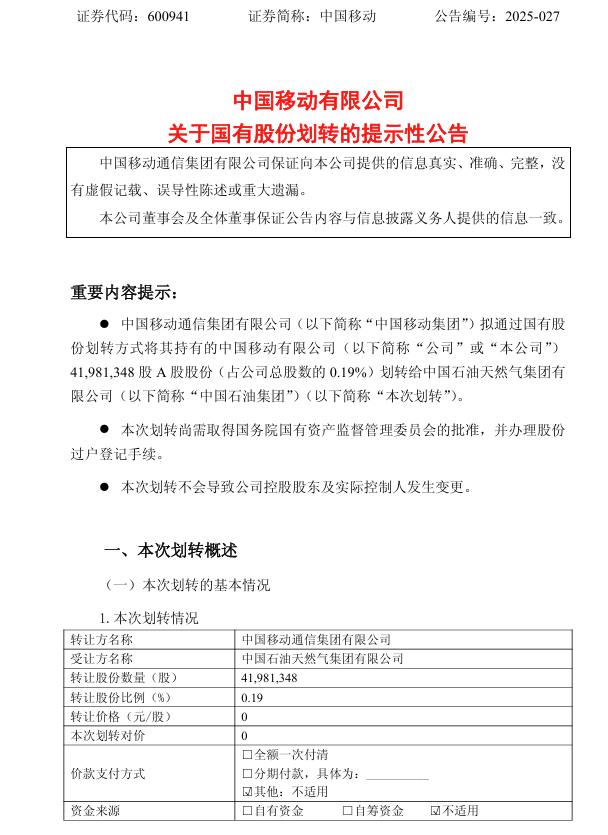
Core Points - China Mobile Group plans to transfer 41,981,348 A-shares (0.19% of total shares) to China National Petroleum Corporation through state-owned share transfer [2][5] - The transfer requires approval from the State-owned Assets Supervision and Administration Commission of the State Council and the completion of share transfer registration [2][7] - The transfer will not change the controlling shareholder or actual controller of China Mobile [3][4] Summary of the Transfer - **Transfer Overview**: China Mobile Group will transfer 41,981,348 A-shares to China National Petroleum Corporation, which will hold 0.19% of the total shares post-transfer [2][5] - **Shareholding Before and After**: Before the transfer, China Mobile Group held 14,932,483,842 shares (69.05% of total shares). After the transfer, it will hold 14,890,502,494 shares (68.85%), while China National Petroleum will hold 41,981,348 shares [4] Background and Purpose - The transfer aims to enhance strategic collaboration between China Mobile Group and China National Petroleum Corporation, particularly in information technology and smart energy sectors [5] Approval and Procedures - The share transfer agreement was signed on October 31, 2025, and is contingent upon obtaining necessary approvals and completing registration [7] Impact on Operations - The transfer is not expected to significantly impact the normal operations of China Mobile and will not involve employee restructuring [4][6]
警钟敲响,央企纷纷退出美股,美国将让出首位?
Sou Hu Cai Jing· 2025-11-03 19:12
Core Viewpoint - The potential delisting of Chinese companies from U.S. stock markets has significant implications for both the U.S. and global capital markets, driven by regulatory changes, geopolitical tensions, and strategic adjustments by companies [1][4][12]. Group 1: Reasons for Delisting - Regulatory changes, particularly the 2020 Foreign Companies Accountability Act, have created a dilemma for Chinese companies, forcing them to choose between compliance with U.S. regulations and adherence to Chinese laws [4]. - Geopolitical factors have intensified scrutiny on Chinese enterprises, especially state-owned enterprises (SOEs), with increasing calls from U.S. lawmakers for their delisting [4]. - Companies are reassessing the costs and benefits of being listed in the U.S. due to rising compliance costs and lower market valuations, leading to a trend of returning to domestic markets [5]. Group 2: Market Impact - The delisting of SOEs could reduce liquidity and diversity in the U.S. capital markets, as Chinese companies have become a significant part of exchanges like NASDAQ and NYSE [5]. - In 2024, 61 Chinese companies raised $3.02 billion in the U.S., a substantial increase from $931 million in 2023, indicating the importance of this financing channel [5]. - The global market landscape is shifting, with the total market capitalization of Chinese markets (including mainland and Hong Kong) exceeding $17.6 trillion, reflecting a growing share of the global market [5][9]. Group 3: Investor Reactions - The potential delisting of major companies like Alibaba could lead to a 7% loss in market value that cannot be recovered through the Hong Kong market, affecting international investors [6]. - In extreme scenarios, U.S. investors might be forced to sell up to $800 billion in Chinese assets, while Chinese investors could withdraw up to $1.7 trillion from U.S. financial assets [8]. - The shift in capital flows may create both challenges and opportunities for the Chinese capital market, with a potential influx of high-quality companies returning to domestic exchanges [8][9]. Group 4: Long-term Outlook - While the U.S. capital market remains dominant, its relative share may decline over time as emerging markets like China and India grow [12]. - The current situation reflects a broader trend towards a more multipolar global financial system, necessitating adaptability from both investors and companies [10][12].



中国移动超4000万股划转给中国石油集团
Zheng Quan Shi Bao· 2025-11-03 17:42
Core Points - China Mobile announced the transfer of 41.9813 million A-shares (0.19% of total shares) to China National Petroleum Corporation (CNPC) to enhance strategic collaboration in information technology and smart energy sectors [1] - Prior to the transfer, China Mobile Group held 14.932 billion shares, representing 69.05% of total issued shares, and after the transfer, its stake will decrease to 68.85% [1] - CNPC did not hold any shares in China Mobile before this transfer, which marks the beginning of their strategic partnership [1] Summary by Sections China Mobile's Share Transfer - China Mobile Group plans to transfer 41.9813 million A-shares to CNPC, which will result in CNPC holding approximately 0.19% of China Mobile's shares [1] - The transfer is aimed at strengthening strategic cooperation between the two companies and exploring new potential in digital and energy integration [1] CNPC's Share Transfer - Previously, CNPC announced the transfer of 54.1 million A-shares (0.30% of total shares) to China Mobile Group to deepen their strategic cooperation and optimize shareholding structure [2] - This move is intended to achieve mutual benefits and promote joint development between the two corporations [2]

央企巨头公告:4198万股,0元划转
Zhong Guo Zheng Quan Bao - Zhong Zheng Wang· 2025-11-03 15:19
Core Viewpoint - China Mobile Group plans to transfer 41,981,348 A-shares (0.19% of total shares) to China National Petroleum Corporation at a price of 0 yuan, which will reduce its stake in China Mobile from 69.05% to 68.85% [1][3][4] Group 1: Share Transfer Details - The share transfer involves China Mobile Group transferring 41,981,348 shares to China National Petroleum Corporation, which will now hold 0.19% of China Mobile's total issued shares [3] - The transfer price is set at 0 yuan, and the payment method is not applicable [3] - After the transfer, China Mobile Group's ownership percentage will decrease from 69.05% to 68.85% [3][4] Group 2: Strategic Collaboration - The share transfer aims to enhance strategic collaboration between China Mobile Group and China National Petroleum Corporation, focusing on areas such as information technology and smart energy [5] - In September, China National Petroleum Corporation announced a similar transfer of 541 million A-shares to China Mobile Group, which increased China Mobile Group's stake in China National Petroleum Corporation from 0.10% to 0.39% [5] - The cross-shareholding between these state-owned enterprises reflects a strategic and business-level "cross-industry collaboration" [5] Group 3: Future Cooperation - Both companies signed a strategic cooperation agreement in January 2024 to promote deep integration of new-generation information technology and the energy industry [5] - They plan to collaborate in various areas, including basic communication services, enterprise digital transformation, 5G innovation applications, international business, marketing, and financial capital [5] - In May 2025, China Mobile will assist China National Petroleum Corporation in launching a large model project, indicating a deepening of their strategic partnership [6]
国内14+液冷数据中心项目盘点
DT新材料· 2025-11-03 14:17
Core Insights - The article emphasizes the growing importance of liquid cooling technology in data centers due to the increasing demands for computing power and energy efficiency in the digital economy [3][4][5]. Background - Traditional air cooling methods face limitations such as inefficiency, high energy consumption, and large space requirements, leading to a shift towards liquid cooling solutions [3]. - Liquid cooling technology is becoming a key driver for the green upgrade and efficient iteration of global digital infrastructure [3]. Domestic Liquid Cooling Projects - **China Mobile Intelligent Computing Center (Qingdao)**: Launched on March 29, 2024, with a total investment of 3.14 billion yuan, deploying 16,000 cabinets with a power density of 25 kW and achieving a PUE of 1.23 [3]. - **Gansu Qingyang "East Data West Calculation" Big Data Park**: Total investment of approximately 5.5 billion yuan, covering 110 acres, with a total power of 60,000 kW [4]. - **Guangxi Laibin New Energy Data Center**: Started construction on March 29, 2024, with a total investment of 1.45 billion yuan, deploying 500 intelligent computing cabinets [5]. - **China Telecom Lingang Intelligent Computing Center (Shanghai)**: Features a new generation of intelligent liquid cooling technology, achieving a unit computing energy consumption of below 1.5 kW/P and a PUE below 1.15 [6]. - **Hong Kong University of Science and Technology (Guangzhou)**: Officially opened on April 18, 2024, utilizing a 40 kW spray liquid cooling system, achieving a PUE as low as 1.08 [7]. - **China Telecom Guangdong-Hong Kong-Macao Greater Bay Area Integrated Data Center**: Launched on May 22, 2024, with a total computing power of 15,000 P and a PUE controlled below 1.25 [8]. - **Lubei Big Data Center**: Scheduled for a lighting ceremony on December 27, 2024, with an average PUE below 1.1 [9]. - **Alashan Green Low-Carbon Intelligent Computing Center (Xinjiang)**: Total investment of 2.5 billion yuan, aiming for a PUE below 1.2 [9]. - **China Mobile Yangtze River Delta (Wuhu) Data Center Project**: Total investment of approximately 6 billion yuan, with a planned building area of 91,470 square meters [10]. - **Alibaba Zhejiang Cloud Computing Data Center**: Planned to support an annual capacity of 100,000 servers [11]. - **China Unicom Guangdong-Hong Kong-Macao Greater Bay Area Hub (Shaoguan) Data Center**: Total investment of 4.8 billion yuan, with a PUE target of less than 1.25 [12]. - **Sinopec Artificial Intelligence Infrastructure Project**: Expected to complete by May 2025, utilizing advanced cooling technology to achieve a PUE of 1.15 [13]. - **China Mobile (Xining) Green Energy Intelligent Computing Integration Demonstration Base**: Total investment exceeding 700 million yuan, aiming for a PUE below 1.2 [14]. - **Guangzhou Next-Generation Liquid Cooling High-Performance R&D Computing Center**: First phase supports 256 units with approximately 4,000 P computing power [15]. Events and Conferences - The 6th Thermal Management Industry Conference and Exposition is set to take place, focusing on innovations in thermal management and liquid cooling technologies [16].


离谱!多地办电话卡要工作证明、无犯罪证明、银行流水
Xin Lang Cai Jing· 2025-11-03 14:12
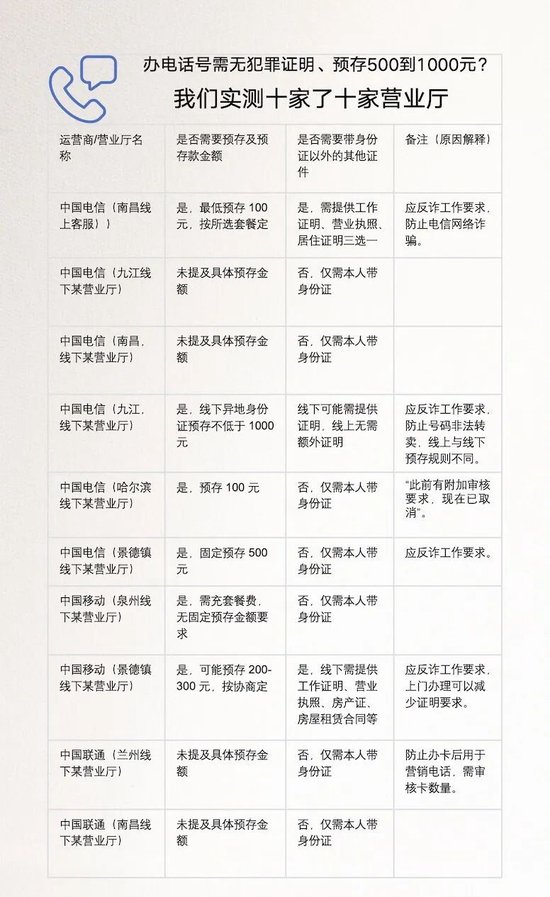
Core Viewpoint - The article discusses the discrepancies in requirements for obtaining a phone card across different regions in China, particularly focusing on the additional documentation and prepayment requirements imposed by telecom operators in Jiangxi province, which are not uniformly mandated by national regulations [1][6][9]. Group 1: Requirements for Obtaining Phone Cards - Telecom operators in Jiangxi have implemented stricter requirements for obtaining phone cards, including the need for documents such as a "no criminal record" certificate, work proof, or property documents, along with a prepayment of 500 to 1000 yuan [1][4][6]. - In contrast, regions like Fujian, Gansu, and Heilongjiang have more lenient requirements, often only requiring an ID and no additional documentation or prepayment [5][6][9]. - The inconsistency in requirements has led to confusion among consumers, with some operators providing conflicting information regarding what is necessary to obtain a phone card [6][8]. Group 2: Justification and Legality of Requirements - Operators justify the additional requirements as measures to combat telecom fraud, but the specific regulations backing these requirements are unclear and not uniformly enforced [1][6][9]. - Experts have pointed out that there is currently no national regulation that explicitly authorizes telecom operators to impose such additional conditions for obtaining phone cards, raising questions about the legality of these practices [1][7][9]. - The lack of a unified standard for phone card applications across different regions has been criticized, with suggestions for regulatory bodies to establish basic standards to streamline the process and reduce unnecessary burdens on consumers [9].

中国移动0元划转4198万股,中石油成为股东
Xin Lang Cai Jing· 2025-11-03 12:41
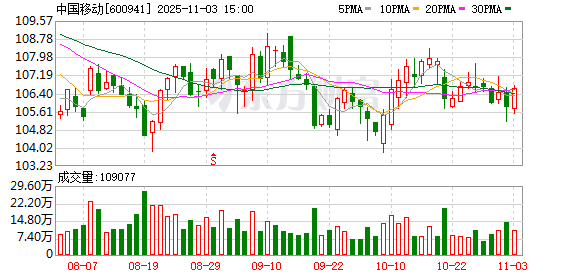
Core Viewpoint - China Mobile Group plans to transfer 41,981,348 A-shares (0.19% of total shares) to China National Petroleum Corporation (CNPC) through state-owned share transfer, aiming to enhance strategic collaboration in information technology and smart energy sectors [1][2][4] Group 1: Share Transfer Details - The share transfer will reduce China Mobile Group's ownership from 69.05% to 68.85%, while CNPC will hold 0.19% of China Mobile's shares post-transfer [1] - The transfer is subject to approval from the State-owned Assets Supervision and Administration Commission and requires share transfer registration [2] Group 2: Strategic Cooperation - The share transfer is intended to deepen the strategic partnership between China Mobile and CNPC, expanding cooperation areas and optimizing equity structure for mutual benefits [4] - Both companies signed a strategic cooperation agreement in January 2024 to promote the integration of new information technology and the energy industry, focusing on various sectors including basic communication services and 5G applications [4] Group 3: Financial Performance - For the first three quarters, China Mobile reported revenue of 794.67 billion yuan, a year-on-year increase of 0.41%, and a net profit of 115.35 billion yuan, up 4.03% [4] - In contrast, CNPC's revenue for the same period was 2.17 trillion yuan, a decrease of 3.9%, with a net profit of 126.29 billion yuan, down 4.9% [4] Group 4: Market Performance - As of November 3, China Mobile's stock price increased by 0.78% to 106.62 yuan per share, with a market capitalization of 2.31 trillion yuan [6] - CNPC's stock price rose by 4.48% to 9.56 yuan per share, with a market capitalization of 1.75 trillion yuan [6]
中国移动(00941):中国移动集团拟将公司0.19%股权划转给中国石油集团
智通财经网· 2025-11-03 10:49
Core Viewpoint - China Mobile Group plans to transfer 41,981,348 A-shares (0.19% of total shares) to China National Petroleum Corporation to enhance strategic collaboration in information technology and smart energy sectors, aiming to unlock new potential in digital and physical integration [1] Group 1 - The share transfer will result in China Mobile Group holding a total of 14,890,502,494 shares, approximately 68.85% of the company's total issued shares [1] - After the transfer, China National Petroleum Corporation will directly hold 41,981,348 A-shares, representing 0.19% of the total issued shares [1] - China Mobile Group's direct holdings include 385,652 A-shares, while it indirectly holds 14,890,116,842 shares of Hong Kong ordinary shares through China Mobile Hong Kong (BVI) Limited [1]