AIA(01299)

Search documents
Asia Markets Diverge: Hong Kong Tech Slumps on AI Fears While Mainland Rallies for Year of the Horse
Stock Market News· 2026-02-24 03:08
Group 1: Hong Kong Market Overview - Hong Kong stocks faced downward pressure, with the Hang Seng Index falling 0.6% to 26,913.68 due to concerns over AI's impact on employment [11] - The Hang Seng Tech Index declined by 1%, driven by losses in major internet and semiconductor firms, including Semiconductor Manufacturing International Corporation (down 1.7% to HK$69.90), Baidu (down 1.6%), and Alibaba Group Holding (down 1.5%) [3][11] - Despite the tech sector slump, some blue-chip stocks like AIA Group and Techtronic Industries rose by 1.5%, indicating a rotation into traditional industrial and financial sectors [4] Group 2: Mainland China Market Performance - Mainland Chinese markets opened the Year of the Horse with gains, as the CSI 300 Index rose 1.4% and the Shanghai Composite Index increased by 1.2%, driven by domestic optimism and holiday consumption data [5][11] - Energy and mining stocks performed well, with PetroChina gaining 1.5% and Zijin Mining advancing 0.8%, reflecting a decoupling from global tech anxieties [6] Group 3: Geopolitical Tensions - South Korea lodged a formal protest with US Forces Korea following a military standoff involving US F-16 fighters and Chinese jets over the Yellow Sea, highlighting regional geopolitical tensions [7][11] - The incident raised concerns about the strategic flexibility of US military assets in the region and Seoul's balancing act between its alliance with the US and economic ties with China [8][9]


智通港股沽空统计|2月24日
智通财经网· 2026-02-24 00:22
Core Insights - The article highlights the top short-selling stocks in the market, indicating significant investor sentiment and potential market movements [1][2]. Short Selling Ratios - The highest short-selling ratio is observed in China Resources Beer (80291) at 100.00%, followed by JD Group (89618) at 92.61% and AIA Group (81299) at 82.83% [1][2]. - Other notable companies with high short-selling ratios include New World Development (80016) at 69.99% and Xiaomi Group (81810) at 69.65% [2]. Short Selling Amounts - The top three companies by short-selling amount are Meituan (03690) with 1.899 billion, Xiaomi Group (01810) with 1.248 billion, and Tencent Holdings (00700) with 1.223 billion [1][2]. - Alibaba (09988) follows with a short-selling amount of 1.107 billion, indicating substantial investor activity in these stocks [2]. Deviation Values - The highest deviation values, which reflect the difference between current short-selling ratios and the average over the past 30 days, are led by Yuan Da Pharmaceutical (00512) at 42.04%, Yuexiu Property (00123) at 40.19%, and COFCO Joycome (01610) at 39.65% [1][2]. - Other companies with significant deviation values include Sunac Services (01516) at 39.64% and China Ship Leasing (03877) at 39.39% [2].





2025年险资规模双位数增长,权益配置同比大幅提升
GF SECURITIES· 2026-02-23 13:32
Investment Rating - The industry investment rating is "Buy" [2] Core Insights - The insurance sector is expected to see a double-digit growth in asset scale by 2025, with a significant increase in equity allocation compared to the previous year [7] - The investment assets of insurance companies reached 38.5 trillion CNY by the end of Q4 2025, marking a 15.7% increase from the beginning of the year, with life insurance and property insurance companies holding 34.7 trillion CNY and 2.4 trillion CNY respectively [7] - The proportion of equity assets in insurance funds has notably increased, with stocks and funds accounting for 23% of total investments by Q4 2025, indicating room for further enhancement in equity allocation [7] Summary by Sections Investment Scale and Allocation - By the end of Q4 2025, the investment balance of insurance companies reached 38.5 trillion CNY, a 15.7% increase year-on-year, with life insurance companies accounting for 90.1% of the total [7] - The bond allocation remained stable, while the proportion of stocks and funds increased significantly, with life and property insurance companies showing respective stock and fund allocations of 15.3% and 17.1% by Q4 2025 [7] Market Performance and Trends - The insurance sector's investment assets have shown continuous double-digit growth, driven by strong demand on the liability side and an upward trend in the equity market [7] - The overall solvency ratio of the insurance industry was 181% by Q4 2025, indicating a healthy capital position and potential for increased equity investments [7] Investment Recommendations - The report suggests focusing on the insurance sector, particularly on stocks such as China Ping An, China Life, China Taiping, and AIA Insurance, which are expected to benefit from improved equity elasticity and favorable market conditions [7]




非银金融行业投资策略周报:开年政策及资金延续向好,看好板块补涨机遇-20260223
GF SECURITIES· 2026-02-23 07:54
Core Viewpoints - The report highlights a positive outlook for the non-bank financial sector, driven by favorable policies and continued capital inflow, suggesting potential for sector rebound [1][6]. - The report maintains a "Buy" rating for the sector, indicating expected strong performance relative to the market [2]. Market Performance - As of February 14, 2026, the Shanghai Composite Index rose by 0.41%, while the Shenzhen Component Index increased by 1.39%. The CSI 300 Index saw a modest gain of 0.36% [12]. - The average daily trading volume in the Shanghai and Shenzhen markets was 2.11 trillion yuan, reflecting a 12.3% decrease week-on-week [6]. Industry Dynamics and Weekly Commentary Insurance Sector - The report indicates that listed insurance companies are expected to maintain high growth, with a marginal improvement in long-term interest margins. The insurance fund utilization scale reached 38.5 trillion yuan in Q4 2025, up 15.7% year-on-year [18]. - The report suggests that the upcoming spring market rally may drive better-than-expected performance for insurance companies in Q1 2026, supported by a stable long-term interest rate and an upward trend in the equity market [18]. Securities Sector - The report discusses the recent optimization measures for refinancing announced by the three major exchanges, which aim to enhance financing efficiency and support high-quality enterprises [19]. - The new refinancing rules are expected to create structural opportunities for securities firms, shifting the focus from compliance to the ability to identify and serve quality clients [20]. - The report emphasizes that the optimization of refinancing will lead to a more differentiated regulatory system, benefiting quality companies while tightening controls on weaker entities [22]. Key Company Valuations and Financial Analysis - The report provides detailed valuations for several key companies in the sector, including: - China Ping An (601318.SH) with a target price of 85.17 yuan and a "Buy" rating [7]. - New China Life (601336.SH) with a target price of 94.21 yuan and a "Buy" rating [7]. - China Life (601628.SH) with a target price of 55.47 yuan and a "Buy" rating [7]. - The report also highlights the expected earnings per share (EPS) growth for these companies, indicating a positive outlook for their financial performance in 2025 and 2026 [7].

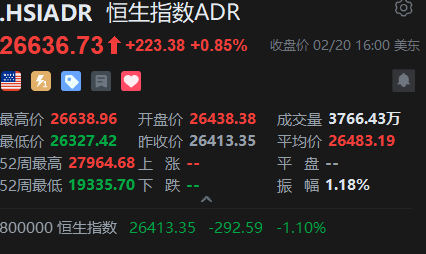
智通ADR统计 | 2月21日
智通财经网· 2026-02-20 23:59
Group 1 - Major blue-chip stocks mostly rose, with HSBC Holdings closing at HKD 137.775, up 2.59% from the previous close in Hong Kong [2] - Tencent Holdings closed at HKD 531.758, an increase of 1.87% from the previous close in Hong Kong [2] Group 2 - Tencent Holdings reported a latest price of HKD 522.000, down HKD 11.000 or 2.06%, with an ADR price of HKD 531.758, showing an increase of HKD 9.758 compared to the Hong Kong stock price [3] - Alibaba Group (W) had a latest price of HKD 147.100, down HKD 7.600 or 4.91%, with an ADR price of HKD 150.874, reflecting an increase of HKD 3.774 compared to the Hong Kong stock price [3] - HSBC Holdings had a latest price of HKD 134.300, up HKD 0.100 or 0.07%, with an ADR price of HKD 137.775, indicating an increase of HKD 3.475 compared to the Hong Kong stock price [3]


智通ADR统计 | 2月20日
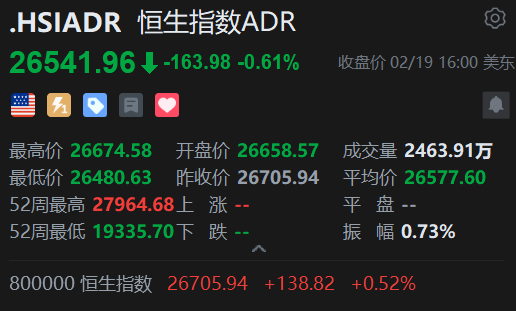
智通财经网· 2026-02-19 23:23
Market Overview - The Hang Seng Index (HSI) closed at 26,541.96, down by 163.98 points or 0.61% on February 19 [1] - The index opened at 26,658.57, reached a high of 26,674.58, and a low of 26,480.63, with a trading volume of 24.6391 million [1] Major Blue-Chip Stocks Performance - HSBC Holdings closed at HKD 135.722, up by 1.13% compared to the previous close [2] - Tencent Holdings closed at HKD 532.399, down by 0.11% compared to the previous close [2] Stock Price Movements - Tencent Holdings (00700) latest price is HKD 533.000, with a slight increase of 1.000 or 0.19% [3] - Alibaba Group (09988) latest price is HKD 154.700, down by 0.700 or 0.45% [3] - HSBC Holdings (00005) latest price is HKD 134.200, down by 1.500 or 1.11% [3] - AIA Group (01299) latest price is HKD 82.350, up by 2.050 or 2.55% [3] - Meituan (03690) latest price is HKD 82.050, down by 0.100 or 0.12% [3] - JD.com (09618) latest price is HKD 105.900, down by 0.500 or 0.47% [3]
Is AIA (AAGIY) Stock Outpacing Its Finance Peers This Year?
ZACKS· 2026-02-19 15:41
Core Viewpoint - AIA (AAGIY) is currently outperforming its peers in the Finance sector, with a year-to-date performance of 2.8% compared to the sector average of 1.1% [4]. Company Performance - AIA has a Zacks Rank of 2 (Buy), indicating a positive outlook based on earnings estimates and revisions [3]. - Over the past 90 days, the Zacks Consensus Estimate for AIA's full-year earnings has increased by 1%, reflecting improved analyst sentiment [3]. - The stock's year-to-date gain of 2.8% positions it favorably against the average Finance sector gain of 1.1% [4]. Industry Context - AIA is part of the Insurance - Life Insurance industry, which consists of 16 individual stocks and currently ranks 62 in the Zacks Industry Rank [5]. - The average performance of the Insurance - Life Insurance industry has been 1.1% year-to-date, indicating that AIA is performing better than its industry peers [5]. - In comparison, Bank of Montreal (BMO), another Finance stock, has shown a year-to-date increase of 9.8% and has a Zacks Rank of 2 (Buy) [4][5].


高盛:保诚(02378)与友邦保险(01299)估值吸引 股价回调提供买入机会
智通财经网· 2026-02-16 08:40
Core Viewpoint - Goldman Sachs has reiterated a "Buy" rating for AIA Group (01299) and Prudential (02378), citing attractive risk-reward at current valuations, with target prices set at HKD 96 for AIA and HKD 150 for Prudential [1] Group 1: Stock Performance - Prudential and AIA's stock prices fell by 8% and 4% respectively on Friday, February 13, due to various factors including weak sales reported by Manulife Financial (00945) for Q4 2025 and concerns over potential disruption from artificial intelligence [1] Group 2: Sales Performance Analysis - The weak sales performance of Manulife is attributed to a high base effect and regulatory changes that disrupted the brokerage channel, which has limited direct implications for AIA and Prudential [1] - AIA and Prudential have a significantly lower contribution from annualized new premiums through the brokerage channel compared to Manulife, making them less susceptible to negative impacts from this channel [1] Group 3: Artificial Intelligence Concerns - While acknowledging the potential for disruption from artificial intelligence, Goldman Sachs emphasizes that products sold through agents are often complex, with long premium payment periods and/or high premium amounts, making them less vulnerable to AI disruption [1] - The firm believes that customer preference for personal interaction in these complex products will mitigate the impact of AI [1] - The narrative of sustained growth remains intact, with most pandemic-related disruptions now considered a thing of the past [1]
2025年四季度保险公司资金运用点评:债券仍是压舱石,权益配置显著提升
GUOTAI HAITONG SECURITIES· 2026-02-14 06:44
Investment Rating - The report maintains an "Overweight" rating for the insurance industry, driven by the growth in premium income and stable asset management [5][3]. Core Insights - The growth in premium income is expected to lead to a steady increase in the balance of insurance funds, with a projected year-end balance of CNY 38.5 trillion for 2025, reflecting a 15.7% increase from the beginning of the year [5][3]. - The report highlights a significant increase in equity allocation, with total equity and fund assets reaching CNY 5.70 trillion, up CNY 1.60 trillion from the start of the year, accounting for 15.4% of total assets [5][3]. - The bond allocation remains robust, constituting 50.4% of the total assets, indicating that bonds continue to serve as a stabilizing force for insurance companies [5][3]. Summary by Sections Premium Growth and Fund Allocation - The insurance industry is projected to see a premium growth of 7.1% year-on-year in 2025, with life insurance premiums increasing by 8.3% and property insurance premiums by 3.9% [5][3]. - By the end of Q4 2025, the allocation of stocks reached CNY 3.73 trillion, an increase of CNY 1.31 trillion from the beginning of the year, while fund assets totaled CNY 1.97 trillion, reflecting a slight decrease in the last quarter [5][3]. Asset Management Strategy - The report anticipates that the stable long-term interest rates, which are expected to range between 1.79% and 1.90%, along with a mild recovery in the equity market, will positively impact the profitability of insurance companies [5][3]. - The report recommends specific stocks, including China Ping An, China Pacific Insurance, New China Life, and China Life, as favorable investment opportunities within the sector [5][3].

恒生指数下跌1.72% 恒生科技指数下跌0.90%
Xin Hua Cai Jing· 2026-02-14 05:50
Market Overview - The Hong Kong stock market experienced a decline, with the Hang Seng Index falling by 1.72% to 26,567.12 points, the Hang Seng Tech Index down by 0.90% to 5,360.42 points, and the National Enterprises Index decreasing by 1.55% to 9,032.71 points [1] - The Hang Seng Index opened lower at 26,640.16 points, dropped by 392.38 points, and ultimately closed down by 465.42 points, with a total trading volume exceeding 257.5 billion HKD [1] - The southbound trading (Hong Kong Stock Connect) saw a net inflow of over 20.2 billion HKD [1] Sector Performance - Overall, sectors such as chips and department stores saw gains, while new consumption, new energy vehicles, and telecommunications had mixed results. Conversely, sectors like gold, non-ferrous metals, biomedicine, port transportation, technology, oil and gas, brokerage, and banking mostly experienced declines [1] Individual Stock Movements - Notable stock movements included Xiaomi Group increasing by 0.88%, AIA Group decreasing by 4.18%, Zijin Mining falling by 7.64%, Hong Kong Exchanges and Clearing down by 2.13%, and Semiconductor Manufacturing International Corporation rising by 0.79% [1] - Ctrip Group-S dropped by 2.10%, Pop Mart fell by 1.90%, while Tian Shu Zhi Xin surged by 14.59% and Zhi Pu increased by 20.65% [1] - China Construction Bank decreased by 1.49%, China Resources Land fell by 2.52%, and Lao Pu Gold dropped by 3.97%, while Guotai Junan International rose by 4.61% and China Petroleum & Chemical Corporation fell by 4.33% [1] Top Traded Stocks - The top three traded stocks included Tencent Holdings, which fell by 0.65% with a trading volume exceeding 14.2 billion HKD; Alibaba, down by 2.02% with over 10.8 billion HKD in transactions; and Meituan, which decreased by 3.18% with a trading volume of over 8.1 billion HKD [2]