
AIA(01299)

Search documents
中信里昂:提升港股权重至超配20% 首选万洲国际(00288)等
智通财经网· 2026-02-12 06:03
Core Viewpoint - Citic Lyon has upgraded the weighting of the Hong Kong market to overweight by 20%, citing reduced correlation with the Chinese market and allowing for differentiated allocation [1] Group 1: Market Performance - The Hong Kong IPO market is expected to surpass its performance in 2025, with total IPO and placement fundraising amounting to $82.3 billion last year [1] - The Hong Kong property market has recorded its first annual increase since 2021, which is anticipated to boost the stock market [1] Group 2: Earnings and Valuation - Earnings forecasts for Hong Kong companies are projected to turn positive starting July 2025, ranking second in the Asia-Pacific region after Japan, South Korea, and Taiwan [1] - The valuation of the Hong Kong stock market is attractive relative to regional peers, with a price-to-earnings ratio of 16.7 times, slightly below the 35-year average of 17.2 times [1] - The Hong Kong market is the furthest from its historical highs, indicating potential for catch-up [1] Group 3: Stock Recommendations - Preferred stocks include WH Group (00288), AIA (01299), Hong Kong Exchanges and Clearing (00388), Sun Hung Kai Properties (00016), CK Hutchison Holdings (00001), Techtronic Industries (00669), and Galaxy Entertainment Group (00027), all rated as "outperform" [1] - WH Group is highlighted as a stock with "high confidence" by the firm [1]




智通ADR统计 | 2月12日
智通财经网· 2026-02-11 22:31
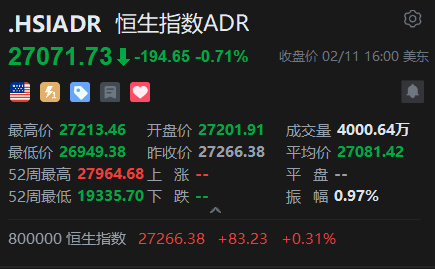
Core Viewpoint - The Hang Seng Index (HSI) closed at 27,071.73, down 194.65 points or 0.71% from the previous close, indicating a decline in market performance [1]. Group 1: Market Performance - The HSI reached a high of 27,213.46 and a low of 26,949.38 during the trading session, with a trading volume of 40 million shares [1]. - The average price for the HSI was 27,081.42, while the 52-week high and low were 27,964.68 and 19,335.70, respectively [1]. Group 2: Major Blue-Chip Stocks - HSBC Holdings closed at HKD 139.794, unchanged from the Hong Kong close, while Tencent Holdings closed at HKD 543.262, down 0.86% [2]. - Among the major stocks, Alibaba (HKD 160.100, down 0.25%), and Xiaomi (HKD 37.100, up 4.27%) showed varied performance [3]. - Notable gainers included BYD Company, which rose by 3.50% to HKD 99.150, while Pop Mart International fell by 5.49% to HKD 255.000 [3].





小摩:友邦保险(01299)及保诚(02378)自由现金流改善前景强劲 重申“增持”评级
智通财经网· 2026-02-11 06:59
Group 1 - The core viewpoint of the reports is that strong improvements in free surplus and free cash flow generation are expected to rebuild market confidence in the intrinsic value of AIA Group (01299) and Prudential (02378) [1] - Morgan Stanley maintains an "overweight" rating on both AIA and Prudential, citing attractive capital returns and free cash flow yield as potential drivers for stock price revaluation against intrinsic value multiples [1] - The stock prices of Prudential and AIA surged approximately 70% to 80% last year, attributed to the recovery of Asian stock markets and improved cash generation capabilities [1] Group 2 - Morgan Stanley forecasts significant growth in new business sales for Hong Kong life insurance in 2025, but expects normalization this year based on benchmark predictions for AIA and Prudential [2] - The firm believes there is upside risk to its assumptions, as the sales and product environment remains attractive, particularly for mainland visitors to Hong Kong [2] - Scenario analysis indicates that if Hong Kong sales maintain strong momentum (doubling the firm's benchmark growth rate), AIA and Prudential could see net earnings yield potential of 2.5% to 3.5% by 2028, along with an IFRS operating profit upside potential of 2.5% to 3% [2]
小摩:友邦保险及保诚自由现金流改善前景强劲 重申“增持”评级
Zhi Tong Cai Jing· 2026-02-11 06:53
Group 1 - The core viewpoint of the reports is that strong improvements in free surplus and free cash flow generation are expected to rebuild market confidence in the intrinsic value of AIA Group (01299) and Prudential (02378) [1] - Morgan Stanley maintains an "overweight" rating on both AIA and Prudential, citing attractive capital returns and free cash flow yield as potential drivers for stock price revaluation against intrinsic value multiples [1] - The stock prices of Prudential and AIA surged approximately 70% to 80% last year, attributed to the recovery of Asian stock markets and improved cash generation capabilities [1] Group 2 - Morgan Stanley forecasts significant growth in new business sales for Hong Kong life insurance in 2025, but expects normalization this year based on baseline predictions for AIA and Prudential [2] - The firm believes there is upside risk to its assumptions, as the sales and product environment remains attractive, particularly for mainland visitors to Hong Kong [2] - Scenario analysis indicates that if Hong Kong sales maintain strong momentum (doubling the baseline growth rate), AIA and Prudential could see net earnings yield potential of 2.5% to 3.5% by 2028, along with an IFRS operating profit upside of 2.5% to 3% [2]
大行评级丨小摩:重申友邦和保诚“增持”评级,自由现金流强劲改善
Ge Long Hui· 2026-02-11 05:31
Core Viewpoint - Morgan Stanley's report indicates that the strong improvement in free surplus and free cash flow generation is expected to rebuild market confidence in the embedded value of AIA and Prudential [1] Group 1: Financial Performance - The report highlights that the free cash flow yield and attractive capital returns may drive a revaluation of the stock prices against embedded value multiples, with strong growth momentum in Hong Kong presenting upside risks [1] - Prudential and AIA's stock prices surged approximately 70% to 80% last year, attributed to the recovery of Asian stock markets and improved cash generation capabilities [1] Group 2: Business Strategy - Both companies are focusing on optimizing their product portfolios to shorten the payback period for new business, such as increasing the proportion of health and protection products [1] - The P/EV multiples have rebounded from previous lows, with AIA at approximately 1.3 times the forecasted embedded value for 2026 and Prudential at about 0.9 times [1] Group 3: Future Outlook - New business profits drive free cash flow, which is utilized for capital returns and further growth, suggesting potential for P/EV revaluation for both stocks [1]
10日港股向上 恒指科指双双收涨
Xin Hua Cai Jing· 2026-02-10 12:08
Market Overview - The Hang Seng Index rose by 0.58% to close at 27,183.15 points, while the Hang Seng Tech Index increased by 0.62% to 5,451.03 points, and the National Enterprises Index climbed by 0.81% to 9,242.75 points [1] - The index opened at 27,202.96 points, initially rising before retreating, and ultimately gained 155.99 points with a total turnover exceeding 234 billion HKD [1] - There were 1,344 advancing stocks, 923 declining stocks, and 896 stocks closing flat by midday [1] - The net inflow for the southbound trading (Hong Kong Stock Connect) was 84.7 million HKD [1] Sector Performance - Most sectors experienced gains, including chips, optical communications, biomedicine, new energy vehicles, oil and gas, banking, aviation, and port transportation [1] - Mixed performance was noted in new consumption, non-ferrous metals, and brokerage sectors, while gold, technology, real estate, and electricity sectors mostly declined [1] Individual Stock Movements - Notable stock movements included Pop Mart rising by 4.90%, Longi Green Energy increasing by 8.88%, Xiaomi Group up by 1.08%, and SMIC gaining 1.71% [1] - China Ping An rose by 0.62%, AIA fell by 0.52%, Zijin Mining increased by 2.52%, and Tianzuo Zhixin surged by 12.40% [1] - COSCO Shipping Energy rose by 5.49%, Zhihui gained 14.81%, and Rongchang Biotech increased by 3.64% [1] - HSBC Holdings rose by 0.72%, Industrial and Commercial Bank of China increased by 0.77%, and China Petroleum gained 1.64% [1] Top Traded Stocks - Tencent Holdings saw a decline of 1.61% with a turnover exceeding 16.1 billion HKD; Alibaba rose by 1.65% with a turnover over 9.3 billion HKD; Meituan fell by 2.47% with a turnover of 6.6 billion HKD [2]


AIA research reveals ingrained health stereotypes are holding back wellbeing in Asia
BusinessLine· 2026-02-10 10:00
Core Insights - AIA Group Limited's research highlights that entrenched stereotypes regarding physical, mental, and financial health significantly influence wellbeing attitudes and behaviors across Asia [1][3] Group 1: Research Findings - The study analyzed over 100 million social media posts and surveyed 2,100 respondents across Mainland China, Hong Kong SAR, Singapore, Thailand, and Malaysia [1][3] - Key findings indicate that 69% of respondents believe fitness requires discipline without compromise, while 59% think improving health necessitates a complete transformation [5] - Additionally, 57% feel that emotional control and avoiding vulnerability are essential for respect, and 63% have negative feelings about financial health stereotypes [5] - 41% associate personal worth with financial success, particularly among men, while those with poorer wellbeing perceive these stereotypes as pressure that reinforces self-doubt [5][6] Group 2: AIA's Initiatives - AIA has launched the next phase of its "Rethink Healthy" campaign, which includes three new films aimed at addressing hidden pressures related to health stereotypes [7][8] - The company organized a summit with creators and brand ambassadors to promote responsible health storytelling and encourage inclusive wellbeing conversations [8] - AIA's long-term goal is to inspire and engage one billion people to live healthier lives by 2030, reinforcing its commitment to improving overall health and wellbeing across Asia [8][13] Group 3: Company Overview - AIA Group Limited is the largest independent publicly listed pan-Asian life insurance group, with a presence in 18 markets and total assets of US$328 billion as of June 30, 2025 [9][10] - The company offers a range of products including life insurance, health insurance, and savings plans, serving over 43 million individual policyholders and 16 million group insurance members [11] - AIA's "One Billion" initiative aims to engage communities in improving physical, mental, and environmental wellness while promoting financial inclusion [13][14]

瑞银:料友邦保险上周股价下滑因获利回吐所致 仍属内地存款迁移受益者
Zhi Tong Cai Jing· 2026-02-10 08:39
Core Viewpoint - UBS reported that AIA Group (01299) shares fell by 8% over two trading days (February 5 and 6), likely due to profit-taking after outperforming the Hang Seng Index by 13 percentage points in the past two months, with some investors viewing the dip as a buying opportunity due to stable performance last year and optimistic long-term outlook, setting a target price of HKD 106 and a "Buy" rating [1] Group 1 - UBS noted that concerns regarding new business value growth pressure stem from temporary factors, such as regulatory changes in Thailand and Hong Kong last year, which created a high base [1] - Despite these concerns, UBS emphasized growth opportunities from the migration of deposits from mainland China, suggesting that while bancassurance is not AIA's focus, it can leverage its elite agency team targeting middle-class and affluent clients [1] - AIA is expected to benefit significantly from providing a wider range of investment options and higher expected returns through Hong Kong insurance products for mainland tourists [1] Group 2 - The company's strong distribution capabilities and focus on protection-oriented products position it well to capitalize on emerging opportunities in the market [1]
瑞银:料友邦保险(01299)上周股价下滑因获利回吐所致 仍属内地存款迁移受益者
智通财经网· 2026-02-10 08:39
Core Viewpoint - UBS reported that AIA Group (01299) experienced an 8% decline in stock price over two trading days (February 5 and 6), attributed to profit-taking after outperforming the Hang Seng Index by 13 percentage points in the past two months, despite no specific news regarding the company [1] Group 1 - Some investors view the dip as a buying opportunity, citing AIA's stable performance last year and optimistic long-term outlook, with a target price set at HKD 106 and a "Buy" rating [1] - UBS noted concerns among investors regarding growth pressure on new business value due to high base effects from temporary factors like regulatory changes in Thailand and Hong Kong last year [1] Group 2 - UBS emphasized growth opportunities from the migration of deposits in mainland China, suggesting that while bancassurance is not AIA's primary focus, it can leverage its elite agency team targeting middle and affluent clients [1] - AIA is expected to benefit significantly from providing a wider range of investment options and higher expected returns through Hong Kong insurance products for mainland tourists, given its strong distribution capabilities and focus on protection-oriented products [1]
大行评级丨瑞银:友邦保险上周股价调整是投资人获利回吐所致,评级“买入”
Ge Long Hui· 2026-02-10 03:47
Core Viewpoint - UBS reported that AIA Group's stock price fell by 8% over two trading days (February 5 and 6), with no specific news related to the company, suggesting profit-taking after outperforming the Hang Seng Index by 13 percentage points in the past two months [1] Group 1 - UBS highlighted concerns among some investors regarding the pressure on new business value growth due to a high base caused by temporary factors [1] - Despite the concerns, UBS emphasized growth opportunities from the migration of deposits from mainland China, indicating that while bancassurance is not AIA's primary focus, it can leverage its elite agency team targeting middle-class and affluent clients [1] - AIA is expected to benefit significantly from its focus on protection products and strong distribution capabilities, positioning it well to capitalize on the demand for Hong Kong insurance products that offer broader investment options and higher expected returns for mainland tourists [1] Group 2 - UBS set a target price of HKD 106 for AIA and maintained a "Buy" rating [1]