
ICBC(01398)

Search documents
工、农、中、建、交、邮储,六大行集体公告
Sou Hu Cai Jing· 2026-01-23 01:31
Group 1 - The core viewpoint of the news is that major Chinese banks have announced the implementation of optimized personal consumption loan subsidy policies, which will automatically apply to loans signed before January 1, 2026, without the need for re-signing agreements [1][3] Group 2 - The implementation period for the personal consumption loan subsidy policy has been extended to December 31, 2026 [3] - The support scope has been expanded to include credit card bill installment services [3] - Restrictions on single transactions of 50,000 yuan and above have been removed, broadening the subsidy areas [3] - The subsidy standards have been improved by removing the cap of 500 yuan on single transaction subsidies and the cumulative limit of 1,000 yuan for each borrower at a single institution for transactions below 50,000 yuan [3]





工商银行取得清算业务处理专利
Sou Hu Cai Jing· 2026-01-23 00:53
声明:市场有风险,投资需谨慎。本文为AI基于第三方数据生成,仅供参考,不构成个人投资建议。 来源:市场资讯 国家知识产权局信息显示,中国工商银行股份有限公司取得一项名为"清算业务处理方法、装置、设 备、介质和程序产品"的专利,授权公告号CN120070026B,申请日期为2025年2月。 天眼查资料显示,中国工商银行股份有限公司,成立于1985年,位于北京市,是一家以从事货币金融服 务为主的企业。企业注册资本35640625.7089万人民币。通过天眼查大数据分析,中国工商银行股份有 限公司共对外投资了28家企业,参与招投标项目5000次,财产线索方面有商标信息969条,专利信息 5000条,此外企业还拥有行政许可79个。 ...
工商银行取得自动化测试方法专利提升金融科技测试效率
Sou Hu Cai Jing· 2026-01-23 00:35
国家知识产权局信息显示,中国工商银行股份有限公司取得一项名为"自动化测试方法、装置、计算机 设备和存储介质"的专利,授权公告号CN116225956B,申请日期为2023年3月。 天眼查资料显示,中国工商银行股份有限公司,成立于1985年,位于北京市,是一家以从事货币金融服 务为主的企业。企业注册资本35640625.7089万人民币。通过天眼查大数据分析,中国工商银行股份有 限公司共对外投资了28家企业,参与招投标项目5000次,财产线索方面有商标信息969条,专利信息 5000条,此外企业还拥有行政许可79个。 声明:市场有风险,投资需谨慎。本文为AI基于第三方数据生成,仅供参考,不构成个人投资建议。 来源:市场资讯 ...
智通ADR统计 | 1月23日
智通财经网· 2026-01-22 22:19
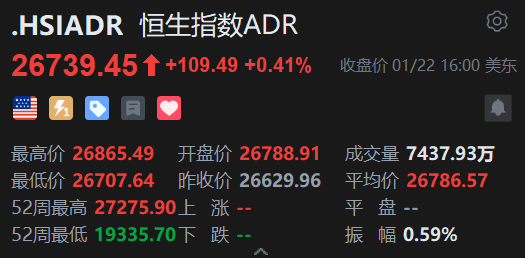
Market Overview - The Hang Seng Index (HSI) closed at 26,739.45, up by 109.49 points or 0.41% as of January 22, 16:00 Eastern Time [1] - The index reached a high of 26,865.49 and a low of 26,707.64 during the trading session, with a trading volume of 74.379 million shares [1] Stock Performance - HSBC Holdings closed at HKD 130.600, an increase of 0.69% compared to the previous close [2] - Tencent Holdings closed at HKD 594.990, a decrease of 0.42% compared to the previous close [2] - Alibaba Group (ADR) saw a price increase of 4.78%, closing at HKD 164.800, while its ADR price was USD 172.684 [3] - Other notable stock movements include: - China Ping An: down 2.34% to HKD 66.900 [3] - Baidu Group: up 4.10% to HKD 160.000 [3] - BYD Company: up 0.71% to HKD 99.750 [3] - New World Development: up 3.63% to HKD 114.200 [3]





信用卡账单分期业务纳入贴息支持范围 年贴息比例为一个百分点
Ren Min Ri Bao· 2026-01-22 22:01
Group 1 - The core viewpoint of the news is the comprehensive upgrade of the consumer loan "national subsidy" policy, which includes extending the policy deadline to the end of this year and incorporating credit card bill installment services into the support scope [1] - The annual subsidy rate for credit card bill installments is set at 1%, which is a significant highlight of the policy upgrade that consumers are concerned about [1] - Financial institutions such as China Construction Bank and Agricultural Bank of China have clarified the application process for credit card bill installment subsidies, emphasizing that the process remains generally the same but requires signing specific agreements [1] Group 2 - Credit card holders can enjoy consumer credit support through bill installments without needing to apply for personal consumer loans, making it more convenient and often at lower rates than credit card overdrafts, which can effectively enhance consumer willingness and capacity [2] - Major banks like Industrial and Commercial Bank of China and Bank of China have stated that loans with completed subsidy applications do not need to re-sign subsidy agreements, and transactions from January 1, 2026, will automatically apply the latest subsidy policy [2] - The policy has expanded the range of institutions eligible for subsidies, including city commercial banks, rural cooperative financial institutions, foreign banks, consumer finance companies, and auto finance companies, which will help boost consumption in lower-tier cities and rural areas [2]

银价上涨带火银质品 银行多款产品脱销
Zheng Quan Ri Bao Zhi Sheng· 2026-01-22 16:37
Core Viewpoint - The silver market has shown remarkable performance since the beginning of the year, with a significant price increase that has outpaced gold, leading to heightened investor demand and temporary shortages in certain silver products [1][2]. Group 1: Market Performance - As of January 21, the London spot silver price reached a peak of $95.42 per ounce, with a year-to-date increase of nearly 32%, significantly exceeding the increase in gold prices during the same period [1]. - The rapid rise in silver prices has triggered a surge in investment and collection demand, resulting in temporary shortages of silver products at several banks, particularly in the zodiac-themed and low-premium investment categories [1][2]. Group 2: Supply and Demand Dynamics - Banks have reported that the recent increase in silver prices has led many investors to shift their focus from gold to silver, causing a mismatch between supply and the rapidly increasing demand [2]. - Factors contributing to the recent rise in silver prices include a supply-demand gap, increased safe-haven demand, and policy expectations, with declining silver production and limited recycling capabilities on the supply side, while industrial demand, particularly from the photovoltaic sector, continues to grow [2][3]. Group 3: Future Price Outlook - Analysts predict that silver prices will experience short-term volatility but may return to fundamental levels in the medium to long term, with potential for further increases, although caution is advised regarding short-term pullback risks [3]. - The current price levels have quickly reflected market expectations, and short-term fluctuations may persist due to regulatory measures and technological pressures, necessitating close attention to policy shifts and market sentiment [3].
工行、农行、中行、建行、交行、邮储,集体公告
Zhong Guo Xin Wen Wang· 2026-01-22 13:23
Core Viewpoint - Major Chinese banks have collectively announced the optimization of personal consumption loan fiscal subsidy policies, extending the implementation period and expanding the support scope for consumers [1][2]. Group 1: Policy Extensions - The implementation period for the personal consumption loan fiscal subsidy policy has been extended to December 31, 2026 [2]. - Loans signed under the previous fiscal subsidy service agreement will automatically apply the latest subsidy policy for consumption occurring after January 1, 2026, without the need for re-signing agreements [1]. Group 2: Expanded Support - The support scope has been expanded to include credit card bill installment services [2]. - Restrictions on single transactions of 50,000 yuan and above have been removed, allowing for broader access to subsidies [2]. Group 3: Enhanced Subsidy Standards - The subsidy standard has been improved by removing the cap of 500 yuan on single transaction subsidies [2]. - The previous limit of 1,000 yuan on cumulative subsidies for each borrower at a single institution for transactions below 50,000 yuan has also been eliminated [2].
工、农、中、建、交、邮储,集体公告!
中国基金报· 2026-01-22 12:31
Core Viewpoint - The article discusses the implementation of the latest fiscal interest subsidy policy for personal consumption loans by six major state-owned banks in China, following the announcement by the Ministry of Finance, the People's Bank of China, and the Financial Regulatory Bureau [2]. Group 1: Policy Optimization - The Industrial and Commercial Bank of China (ICBC) outlines four main areas of optimization for the subsidy policy: extending the policy period to the end of 2026, including credit card installment payments in the support scope, removing the restriction on consumption fields above 50,000 yuan, and raising the subsidy standards by eliminating the 500 yuan cap on single transaction subsidies and the 1,000 yuan cap for individual borrowers at the same financial institution [4]. Group 2: Implementation Details - China Construction Bank states that customers must sign a service agreement to enjoy the fiscal subsidy, allowing the bank to access transaction information to identify eligible consumption transactions. The subsidy amount will be automatically deducted from the interest due on the loan during repayment. If transactions are not automatically recognized, customers can submit receipts for manual verification [5]. - Bank of China mentions that loans already approved for subsidies will not require a new agreement, and transactions from January 1, 2026, will automatically apply the new subsidy policy [5]. - Agricultural Bank of China warns that fraudulent activities related to subsidy claims will not be subsidized, and any previously granted subsidies may be deducted or reclaimed [5]. - The Bank of Communications emphasizes adherence to market-oriented and legal principles for eligible loans and credit card installments, with violations affecting credit records and subject to legal consequences [6]. - Postal Savings Bank clarifies that no additional fees will be charged for personal consumption loans beyond the agreed interest, and any fees collected under false pretenses are considered fraud [6].
六大行集体公告
Sou Hu Cai Jing· 2026-01-22 11:25
Group 1 - The core viewpoint of the news is that major Chinese banks have announced the implementation of an optimized personal consumption loan subsidy policy, extending its benefits and expanding its scope [1][2][3] Group 2 - The implementation period for the personal consumption loan subsidy policy has been extended to December 31, 2026 [1] - The support scope has been expanded to include credit card bill installment services [1] - The subsidy field has been broadened by removing the restriction on single transactions of 50,000 yuan and above [2] - The subsidy standards have been improved by eliminating the 500 yuan cap on single transaction subsidies and the 1,000 yuan cumulative subsidy limit for borrowers at a single institution [2] - Existing loan agreements signed under the previous subsidy policy will automatically apply the new subsidy terms for transactions occurring after January 1, 2026, without the need for re-signing [2]
落实个人消费贷款最新财政贴息政策,六大行集体公告
Feng Huang Wang· 2026-01-22 11:01
Core Viewpoint - Major Chinese banks have announced the implementation of an optimized personal consumption loan subsidy policy, extending its duration and expanding its scope to support consumer spending [1] Group 1: Policy Implementation - The implementation period for the personal consumption loan subsidy policy has been extended to December 31, 2026 [1] - The scope of support has been expanded to include credit card installment payment services [1] Group 2: Subsidy Expansion - The subsidy field has been broadened by removing the restriction on single transactions of 50,000 yuan and above [1] - The subsidy standard has been improved by eliminating the cap of 500 yuan on single transaction subsidies and the previous limit of 1,000 yuan for cumulative subsidies under 50,000 yuan per borrower at a single institution [1] Group 3: Existing Agreements - For loans that have already signed the personal consumption loan subsidy service agreement, any consumption occurring after January 1, 2026, will automatically apply the latest subsidy policy without the need to re-sign the agreement [1]