PSBC(01658)

Search documents
农行涨幅领跑 6家上市银行2025年A股股价涨超20%
Zheng Quan Shi Bao Wang· 2026-01-02 06:10
Core Viewpoint - In 2025, the A-share banking sector index increased by 12%, with significant fluctuations throughout the year, including a strong performance in the first half, a pullback in the third quarter, and a recovery in the fourth quarter [1] Group 1: Overall Market Performance - The A-share banking sector index saw a cumulative increase of 12% in 2025 [1] - Agricultural Bank of China (ABC) stood out with a stock price increase of over 52.66%, making it the highest-performing bank in terms of stock price growth [1] - By the end of 2025, six banks had stock price increases exceeding 20%, including ABC, Xiamen Bank, Shanghai Pudong Development Bank, Chongqing Bank, Industrial and Commercial Bank of China (ICBC), and Ningbo Bank [1] Group 2: Market Capitalization - By the end of 2025, ABC's A-share market capitalization surpassed that of ICBC, making it the highest market capitalization bank in A-shares, although ICBC still held a higher total market capitalization when including H-shares [1] - The total market capitalization rankings of the six major state-owned banks were led by ICBC (2.63 trillion yuan), followed closely by ABC (2.61 trillion yuan) [3] Group 3: Valuation Metrics - ABC's price-to-book (PB) ratio exceeded 1 for the first time, breaking the long-standing trend of state-owned banks trading below book value, which contributed to the overall valuation recovery of A-share listed banks [3] - The PB ratio for ABC was reported at 1.00, indicating a significant improvement in its market valuation [2] Group 4: Growth Drivers - The recovery of ABC's PB ratio is attributed to the potential release of county-level business opportunities amid urban-rural integration, which is expected to drive credit growth more significantly than its peers [4] - The bank benefits from lower liability costs and superior asset quality in the county financial sector, supporting steady growth in asset scale and profitability [4]





六大行明年起为数字人民币钱包余额计息,利率0.05%
Sou Hu Cai Jing· 2026-01-01 09:10
Group 1 - The six major state-owned banks in China announced that starting from January 1, 2026, they will pay interest on the balances of real-name digital RMB wallets at the same rate as current deposit rates, which is currently set at 0.05% [1] - This move makes China the first economy to offer interest on central bank digital currency [1]


财经观察|今日起,数字人民币开始计息!对你我生活有何影响?
Sou Hu Cai Jing· 2026-01-01 08:59
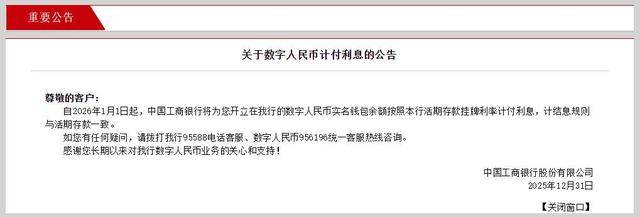
今天,数字人民币正式迈入"计息"时代,用户实名钱包里的余额能"钱生钱"了。 图片截取自工商银行官方网站 六大行集体官宣 图片截取自农业银行官方网站 2025年12月31日,工商银行、农业银行、中国银行、建设银行、交通银行、邮储银行集体发布关于数字 人民币重磅公告。公告称,自2026年1月1日(含)起,将为客户开立在该行的数字人民币实名钱包余 额,按照活期存款挂牌利率计付利息,计结息规则与活期存款一致。 这意味着,存放在这些钱包里的数字人民币,将和传统银行活期存款一样,开始产生收益。目前,几家 大行官网显示的活期存款挂牌利率为0.05%。 图片截取自工商银行官方网站 值得注意的是,并非所有数字人民币钱包都能享受计息。 数字人民币现金型1.0版迈入存款货币型2.0版,一大变化点是由央行对客户负债,变成了商业银行对客 户负债。为何会出现这一变化? 中国人民银行党委委员、副行长陆磊在撰文中指出,数字现金作为中央银行对公众的负债,理论上不需 要商业银行等金融机构参与运营维护。但是在研发试点中,数字现金与流通中纸币的权责关系存在明显 差异。商业银行是数字钱包开立、场景开发和技术维护不可或缺的运营者,其服务伴随数字现金流通 ...
六大国有银行,集体宣布
Sou Hu Cai Jing· 2026-01-01 05:16
Core Viewpoint - Starting from January 1, 2026, the six major state-owned banks in China will begin to pay interest on the balances in customers' real-name digital RMB wallets at the same rate as current deposit rates, which is currently set at 0.05% [1][2]. Group 1: Digital RMB Overview - Digital RMB is a legal digital currency issued by the People's Bank of China, applicable in various scenarios such as transportation, dining, shopping, and bill payments [3]. - The pilot program for digital RMB has expanded from select cities to provincial levels, including major municipalities and several provinces [3]. Group 2: Implementation Details - The People's Bank of China has released an action plan to enhance the management and service system for digital RMB, effective from January 1, 2026, which includes interest payments on wallet balances [3]. - Digital RMB will be included in the deposit insurance scheme, providing the same security guarantees as traditional deposits [3]. Group 3: Wallet Classification - Digital RMB wallets are classified into four categories based on the level of real-name verification, with categories one to three requiring more stringent identity verification than category four [4]. - The balance limits for different wallet categories are as follows: category one has no limit, category two is capped at 500,000 yuan, category three at 20,000 yuan, and category four at 10,000 yuan [4][5]. Group 4: Banking Institutions - Currently, ten commercial banks are authorized to open digital RMB wallets, including the six major state-owned banks and four other banks [6].
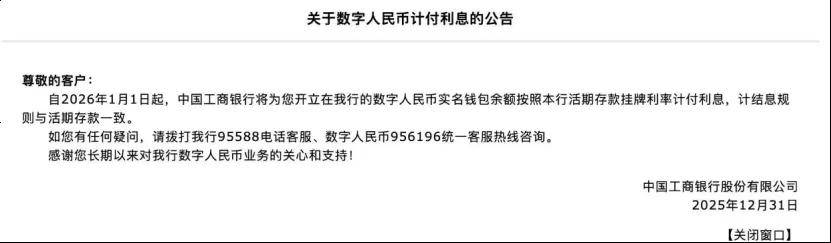
六大国有银行公告:数字人民币实名钱包余额明起计付利息
Sou Hu Cai Jing· 2026-01-01 04:42
Core Viewpoint - Starting January 1, 2026, several major banks in China, including Industrial and Commercial Bank of China, Agricultural Bank of China, Bank of China, China Construction Bank, Bank of Communications, and Postal Savings Bank, will offer interest on the balances of digital RMB real-name wallets at the same rate as current deposit rates [1] Group 1 - The interest calculation rules for digital RMB wallets will align with those of current deposits [1] - China Construction Bank's announcement specifies that four types of wallets are excluded from this interest policy [1] - Bank of Communications states that if a customer opens a type four personal digital RMB wallet, the balance will not earn interest [1]
银行“抢滩”年终奖 跨年理财高收益获投资者青睐
2 1 Shi Ji Jing Ji Bao Dao· 2026-01-01 03:18
Core Insights - The article discusses the increasing demand for wealth management products as year-end bonuses are being distributed, highlighting a competitive marketing environment among banks to attract customers [1][2][4] Group 1: Bank Marketing Strategies - Banks are launching exclusive wealth management activities and products to capture the influx of year-end bonuses, with a focus on flexible redemption and low entry thresholds [2][8] - For example, Bank of Communications has introduced a series of wealth management products with an annualized return of 4.68%, allowing daily purchases and redemptions starting from 1 yuan [2][8] - Industrial and Commercial Bank of China is promoting three wealth management products, with one offering a near-month annualized return of 3.09% and a minimum investment of 1 yuan [2][8] Group 2: Product Design Trends - Mid to low-risk products are becoming mainstream for year-end bonus investments, balancing risk control with potential returns to meet the demand for stable investments [3][9] - The trend of lowering investment thresholds, such as allowing purchases from 1 yuan, is expanding the customer base to include ordinary investors with small amounts of idle funds [3][9] - Traditional deposit products are also being enhanced, with Tianjin Bank offering a three-year deposit with a higher annual interest rate of 1.85%, appealing to conservative investors [3][9] Group 3: Investor Preferences - Investors are showing a preference for stable wealth management options, with many prioritizing safety over high returns when managing their year-end bonuses [4][10] - A common strategy among investors is to allocate funds based on purpose, with approximately 10% for emergency cash, 30-40% for liquidity, and over 50% for medium to long-term investments [5][11] - The trend towards "cross-year wealth management" is noted, where investors seek flexible products that do not interfere with holiday spending while still providing higher returns than regular products [6][12]


银行业十五五展望系列专题(上篇):回眸十四五,监管引导和主动求变下的银行经营理念重构
Shenwan Hongyuan Securities· 2025-12-31 14:14
Investment Rating - The report indicates a positive outlook for the banking industry, suggesting a return to a price-to-book (PB) ratio of 1x during the "15th Five-Year Plan" period, focusing on stable profitability and high-quality development [3][4]. Core Insights - The banking sector is transitioning from a focus on scale to quality, with an emphasis on risk management and structural optimization. The "15th Five-Year Plan" includes the goal of building a strong financial nation, highlighting the importance of high-quality development [3][16]. - The report identifies key changes in the banking industry during the "14th Five-Year Plan," including a shift in credit structure, a focus on profitability, and the need for banks to balance risk and efficiency [2][4]. - Regulatory support is expected to stabilize net interest margins, which have reached record lows, with a projected recovery in the coming years [5][19]. Summary by Sections 1. From Quantity to Quality - The banking industry has evolved through three five-year plans, with a shift from rapid expansion to a focus on quality and risk management. The current phase emphasizes high-quality development and financial support for key sectors [2][10]. 2. Developments During the "14th Five-Year Plan" 2.1 ROE: Resilience of State-Owned Banks and Advantages of City Commercial Banks - The return on equity (ROE) for listed banks has remained around 10%, with city commercial banks showing a slight advantage due to higher leverage and better provisioning [19][20]. 2.2 Credit: Moving Away from Scale to Balance Capital and Efficiency - Banks are prioritizing structural transformation over sheer volume, focusing on supporting key sectors and optimizing credit distribution [4][12]. 2.3 Interest Margin: Recovery from Continuous Decline - The report anticipates a stabilization of net interest margins, which have been under pressure, with regulatory measures aimed at supporting banks [5][19]. 2.4 Risk: Provisioning to Support Stability - The banking sector is expected to manage risks more effectively, with a focus on maintaining adequate provisions to support profitability during challenging economic conditions [4][19]. 2.5 Financial Markets: An Alternative Revenue Stream - The report highlights the increasing importance of financial market activities as a means to smooth revenue amid declining interest income, with banks diversifying their investment strategies [4][19]. 3. Investment Analysis Opinion - The report suggests a dual strategy of focusing on leading banks and undervalued city commercial banks, anticipating a recovery in valuations for state-owned banks that have been lagging [3][4].

邮储银行滨州市分行:8亿银团赋能沾化300MW渔光互补项目
Qi Lu Wan Bao· 2025-12-31 14:03
Group 1 - The project involves a 300MW fish-solar complementary photovoltaic power generation base in Shandong Province, utilizing saline-alkali land for dual purposes: energy generation and shrimp farming [1] - The project is developed by Jinhui New Energy, which employs a multi-faceted approach including "fishing, solar, storage, and transmission" to maximize land use [1] - The project faced significant financing challenges due to its large scale and tight timeline, necessitating financial support from Postal Savings Bank [1] Group 2 - Postal Savings Bank initiated a green credit approval process to expedite financing for the project, completing the necessary approvals in just two weeks [2] - The bank successfully led a syndicate to secure 800 million yuan in funding, providing crucial financial support to the project [2] - As of August, Postal Savings Bank's green loan balance reached 4.331 billion yuan, with a year-on-year growth rate of 20.14%, significantly outpacing other loan growth rates [2]
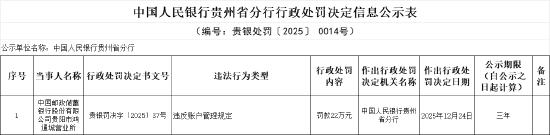
邮储银行贵阳市鸿通城营业所被罚22万元:违反账户管理规定
Xin Lang Cai Jing· 2025-12-31 12:50
Core Viewpoint - China Postal Savings Bank's Guiyang Hongtongcheng branch was fined 220,000 yuan for violating account management regulations as per the announcement from the People's Bank of China Guizhou branch [1][2]. Group 1 - The fine imposed on China Postal Savings Bank's Guiyang branch amounts to 220,000 yuan [1][2]. - The violation pertains to account management regulations [1][2]. - The administrative penalty was announced on December 24, 2025 [2].
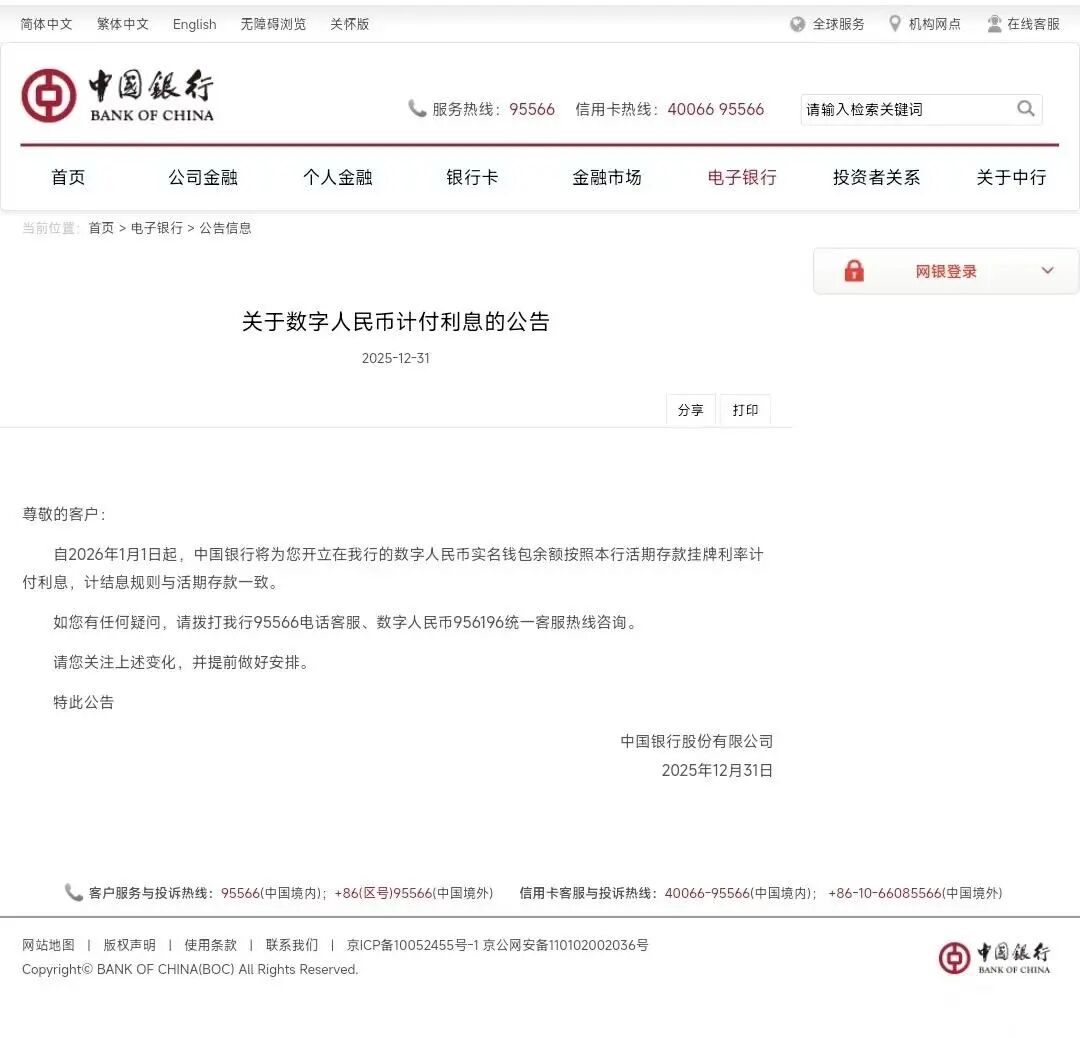
中行、工行、农行、建行、交行、邮储银行集体官宣:这笔钱要计利息!
Mei Ri Jing Ji Xin Wen· 2025-12-31 12:20
Core Viewpoint - Starting from January 1, 2026, six major state-owned banks in China will begin to pay interest on the balances of digital RMB real-name wallets at the same rate as their current deposit rates, following the same interest calculation rules as regular savings accounts [1][10]. Group 1: Announcement Details - The six banks involved are the Bank of China, Industrial and Commercial Bank of China, Agricultural Bank of China, China Construction Bank, Bank of Communications, and Postal Savings Bank [1]. - The current interest rate for regular savings accounts is noted to be 0.05% [10]. - Interest will be calculated quarterly, with the interest credited to accounts on the 21st of each quarter's last month [10]. Group 2: Wallet Types and Interest Eligibility - Digital RMB wallets are categorized into four types: Type 1, Type 2, and Type 3 are real-name wallets eligible for interest, while Type 4 is an anonymous wallet that does not earn interest [10][12]. - Type 1 wallets require in-person verification and must be linked to a domestic bank account, while Type 2 and Type 3 wallets can be opened remotely with varying identification requirements [12][13][14]. - The new definition of digital RMB indicates a shift from being classified as M0 (cash) to being recognized as a form of deposit currency, allowing for interest accrual [11][12].