PSBC(01658)

Search documents
2025,银行大罚单明显变多了
Xin Lang Cai Jing· 2026-01-04 12:48
Core Insights - A significant trend observed in 2025 is the increase in large fines imposed on banks, reflecting compliance shortcomings and risk points during the transition to high-quality development in the banking industry [2][16] - In 2025, regulatory authorities issued a total of 454 fines exceeding one million yuan to banking institutions and personnel, an increase of 58 from the previous year, with the total amount of fines nearly doubling [2][16] - The main areas of violations in 2025 were concentrated in credit business, anti-money laundering, and internal control systems, with anti-money laundering violations seeing the most notable increase, reaching 894 fines, a rise of 185.09% compared to the previous year [2][16] Summary of Fines Over 20 Million Yuan - In 2025, there were 12 fines disclosed with amounts exceeding 20 million yuan, primarily related to compliance management issues in traditional business areas such as loans and bills, indicating deficiencies in basic business risk control and regulatory cooperation [4][17] - Common violations included issues with account management and anti-money laundering, highlighting flaws in customer identity verification and transaction monitoring processes [3][17] Summary of Fines Between 10 Million and 20 Million Yuan - This category of fines predominantly involved joint-stock banks, reflecting a conflict between business innovation and compliance management [6] - Violations were mainly related to compliance operations (account and anti-money laundering) and business management (internet loans and agency sales), with cross-border foreign exchange violations being a secondary concern [7] Summary of Fines Between 5 Million and 10 Million Yuan - Fines in this range were primarily concentrated among city commercial banks, joint-stock banks, and rural commercial banks [10] - The most common violations included anti-money laundering and customer identity verification issues, alongside traditional problems related to credit "three checks" failures [10]





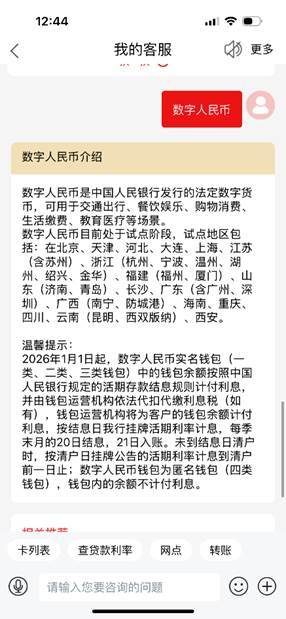
今年1月1日起 六大银行数字人民币计利息收益
Sou Hu Cai Jing· 2026-01-04 11:48
Group 1 - From January 1, 2026, digital RMB real-name wallet balances will earn interest based on the current demand deposit rate set by the respective banks, which is currently 0.05% [1] - The digital RMB is categorized into four types of wallets, with only the first three types (real-name wallets) eligible for interest, while the fourth type (anonymous wallet) will not earn interest [1] - The interest will be calculated according to the People's Bank of China’s demand deposit interest rules, with interest credited on the 20th of each quarter's last month [1] Group 2 - There are currently 10 designated operating institutions for digital RMB, including six state-owned commercial banks, two joint-stock commercial banks, and two internet banks [2] - The central bank is working on expanding the number of operating institutions and has introduced a new action plan to enhance the management and service system for digital RMB, set to be implemented on January 1, 2026 [2] - Banks will manage the digital RMB wallet balances autonomously and provide the same level of security as traditional deposits through deposit insurance [2]


邮储银行永城市支行开展“金融知识进社区”暖冬行动
Huan Qiu Wang· 2026-01-04 11:27
Core Viewpoint - Postal Savings Bank of China is actively engaging in community financial education initiatives, focusing on promoting electronic social security cards and enhancing financial literacy among residents [1][2] Group 1: Community Engagement - The Postal Savings Bank of China, along with local government and community organizations, launched a "Financial Knowledge into Community" initiative to provide convenient and secure financial services directly to residents [1] - The event featured a service point at the community center, with promotional materials and experienced staff offering one-on-one guidance to assist residents, particularly the elderly, in using electronic social security cards [1] Group 2: Financial Education - Staff provided detailed explanations of the functionalities of electronic social security cards, including social security inquiries, medical insurance settlements, and pension disbursements, while addressing safety concerns through real-life examples [1] - The initiative also included a micro-lecture on financial knowledge, highlighting common scams such as "pension fraud" and "false investments," and promoting awareness of personal credit protection and rational financial management [1] Group 3: Future Plans - The bank's leadership emphasized the importance of community as the "last mile" in financial services and committed to further collaboration with community and government entities to enhance financial services and support the digitalization of public services [2]

工农中建交邮储六大行集体公告!数字人民币实名钱包余额计付利息,计结息规则与活期存款一致
Sou Hu Cai Jing· 2026-01-04 06:55
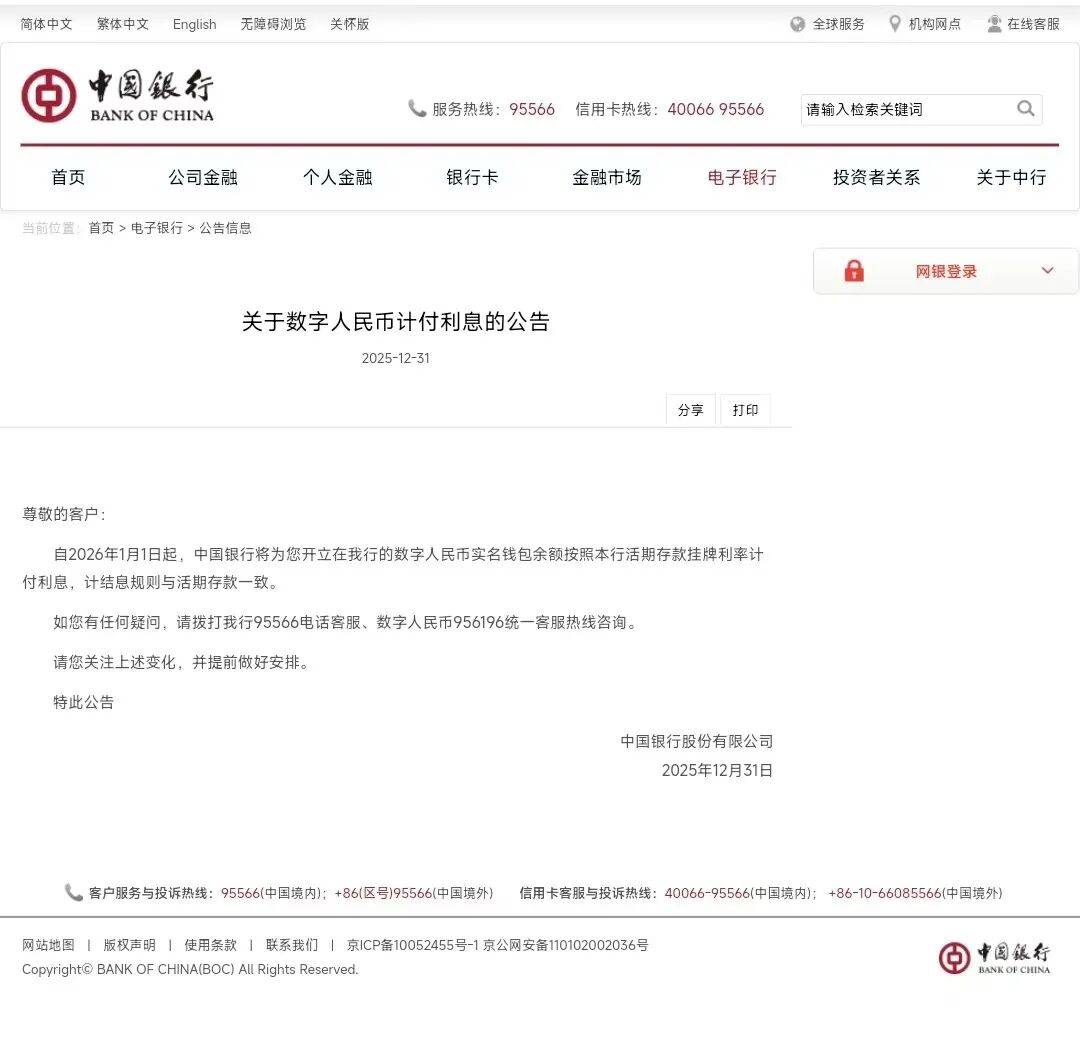
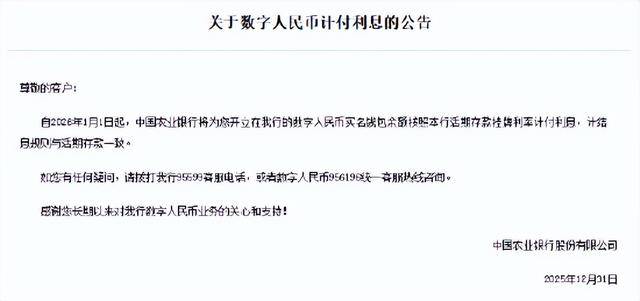
Core Viewpoint - Major Chinese banks, including ICBC, ABC, BOC, CCB, BOCOM, and PSBC, will start paying interest on the balances of digital RMB wallets at the rate of their respective demand deposit rates from January 1, 2026 [1][2][4][5][8][9]. Group 1: Bank Announcements - ICBC will pay interest on digital RMB wallet balances according to its demand deposit rate, with interest calculation rules consistent with those for demand deposits [1]. - ABC will also apply the same interest payment policy for digital RMB wallet balances starting January 1, 2026 [2]. - BOC will follow the same approach, paying interest on digital RMB wallet balances at its demand deposit rate from January 1, 2026 [4]. - CCB will implement interest payments on digital RMB wallet balances based on its demand deposit rate, with relevant service agreement updates [5]. - BOCOM will pay interest on digital RMB wallet balances according to its demand deposit rate, effective January 1, 2026 [8]. - PSBC will also apply the same interest payment policy for digital RMB wallet balances starting January 1, 2026 [9].

年终奖理财怎么投?银行力推“一站式”稳健配置
Huan Qiu Wang· 2026-01-04 03:41
Core Insights - The focus of investors is on how to effectively plan their year-end bonuses in the current market environment, aiming for safety while upgrading returns [1] - Financial institutions like Postal Savings Bank, Guangfa Bank, and Everbright Wealth Management are launching targeted "one-stop" year-end bonus investment plans [1][2] - The core theme for year-end bonus investments this year is "steady and low volatility," with institutions providing diversified asset allocation solutions for different risk preferences [1][4] Group 1: Investment Strategies - Guangfa Bank offers a tiered asset allocation strategy categorized as "Conservative - Steady - Aggressive," matching different investors' risk tolerance and return expectations [1] - The conservative allocation focuses on pure bond funds to create a "safety cushion" for asset growth, while the steady allocation suggests "fixed income+" products to enhance yield [1] - The aggressive allocation recommends broad-based index funds for higher returns through long-term holding [1] Group 2: Product Offerings - Everbright Wealth Management suggests splitting the year-end bonus into three segments: short-term living expenses, medium-term expenditures, and long-term compounding growth, each corresponding to different types of fixed-income products [1] - Postal Savings Bank and Bank of Communications are also actively participating in the year-end bonus investment market, offering low-risk or medium-low-risk products tailored to various scenarios [2] - Bank of Communications has enhanced its offerings by adding insurance and precious metals to its "one-stop" investment product matrix [2] Group 3: Risk and Financial Planning - The main risk levels of products are concentrated in PR1 to PR2 categories, with few products rated PR3 or higher appearing in fund recommendations [4] - Analysts recommend that investors analyze their financial situation, risk tolerance, and funding needs before customizing their year-end bonus investment plans [4] - A combined approach of "earmarked funds" and "diversified allocation" is suggested, with cash or daily-opening investment products for short-term needs and insurance products for long-term planning [4][5]


【基层创新故事】“守艺贷”为非遗传承注入新活力
Xin Lang Cai Jing· 2026-01-03 23:23
Core Viewpoint - The article highlights the integration of traditional cultural heritage with modern financial support, showcasing how specialized loan products are facilitating the preservation and development of intangible cultural heritage in Huangshan, China [1][2][3]. Group 1: Cultural Heritage and Its Preservation - The "Shengzhatang Ancient Oil Press Culture Park" in Huangshan displays nearly a hundred traditional oil extraction tools, emphasizing the rich heritage of Huizhou wood oil craftsmanship [1]. - Yu Hai, a representative inheritor of Huizhou wood oil craftsmanship, established the cultural park in 2008 to promote traditional handcrafts and founded Huangshan Yuxiangyuan Food Co., Ltd. to produce wood-pressed oil [1]. Group 2: Financial Support for Intangible Cultural Heritage - In 2023, China Postal Savings Bank's Huangshan branch launched the "Huizhou Guardian Loan" tailored for inheritors of intangible cultural heritage, offering credit limits based on the level of recognition: up to 3 million yuan for national inheritors, 2 million for provincial, and 1 million for municipal [1][2]. - Other banks, including China Construction Bank and Agricultural Bank of China, have also introduced similar credit products to support intangible cultural heritage [2]. - Financial institutions in Huangshan have provided a total of 430 million yuan in loans to 48 inheritors and 45 enterprises, enabling them to expand operations and invest in new production lines [2]. Group 3: Impact of Financial Products - The introduction of specialized loan products like "Huizhou Guardian Loan" addresses the financing challenges faced by inheritors due to their "light asset and lack of collateral" status, demonstrating the significant role of financial leverage in cultural heritage preservation [3]. - This financial empowerment model serves as a replicable example for sustainable development of intangible cultural heritage [3].
近30笔千万级罚单!2025年银行业罚单大盘点
证券时报· 2026-01-03 05:27
Core Viewpoint - In 2025, the Chinese banking industry is undergoing significant regulatory scrutiny characterized by "strict regulation, strong accountability, and zero tolerance," leading to a notable increase in both the quantity and severity of penalties imposed on banks [1]. Group 1: Regulatory Environment - The number of penalties exceeding 10 million yuan in the banking sector reached nearly 30, affecting various types of institutions including state-owned banks, policy banks, joint-stock banks, city commercial banks, private banks, and bank-affiliated wealth management subsidiaries [2]. - Regulatory focus has expanded beyond traditional areas like credit management to include corporate governance, related party transactions, anti-money laundering, data security, and wealth management business oversight [2][4]. Group 2: Major Penalties - Major state-owned banks such as Bank of China, Industrial and Commercial Bank of China, and Agricultural Bank of China received substantial fines, with Bank of China facing a fine of 97.9 million yuan for issues related to corporate governance and asset quality management [4]. - In December 2025, China Communications Bank was fined 68.07 million yuan for violating multiple regulations, including account management and anti-money laundering obligations [4][5]. Group 3: Compliance and Risk Management - The penalties highlight a trend of inadequate compliance and risk management across various banking operations, including loan management, interbank transactions, and wealth management [7][10]. - The regulatory environment has intensified scrutiny on compliance with anti-money laundering regulations, with significant fines imposed for failures in customer identity verification and transaction reporting [8][9]. Group 4: Emerging Business Areas - New banking business models, such as wealth management subsidiaries and direct banks, are also facing strict regulatory penalties, indicating that the regulatory environment is not limited to traditional banking practices [13]. - For instance, Jiaoyun Wealth Management was fined 17.5 million yuan for non-compliance in product information disclosure and post-investment management [13]. Group 5: Double Penalty System - The implementation of a "double penalty system" has become prevalent, where not only institutions are fined but also individual responsible parties face penalties, enhancing accountability within financial institutions [15]. - This system links the career prospects of involved personnel directly to the compliance performance of their institutions, thereby increasing regulatory pressure [15]. Group 6: Future Outlook - The ongoing trend of strict regulation and accountability is expected to continue, prompting banks to improve their internal governance structures and compliance management systems [16]. - The adjustments in business processes and increased technological investments are anticipated to have a profound impact on the operational models and competitive landscape of the banking industry [16].



重拳出击!近30笔千万级罚单!2025年银行业罚单大盘点
券商中国· 2026-01-03 03:33
Core Viewpoint - In 2025, the Chinese banking industry is undergoing significant regulatory scrutiny characterized by "strict regulation, strong accountability, and zero tolerance," leading to a notable increase in both the quantity and amount of penalties imposed on various banking institutions [1]. Regulatory Penalties Overview - The number of penalties exceeding ten million yuan has reached nearly 30, affecting a wide range of institutions including state-owned banks, policy banks, joint-stock banks, city commercial banks, private banks, and bank-affiliated wealth management subsidiaries [1]. - Penalties are not limited to traditional areas like credit management but also extend to corporate governance, related party transactions, anti-money laundering, data security, and wealth management [2]. Corporate Governance and Compliance - Major state-owned banks such as Bank of China, Industrial and Commercial Bank of China, and Agricultural Bank of China have received substantial fines for issues related to corporate governance and business management [3]. - The largest penalty of the year was imposed on Bank of China, amounting to 97.9 million yuan for various management issues [3]. - Regulatory focus has shifted to deeper issues such as the effectiveness of board responsibilities and the integrity of internal control processes [3]. Compliance and Anti-Money Laundering - There has been an intensified crackdown on compliance, particularly in the anti-money laundering sector, with significant fines imposed on banks for failing to adhere to basic financial management regulations [4]. - For instance, China Merchants Bank was fined 68.07 million yuan for violating 11 regulations related to account management and anti-money laundering [4]. Business Management Issues - The primary reasons for penalties in the banking sector include: - Inadequate management across various business areas such as loans, interbank transactions, and wealth management [6]. - Non-compliance with anti-money laundering responsibilities, including failure to identify customers and report suspicious transactions [7]. - Violations in foreign exchange and investment operations, including illegal currency transactions and improper investment disclosures [8]. - Insufficient implementation of regulatory requirements, leading to non-compliance in data reporting and employee management [9]. Emerging Business Areas - New banking business models, including wealth management subsidiaries and direct banks, have also faced penalties, indicating strict regulatory oversight in these emerging sectors [11]. - For example, a wealth management subsidiary was fined 17.5 million yuan for non-compliance in product information disclosure and post-investment management [12]. Double Penalty System - The implementation of a "double penalty system" has become a significant aspect of regulatory actions, where both institutions and responsible individuals face penalties [13]. - This system aims to link the career prospects of involved personnel directly to the compliance performance of their institutions, thereby enhancing accountability [14]. Summary of Penalties - A detailed overview of penalties reveals that various banks have faced significant fines for a range of compliance failures, with amounts often exceeding ten million yuan [15][16].


国有六大行集团宣布:数字人民币实名钱包余额按活期利率计息
Huan Qiu Wang· 2026-01-03 01:39
Group 1 - The six major state-owned banks in China will start paying interest on the balances of real-name digital RMB wallets at the same rate as current deposit rates, effective January 1, 2026 [1][3] - The current interest rate for current deposits is set at 0.05%, and only real-name wallets (categories one, two, and three) will earn interest, while anonymous wallets (category four) will not [1][3] - The People's Bank of China has introduced a new action plan to enhance the management and service system for digital RMB, which will officially launch on January 1, 2026 [3] Group 2 - The action plan allows banks to manage the assets and liabilities of digital RMB wallet balances independently, while ensuring the same level of security as traditional deposits through deposit insurance [3]
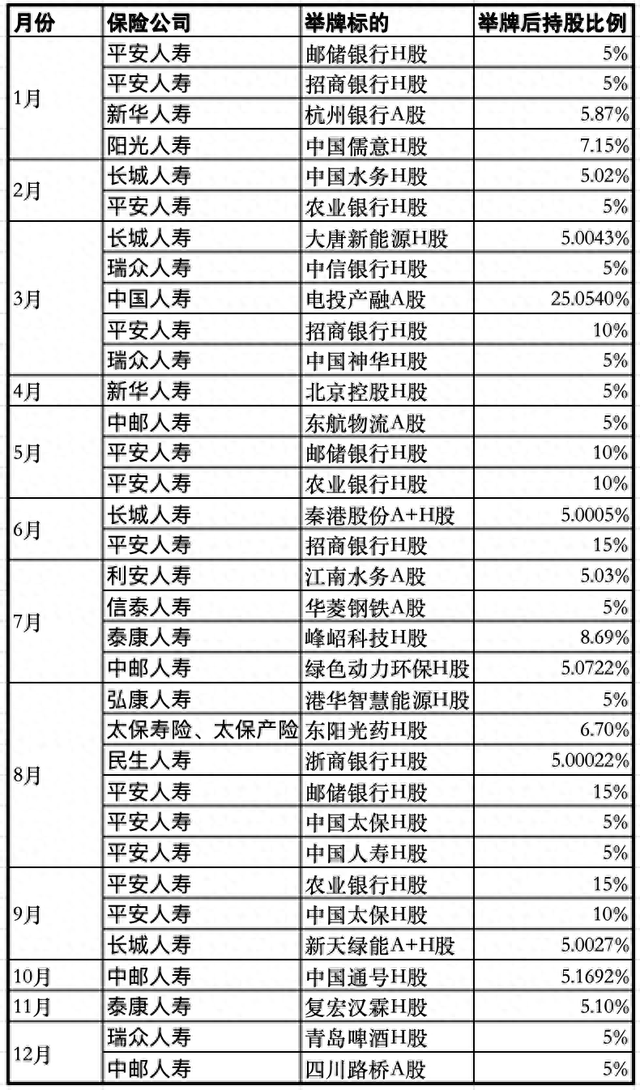
2025年险资举牌超30次再创新高,银行H股成“重仓区”
Xin Lang Cai Jing· 2026-01-02 23:44
登录新浪财经APP 搜索【信披】查看更多考评等级 2025年,保险资金举牌上市公司继续升温。 | 月份 | 保险公司 | 举牌标的 | 举牌后持股比例 | | --- | --- | --- | --- | | 1月 | 平安人寿 | 邮储银行H股 | 5% | | | 平安人寿 | 招商银行H股 | 5% | | | 新华人寿 | 杭州银行A股 | 5.87% | | | 阳光人寿 | 中国儒意H股 | 7.15% | | 2月 | 长城人寿 | 中国水务H股 | 5.02% | | | 平安人寿 | 农业银行H股 | 5% | | 3月 | 长城人寿 | 大唐新能源H股 | 5.0043% | | | 瑞众人寿 | 中信银行H股 | 5% | | | 中国人寿 | 电投产融A股 | 25.0540% | | | 平安人寿 | 招商银行H股 | 10% | | | 瑞众人寿 | 中国神华H股 | 5% | | 4月 | 新华人寿 | 北京控股H股 | 5% | | 5月 | 中邮人寿 | 东航物流A股 | 5% | | | 平安人寿 | 邮储银行H股 | 10% | | | 平安人寿 | 农业银行H股 | ...