BENQ HOLDING(02581)

Search documents
明基医院(02581) - 截至二零二六年一月三十一日止股份发行人的证券变动月报表
2026-02-05 05:08
股份發行人及根據《上市規則》第十九B章上市的香港預託證券發行人的證券變動月報表 截至月份: 2026年1月31日 狀態: 新提交 致:香港交易及結算所有限公司 公司名稱: 明基醫院集團股份有限公司 呈交日期: 2026年2月5日 I. 法定/註冊股本變動 | 根據《主板上市規則》第13.32D(1)條或第19A.28D(1)條 / 《GEM上市規則》第17.37D(1)條或第25.21D(1)條,我們在此確認,就上述所列股份類別而言,截至本月底: | | --- | | ✔ 已符合適用的公眾持股量要求(見下方) | | 未符合適用的公眾持股量要求(見下方) | | 根據《主板上市規則》第13.32B條或第19A.28B條 / 《GEM上市規則》第17.37B條或第25.21B條(視情況而定)所載的有關股份類別的最低公眾持股量要求為: | | 適用的公眾持股量門檻 初始指定門檻 - 上市股份所屬類別的已發行股份總數(不包括庫存股份)的25% | | 額外信息 | 第 2 頁 共 10 頁 v 1.2.0 | 1. 股份分類 | 普通股 | 股份類別 | 不適用 | | 於香港聯交所上市 (註1) | | 是 | ...
智通港股52周新高、新低统计|2月3日





智通财经网· 2026-02-03 08:44
Group 1 - A total of 78 stocks reached a 52-week high as of February 3, with notable performers including Asia Pacific Financial Investments (08193) at 57.14%, Chao Wei Holdings (08059) at 36.00%, and Asia Backup (08290) at 33.33% [1] - The closing prices for the top three stocks that reached new highs were 0.550, 0.052, and 0.024 respectively, with their highest prices being 0.550, 0.068, and 0.036 [1] - Other significant stocks that reached new highs include Huameilele (08429) with a high rate of 20.37% and Haode Holdings (08149) at 17.65% [1] Group 2 - The report also lists stocks that reached 52-week lows, with the worst performer being Gaodi Holdings (01676) at -10.00%, followed by Huajian Medical (01931) at -9.29% and Electronic Trading Group (08036) at -9.09% [3] - The closing prices for the stocks that reached new lows include 0.340, 1.280, and 0.021 respectively, with their lowest prices being 0.315, 1.270, and 0.020 [3] - Other notable stocks that reached new lows include Controllon (01912) at -8.93% and Cool Link (08491) at -8.11% [3]
明基医院(02581) - 致非登记股东之通知信函及回条 - 以电子方式发布公司通讯安排
2026-01-28 08:33
BenQ BM Holding Cayman Corp. 明基醫院集團股份有限公司 (A company incorporated in the Cayman Islands with limited liability) (於開曼群島註冊成立的有限公司) (Stock code 股份代號 : 2581) 29 January 2026 Dear non-registered shareholder(s), Arrangement of Electronic Dissemination of Corporate Communications Pursuant to Rule 2.07 of the Rules Governing The Listing of Securities on The Stock Exchange of Hong Kong Limited (the "Listing Rules") under the expansion of paperless listing regime and electronic dissemination of corporate communicatio ...
明基医院(02581) - 致登记股东之通知信函及回条 - 以电子方式发布公司通讯安排
2026-01-28 08:30
Solicitation of electronic contact details BenQ BM Holding Cayman Corp. 明基醫院集團股份有限公司 Arrangement of Electronic Dissemination of Corporate Communications (A company incorporated in the Cayman Islands with limited liability) (於開曼群島註冊成立的有限公司) (Stock code 股份代號 : 2581) Pursuant to Rule 2.07 of the Rules Governing The Listing of Securities on The Stock Exchange of Hong Kong Limited (the "Listing Rules") under the expansion of paperless listing regime and electronic dissemination of corporate communications that c ...
上市满月即签6亿合约:明基医院与合富中国的双向妥协与隐忧
Guan Cha Zhe Wang· 2026-01-27 06:41
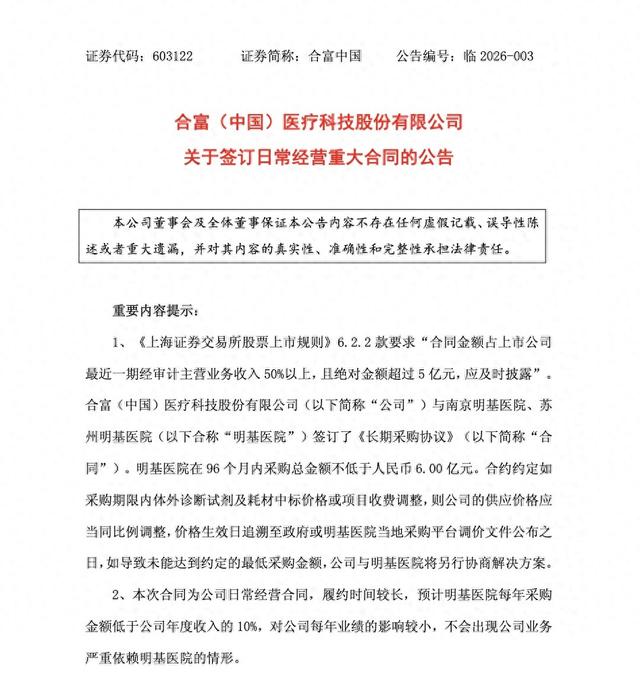
Core Viewpoint - The recent long-term procurement contract worth 600 million yuan between Mingji Hospital and Hefei China reflects both companies' operational anxieties, with Mingji Hospital needing to implement its expansion plans and Hefei China facing significant performance declines due to industry pressures [1][5][8]. Group 1: Company Performance - Hefei China is experiencing a significant downturn, with a projected revenue decline of 26.67% to 689 million yuan for 2025 and a shift from a net profit of 27.57 million yuan to a loss between 25 million and 36 million yuan [5][7]. - The company's losses are attributed to the implementation of centralized procurement policies in the in vitro diagnostics industry, which have drastically reduced procurement prices and squeezed sales revenue and gross margins [7][11]. - Despite cost control measures, Hefei China is unable to reduce fixed expenses proportionally to its declining revenue, leading to continued financial strain [7][11]. Group 2: Strategic Implications - The partnership between Mingji Hospital and Hefei China is driven by Mingji's urgent need for a stable supply chain to support its expansion plans following its recent IPO, where it raised approximately 555 million HKD [8][11]. - Mingji Hospital's operational model is limited by its higher pricing compared to public hospitals and a narrow customer base, which constrains its growth potential [11][15]. - The exclusive supply agreement with Hefei China may limit Mingji Hospital's ability to negotiate prices and manage costs effectively, especially in a context of increasing centralized procurement [11][12]. Group 3: Contractual Risks - The eight-year procurement agreement includes clauses for price adjustments based on market fluctuations, which could significantly impact Hefei China's profit margins and overall financial health [12][15]. - Payment terms require Hefei China to front nearly four months of payment for supplies, increasing its cash flow pressure amid ongoing losses [13][15]. - The lack of clear fallback provisions in the contract raises concerns about potential disputes and the overall stability of the partnership [12][14].


明基医院(02581) - 截至二零二五年十二月三十一日止股份发行人的证券变动月报表
2026-01-06 09:20
股份發行人及根據《上市規則》第十九B章上市的香港預託證券發行人的證券變動月報表 呈交日期: 2026年1月6日 I. 法定/註冊股本變動 | 1. 股份分類 | 普通股 | 股份類別 | 不適用 | | 於香港聯交所上市 (註1) | | 是 | | | --- | --- | --- | --- | --- | --- | --- | --- | --- | | 證券代號 (如上市) | 02581 | 說明 | | | | | | | | | | 法定/註冊股份數目 | | | 面值 | | 法定/註冊股本 | | | 上月底結存 | | | 500,000,000 | USD | | 1 USD | | 500,000,000 | | 增加 / 減少 (-) | | | 0 | | | USD | | 0 | | 本月底結存 | | | 500,000,000 | USD | | 1 USD | | 500,000,000 | 本月底法定/註冊股本總額: USD 500,000,000 備註: 截至月份: 2025年12月31日 狀態: 新提交 致:香港交易及結算所有限公司 公司名稱: 明基醫院集團股份 ...
明基医院跌超8%创上市新低 较招股价已跌超55%
Zhi Tong Cai Jing· 2025-12-30 07:19
Core Viewpoint - Ming Kee Hospital's stock price has dropped over 8%, reaching a new low of 4.12 HKD, which is more than a 55% decline from its IPO price of 9.34 HKD, marking the worst debut performance for a new stock on the Hong Kong Stock Exchange this year [1] Financial Performance - The company reported revenues of 2.34 billion CNY, 2.69 billion CNY, 2.66 billion CNY, and 1.31 billion CNY for the years 2022, 2023, 2024, and the six months ending June 30, 2025, respectively [1] - Corresponding net profits for the same periods were 89.55 million CNY, 170 million CNY, 110 million CNY, and 48.7 million CNY [1] Market Reaction - The public offering of Ming Kee Hospital received a lukewarm response, with the Hong Kong public offering portion being subscribed only 6.28 times and the international placement subscribed 1.28 times, both significantly lower than recent popular new stocks [1] - Analysts noted that the company's price-to-earnings (PE) ratio during the IPO phase was 29.8 times, which is substantially higher than the average PE ratio of 16.7 times for the private hospital sector in Hong Kong, indicating that the pricing was too high and contributed to the significant drop in share price [1]
港股异动 | 明基医院(02581)跌超8%创上市新低 较招股价已跌超55%
智通财经网· 2025-12-30 07:16
Core Viewpoint - BenQ Hospital's stock has dropped over 8%, reaching a new low of 4.12 HKD, which is more than a 55% decline from its IPO price of 9.34 HKD, marking the worst debut performance for a new Hong Kong stock in 2023 [1] Financial Performance - The company reported revenues of 2.34 billion RMB, 2.69 billion RMB, 2.66 billion RMB, and 1.31 billion RMB for the years 2022, 2023, 2024, and the six months ending June 30, 2025, respectively [1] - Corresponding net profits for the same periods were 89.55 million RMB, 170 million RMB, 110 million RMB, and 48.7 million RMB [1] Market Reaction - The public offering of BenQ Hospital received a lukewarm response, with the Hong Kong public offering being subscribed only 6.28 times and the international placement subscribed 1.28 times, both significantly lower than recent popular IPOs [1] - Analysts noted that the company's price-to-earnings (PE) ratio during the IPO phase was 29.8 times, which is substantially higher than the average PE ratio of 16.7 times for the private hospital sector in Hong Kong, indicating that overpricing was a direct cause of the significant drop in share price [1]
为肺结节患者提供一站式诊疗服务 南京明基医院肺结节诊疗中心成立
Xin Lang Cai Jing· 2025-12-25 17:23
Group 1 - The establishment of the Lung Nodule Diagnosis and Treatment Center at Nanjing Mingji Hospital aims to provide a one-stop diagnostic service for patients with lung nodules through multidisciplinary collaboration [1][2] - The center is led by Professor Liu Huiping, who emphasizes that many lung nodules are benign and do not require excessive treatment, with guidelines suggesting that nodules smaller than 8mm generally do not need intensive intervention [1][2] - Early detection of lung nodules is crucial for lung cancer prevention, as it allows for timely treatment and significantly improves cure rates and five-year survival rates [2] Group 2 - The center's approach balances the risks of overtreatment and delayed diagnosis, providing scientifically sound and customized solutions for patients [2] - High-risk individuals, such as those over 40, long-term smokers, or with a family history of lung cancer, are encouraged to include low-dose CT scans in their regular health check-ups [2] - The center represents a significant initiative by the hospital to enhance specialized care and improve public health services [2]
港股IPO提速遇“年末寒流” 12月新股首日破发率直逼五成
Sou Hu Cai Jing· 2025-12-25 10:01
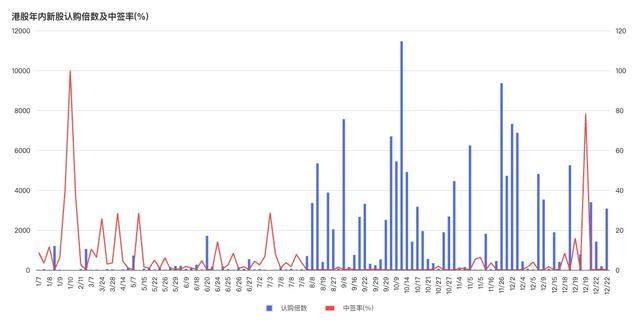
Core Viewpoint - The Hong Kong IPO market, which has been thriving throughout the year, is now experiencing a downturn with increasing first-day loss rates for newly listed stocks as the year comes to a close [1][3]. Group 1: IPO Performance - In November and December, there were 11 and 20 new listings respectively, marking a high monthly volume for the year [1]. - The first-day loss rate for new stocks has risen significantly, with 5 companies in November and 10 in December experiencing price drops below their issue prices, leading to a 50% first-day loss rate in December, which is notably higher than the year-to-date average of 29% [1][3]. - On December 22, four newly listed stocks collectively faced first-day losses, with Mindray Hospital (02581.HK) plummeting nearly 50%, marking the worst debut performance of the year [3]. Group 2: Subscription Trends - The subscription multiples for new IPOs have been declining sharply, indicating a weakening profit potential for investors, despite an increase in the chances of winning allocations [3]. - The phenomenon of "one signature hard to obtain" has diminished, with higher winning rates but lower profitability for investors [3]. Group 3: Market Dynamics - There is a notable structural differentiation in new stock performances, with some stocks like Mindray Hospital and Hanshi Aitai-B (03378.HK) experiencing significant declines, while others like Guoxia Technology (02655.HK) and Nobi Can (02635.HK) have seen substantial gains [3][4]. - The Hong Kong Securities and Futures Commission and the Hong Kong Stock Exchange have expressed concerns over the declining quality of new listings and compliance issues [5]. - The IPO issuance has accelerated as the year-end approaches, with a significant increase in companies passing the listing hearing and applying for IPOs in December compared to November [5][6]. Group 4: Market Pressure - As of December 17, there were 298 companies in the IPO hearing stage, with 28 new additions in December, indicating a growing backlog of IPO applications [6]. - The current IPO market shows signs of overheating, with potential pressure on the secondary market due to the high volume of new listings, which could exacerbate liquidity issues [6].