
CPIC(02601)

Search documents
195天,打响资产负债表保卫战:中小险企谁将出局?
Xin Lang Cai Jing· 2025-12-31 07:02
Core Viewpoint - The new regulatory framework for insurance companies aims to enforce a unified decision-making framework for asset allocation, product design, and risk management, addressing the historical disconnection between asset and liability management in the industry [1][2]. Regulatory Changes - The new regulation, effective from July 1, 2026, introduces a three-pronged approach to asset-liability management, emphasizing governance, quantitative indicators, and comprehensive management requirements [1]. - The evaluation period for cost-benefit indicators has been extended to 3-5 years, promoting long-term operations and patient capital within the insurance sector [2]. Impact on Large Insurers - Major insurers like China Life, Ping An, and China Pacific have already established robust asset-liability management mechanisms, positioning them favorably under the new compliance requirements [2][3]. - China Ping An's effective duration gap is reported at -2.6 years, indicating compliance with the new thresholds, while other major players are also narrowing their duration gaps [3]. Challenges for Small and Medium Insurers - Smaller insurance companies face significant challenges due to the new mandatory duration matching requirements, which compel them to invest in lower-yield long-term bonds, potentially leading to a mismatch between investment returns and high liability costs [4][6]. - The historical reliance on high-cost liabilities for growth has left many small insurers vulnerable, as they struggle to adapt to the new regulatory environment [6][7]. Industry Data and Trends - Data from the China Insurance Asset Management Association indicates that the average duration gap for the life insurance industry has been widening, with small insurers showing even greater discrepancies from regulatory requirements [7]. - The new regulations are expected to trigger a wave of mergers and acquisitions among small insurers, as many may not survive the stringent compliance demands [17]. Organizational Changes - The new regulations necessitate a fundamental restructuring of insurance companies' internal governance, with a clear delineation of responsibilities for asset-liability management [8][9]. - The asset-liability management department will become the strategic core of insurance companies, shifting the focus from a liability-driven to an asset-driven approach in product design [8][9]. Long-term Industry Outlook - The new regulatory framework is anticipated to catalyze a transformation in the insurance industry, moving away from a focus on scale to a model emphasizing high-quality, sustainable growth [17]. - The rigorous compliance requirements will likely lead to a significant consolidation in the market, favoring larger, more capable insurers while challenging the survival of smaller firms [17].



险企密集“去监事会” 保险业公司治理变革深化
Jin Rong Shi Bao· 2025-12-31 01:52
Core Viewpoint - The insurance industry is undergoing a significant transformation with the "exit of the supervisory board," as many companies are abolishing this governance structure to enhance efficiency and adapt to new regulatory requirements [2][4]. Group 1: Changes in Governance Structure - As of December 25, 2023, 13 insurance companies, including China Life and China Pacific Insurance, have announced the abolition of their supervisory boards, marking a profound change in the long-standing "three meetings and one layer" governance framework [2][3]. - The trend began with Japan's insurance company in April 2023, which was the first to announce the removal of the supervisory board, followed by state-owned insurance groups [2][3]. - By December 2023, major companies like China Life and New China Life had completed the necessary regulatory approvals to officially abolish their supervisory boards [3][4]. Group 2: Policy and Regulatory Drivers - The reform is driven by the new Company Law effective July 2024, allowing state-owned companies to replace supervisory boards with audit committees, which can enhance governance efficiency [4]. - The China Banking and Insurance Regulatory Commission issued a notice in December 2024, clarifying that financial institutions can establish audit committees to perform the functions of supervisory boards [4]. Group 3: Motivations Behind the Reform - The primary motivations for abolishing supervisory boards include the need to reduce costs, improve efficiency, and address issues of overlapping functions and formalized supervision [4]. - The transition is not seen as a reduction in oversight but rather a restructuring of the supervisory system, with audit committees taking over the responsibilities of the supervisory boards [4]. - The industry anticipates that this reform will enhance compliance and risk management capabilities, contributing to the high-quality development of the insurance sector [4].


中国分红险发展的前世今生:低利率时代的重逢
Soochow Securities· 2025-12-30 10:06
Investment Rating - The report maintains an "Accumulate" rating for the insurance sector [1]. Core Insights - The report discusses the evolution of participating insurance in China, highlighting its significance in a low-interest-rate environment and the shift towards floating yield products, which are gaining traction among domestic investors [2][6]. Summary by Sections 1. What is Participating Insurance? - Participating insurance is a type of insurance that combines protection and investment, allowing policyholders to share in the insurer's surplus [12]. - The operational mechanism involves sharing profits derived from better-than-expected performance, with a minimum of 70% of the surplus distributed to policyholders [6][15]. 2. Historical Development of Participating Insurance in Mainland China - The development of participating insurance has seen significant fluctuations influenced by policy and market factors, with its market share peaking at 75% in 2010 before declining due to market reforms [6][45]. - Since 2024, regulatory policies have encouraged the development of floating yield products, marking a consensus in the industry towards transitioning to participating insurance [6][45]. 3. Current Transition of Participating Insurance - The report anticipates that the proportion of participating insurance will continue to rise, with over 50% of new policies in the first half of 2025 being participating insurance [6][45]. - The transition is expected to alleviate pressure from interest rate losses and enhance the reliability of the insurance sector's embedded value (EV) [6][45]. 4. International Experience - In mature markets, floating yield products dominate, with Hong Kong's participating insurance being a core component, accounting for 85% of new premiums in 2024 [2][6]. - The report suggests that the characteristics of participating insurance in Hong Kong, such as multi-currency support and a design of low guarantees with high floating returns, could serve as a model for the mainland market [2][6]. 5. Key Metrics for Evaluating Participating Insurance - The report outlines four key indicators for assessing the performance of participating insurance: 1. **Guaranteed Rate**: Currently set at 1.75%, which is lower than traditional insurance [23]. 2. **Demonstration Rate**: Reflects expected returns, with current rates around 3.5% to 4% [24]. 3. **Actual Yield**: The industry average is capped at 3.2%, with some companies exceeding this limit [27]. 4. **Dividend Realization Rate**: Increased by 11 percentage points to 62% in 2024, indicating improved management and expectation guidance [29].

2025保险业做实理性经营 体量、效益、股价同创新高
Zheng Quan Shi Bao· 2025-12-29 19:13
Core Insights - The insurance industry in China has achieved record high asset levels and profitability in 2025, driven by practical reforms and a focus on rational management [1][2]. Group 1: Industry Growth and Performance - By the end of October 2025, China's insurance industry total assets reached 40.59 trillion yuan, an increase of 4.68 trillion yuan from the beginning of the year, marking a growth rate of 13.03% [2]. - The total assets of the insurance industry have seen double-digit growth since 2023, primarily due to increased premium income, cost optimization, enhanced capital replenishment, and improved asset allocation [2]. - The combined market capitalization of five listed insurance companies in A-shares exceeded 3.3 trillion yuan, with a growth of over 700 billion yuan, reflecting a nearly 30% increase [3]. Group 2: Profitability and Financial Health - In the first three quarters of 2025, the five listed insurance companies achieved a total net profit of 426 billion yuan, a year-on-year increase of 33.5%, setting a historical high [4]. - The insurance sector's balance sheet has entered a phase of healthy expansion, benefiting from low interest rates and strong sales of main products like dividend insurance [4]. Group 3: Regulatory and Structural Reforms - The dynamic adjustment mechanism for insurance product preset rates was officially launched in 2025, with preset rates decreasing from 2.34% at the beginning of the year to 1.90% by the end of the year [10][11]. - The introduction of the fourth life table in October 2025 will impact insurance product pricing, reflecting changes in population structure and mortality rates [15][16]. Group 4: Market Strategies and Innovations - The insurance industry is increasingly focusing on dividend insurance products, which now account for nearly half of new life insurance products launched after September 2025 [13]. - The commercial health insurance innovation drug directory was released in December 2025, marking a significant step in clarifying the boundaries between basic medical insurance and commercial health insurance [17][18]. Group 5: Investment Trends - Insurance capital has accelerated its entry into the market, with equity asset allocation reaching historical highs, and the stock and fund allocation balance reaching 5.59 trillion yuan, a 35.92% increase from the previous year [8][9]. - The "long money, long investment" strategy has gained traction, with regulatory changes encouraging insurance funds to focus on long-term investments [7].


上市潮未歇,AI成保险科技叙事新逻辑
Xin Lang Cai Jing· 2025-12-29 13:45
Core Insights - The insurance technology sector is experiencing a significant transformation, moving from a "traffic-driven" narrative to an "AI-driven" approach, reflecting a fundamental shift in growth paths and capital market valuations [3][24][30] Group 1: Market Developments - On December 23, 2025, Easy Health was listed and saw a first-day surge of 158%, reaching a market capitalization of over HKD 12 billion, marking it as a standout in the Hong Kong insurance technology sector [23] - White Dove Online has also passed the Hong Kong Stock Exchange's listing hearing, aiming to become the "first AI stock in the domestic insurance industry" [3][24] - The insurance technology industry is witnessing a new wave of listings, with various companies like Yuanbao and iCloud Insurance entering the market, indicating a robust trend towards public offerings [3][24][25] Group 2: AI Integration and Investment - In 2025, the Chinese insurance industry is projected to invest over CNY 67 billion in technology, with a focus on big data, cloud computing, and artificial intelligence [25] - McKinsey's research indicates that leading insurance companies utilizing AI have seen shareholder returns 6.1 times greater than those lagging behind, highlighting AI as a core competitive advantage [25] - Major insurance firms are evolving their strategies from "ALL in AI" to "AI in ALL," integrating AI across the entire value chain, including product design and risk management [25][26] Group 3: Competitive Landscape - Traditional insurance companies are enhancing their internal capabilities while new tech-driven firms are rapidly exploring boundaries, validating AI's value creation potential [26][28] - Companies like Easy Health and White Dove Online are leveraging AI technologies to transform traditional processes, focusing on areas such as health data structuring and scenario adaptation [26][28] - The competition is intensifying, with a clear divide in market valuations based on the effectiveness of AI implementation among different firms [4][25] Group 4: Narrative Reconstruction - The narrative surrounding insurance technology is shifting from acquiring large user bases to emphasizing AI technology barriers and digital solutions [30][31] - This transition is driven by market saturation, regulatory pressures, and changing consumer expectations for more precise and transparent services [32][33] - The new narrative emphasizes the importance of technology-driven value creation, moving away from the previous reliance on external traffic growth [34][39] Group 5: Challenges and Risks - The rise of AI in insurance also brings challenges related to data security and algorithm fairness, as companies must navigate the complexities of handling sensitive personal information [36][37] - There are significant risks associated with the interpretability of AI models, which can lead to unfair treatment of certain demographic groups if historical biases are present in training data [36][37] - Companies are urged to build resilience in technology and governance to address these challenges and ensure compliance with regulatory standards [36][38]

内部管理不到位 太保寿险遵义中心支公司合计被罚1.7万元
Bei Jing Shang Bao· 2025-12-29 09:50
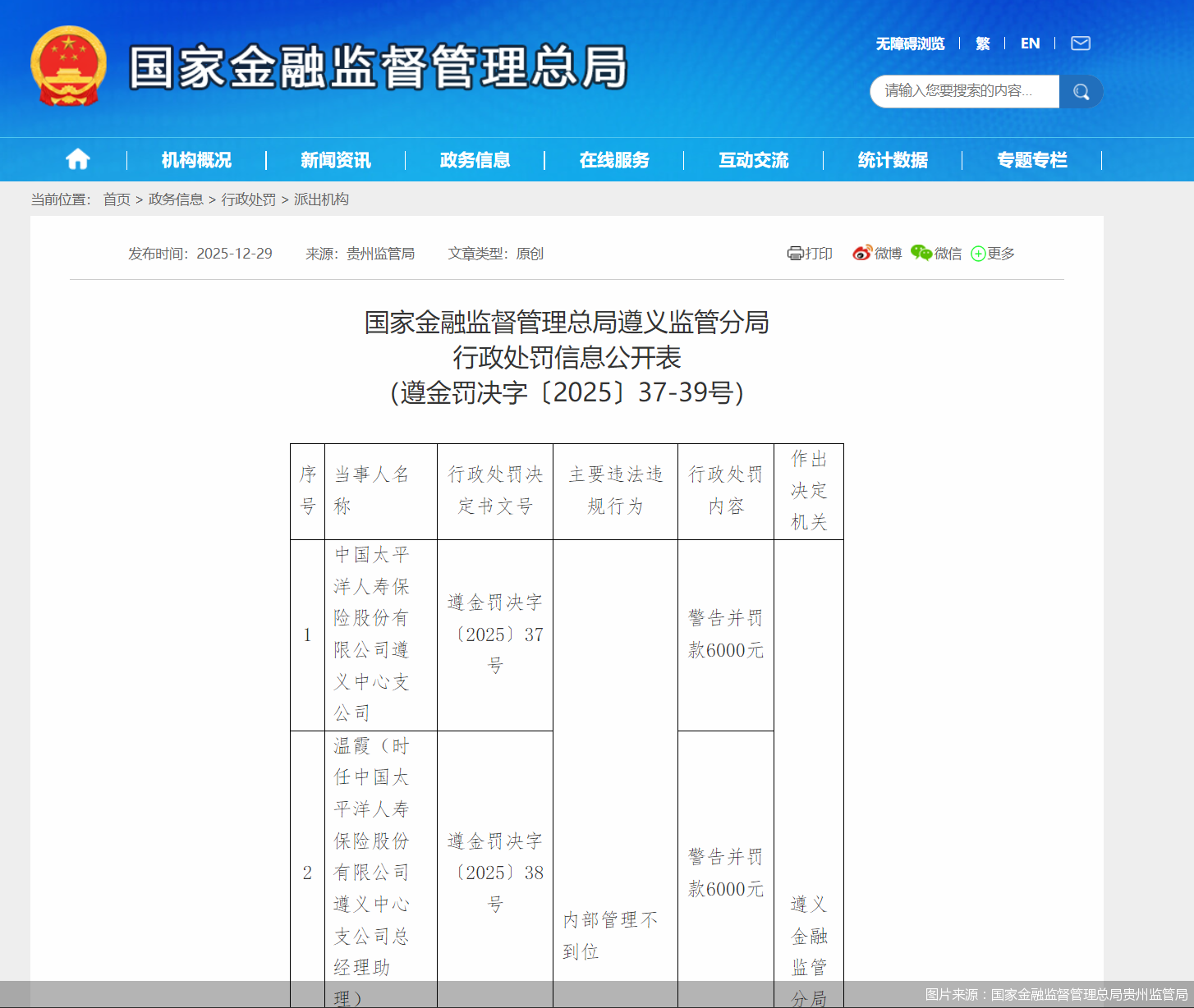
12月29日,国家金融监督管理总局贵州监管局发布行政处罚信息显示,中国太平洋人寿保险股份有限公司遵义中心支公司,因内部管理不到位,被警告并罚 款6000元。时任中国太平洋人寿保险股份有限公司遵义中心支公司总经理助理温霞,被警告并罚款6000元;时任中国太平洋人寿保险股份有限公司遵义中心 支公司消费者权益保护部经理杨光林被警告并罚款5000元。 | 国家金融监督管理总局 | | | | | | | 无障 请 | | --- | --- | --- | --- | --- | --- | --- | --- | | 个 机构概况 新闻资讯 政务信息 在线服务 互动交流 | | | | | | | 统计费 | | 当前位置: 首页 > 政务信息 > 行政处罚 > 派出机构 | | | | | | | | | 发布时间: 2025-12-29 | | 来源:贵州监管局 | 文章类型:原创 | | | 高打印 | る微博 | | 国家金融监督管理总局遵义监管分局 | | | | 行政处罚信息公开表 (遵令罚决字〔2025〕 37-39号) | | | | | 作品 | 序 | 当事人名 | 行政处罚决 | 主要违法违 ...
内部管理不到位,太保寿险遵义中心支公司合计被罚1.7万元
Bei Jing Shang Bao· 2025-12-29 09:41
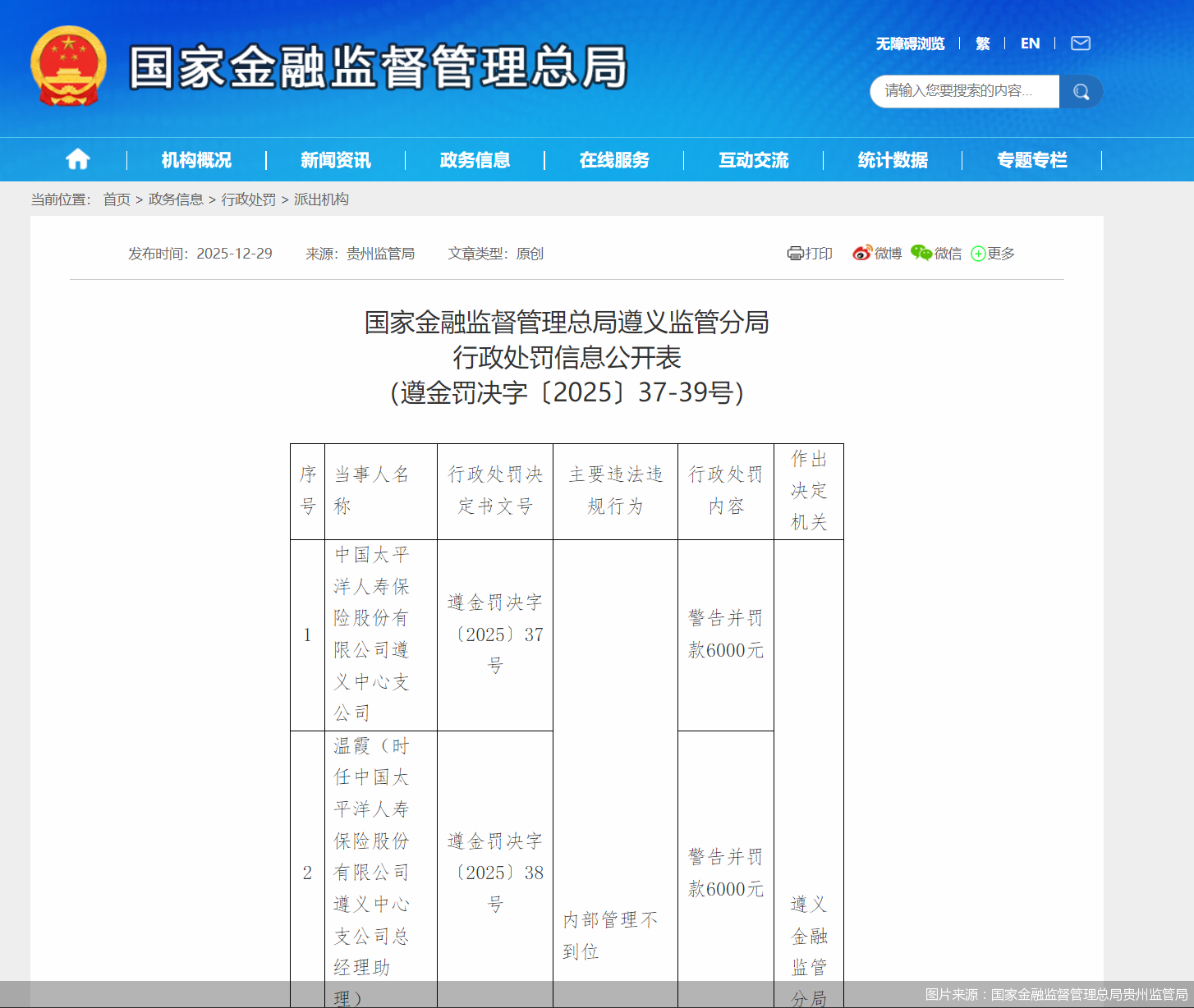
| 序 | 当事人名 | 行政处罚决 | 主要违法违 | 行政处罚 | 作出 | | --- | --- | --- | --- | --- | --- | | 름 | 称 | 定书文号 | 规行为 | 内容 | 决定 | | | | | | | 机关 | | 1 | 中国大平 洋人寿保 险股份有 限公司遵 | 遵金罚决字 (2025) 37 릉 | | 警告并罚 款6000元 | | | | 义中心支 | | | | | | | 公司 | | | | | | | 温霞(时 任中国大 平洋人寿 保险股份 | 遵金罚决字 | | 警告并罚 | | | 2 | 有限公司 | (2025) 38 | | | | | | 遵义中心 | 를 | 内部管理不 | 款6000元 | 遵义 | | | 支公司总 | | 到位 | | 金融 | | | 经理助 | | | | 监管 | | | 理) | | | | 分局 | 北京商报讯(记者 李秀梅)12月29日,国家金融监督管理总局贵州监管局发布行政处罚信息显示,中国太平洋人寿保险股份有限公司遵义中心支公司,因 内部管理不到位,被警告并罚款6000元。时任中国太平洋人寿保险 ...
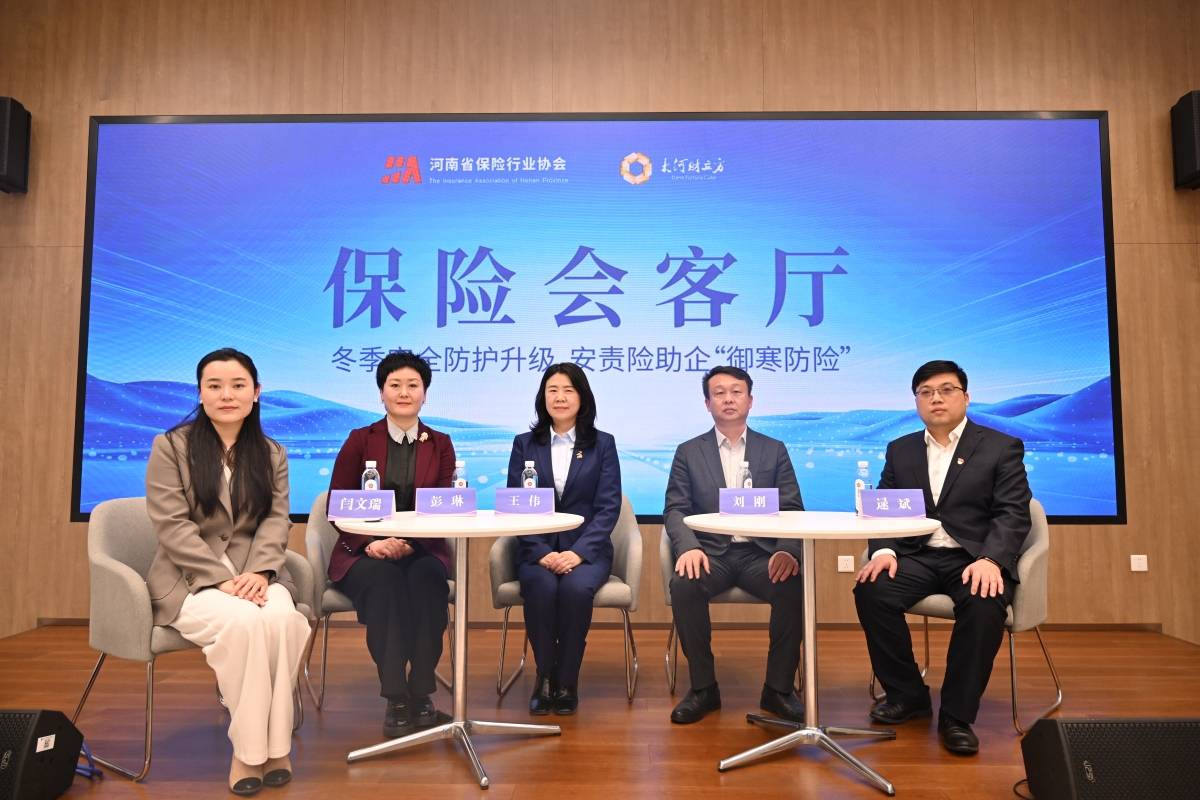
“保险会客厅”第六期:安责险如何为企业“御寒防险”?
Sou Hu Cai Jing· 2025-12-29 06:48
Core Viewpoint - The article emphasizes the importance of safety production during winter, highlighting the need for enhanced risk management strategies, particularly through the use of liability insurance for safety (安责险) to mitigate various seasonal risks faced by enterprises [5][10]. Group 1: Importance of Safety Insurance - The rising incidence of winter safety accidents underscores the dual value of safety liability insurance, which includes risk coverage and proactive prevention [5]. - Safety liability insurance has evolved from a focus on post-incident compensation to a comprehensive risk management approach that encompasses prevention, response, and compensation [5]. - In high-risk sectors such as mining and hazardous chemicals, the coverage rate for safety liability insurance in Henan is approximately 70%, with a market share of over 40% for People's Insurance Company of China (人保财险) [5]. Group 2: Product and Service Upgrades - Safety liability insurance offers unique advantages during winter, including comprehensive coverage for personal injury, property damage, emergency rescue, and legal costs [6]. - The insurance claims process has been streamlined, with mechanisms like green channels and advance payment, exemplified by a case where a death claim of 1.2 million yuan was settled within three working days [6][7]. - Free accident prevention services are highlighted as a key tool for winter risk management, with specialized teams providing on-site services and safety inspections [7]. Group 3: Collaborative Efforts and Policy Support - A provincial supervisory mechanism for safety liability insurance has been established in Henan, creating a closed-loop system involving insurance inspections, government oversight, and enterprise rectification [9]. - Multi-departmental collaboration has led to significant results, with inspections covering numerous high-risk enterprises and identifying thousands of safety hazards [9]. - Insurance companies are adopting differentiated pricing strategies to make safety liability insurance more accessible for small and medium-sized enterprises, with premiums as low as 500 yuan for certain sectors [9]. Group 4: Technological Empowerment - Technology plays a crucial role in enhancing risk management for safety liability insurance, with the integration of IoT and big data for real-time monitoring and risk assessment [10]. - The use of AI and IoT technologies allows for targeted risk management in high-risk areas, facilitating real-time sensing, intelligent analysis, and proactive measures [10]. - The long-term vision is to transition safety liability insurance from a reactive compensation model to a proactive prevention and process control framework, contributing to a smarter safety ecosystem [10].
保险行业周报(20251222-20251226):资负共振,驱动保险板块估值修复-20251229
Huachuang Securities· 2025-12-29 05:13
Investment Rating - The report maintains a "Recommended" rating for the insurance sector, expecting the industry index to outperform the benchmark index by more than 5% in the next 3-6 months [19]. Core Insights - The insurance index increased by 2.98%, outperforming the broader market by 1.03 percentage points. Individual stock performances varied, with notable increases from ZhongAn (+4.74%), Ping An (+3.51%), and China Pacific (+3.14%) [1]. - As of November 2025, the insurance industry is projected to achieve a cumulative original premium of 5.76 trillion yuan, with property insurance at 1.34 trillion yuan and life insurance at 4.42 trillion yuan [2]. - The report highlights a potential short-term upward trend in long-term interest rates, which may benefit the insurance sector. Despite anticipated performance pressure due to high investment bases in 2026, the report suggests that stabilizing interest rates and improving "spread" (investment income minus comprehensive liability costs) could drive valuation recovery [3][4]. Summary by Sections Market Performance - The insurance sector's absolute performance over the past 12 months is 33.4%, with a relative performance of 16.6% compared to the benchmark [6]. Company Valuations - The report provides PEV valuations for life insurance companies: China Life at 0.89x, Ping An at 0.86x, New China at 0.8x, and China Pacific at 0.69x. For H-shares, Ping An is at 0.74x, New China at 0.57x, and China Pacific at 0.54x [4]. - The report recommends focusing on companies with significant valuation recovery potential, such as China Life H and China Pacific [3]. Earnings Forecasts - Earnings per share (EPS) estimates for 2025E for key companies are as follows: China Pacific at 5.68 yuan, China Life at 6.34 yuan, New China at 12.62 yuan, China Pacific at 3.00 yuan, and China Property at 2.07 yuan. The report also provides PE and PB ratios for these companies, indicating a favorable investment outlook [4].
给予投保人合同约定以外利益等,太保寿险山西分公司合计被罚8.9万元
Bei Jing Shang Bao· 2025-12-26 12:44
北京商报讯(记者 胡永新)12月26日,国家金融监督管理总局山西监管局发布的行政处罚信息显示, 中国太平洋人寿保险股份有限公司山西分公司因给予投保人合同约定以外利益、未在规定时限内送达保 险合同至投保人,被责令改正,警告,罚款7.5万元。时任该公司银行保险部副总经理阎晓伟对给予投 保人合同约定以外利益的行为负有责任,被警告,并处1万元罚款。时任该公司消费者权益保护部总经 理王建云对未在规定时限内送达保险合同至投保人的行为负有责任,被警告,并处0.4万元罚款。 ...