Chongqing Rural Commercial Bank(03618)

Search documents
按揭、信用卡、消费贷与经营贷深度:深度银行四大零售资产的风险分析框架
ZHONGTAI SECURITIES· 2026-01-07 11:17
Investment Rating - The report maintains an "Overweight" rating for the banking sector [2] Core Insights - The four categories of retail loans (mortgages, credit cards, consumer loans, and business loans) collectively constitute household liabilities, each with distinct collateral types, duration structures, and policy influences. The report aims to establish a risk framework for these retail assets and assess their impact on banking operations in the future [2][4] - Under stress testing, the non-performing loan (NPL) ratios for mortgages, credit cards, and consumer loans are projected to increase by 11, 12, and 20 basis points respectively in 2026, while the growth in non-performing amounts remains manageable. The overall quality of corporate assets is expected to continue improving, indicating a stable banking sector [2][4] - Retail asset risks are deemed controllable, with policies expected to maintain stability in the near term [2] Summary by Sections Retail Asset Analysis Framework: Collateral Types + Duration Structure + Policy Impact - The overall NPL ratio for retail loans of listed banks is estimated at 1.27% in the first half of 2025, slightly above the corporate NPL ratio of 1.26%, but the increase in NPL ratios is stabilizing. The composition of existing NPLs is 63% corporate and 37% retail, with business loans and mortgages showing higher proportions of both existing and newly added NPLs [2][12] - The report establishes a risk analysis framework for retail assets, highlighting the differences in collateral types, duration structures, and policy impacts among the four categories of retail loans [2][4] Consumer Loans: "High-Risk" Assets - The relationship between consumer loans and consumption trends is closely aligned, with notable deviations occurring during strict property purchase restrictions and regulatory cycles for online loans. The market structure for consumer credit (excluding credit cards and mortgages) shows that listed banks hold over 51.5% of the market, while non-listed banks account for 17% and other players for 31% [2][4] - The risk logic for consumer credit indicates that risk pricing is primarily determined by interest rates, which can be categorized into four tiers based on risk levels. The report estimates that 4.4% of consumer loans fall into the "high-risk" category, with commercial banks' high-risk consumer loans representing only 0.6% of their total consumer loans [2][4] Mortgage Loans: Risk Sources and International Comparisons - The primary sources of mortgage risk include negative cash flow and high loan-to-value (LTV) ratios, with 1.2% of respondents reporting monthly incomes below their mortgage payments. The report anticipates that the current high LTV portion, which constitutes 2.9% of total mortgage balances, will not necessarily lead to increased NPLs [2][4] - International comparisons indicate that mortgage NPL ratios in most countries remain below 2%, suggesting that the risks in the domestic market are manageable [2][4] Business Loans: High-Risk Assets - The report estimates that approximately 2 trillion yuan of high-risk business loans were outstanding at the end of 2021, with nearly one-third of these high-risk assets already exposed. The peak of risk exposure is expected in 2024 and the first half of 2025, with NPL ratios projected to rise by 18 basis points to 1.96% under stress testing conditions [2][4] Credit Cards: Early NPL Exposure - Credit cards have historically shown early exposure to NPLs, with the NPL ratio at 2.44% in the first half of 2025. The report notes that the net increase in credit card NPLs has significantly decreased, indicating that credit cards are not currently a major pressure point for banks [2][4] Investment Recommendations - The report suggests two main investment lines for bank stocks: focusing on regional banks with strong certainty and advantages, particularly in areas like Jiangsu, Shanghai, Chengdu, Shandong, and Fujian, and recommending large banks with high dividend yields such as Agricultural Bank, Construction Bank, and Industrial and Commercial Bank [2][4]





大竹渝农商村镇银行4项违规被处罚 为渝农商行子公司
Zhong Guo Jing Ji Wang· 2026-01-06 06:36
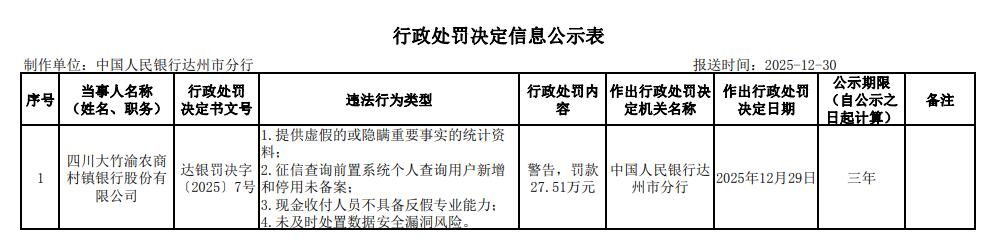
以下为原文: 中国经济网北京1月6日讯 中国人民银行达州市分行近日发布的行政处罚决定信息公示表(达银罚决字〔2025〕7号)显示,四川大竹渝农商 村镇银行股份有限公司存在以下违法行为类型:1.提供虚假的或隐瞒重要事实的统计资料;2.征信查询前置系统个人查询用户新增和停用未 备案;3.现金收付人员不具备反假专业能力;4.未及时处置数据安全漏洞风险。中国人民银行达州市分行对其警告,罚款27.51万元。 渝农商行(601077)2024年年度报告显示,四川大竹渝农商村镇银行股份有限公司是渝农商行的子公司,持股比例91%。 | 明上手段: 十四八尺次 < 川九月 | | | | TRANTH: 20GD 16 00 | | | | | | --- | --- | --- | --- | --- | --- | --- | --- | --- | | | 当事人名称 序号 | 行政处罚 | 违法行为类型 | 行政处罚内 作出行政处罚决 | | 作出行政处罚 | 公示期限 (自公示之 | 备注 | | | (姓名、职务) | 决定书文号 | | 答 | 定机关名称 | 决定日期 | 日起计算) | | | | | | 1 ...

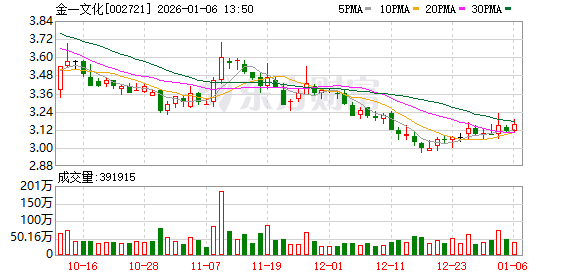
金一文化:开科唯识客户涵盖广西北部湾银行、贵州银行、桂林银行、渝农商行、柳州银行等金融机构
Mei Ri Jing Ji Xin Wen· 2026-01-06 05:49
Core Viewpoint - Jin Yi Culture (002721.SZ) is actively engaged in providing software development, technical services, operation maintenance, and consulting services primarily to financial institutions, focusing on wealth management and financial market solutions [2] Company Overview - The main business of Kai Ke Wei Shi is to offer software development and technical services in the fields of wealth management, financial markets, and payment clearing to banks and financial institutions [2] - Kai Ke Wei Shi's clients include several banks in the western region, such as Guangxi Beibu Gulf Bank, Guizhou Bank, Guilin Bank, Chongqing Rural Commercial Bank, and Liuzhou Bank [2]

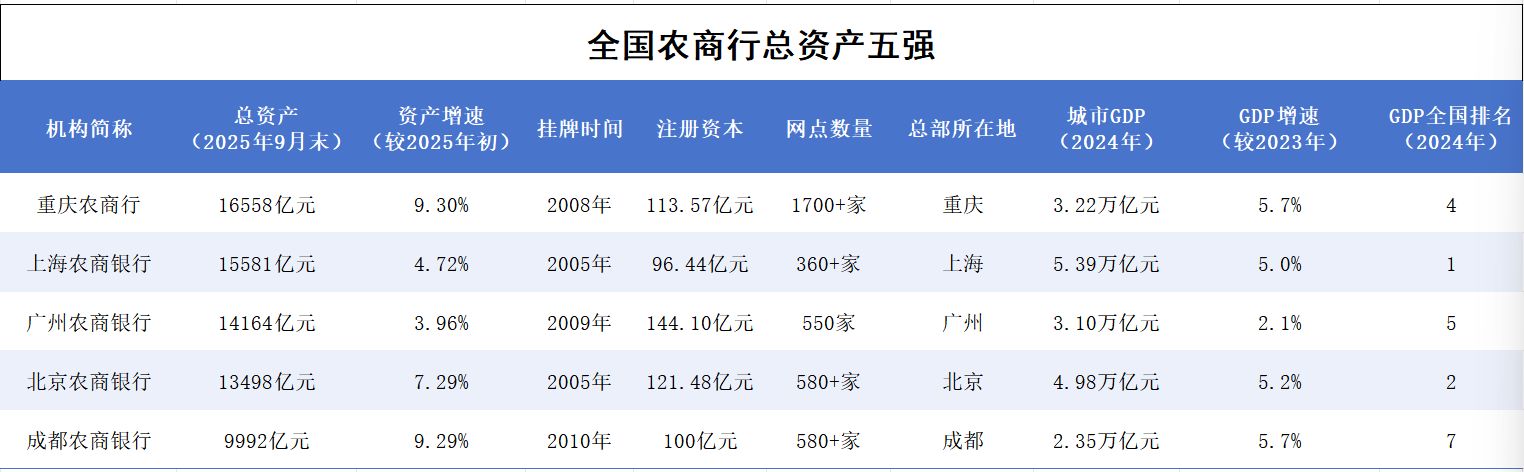
成都农商银行晋级万亿元:农商行头部阵营扩容至五家 金融资源“极化”趋势凸显
Mei Ri Jing Ji Xin Wen· 2026-01-04 15:24
Core Insights - Chengdu Rural Commercial Bank has officially announced that its asset scale has surpassed 1 trillion yuan as of December 31, 2025, joining the "trillion yuan club" alongside four other major rural commercial banks in China [1][3] - The emergence of these banks reflects a trend of financial resource concentration in economically vibrant regions, indicating a shift in China's regional economic development landscape [1][8] Group 1: Overview of the Trillion Yuan Club - The "trillion yuan era" for rural commercial banks began six years ago, with Chongqing Rural Commercial Bank being the first to exceed this threshold in June 2019 [2] - As of September 2025, the total assets of the five major rural commercial banks exceeded 11% of the total assets of all rural financial institutions in China, showcasing significant concentration effects [4] - The five banks—Chongqing, Shanghai, Guangzhou, Beijing, and Chengdu—are primarily located in major cities with strong economic performance, collectively accounting for over 14% of the national GDP [4] Group 2: Individual Bank Performance - As of September 2025, the asset scales of the five banks are as follows: Chongqing Rural Commercial Bank at 1.66 trillion yuan, Shanghai Rural Commercial Bank at 1.56 trillion yuan, Guangzhou Rural Commercial Bank at 1.42 trillion yuan, Beijing Rural Commercial Bank at 1.35 trillion yuan, and Chengdu Rural Commercial Bank at 999.2 billion yuan [6] - Each bank has developed unique strategies based on their regional characteristics, such as Beijing's focus on serving agriculture and small enterprises, and Shanghai's emphasis on wealth management and technology [10][11] Group 3: Strategic Implications - The formation of the "trillion yuan club" among these banks enhances their ability to support local infrastructure projects, providing greater financial autonomy for regional development [15] - The collective strength of these banks facilitates the integration of financial services across administrative boundaries, potentially lowering financing costs for businesses operating in multiple regions [15] - The emergence of this banking cluster is expected to contribute to the establishment of a Western financial center, attracting more financial resources and fostering innovation in financial products tailored to local industries [15]
渝农商行(601077) - 渝农商行H股公告
2026-01-04 08:45
FF301 股份發行人及根據《上市規則》第十九B章上市的香港預託證券發行人的證券變動月報表 截至月份: 2025年12月31日 狀態: 新提交 致:香港交易及結算所有限公司 公司名稱: 重慶農村商業銀行股份有限公司 呈交日期: 2026年1月2日 I. 法定/註冊股本變動 | 1. 股份分類 | 普通股 | 股份類別 | H | | | 於香港聯交所上市 (註1) | | 是 | | | --- | --- | --- | --- | --- | --- | --- | --- | --- | --- | | 證券代號 (如上市) | 03618 | 說明 | | | | | | | | | | | 法定/註冊股份數目 | | | 面值 | | | 法定/註冊股本 | | | 上月底結存 | | | 2,513,336,041 | RMB | | | 1 RMB | | 2,513,336,041 | | 增加 / 減少 (-) | | | | | | | RMB | | | | 本月底結存 | | | 2,513,336,041 | RMB | | | 1 RMB | | 2,513,336,041 | | ...
重庆农村商业银行(03618) - 截至2025年12月31日止月份之股份发行人的证券变动月报表
2026-01-02 08:31
致:香港交易及結算所有限公司 公司名稱: 重慶農村商業銀行股份有限公司 呈交日期: 2026年1月2日 FF301 股份發行人及根據《上市規則》第十九B章上市的香港預託證券發行人的證券變動月報表 截至月份: 2025年12月31日 狀態: 新提交 I. 法定/註冊股本變動 | 1. 股份分類 | 普通股 | 股份類別 | H | | | 於香港聯交所上市 (註1) | | 是 | | | --- | --- | --- | --- | --- | --- | --- | --- | --- | --- | | 證券代號 (如上市) | 03618 | 說明 | | | | | | | | | | | 法定/註冊股份數目 | | | 面值 | | | 法定/註冊股本 | | | 上月底結存 | | | 2,513,336,041 | RMB | | | 1 RMB | | 2,513,336,041 | | 增加 / 減少 (-) | | | | | | | RMB | | | | 本月底結存 | | | 2,513,336,041 | RMB | | | 1 RMB | | 2,513,336,041 | | ...
农商行板块12月31日涨0.94%,渝农商行领涨,主力资金净流入1263.96万元
Zheng Xing Xing Ye Ri Bao· 2025-12-31 09:06
Group 1 - The agricultural commercial bank sector increased by 0.94% on December 31, with Chongqing Rural Commercial Bank leading the gains [1] - The Shanghai Composite Index closed at 3968.84, up 0.09%, while the Shenzhen Component Index closed at 13525.02, down 0.58% [1] - The trading volume and turnover for Chongqing Rural Commercial Bank were 791,700 shares and 509 million yuan, respectively, with a price increase of 2.38% [1] Group 2 - The net inflow of main funds into the agricultural commercial bank sector was 12.64 million yuan, while retail investors experienced a net outflow of 39.35 million yuan [1] - The main net inflow for Changshu Bank was 22.32 million yuan, accounting for 13.28% of its trading volume [2] - Zhangjiagang Bank saw a main net inflow of 15.00 million yuan, representing 11.93% of its trading volume [2]



普益标准发布商业银行综合竞争力评价报告农商行百强榜(2025年),哪些银行上榜?
Xin Lang Cai Jing· 2025-12-31 07:14
Core Viewpoint - The 2025 ranking of the top 100 rural commercial banks in China highlights the competitive landscape, focusing on various dimensions of performance including comprehensive competitiveness, operational scale, profitability, stability, technological innovation, and brand building [3][4][6]. Comprehensive Competitiveness - The top ten banks in comprehensive competitiveness are: Chongqing Rural Commercial Bank, Shanghai Rural Commercial Bank, Beijing Rural Commercial Bank, Shenzhen Rural Commercial Bank, Chengdu Rural Commercial Bank, Dongguan Rural Commercial Bank, Guangzhou Rural Commercial Bank, Jiangsu Jiangnan Rural Commercial Bank, Tianjin Rural Commercial Bank, and Qingdao Rural Commercial Bank [1][8]. Operational Scale and Capital Strength - The leading banks in operational scale and capital strength are: Shanghai Rural Commercial Bank, Chongqing Rural Commercial Bank, Beijing Rural Commercial Bank, Guangzhou Rural Commercial Bank, Dongguan Rural Commercial Bank, Shenzhen Rural Commercial Bank, Chengdu Rural Commercial Bank, Jiangsu Jiangnan Rural Commercial Bank, Tianjin Rural Commercial Bank, and Guangdong Shunde Rural Commercial Bank [1][13]. Profitability - The top banks in profitability are: Shanghai Rural Commercial Bank, Chongqing Rural Commercial Bank, Chengdu Rural Commercial Bank, Jiangsu Changshu Rural Commercial Bank, Shenzhen Rural Commercial Bank, Hangzhou United Rural Commercial Bank, Beijing Rural Commercial Bank, Jiangsu Jiangnan Rural Commercial Bank, Dongguan Rural Commercial Bank, and Zhejiang Xiaoshan Rural Commercial Bank [1][18]. Stability - The banks excelling in stability are: Shanghai Rural Commercial Bank, Chongqing Rural Commercial Bank, Shenzhen Rural Commercial Bank, Dongguan Rural Commercial Bank, Jiangsu Jiangnan Rural Commercial Bank, Tianjin Rural Commercial Bank, Guangzhou Rural Commercial Bank, Beijing Rural Commercial Bank, Shaanxi Qinong Rural Commercial Bank, and Wuhan Rural Commercial Bank [1][6]. Technological and Service Innovation Capability - The top banks in technological and service innovation capability are: Chongqing Rural Commercial Bank, Shanghai Rural Commercial Bank, Beijing Rural Commercial Bank, Chengdu Rural Commercial Bank, Guangzhou Rural Commercial Bank, Jiangsu Suzhou Rural Commercial Bank, Shenzhen Rural Commercial Bank, Qingdao Rural Commercial Bank, Tianjin Rural Commercial Bank, and Dongguan Rural Commercial Bank [2][6]. Brand Building Capability - The leading banks in brand building capability are: Chongqing Rural Commercial Bank, Shanghai Rural Commercial Bank, Jiangsu Zijin Rural Commercial Bank, Dongguan Rural Commercial Bank, Jiangsu Kunshan Rural Commercial Bank, Shenzhen Rural Commercial Bank, Jiangsu Jiangnan Rural Commercial Bank (tied for seventh), Zhejiang Shaoxing Ruifeng Rural Commercial Bank (tied for seventh), Beijing Rural Commercial Bank, and Chengdu Rural Commercial Bank [2][6].

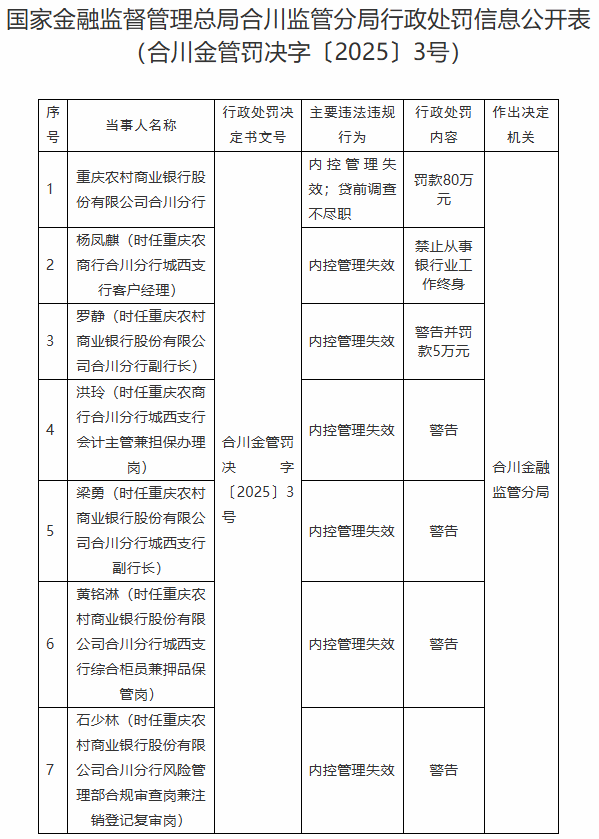
渝农商行合川分行被罚 内控管理失效贷前调查不尽职
Zhong Guo Jing Ji Wang· 2025-12-31 03:25
Summary of Key Points Core Viewpoint - The Chongqing Rural Commercial Bank's Hechuan branch faced administrative penalties due to internal control failures and inadequate pre-loan investigations, resulting in a fine of 800,000 yuan [1][4]. Group 1: Administrative Penalties - The Hechuan branch of Chongqing Rural Commercial Bank was fined 800,000 yuan for internal control management failures and inadequate pre-loan investigations [1][4]. - Yang Fengqi, a customer manager at the Hechuan branch, was held responsible for the internal control failures and is permanently banned from working in the banking industry [1][4]. - Luo Jing, the deputy branch manager, received a warning and a fine of 50,000 yuan for the same violations [1][4]. Group 2: Other Responsible Individuals - Hong Ling, the accounting supervisor and guarantee processing position holder, received a warning for internal control failures [1][2]. - Liang Yong, the deputy branch manager, was also warned for the same violations [1][2]. - Huang Minglin, a comprehensive teller and collateral custodian, received a warning for internal control failures [1][2]. - Shi Shaolin, responsible for compliance review and deregistration at the risk management department, was warned for internal control failures [2].
江苏异地村镇银行“收编”再落子,跨行吸收合并路径清晰
Hua Xia Shi Bao· 2025-12-30 14:44
本报(chinatimes.net.cn)记者张萌 卢梦雪 北京报道 江苏省内村镇银行改革再现新进展。 12月29日,苏州农商银行召开临时会议,审议通过了关于吸收合并江苏张家港渝农商村镇银行股份有限 公司(下称"张家港渝农商村镇银行")并设立分支机构的议案。该议案尚需提交该行股东会审议。 此前,重庆农商银行作为主发起行,曾以2.41亿元挂牌转让其持有的张家港渝农商村镇银行全部90%股 权。如今,该项交易即将落地。 据Wind数据显示,这将是江苏省内第8家由异地主发起行设立、后被省内农商银行吸收合并的村镇银 行。 据Wind数据,截至目前,江苏省内已有8家由异地主发起行设立的村镇银行启动或完成改革。 2.41亿元挂牌转让 12月19日,重庆农商银行在重庆市公共资源交易网披露,拟挂牌转让其持有的张家港渝农商村镇银行全 部1.8亿股股份,占该行总股本的90%,转让底价为2.41亿元。 从经营数据来看,张家港渝农商村镇银行仍保持盈利状态。挂牌信息显示,该行2024年实现营业收入 2457.67万元,净利润达2032.94万元;2025年前10个月,该行营业收入和净利润分别为1909.92万元和 780.75万元。不过 ...