
Chongqing Rural Commercial Bank(03618)

Search documents
花旗:予重庆农村商业银行纳入90日正面催化剂观察名单 评级“买入”
Zhi Tong Cai Jing· 2026-02-06 08:09
Core Viewpoint - Citigroup has set a target price of HKD 7.53 for Chongqing Rural Commercial Bank (03618) and maintains a "Buy" rating, placing the bank on a 90-day positive catalyst watchlist, anticipating that its upcoming Q4 2025 earnings report (expected on March 25) will likely exceed market forecasts [1] Financial Performance Expectations - The bank is expected to achieve a year-on-year profit growth of 16% for the quarter, which implies a 5% growth for the entire previous year, surpassing market consensus by approximately 1% [1] - Citigroup forecasts that Chongqing Rural Commercial Bank's revenue and profit growth will accelerate to 5% and 10% year-on-year, respectively, driven by strong corporate loan growth, stable net interest margins, and increased income from bank insurance, wealth management, and precious metals-related fees, which are expected to double year-on-year [1]
花旗:予重庆农村商业银行(03618)纳入90日正面催化剂观察名单 评级“买入”
智通财经网· 2026-02-06 08:06
Group 1 - The core viewpoint of the article is that Citigroup has set a target price of HKD 7.53 for Chongqing Rural Commercial Bank (03618) and maintains a "Buy" rating, placing the bank on a 90-day positive catalyst watchlist, anticipating that its upcoming Q4 2025 earnings report (expected on March 25) will likely exceed market forecasts [1] - Citigroup projects a 16% year-on-year increase in the bank's quarterly profit, which implies a 5% growth in full-year profit compared to last year, exceeding market consensus predictions [1] - The expected acceleration in revenue and profit growth for Chongqing Rural Commercial Bank this year is forecasted at 5% and 10% year-on-year, respectively, driven by strong corporate loan growth, stable net interest margins, and significant increases in income from bank insurance, wealth management, and precious metals-related fees [1]
2026 银行人事第一波!4 位高管兼任首席合规官,履历太耀眼!
Xin Lang Cai Jing· 2026-02-05 12:18
Group 1: Qilu Bank - Qilu Bank announced a board resolution on February 4, approving the appointment of current president Zhang Hua as Chief Compliance Officer, with a term ending on August 10, 2026 [1][6] - Zhang Hua, born in June 1966, holds a bachelor's and master's degree, and has extensive practical experience in banking, having risen through the ranks at Qilu Bank [1][6] - His career includes key positions such as branch manager and head of credit management, as well as experience in local government financial oversight, enhancing his compliance management expertise [1][6] Group 2: Chongqing Rural Commercial Bank - On January 29, Chongqing Rural Commercial Bank's board approved the appointment of president Sui Jun as Chief Compliance Officer, with unanimous support from the board [2][7] - Sui Jun, born in December 1968, is a member of the Communist Party and holds a doctoral degree in economics, with a rich background in banking [2][7] - His previous roles include various leadership positions in both Chongqing Rural Commercial Bank and China Construction Bank, showcasing his extensive experience in the financial sector [2][7] Group 3: Xiamen Bank - Xiamen Bank announced on January 28 that its board approved the appointment of assistant president and Chief Risk Officer Chen Song as Chief Compliance Officer, pending regulatory approval [3][8] - Chen Song, born in May 1974, has a strong background in risk management and compliance, having held various positions in banking [3][8] - His experience includes roles at Industrial Bank and Ping An Bank, contributing to his qualifications in risk control and compliance management [3][8] Group 4: Pudong Development Bank - On January 24, Pudong Development Bank's board approved the appointment of Cui Bingwen as Chief Risk Officer, Chief Compliance Officer, and General Counsel, with a term aligned with the current board [4][8] - Cui Bingwen, born in 1969, holds a doctoral degree and has extensive banking experience, having served in various leadership roles [4][8] - His career includes significant positions at Industrial and Commercial Bank of China and Pudong Development Bank, enhancing his expertise in legal and compliance matters [4][8]

银行股集体上扬,渝农商行涨超2%成“领头羊,渝农商行涨超2%领跑,多股跟涨超1%
Ge Long Hui· 2026-02-04 02:02
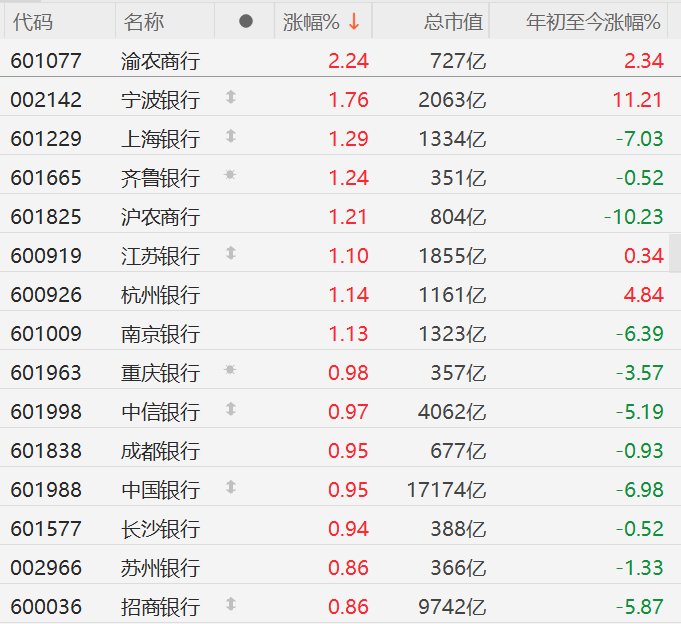
此次银行(核心股)股的集体上扬,也吸引了众多投资者的目光。市场分析人士认为,银行股作为大盘 蓝筹股的重要组成部分,其稳定的表现和较高的股息率,对于追求稳健收益的投资者具有较强的吸引 力。未来,随着银行业基本面的不断改善和市场信心的逐步恢复,银行股有望继续保持良好的上涨态 势。 股票频道更多独家策划、专家专栏,免费查阅>> 责任编辑:栎树 2月4日,A股市场银行(核心股)板块表现亮眼,呈现出集体上涨的态势,为市场注入了一股强劲动 力。在众多银行股中,渝农商行表现尤为突出,涨幅超过2%,成为银行板块中的领涨先锋。与此同 时,宁波银行、上海银行、齐鲁银行、沪农商行、江苏银行、杭州银行、南京银行等也纷纷跟涨,涨幅 均超过1%。 | 代码 | 名称 | | 涨幅% ↓ | 总市值 | 年初至今涨幅%。 | | --- | --- | --- | --- | --- | --- | | 601077 | 渝农商行 | | 2.24 | 727亿 | 2.34 | | 002142 | 宁波银行 | 1 | 1.76 | 2063亿 | 11.21 | | 601229 | 上海银行 | 1 | 1.29 | 1334 乙 ...

A股银行股集体上涨,渝农商行涨超2%
Ge Long Hui A P P· 2026-02-04 01:57
Group 1 - A-shares of bank stocks collectively rose, with notable increases in stocks such as Chongqing Rural Commercial Bank, which rose over 2%, and several others including Ningbo Bank, Shanghai Bank, and Qilu Bank, which rose over 1% [1] - Specific stock performance includes Chongqing Rural Commercial Bank increasing by 2.24% with a total market value of 72.7 billion, and Ningbo Bank rising by 1.76% with a market value of 206.3 billion [2] - The year-to-date performance shows significant variations, with Ningbo Bank up 11.21%, while Shanghai Bank down 7.03%, and Hu'nong Commercial Bank down 10.23% [2] Group 2 - The MACD golden cross signal has formed, indicating a positive trend for these bank stocks [2]



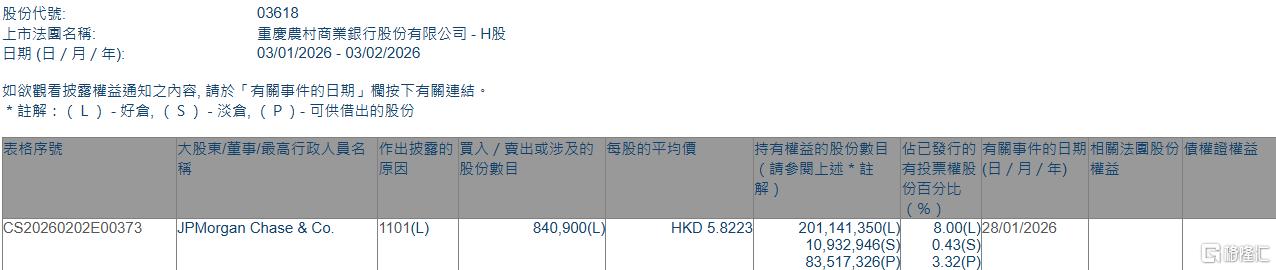
重庆农村商业银行(03618.HK)获摩根大通增持84.09万股
Ge Long Hui· 2026-02-03 13:40
Group 1 - JPMorgan Chase & Co. increased its stake in Chongqing Rural Commercial Bank by purchasing 840,900 shares at an average price of HKD 5.8223 per share, totaling approximately HKD 4.896 million [1] - Following this transaction, JPMorgan's total holdings in Chongqing Rural Commercial Bank rose to 201,141,350 shares, increasing its ownership percentage from 7.96% to 8.00% [1][2]
丈量地方性银行(2):浙江163家区域性银行全梳理-20260203
GF SECURITIES· 2026-02-03 13:31
Investment Rating - The industry investment rating is "Buy" [2] Core Insights - The report provides a comprehensive analysis of 163 regional banks in Zhejiang Province, highlighting their asset and liability structures, profitability, and asset quality [6][20] - The asset growth rate for major city commercial banks in Zhejiang is 9.4%, which is lower than the 14.2% growth rate of listed city commercial banks, while major rural commercial banks show an asset growth rate of 8.0%, exceeding the 6.7% growth rate of listed rural commercial banks [6][25] - The report indicates that the loan-to-asset ratio for city commercial banks is projected to reach 55.5% in 2024, an increase of 95 basis points year-on-year, while rural commercial banks will see a decrease to 59.3%, down 19 basis points [31] - Profitability metrics show that the average Return on Assets (ROA) for city commercial banks in Zhejiang is 0.78%, slightly above the average of listed city commercial banks, while rural commercial banks have an average ROA of 0.82%, which is below the average of listed rural commercial banks [6][31] - The asset quality of regional banks in Zhejiang is reported to be better than that of listed banks, with non-performing loan ratios lower by 16 basis points for city commercial banks and 9 basis points for rural commercial banks compared to their listed counterparts [6][31] Summary by Sections Section 1: Economic Structure of Zhejiang Province - Zhejiang Province is focused on high-quality development and aims to become a model for common prosperity [13] - The province's GDP is heavily concentrated in cities like Hangzhou, Ningbo, and Wenzhou, with Hangzhou accounting for 24.3% of the total GDP in 2025 [15] Section 2: Overview of 163 Regional Banks - The report categorizes the banks into city commercial banks, rural banks, and others, with a total of 163 banks in the region [20] - The distribution of registered capital among these banks is relatively balanced, with 63 banks having over 500 million yuan in registered capital [22] Section 3: Asset and Liability Structure - The asset growth of major city and rural commercial banks has been declining since 2019, with city banks showing a growth rate of 9.4% in the first half of 2025 [25] - The liability structure indicates that customer deposits account for 77.5% of liabilities for city commercial banks, which is higher than the 66.2% for listed city banks [44] Section 4: Profitability and Asset Quality - The average ROE for city commercial banks in Zhejiang is 11.98%, slightly lower than the average of listed city banks [6][31] - The report highlights that the non-performing loan ratio for city commercial banks is lower than that of listed banks, indicating better asset quality [6][31]




小摩增持重庆农村商业银行84.09万股 每股作价约5.82港元
Zhi Tong Cai Jing· 2026-02-03 11:15
联交所最新资料显示,1月28日,小摩增持重庆农村商业银行(03618)84.09万股,每股作价5.8223港元, 总金额约为489.6万港元。增持后最新持股数目约为2.01亿股,最新持股比例为8%。 ...
小摩增持重庆农村商业银行(03618)84.09万股 每股作价约5.82港元
智通财经网· 2026-02-03 11:12
智通财经APP获悉,联交所最新资料显示,1月28日,小摩增持重庆农村商业银行(03618)84.09万股,每 股作价5.8223港元,总金额约为489.6万港元。增持后最新持股数目约为2.01亿股,最新持股比例为 8%。 ...
银行行业深度报告:2026年净息差展望:筑底企稳
KAIYUAN SECURITIES· 2026-02-03 05:46
Investment Rating - The industry investment rating is "Positive" (maintained) [1] Core Insights - The report indicates that the net interest margin (NIM) for listed banks is expected to slightly narrow by 4 basis points in 2026, with pressure concentrated in the first half of the year [5][49] - The theoretical NIM is estimated to support a risk-weighted asset (RWA) growth rate of around 6%, with a bottom line NIM of approximately 1.44%-1.57% [17] - The report highlights that the deposit pricing structure has improved, leading to a reduction in deposit costs, which supports the stabilization of NIM [4][23] Summary by Sections 1. NIM Outlook - The NIM for listed banks is projected to narrow by 4 basis points in 2026, primarily due to factors affecting both the asset and liability sides [5][49] - The asset side will experience a negative impact from loan repricing and bond investment returns, while the liability side will benefit from the repricing of high-interest deposits [49][53] 2. Deposit Pricing Dynamics - The average deposit cost for listed banks is expected to decrease by 15 basis points to 1.35% in 2026, driven by the maturity of high-interest deposits [7][8] - The report notes that the repricing of maturing deposits will contribute positively to the improvement of deposit costs by approximately 14.7 basis points [8][29] 3. Investment Recommendations - The report recommends a bottom-line allocation to large state-owned banks, with specific beneficiaries identified as Agricultural Bank of China and Industrial and Commercial Bank of China [9] - Core allocations should focus on leading comprehensive banks, with China Merchants Bank and Industrial Bank highlighted as key beneficiaries [9] 4. Market Trends - The report discusses the trend of deposit non-bankization, which negatively impacts the overall deposit cost rate, indicating a shift in deposit structures [34][37] - It also mentions that the competitive landscape for deposit pricing has eased, reducing the "involution" in deposit competition among banks [45][46]


