
BANK OF QINGDAO(03866)

Search documents
智通港股通占比异动统计|11月7日
Zhi Tong Cai Jing· 2025-11-07 01:15
Core Insights - The article highlights the changes in the Hong Kong Stock Connect holdings, with notable increases and decreases in ownership percentages for various companies [1][2] Group 1: Significant Increases in Holdings - Qingdao Bank (03866) saw the largest increase in holdings, up by 2.24% to a total of 14.87% [1] - Qin Port Co. (03369) and Guotai Junan International (01788) also experienced significant increases of 0.84% and 0.78%, bringing their holdings to 44.42% and 14.70% respectively [1] - Over the last five trading days, Qingdao Bank (03866) had the highest increase at 7.31%, followed by Hang Seng China Enterprises (02828) at 6.53% and Anjuke Food (02648) at 3.86% [1] Group 2: Significant Decreases in Holdings - Shandong Molong (00568) experienced the largest decrease in holdings, down by 0.87% to 58.74% [1] - Other notable decreases include China Merchants Energy (01138) and Lens Technology (06613), which saw reductions of 0.84% and 0.80%, resulting in holdings of 69.25% and 15.88% respectively [1] - Over the last five trading days, the largest decrease was recorded by Changfei Optical Fiber (06869) at -4.32%, followed by Delin Holdings (01709) at -3.75% and ZTE Corporation (00763) at -2.86% [1] Group 3: Long-term Trends in Holdings - Over the past 20 days, GX Hang Seng Technology (02837) had the highest increase in holdings at 19.01%, followed by Ying'en Bio-B (09606) at 16.05% [2] - Qingdao Bank (03866) also showed a significant increase of 7.76% over the same period, indicating a positive trend in investor interest [2] - Conversely, Changfei Optical Fiber (06869) recorded the largest decrease in holdings over 20 days at -10.14%, indicating potential concerns among investors [2]
智通港股通资金流向统计(T+2)|11月7日
智通财经网· 2025-11-06 23:34
Key Points - The top three companies with net inflows of southbound funds are China National Offshore Oil Corporation (CNOOC), Xiaomi Group, and Southern Hang Seng Technology, with net inflows of 1.045 billion, 0.998 billion, and 0.766 billion respectively [1] - The top three companies with net outflows of southbound funds are Alibaba Group, Sunny Optical Technology, and Luoyang Molybdenum, with net outflows of -0.873 billion, -0.339 billion, and -0.254 billion respectively [1] - In terms of net inflow ratio, Qingdao Bank, Dasheng Holdings, and Shougang Resources lead the market with ratios of 86.77%, 70.86%, and 63.91% respectively [1] - The companies with the highest net outflow ratios are Pacific Basin Shipping, Yimaitong, and Sichuan Chengyu Expressway, with ratios of -54.77%, -46.94%, and -37.64% respectively [1] Net Inflow Rankings - The top ten companies by net inflow include CNOOC (1.045 billion), Xiaomi Group (0.998 billion), and Southern Hang Seng Technology (0.766 billion) [2] - Other notable companies in the net inflow list are China Mobile (0.752 billion), Industrial and Commercial Bank of China (0.531 billion), and China Petroleum (0.431 billion) [2] Net Outflow Rankings - The top ten companies by net outflow include Alibaba Group (-0.873 billion), Sunny Optical Technology (-0.339 billion), and Luoyang Molybdenum (-0.254 billion) [2] - Other significant companies with net outflows are SMIC (-0.240 billion), Jiangxi Copper (-0.220 billion), and Bilibili (-0.200 billion) [2] Net Inflow Ratio Rankings - The top three companies by net inflow ratio are Qingdao Bank (86.77%), Dasheng Holdings (70.86%), and Shougang Resources (63.91%) [2][3] - Other companies with high net inflow ratios include Wanwuyun (61.22%) and Prudential (60.12%) [3] Net Outflow Ratio Rankings - The top three companies by net outflow ratio are Pacific Basin Shipping (-54.77%), Yimaitong (-46.94%), and Sichuan Chengyu Expressway (-37.64%) [3] - Other companies with significant net outflow ratios include Yancoal Australia (-34.65%) and Lens Technology (-33.16%) [3]




Q3单季营收却“掉链子”?青岛银行营利双增背后藏隐忧
智通财经网· 2025-11-06 08:21
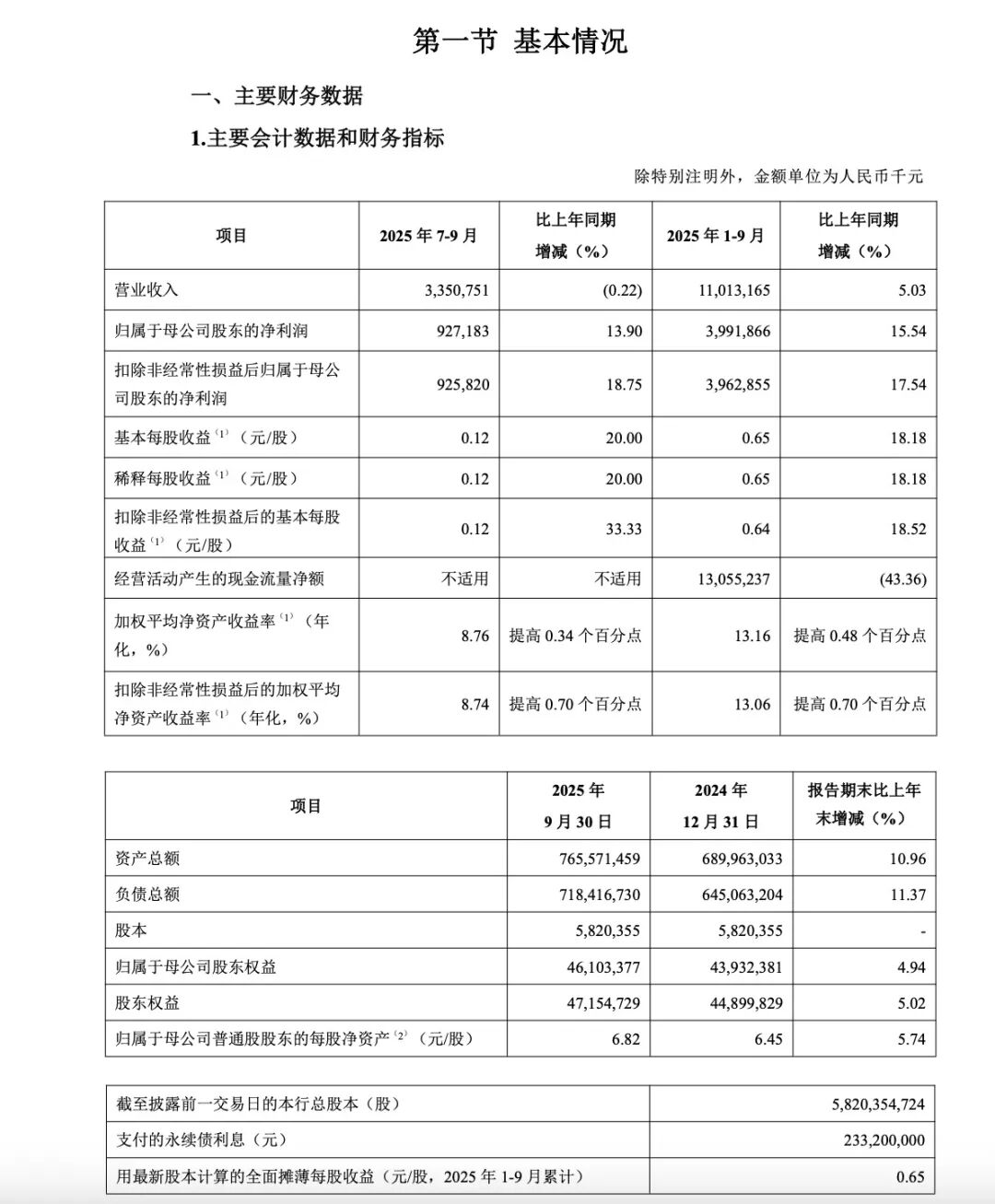
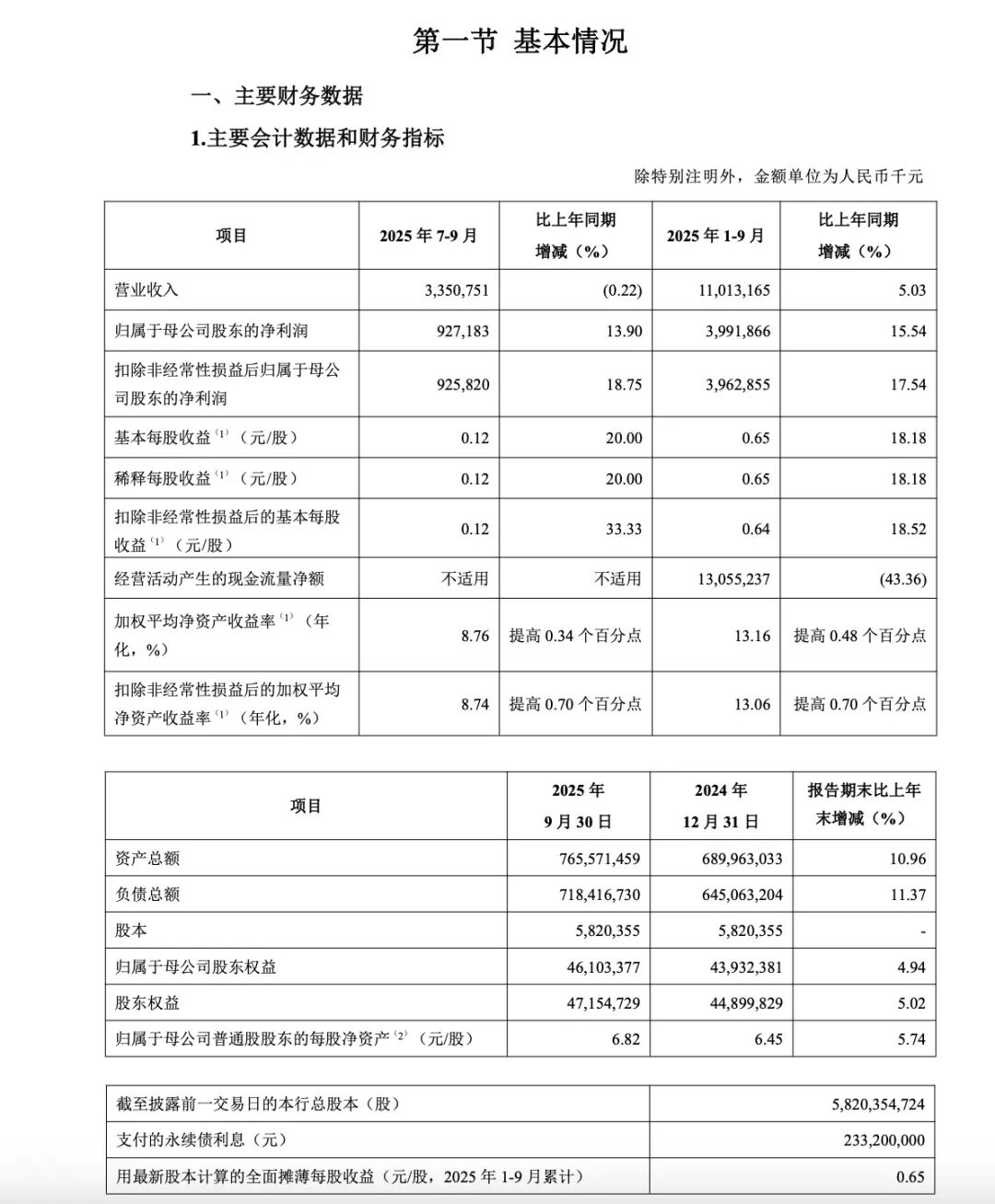
Core Viewpoint - Qingdao Bank's Q3 2025 report shows a slight decline in quarterly revenue, contrasting with overall growth in the first three quarters, highlighting challenges in non-interest income and management adjustments [1][2][5]. Financial Performance - For Q3 2025, Qingdao Bank reported revenue of 3.35 billion yuan, a minor decrease of 0.22% year-on-year, while total revenue for the first three quarters reached 11.01 billion yuan, up 5.03% [4][5]. - Net profit attributable to shareholders for Q3 was 927.18 million yuan, reflecting a 13.90% increase, and for the first three quarters, it was 3.99 billion yuan, up 15.54% [4][6]. - The bank's interest income for the first three quarters was 17.22 billion yuan, a year-on-year increase of 5.89%, while interest expenses decreased by 2.83 billion yuan [6]. Non-Interest Income Challenges - Non-interest income for the first three quarters was 2.87 billion yuan, down 10.72% year-on-year, primarily due to declines in investment income and fees from wealth management [5][6]. - The bank's reliance on non-interest income from the bond market and wealth management services exposes it to market fluctuations, indicating a lack of diversification in revenue sources [5][6]. Asset Quality and Capital Adequacy - As of September 30, 2025, the non-performing loan ratio was 1.10%, a decrease of 0.04 percentage points from the end of the previous year, with a provision coverage ratio of 269.97% [7][8]. - The capital adequacy ratio stood at 13.14%, below the industry average of approximately 15.8%, indicating a need for improved capital strength [8][9]. Management and Governance Changes - Qingdao Guoxin Group plans to increase its stake in Qingdao Bank to 19.99%, enhancing state-owned capital's influence in governance [9][10]. - Recent management changes include key personnel shifts across the bank's headquarters and branches, aimed at revitalizing operations and addressing challenges in non-interest income [10][11]. Wealth Management Performance - Qingyin Wealth Management has faced declining performance, with assets under management dropping from 2 trillion yuan in 2024 to 1.89 trillion yuan by mid-2025, alongside significant decreases in revenue and net profit [12][13].

Q3单季营收却“掉链子”?青岛银行(002948.SZ)营利双增背后藏隐忧
智通财经网· 2025-11-06 08:15
Core Viewpoint - Qingdao Bank's Q3 2025 report shows a slight decline in quarterly revenue, contrasting with overall growth in the first three quarters, highlighting challenges in non-interest income and management adjustments [1][2][6]. Financial Performance - In Q3 2025, Qingdao Bank reported revenue of 3.35 billion yuan, a minor decrease of 0.22% year-on-year, while the first three quarters saw total revenue of 11.01 billion yuan, up 5.03% [4][6]. - Net profit attributable to shareholders for Q3 was 927.18 million yuan, an increase of 13.90%, with a year-to-date net profit of 3.99 billion yuan, reflecting a 15.54% rise [4][8]. - The bank's interest income reached 17.22 billion yuan in the first three quarters, up 5.89%, while interest expenses decreased by 2.83 billion yuan [8]. Non-Interest Income Challenges - Non-interest income for the first three quarters was 2.87 billion yuan, down 10.72% year-on-year, primarily due to declines in investment income and fees from wealth management [7][8]. - The bank's reliance on non-interest income from bond markets and wealth management exposes it to market fluctuations, indicating a need for diversification in revenue sources [7][8]. Asset Quality and Capital Adequacy - As of September 30, 2025, the non-performing loan ratio was 1.10%, down 0.04 percentage points from the previous year, with a provision coverage ratio of 269.97%, up 28.65 percentage points [9][10]. - The capital adequacy ratio stood at 13.14%, below the industry average of approximately 15.8%, indicating a need for capital strengthening [12][13]. Shareholder and Management Changes - Qingdao Guoxin Group plans to increase its stake in Qingdao Bank to 19.99%, enhancing state-owned capital's influence in governance [13][14]. - Recent management changes include key personnel shifts across the bank's headquarters and branches, aimed at revitalizing operations and addressing challenges in non-interest income [13][14][15]. Wealth Management Performance - Qingyin Wealth Management has faced declining performance, with assets under management dropping from 2,081.22 billion yuan in 2023 to below 2,000 billion yuan in 2024, and a significant decrease in revenue and net profit [16].
五家银行跻身绿色信贷“万亿俱乐部” 绿色债券存量规模近2万亿
2 1 Shi Ji Jing Ji Bao Dao· 2025-11-05 23:42
Core Insights - Green finance has transitioned from an optional choice to a mandatory requirement for the banking industry, serving as a new engine for strategic transformation and a blue ocean market for future growth [1] - The balance of green financing at Industrial Bank has reached nearly 2.5 trillion yuan, with green loans exceeding 1 trillion yuan and a non-performing loan rate of only 0.57% [1] - The People's Bank of China and other departments have issued a unified policy framework for green finance, effective from October 1, 2025, to standardize various financial products [2] Group 1: Green Credit Growth - As of the end of 2024, the total balance of green credit among 42 A-share listed banks exceeded 27 trillion yuan, reflecting a year-on-year growth of approximately 20% [3] - State-owned banks dominate the green credit market, with the six major state-owned banks accounting for over 21 trillion yuan, representing 77.6% of the total [3] - Industrial Bank's green loan balance has risen to 1.08 trillion yuan, joining the "trillion club" [3] Group 2: Performance and Sector Focus - The average growth rate of green credit for A-share listed banks in 2024 was 20.6%, a slowdown from approximately 28% in 2023, yet leading institutions maintained strong growth [4] - The focus of green credit issuance is concentrated in four key areas: clean energy, green transportation, energy conservation and environmental protection, and green buildings [4] - The Yangtze River Delta, Guangdong-Hong Kong-Macau Greater Bay Area, and Chengdu-Chongqing Economic Circle are identified as core regions for green credit [4] Group 3: Product Innovation - A-share listed banks are deepening innovation in green financial products, creating a multi-dimensional product system that includes loans, bonds, asset securitization, insurance, and carbon finance [5] - Sustainable Development Linked Loans (SLL), carbon emission rights pledge financing, and environmental rights collateral loans are gaining traction [5] - Industrial Bank has launched the first green loan with biodiversity protection insurance, while Bohai Bank introduced a green loan linked to data center energy efficiency [6] Group 4: Broader Financial Tools - The issuance of green bonds has expanded, with the cumulative issuance of labeled green bonds in 2024 surpassing 4 trillion yuan [6] - Banks are actively participating in green wealth management and fund products, enhancing investor engagement through innovative offerings [6] - Carbon finance tools are transitioning from pilot programs to broader applications, with various banks introducing carbon emission rights pledge financing products [6] Group 5: Future Directions - The banking industry is expected to continue innovating green financial products to support sustainable economic development, moving beyond traditional green credit [7] - The development of ESG-linked loans and financing models using carbon emission rights as collateral will be explored [7] - These innovations will not only assist in achieving national carbon reduction goals but also cultivate new growth momentum for banks [7]


智通港股通资金流向统计(T+2)|11月6日
智通财经网· 2025-11-05 23:32
Key Points - Xiaomi Group-W (01810), China National Offshore Oil Corporation (00883), and CanSino Biologics (09926) ranked the top three in net inflow of southbound funds, with net inflows of 1.03 billion, 0.99 billion, and 0.53 billion respectively [1] - Semiconductor Manufacturing International Corporation (00981), Alibaba Group Holding Limited-W (09988), and the Tracker Fund of Hong Kong (02800) ranked the top three in net outflow of southbound funds, with net outflows of -1.38 billion, -0.96 billion, and -0.70 billion respectively [1] - In terms of net inflow ratio, Qingdao Bank (03866), Tsingtao Brewery Group (00168), and Beijing Automotive Group (01958) led the market with ratios of 88.99%, 72.17%, and 65.26% respectively [1] - In terms of net outflow ratio, Boleton (01333), Guangzhou-Shenzhen Railway (00525), and Jin Hui Holdings (09993) had the highest ratios of -46.65%, -42.57%, and -41.08% respectively [1] Top 10 Net Inflow Stocks - Xiaomi Group-W (01810) had a net inflow of 1.03 billion with a net inflow ratio of 10.99% and closed at 44.720, up 3.52% [2] - China National Offshore Oil Corporation (00883) had a net inflow of 0.99 billion with a net inflow ratio of 27.37% and closed at 20.460, up 3.49% [2] - CanSino Biologics (09926) had a net inflow of 0.53 billion with a net inflow ratio of 33.46% and closed at 118.300, up 4.32% [2] Top 10 Net Outflow Stocks - Semiconductor Manufacturing International Corporation (00981) had a net outflow of -1.38 billion with a net outflow ratio of -19.89% and closed at 72.850, down 2.87% [2] - Alibaba Group Holding Limited-W (09988) had a net outflow of -0.96 billion with a net outflow ratio of -7.84% and closed at 163.200, down 1.15% [2] - Tracker Fund of Hong Kong (02800) had a net outflow of -0.70 billion with a net outflow ratio of -5.01% and closed at 26.260, up 0.77% [2] Top 10 Net Inflow Ratios - Qingdao Bank (03866) had a net inflow ratio of 88.99% with a net inflow of 0.215 billion and closed at 4.280, down 0.23% [2] - Tsingtao Brewery Group (00168) had a net inflow ratio of 72.17% with a net inflow of 0.125 billion and closed at 52.250, down 0.48% [2] - Beijing Automotive Group (01958) had a net inflow ratio of 65.26% with a net inflow of 13.59 million and closed at 2.000, down 0.50% [2]


青岛银行:国信产融控股增持本行H股股份4900万股
Xin Lang Cai Jing· 2025-11-05 14:10
青岛银行11月5日晚间公告,本行于2025年11月5日收到青岛国信产融控股(集团)有限公司(下称"国 信产融控股")出具的《关于增持青岛银行股份有限公司股份的告知函》。国信产融控股于2025年11月4 日通过港股通渠道增持本行H股股份49,000,000股,占本行股份总数的0.84%,资金来源为自有资金。本 次增持后,国信产融控股持股比例从13.55%增加至14.39%,国信产融控股及其一致行动人合计持股比 例从17.29%增加至18.13%。 ...
青岛银行:获国信产融控股增持4900万股H股股份
Bei Jing Shang Bao· 2025-11-05 13:33
国信产融控股于2025年11月4日通过港股通渠道增持青岛银行H股股份4900万股,占该行股份总数的 0.84%,资金来源为自有资金。本次增持后,国信产融控股持有青岛银行股份从约7.89亿股增加至约 8.38亿股,占该行股份总数比例从13.55%增加至14.39%,国信产融控股及其一致行动人合计持有该行股 份从约10.06亿股增加至约10.55亿股,占该行股份总数比例从17.29%增加至18.13%。 北京商报讯(记者宋亦桐)11月5日,青岛银行(002948)发布公告指出,该行于2025年11月5日收到青岛 国信产融控股(集团)有限公司(以下简称"国信产融控股")出具的《关于增持青岛银行股份有限公司股份 的告知函》。 ...
青岛银行(03866)获国信产融控股增持4900万股H股
智通财经网· 2025-11-05 12:45
本次增持后,国信产融控股持有该行股份从7.89亿股增加至8.38亿股,占该行股份总数比例从13.55%增 加至14.39%,国信产融控股及其一致行动人合计持有该行股份从10.06亿股增加至10.55亿股,占该行股 份总数比例从17.29%增加至18.13%。 智通财经APP讯,青岛银行(03866)发布公告,该行于2025年11月5日收到青岛国信产融控股(集团)有限 公司(国信产融控股)出具的《关于增持青岛银行股份有限公司股份的告知函》。国信产融控股于2025年 11月4日通过港股通渠道增持该行H股股份4900万股,占该行股份总数的0.84%,资金来源为自有资金。 ...
青岛银行获国信产融控股增持4900万股H股
Zhi Tong Cai Jing· 2025-11-05 12:44
本次增持后,国信产融控股持有该行股份从7.89亿股增加至8.38亿股,占该行股份总数比例从13.55%增 加至14.39%,国信产融控股及其一致行动人合计持有该行股份从10.06亿股增加至10.55亿股,占该行股 份总数比例从17.29%增加至18.13%。 青岛银行(002948)(03866)发布公告,该行于2025年11月5日收到青岛国信产融控股(集团)有限公司(国 信产融控股)出具的《关于增持青岛银行股份有限公司股份的告知函》。国信产融控股于2025年11月4日 通过港股通渠道增持该行H股股份4900万股,占该行股份总数的0.84%,资金来源为自有资金。 ...