BANK OF CHINA(03988)

Search documents
六大行绿色贷款余额超23万亿元:银行业绿色金融成效显著前景广阔
Jing Ji Guan Cha Wang· 2025-09-30 07:00
Core Insights - The "14th Five-Year Plan" marks a significant milestone in China's ecological civilization and environmental protection efforts, transitioning from pollution control to comprehensive promotion of a beautiful China [2] - The Ministry of Ecology and Environment reported over 100 projects supported by financial institutions, with a total credit amount of 216.4 billion yuan and loans disbursed amounting to 76.4 billion yuan [2] - Green loans have seen substantial growth, with the balance increasing from 9.9 trillion yuan at the end of 2019 to 36.6 trillion yuan by the end of 2024, averaging an annual growth rate of over 20% [2] Green Finance Development - The six major state-owned banks play a leading role in green finance, with a total green loan balance of 23.8 trillion yuan as of June this year [3] - Industrial and Commercial Bank of China leads with over 6 trillion yuan in green loans, growing at a rate of 16.4% [3] - Agricultural Bank and China Construction Bank also report green loan balances exceeding 5 trillion yuan, with growth rates of 14.6% and 14.88% respectively [3] Policy and Demand Drivers - The rapid growth of green loans is attributed to policy support, demand from enterprises for low-carbon transformation, and increased supply of green financial products [3][7] - The banking sector views green finance as a core growth area, with ongoing innovation in green financial products [5][7] Innovations in Green Financial Products - Banks are actively launching differentiated green financial products, creating a complete ecosystem centered around green credit and green bonds [7] - The issuance and investment in green bonds are becoming significant methods for banks to support green development, with notable participation in the bond market [6][7] Challenges in Carbon Finance - The carbon quota pledge loan business faces challenges, including unclear legal definitions and compliance risks [8] - The lack of standardized carbon accounting and pricing mechanisms hampers banks' ability to assess carbon asset values [8][9] Recommendations for Carbon Market Support - Experts suggest enhancing carbon financial infrastructure, establishing clear legal attributes for carbon assets, and developing standardized carbon financial contracts [9] - Improving carbon emission data quality and establishing a comprehensive carbon data governance system are essential for banks to effectively engage in carbon finance [9]





德阳金融监管分局核准张玎中国银行德阳分行行长任职资格
Jin Tou Wang· 2025-09-30 03:28
二、中国银行应要求上述核准任职资格人员严格遵守金融监管总局有关监管规定,自中国银行政许可决 定作出之日起3个月内到任,并按要求及时报告到任情况。未在上述规定期限内到任的,本批复文件失 效,由德阳金融监管分局办理注销手续。 三、中国银行应督促上述核准任职资格人员持续学习和掌握经济金融相关法律法规,熟悉任职岗位职 责,忠实勤勉履职。 一、核准张玎中国银行股份有限公司德阳分行行长的任职资格。 2025年9月23日,德阳金融监管分局发布批复称,《中国银行(601988)四川省分行关于张玎高级管理 人员任职资格许可的请示》(川中银报〔2025〕133号)收悉。经审核,现批复如下: ...

流动服务赋能企业 跨境结算保驾护航——中国银行山东省分行“单证巴士”走进枣庄
Qi Lu Wan Bao· 2025-09-30 03:26
Group 1 - The foreign trade in Zaozhuang has shown steady growth, driven by key industries such as machinery, new materials, chemicals, and textiles, with private enterprises being the main contributors [1] - Shandong Tenglong Import and Export Co., Ltd. is a leading foreign trade enterprise in Zaozhuang, focusing on the export of stainless steel fasteners, and is a wholly-owned subsidiary of Shandong Tenda Fastening Technology Co., Ltd. [1] - In July, the Bank of China Shandong Branch held a "Document Bus" training event for local import and export enterprises, with over 40 key foreign trade companies participating [1] Group 2 - Following the training, Shandong Tenglong Import and Export Co., Ltd. invited the Bank of China to provide specialized training for their foreign trade and document personnel, focusing on international settlement documentation and trade financing [1] - The Bank of China Shandong Branch emphasizes a customer-centric service approach, providing customized training services to strengthen relationships with enterprises and support foreign trade expansion [2] - Future plans include deepening cooperation with government departments and hosting specialized service meetings for foreign trade enterprises to optimize regional economic and trade services [2]
经常HUI企 中银护航——中国银行山东省分行深耕涉外金融服务
Qi Lu Wan Bao· 2025-09-30 03:26
Core Insights - Shandong Bank is enhancing its international financial services to support both "bringing in" and "going out" clients, achieving significant results in foreign currency exchange and related services [1][2][3] Group 1: Service Expansion - Shandong Bank has established 73 foreign currency exchange points across 15 cities, allowing foreign individuals to exchange cash without visiting a bank [1] - The bank has set up a tax refund service point at Jinan Yaoqiang Airport, processing 41 tax refund transactions with a total sales amount of 686,100 yuan and a refund amount of 61,500 yuan by the end of August [1] Group 2: Digitalization and Efficiency - The bank has launched online salary exchange services for outbound enterprises, allowing employees to self-process currency exchange without using their annual quota [2] - In July, Shandong Bank processed 4,851 online foreign currency cash reservations, enhancing customer experience [2] Group 3: Cash Supply and Accessibility - Shandong Bank has built a one-stop cross-border financial service system with 41 specialized outlets and supports cash withdrawal in 9 foreign currencies [3] - The bank has installed over 1,100 ATMs that support 25 mainstream foreign currencies and has achieved 100% coverage for foreign card cash withdrawal services [3] Group 4: Merchant Services and Payment Solutions - The bank has expanded its foreign card acceptance to over 4,300 merchants, a 6% increase since the beginning of the year, and has upgraded payment systems for high-frequency consumer areas [4] - Shandong Bank is promoting a "small change wallet" service, distributing over 80,000 wallets, including 15,000 for the taxi industry, to facilitate small cash payments [3][4]
全国首个“涉重金属+AI专利池”启用
Guang Xi Ri Bao· 2025-09-30 03:10
Core Viewpoint - The event held in Nanning focuses on leveraging patents and AI technology to enhance heavy metal pollution prevention and promote high-quality development in the critical metals industry, transitioning from "end-of-pipe treatment" to "source prevention" [1][2] Group 1: Event Highlights - The event facilitated the signing of 20 key projects with a total contract value exceeding 20 billion yuan, covering areas such as technology research and development, achievement transformation, and industrial implementation [1] - China Bank's Guangxi branch established credit cooperation with several key enterprises in the critical metals sector, amounting to over 10 billion yuan [1] - The first national "Heavy Metal (including Critical Metals) + AI Patent Pool" was officially launched, integrating core patent technologies from universities, research institutions, and enterprises, utilizing AI algorithms for intelligent matching of technology supply and demand [1] Group 2: Reports and Initiatives - The event released the "Critical Metals Industry Patent Technology Situation Report" and the "Heavy Metal Pollution Prevention Patent Technology Analysis Report," which systematically outlined industry frontier technology dynamics and intellectual property layout, providing precise navigation for industrial innovation [1] - An initiative for cross-regional cooperation in intellectual property to empower the high-quality development of the critical metals industry was announced, along with the unveiling of the Heavy Metal Pollution Prevention and Resource Recycling Engineering Center and the Critical Metals Industry Intellectual Property Innovation Consortium [2]
人民币知识宣传进校园 筑牢货币安全防线
Zhong Guo Jin Rong Xin Xi Wang· 2025-09-30 02:55
Core Points - The event focused on promoting knowledge about the Renminbi and enhancing public awareness regarding currency security [1][3] - The dual-mode approach of "promotion + interactive experience" effectively combined anti-counterfeiting education with digital Renminbi promotion [3][4] Group 1: Event Overview - The event was held on September 28, organized by the People's Bank of China Hunan Branch and hosted by the Bank of China Hunan Branch [1] - Hundreds of participants, including university staff, students, and local residents, engaged actively in the event [3] Group 2: Activities and Engagement - The event featured a consultation service area, thematic exhibition boards, and educational videos on currency security displayed on LED screens [3] - Interactive activities included knowledge quizzes, practical exercises on counterfeit detection, and one-on-one guidance from experts [3] Group 3: Key Messages from Officials - Li Qingqi, a deputy governor, emphasized the importance of public education on currency knowledge as a foundation for currency security [3] - Chen Hui from the Bank of China highlighted the initiative as a means to enhance public skills in counterfeit detection and proper currency usage [4]
银行业绿色金融成效显著前景广阔
Jin Rong Shi Bao· 2025-09-30 01:34
Core Insights - The "14th Five-Year Plan" marks a significant milestone in China's ecological civilization and environmental protection efforts, transitioning from pollution control to comprehensive promotion of a beautiful China [1] - The Ministry of Ecology and Environment reported over 100 projects supported by financial institutions, with a total credit amount of 216.4 billion yuan and loans issued amounting to 76.4 billion yuan [1] - Green loans have seen substantial growth, with the balance increasing from 9.9 trillion yuan at the end of 2019 to 36.6 trillion yuan by the end of 2024, averaging an annual growth rate of over 20% [1] Group 1: Green Finance Growth - Major commercial banks have reported rapid growth in green credit, outpacing average loan growth rates, with the six major state-owned banks holding a total green loan balance of 23.8 trillion yuan as of June [2] - Industrial and Commercial Bank of China leads with over 6 trillion yuan in green loans, growing at 16.4%, while Agricultural Bank and China Construction Bank also report significant increases [2] - The growth in green loans is driven by policy support, demand from enterprises for low-carbon transformation, and banks' focus on green finance as a core growth area [2][3] Group 2: Innovation in Green Financial Products - Banks are expanding their green financial product offerings beyond loans, including the issuance and investment in green bonds, which have seen steady growth [5] - In the first half of the year, several banks actively participated in the green bond market, with China Construction Bank underwriting green and sustainable bonds worth approximately 235.56 billion yuan [5] - The development of a complete ecosystem of green financial products, including green loans and bonds, enhances the efficiency of green capital allocation and supports enterprises in their low-carbon transitions [5] Group 3: Carbon Market Development - The central government has outlined a roadmap for the development of a national carbon market, emphasizing the role of financial institutions in enhancing market vitality [6] - Banks are exploring carbon quota pledge loan services to help enterprises leverage carbon assets, although they face challenges related to legal clarity and risk management [6][7] - Recommendations for improving the carbon market include establishing clear legal frameworks for carbon assets, developing standardized carbon financial contracts, and enhancing carbon data quality [7]



中国银行在深圳的跨境金融探索之路
Jin Rong Shi Bao· 2025-09-30 01:23
Core Insights - The article highlights the role of the Bank of China in facilitating cross-border financial services and supporting enterprises in their international expansion efforts, particularly in the context of the Guangdong-Hong Kong-Macao Greater Bay Area and the Belt and Road Initiative [1][9][12] Group 1: Financial Innovation and Support - The Bank of China has implemented innovative financial policies in the Qianhai cooperation zone, including the first batch of RMB import payments for enterprises and the launch of the "BOC Cross-Border Payment" solution to address challenges faced by cross-border e-commerce [2][3] - The bank has developed a comprehensive service system for technology enterprises, covering financing, resource integration, and support throughout the entire lifecycle from research and development to industrialization [6][12] Group 2: Cross-Border Services and Global Expansion - The Bank of China provides a full range of services for enterprises going abroad, including cross-border funding pools and foreign exchange risk management, to help them expand into global markets [3][9] - The bank has organized over 40 cross-border financial matching events to assist Shenzhen enterprises in entering Belt and Road countries, reflecting the growing demand for overseas loans and investments [9][11] Group 3: Infrastructure and Regional Development - The Bank of China has played a significant role in financing major infrastructure projects in the Greater Bay Area, including a 239 billion yuan green loan for the Shenzhen-Dazhong Intercity Railway, enhancing connectivity within the region [7][10] - The bank has also supported the issuance of offshore RMB bonds and facilitated cross-border financial services, contributing to the internationalization of the RMB and the development of the Greater Bay Area [8][10] Group 4: Digital Transformation and Internationalization - The bank has initiated projects like the RMB export credit for telecommunications in Egypt, supporting digital transformation in Belt and Road countries and promoting the use of RMB in global trade [11][12] - The establishment of the Bank of China Structured Financing Center in Shenzhen has enabled the bank to provide export credit support for numerous overseas infrastructure projects, enhancing its role in international financing [11]

智通ADR统计 | 9月30日





智通财经网· 2025-09-29 22:56
Market Overview - The Hang Seng Index (HSI) closed at 26,665.59, up by 42.71 points or 0.16% on September 29 [1] - The index reached a high of 26,699.71 and a low of 26,495.38 during the trading session, with a trading volume of 61.6389 million [1] - The 52-week high for the index is 26,915.35, while the 52-week low is 18,856.77, indicating a trading range of 0.77% [1] Major Blue-Chip Stocks Performance - HSBC Holdings closed at HKD 109.701, up 0.83% from the previous close [2] - Tencent Holdings closed at HKD 661.446, reflecting a 0.22% increase from the previous close [2] ADR and Stock Price Movements - Tencent Holdings (ADR) increased by 2.48% to HKD 660.000, with an ADR conversion price of HKD 661.446, showing a rise of HKD 1.446 compared to its Hong Kong stock price [3] - Alibaba Group (ADR) rose by 4.14% to HKD 173.400, with an ADR conversion price of HKD 175.032, indicating an increase of HKD 1.632 [3] - HSBC Holdings (ADR) saw a 1.97% increase to HKD 108.800, with an ADR conversion price of HKD 109.701, up by HKD 0.901 [3] - Other notable movements include a 2.66% increase for Trip.com Group and a 3.09% increase for JD.com [3]
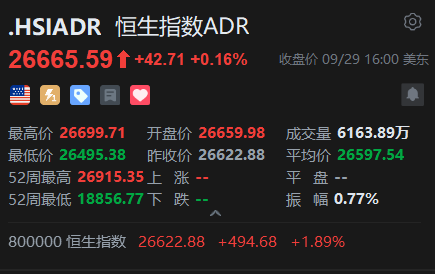
再见了 中行“缤纷生活”!大行宣布关停信用卡App 业内:盈利压力之下,运营独立App变得不再经济
Mei Ri Jing Ji Xin Wen· 2025-09-29 15:05
Core Viewpoint - The recent decision by Bank of China to shut down its "Bountiful Life" app and migrate its functions to the main "Bank of China" app reflects a broader trend among banks to consolidate credit card applications due to increasing operational costs and profitability pressures in the credit card business [1][2][8]. Summary by Sections Bank Actions - On September 28, Bank of China announced the initiation of the service migration from the "Bountiful Life" app to the "Bank of China" app, with the former set to cease downloads and services in the future [2]. - Other banks, including various joint-stock and regional banks, have previously shut down their credit card apps, migrating functionalities to their main banking apps [8][9]. App Performance - The "Bountiful Life" app, which primarily served credit card functions, had a monthly active user count of 1.5454 million, ranking 13th among credit card apps in China [4][5]. - In contrast, the top five credit card apps had monthly active users exceeding 10 million, indicating a significant disparity in user engagement [4][5]. Industry Trends - The recent wave of app consolidations is driven by cost reduction and efficiency improvements, as maintaining separate apps for credit card services has become economically unfeasible due to rising profitability pressures [8][9]. - Historically, banks launched independent credit card apps to leverage high user engagement for broader retail business growth, but current market conditions have shifted the focus towards integration within comprehensive banking apps [9].