NIO(09866)

Search documents
2026年春季汽车行业投资策略:科技赋能下的换道再提速
Shenwan Hongyuan Securities· 2026-03-19 06:06
Core Conclusions - The automotive industry is expected to embrace technological advancements, with a limited impact from policy changes on demand, particularly in the mid-to-high-end segments, which are anticipated to see a significant recovery in demand [3] - The globalization of Chinese smart electric vehicles is underway, with overseas sales projected to approach 10 million units in five years, driven by engineering advantages [3] - Key players in the technology sector include Xiaopeng, NIO, and Li Auto, while established brands like BYD, Great Wall, and Geely are expected to lead the market [3] - The automotive parts sector represents a typical example of "high-end manufacturing" in China, with new applications in robotics, low-altitude economy, and AIDC becoming essential for growth [3] - The focus on robotics, low-altitude economy, and AIDC is expected to drive new industry directions, with significant developments anticipated by 2026 [3] - The trend of globalization remains a long-term growth path for excellent automotive parts companies, particularly in Europe, as domestic market saturation increases [3] - The automotive industry is undergoing dual transformations of electrification and AI integration, with AI expected to enhance driving, cabin, chassis, and power systems [3] Market Review - The automotive sector's performance has slightly lagged behind the CSI 300 index, with a cumulative increase of 0.5% from the end of 2025 to March 11, 2026 [11] - The automotive service, commercial freight, and parts sectors have shown notable growth, with increases of 6.21%, 3.84%, and 2.15% respectively [11] - The overall fund holding in the automotive sector increased to 3.29% in Q4 2025, with the parts sector contributing significantly to this growth [12] Vehicle Sector - The impact of policy changes on vehicle demand is limited, with a focus on technological advancements to drive growth [5] - The wholesale sales of passenger vehicles reached 30.06 million units in 2025, reflecting a year-on-year increase of 9.10%, while the first two months of 2026 saw a decline of 10.75% [18] - The penetration rate of new energy vehicles reached 51.50% in 2025, with a slight decrease to 45.25% in early 2026 [18] Parts Sector - The automotive parts sector is focusing on technological spillover and globalization, with strong horizontal expansion capabilities [3] - The sector is expected to benefit from shared resources and cost optimization through advanced manufacturing capabilities [3] AI Industry Trends - The automotive industry is entering the "Token era," where AI integration will redefine vehicle functionalities and consumer experiences [3] - The integration of AI in vehicles is expected to enhance user experience and operational efficiency, marking a significant shift in the industry [3]



盘前必读丨15只硬科技主题基金获批;福耀玻璃营收净利双增
Di Yi Cai Jing· 2026-03-18 00:04
Group 1 - The Chinese government has launched a new batch of 13 major foreign investment projects with a planned investment of $13.4 billion, focusing on manufacturing sectors such as electronics, chemicals, automotive, and machinery [2] - The new projects include logistics and biopharmaceutical R&D centers, signaling increased support for the service industry and the integration of modern services with advanced manufacturing [2] - The investment sources are diversified, including multinational companies from the UK, Germany, Switzerland, Sweden, and Turkey [2] Group 2 - The China Securities Regulatory Commission has approved a new batch of 15 hard technology-themed fund products, focusing on core technology and strategic emerging industries [3] - These funds will track indices related to artificial intelligence and China's strategic emerging industries, with plans to start fundraising soon [3] Group 3 - Nvidia's CEO announced at the GTC conference that the AI inference market has reached a turning point, with exponential growth in demand for inference computing power [4] - Nvidia plans to collaborate with a startup focused on inference technology to launch AI server systems, targeting the trillion-level computing market [4] - Huawei introduced new AI data infrastructure aimed at enhancing AI inference efficiency and reducing deployment barriers, with significant improvements in accuracy and utilization rates [4] Group 4 - Tencent Music's stock dropped by 24.65% after reporting a gross margin of 44.7%, below market expectations of 45.1%, and lower-than-expected active user numbers [7] - The company reported total revenue of 8.64 billion yuan for the fourth quarter, a year-on-year increase of 15.9% [7] Group 5 - The U.S. stock market saw slight gains, with the S&P 500 up 0.25%, the Nasdaq up 0.47%, and the Dow Jones up 0.10% [5] - Major tech stocks showed mixed performance, with Tesla, Amazon, and Google all rising, while Nvidia and other tech stocks experienced declines [6]




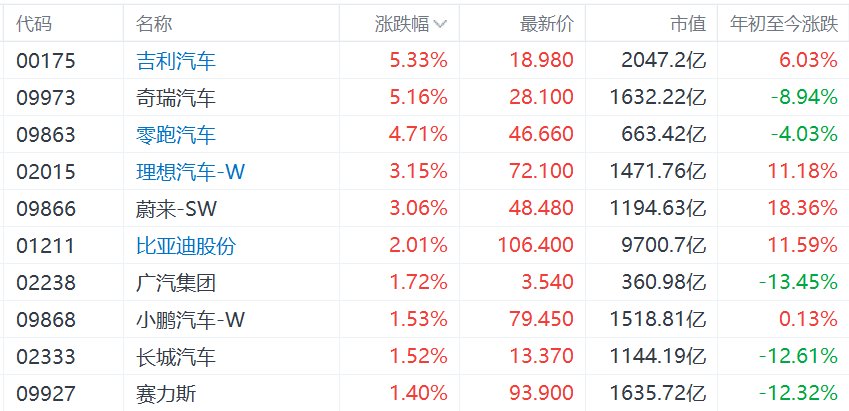
港股汽车股走强,吉利汽车涨超5%
Jin Rong Jie· 2026-03-17 04:44
Group 1 - The Hong Kong stock market saw a strong performance in the automotive sector, with Geely Automobile and Chery Automobile rising over 5% [1] - Leap Motor increased by more than 4%, while Li Auto and NIO both rose over 3% [1] - BYD Company Limited experienced a gain of over 2% [1]



港股汽车集体冲高,吉利大涨5%,A股跳水翻绿,算力股重挫
21世纪经济报道· 2026-03-17 04:41
Market Overview - The A-share market experienced a morning surge followed by a decline, with all three major indices turning negative. As of midday, the Shanghai Composite Index fell by 0.04%, the Shenzhen Component Index decreased by 0.4%, the ChiNext Index dropped by 0.58%, and the Sci-Tech Innovation Board Index declined by 0.72% [1][2]. Sector Performance - The green energy sector showed repeated activity, with Huadian Liaoning Energy achieving two consecutive trading limits, and Jiangsu New Energy and Zhejiang New Energy hitting the daily limit [5]. - The real estate sector saw gains, with Zhongzhou Holdings and Jingneng Real Estate reaching the daily limit [5]. - The space photovoltaic concept surged, with GCL-Poly Energy and Yabo Co. hitting the daily limit [5]. - The steel sector was active, with Anyang Steel and Jiugang Hongxing both reaching the daily limit [5]. - Financial stocks strengthened, with Aijian Group hitting the daily limit and several securities firms, including Guosen Securities and Dongfang Caifu, following suit. Hangzhou Bank reached a historical high during the session [6]. Declining Sectors - The computing power sector, including optical modules, optical communications, and optical chips, led the market decline, with Tianfu Communication dropping over 9% [6]. - Other sectors that saw significant declines included agriculture, mineral products, communication equipment, coal, and petrochemicals [6]. Hong Kong Market - In the Hong Kong market, automotive stocks performed well, with Geely Auto and Chery Auto rising over 5%, and Li Auto and NIO increasing by over 3% [7]. Nvidia GTC Conference - Nvidia announced collaborations with several automotive companies, including BYD and Geely, to develop L4 autonomous vehicles on the NVIDIA DRIVE Hyperion platform during the GTC conference [9]. Cryptocurrency Market - Bitcoin surpassed $75,000, with the entire cryptocurrency market experiencing an upward trend, leading to over 120,000 liquidations [12].

港股异动丨汽车股走强,吉利汽车涨超5%,英伟达与比亚迪吉利等车企合作打造L4级自动驾驶汽车
Ge Long Hui A P P· 2026-03-17 04:07
Group 1 - The Hong Kong stock market saw a strong performance in the automotive sector, with companies like Geely Auto and Chery Auto rising over 5%, and Li Auto and NIO increasing by over 3% [1] - NVIDIA announced collaborations with several automakers, including BYD, Geely, Hyundai, and Nissan, to develop L4 autonomous vehicles using the NVIDIA DRIVE Hyperion platform [1] - BYD, Geely, and Nissan are working on next-generation L4 passenger vehicle projects that will feature advanced autonomous capabilities for complex urban road scenarios [1] Group 2 - The stock performance of key automotive companies includes: - Geely Auto: up 5.33% to HKD 18.980, market cap of HKD 204.72 billion, year-to-date increase of 6.03% [2] - Chery Auto: up 5.16% to HKD 28.100, market cap of HKD 163.22 billion, year-to-date decrease of 8.94% [2] - Li Auto: up 3.15% to HKD 72.100, market cap of HKD 147.18 billion, year-to-date increase of 11.18% [2] - NIO: up 3.06% to HKD 48.480, market cap of HKD 119.46 billion, year-to-date increase of 18.36% [2] - BYD: up 2.01% to HKD 106.400, market cap of HKD 970.07 billion, year-to-date increase of 11.59% [2]

中国资产深夜大涨,美股科技股普涨,半导体集体拉升,国际油价大跳水
21世纪经济报道· 2026-03-16 23:14
Market Performance - The US stock market saw all three major indices rise, with the Dow Jones up 0.83%, the Nasdaq up 1.22%, and the S&P 500 up 1.01% [1] - Major European indices also closed higher, with Germany's DAX 30 up 0.5% and the UK's FTSE 100 up 0.55% [1] Technology Sector - Major tech stocks experienced significant gains, with META rising 2.33%, Amazon nearly 2%, and Nvidia up 1.63%, reaching an intraday high of 4.31% [2] - Nvidia's CEO Jensen Huang raised the revenue forecast to $1 trillion by 2027 during the GTC conference, where new chip architecture was announced [3] - The Philadelphia Semiconductor Index rose by 1.96%, with notable increases in stocks like SanDisk (over 6%), Western Digital (over 5%), and Micron Technology (3.68%) [3] Chinese Tech Stocks - The Nasdaq Golden Dragon China Index increased by 0.95%, with significant gains in popular Chinese stocks such as BYD (up 8.2%), Xiaomi (5.4%), and Li Auto (5.3%) [3] Commodity Prices - Gold and silver prices declined, with spot gold fluctuating around $5000 and silver around $80 per ounce [3] - International oil prices fell sharply, with WTI crude oil futures closing at $93.50 per barrel (down 5.28%) and Brent crude at $100.21 per barrel (down 2.84%) [5] Cryptocurrency Market - The cryptocurrency market showed strength, with Bitcoin surpassing $74,000 (up 3.63%) and Ethereum rising over 9% to $2361 [6]



Nio stock extends gains after Wall Street upgrades and profit surprise
Invezz· 2026-03-16 16:00AI Processing
Shares of Chinese electric vehicle maker Nio Inc. climbed to a four-month high as Wall Street upgrades and strong financial results strengthened the company's growth outlook. US-listed shares of Nio r... ...

别急着给换电判死刑
远川研究所· 2026-03-16 12:28
Core Viewpoint - The article discusses the competition between BYD's ultra-fast charging technology and NIO's battery swapping model, highlighting their respective advantages and market strategies in the electric vehicle industry [6][10]. Summary by Sections Charging Technology - BYD's "Megawatt Flash Charge 2.0" allows charging from 10% to 97% in as little as 9 minutes, even in extreme cold conditions [6][7]. - The "trickle charging" issue, where charging slows significantly after reaching 80%, has been addressed by BYD, making their charging speed competitive with battery swapping [7][8]. Battery Management - The article explains the physical limitations of lithium-ion batteries, where fast charging can lead to lithium plating, potentially damaging the battery [8][11]. - Research indicates that batteries charged frequently with fast charging (over 100kW) have a deterioration rate twice that of those charged slowly, with an average annual capacity loss of 2.3% [8][9]. Market Positioning - BYD aims to capture a larger share of the fuel vehicle market, while NIO focuses on enhancing the user experience through battery swapping [10][16]. - The article notes that both companies' strategies are shaped by their respective business models, with NIO's battery-as-a-service (BaaS) model providing flexibility and lowering purchase costs for consumers [14]. Technological Advancements - NIO's battery swapping stations have evolved, with the latest generation offering improved compatibility and efficiency, while BYD's focus on high-voltage architecture aims to enhance the appeal of its high-end models [10][14][15]. - The article highlights that both charging and swapping technologies have their strengths and weaknesses, and they are not mutually exclusive [9][10]. Consumer Experience - The consumer's decision-making process regarding electric vehicles is influenced by various factors beyond just charging speed, indicating that both companies must consider broader market dynamics [10][16]. - BYD's recent initiatives, such as offering free charging for a year to new owners of certain models, aim to enhance customer satisfaction and loyalty [15].

港股新能源车企股震荡走高,比亚迪股份涨超7%
Mei Ri Jing Ji Xin Wen· 2026-03-16 06:16
Group 1 - The core viewpoint of the article highlights the upward trend in Hong Kong's new energy vehicle stocks, with significant gains observed among major companies in the sector [1] Group 2 - BYD Company Limited (01211.HK) experienced a rise of over 7% [1] - Xiaomi Group (01810.HK) and NIO Inc. (09866.HK) both saw increases of over 5% [1] - Other companies such as Geely Automobile Holdings Limited (00175.HK), Great Wall Motors (02333.HK), Seres (09927.HK), and Li Auto Inc. (02015.HK) also followed suit with gains [1]

港股科网股,集体大涨
第一财经· 2026-03-16 04:19
Market Performance - The Hang Seng Index rose over 1% and the Hang Seng Tech Index increased by more than 2% as of the midday close on March 16 [1] - The Hang Seng Index closed at 25,756.27, up by 290.67 points (1.14%), while the Hang Seng Tech Index reached 5,089.53, gaining 111.45 points (2.24%) [2] Sector Highlights - Technology stocks showed strong performance, with BYD Co. and NIO both rising over 5%, while Xiaomi Group and JD Health increased nearly 5% [2] - Tencent Music rose over 4%, and Tencent Holdings, JD Group, and Trip.com increased by more than 2% [2] - Alibaba and Baidu also saw their stock prices rise [2] Semiconductor Sector - The semiconductor sector experienced significant gains, with Zhaoyi Innovation rising over 10% and Hua Hong Semiconductor increasing by 5.28% [3][4] - Other notable performers included Horizon Robotics and Hongguang Semiconductor, both rising over 3% [3] Precious Metals Sector - The precious metals sector was underperforming, with Chifeng Jilong Gold Mining falling nearly 7% and Shandong Gold dropping close to 6% [5][6] - Other companies in the sector, such as Lingbao Gold and China Gold International, also saw declines exceeding 5% [5]