
China Meheco(600056)

Search documents
中国医药(600056.SH):注射用更昔洛韦通过仿制药一致性评价
智通财经网· 2025-11-21 10:56
Core Viewpoint - China Medical (600056.SH) announced that its wholly-owned subsidiary, Hainan Tongyong Kangli Pharmaceutical Co., Ltd. (referred to as "Kangli Pharmaceutical"), has received two approval notices for the injectable drug Ganciclovir from the National Medical Products Administration (NMPA) [1] Group 1 - The injectable Ganciclovir has passed the consistency evaluation of quality and efficacy for generic drugs [1] - Ganciclovir is primarily used for treating life-threatening or vision-threatening cytomegalovirus infections in immunocompromised patients, as well as for preventing cytomegalovirus infections in organ transplant patients [1]

中国医药(600056) - 关于公司涉及诉讼事项的进展公告
2025-11-21 10:15
证券代码:600056 证券简称:中国医药 公告编号:临 2025-086 号 三、本次诉讼案件对公司的影响 中国医药健康产业股份有限公司 关于公司涉及诉讼事项的进展公告 本公司董事会及全体董事保证本公告内容不存在任何虚假记载、误导性陈述 或者重大遗漏,并对其内容的真实性、准确性和完整性承担法律责任。 重要内容提示: 是否会对上市公司损益产生负面影响:截至本公告披露日,本次诉讼二 审尚未开庭审理,最终结果存在不确定性。 一、本次诉讼案件的基本情况 2024 年 10 月,因业绩补偿引起的合同纠纷,公司作为原告向北京市第二中 级人民法院提交《民事起诉状》,对西藏天晟泰丰药业股份有限公司(以下简称 "西藏天晟")及徐攀峰提起诉讼,北京市第二中级人民法院已做出一审判决。 其他相关内容详见公司分别于 2024 年 10 月 12 日、2025 年 10 月 11 日在上海证 券交易所网站(www.sse.com.cn)披露的临 2024-055 号《关于公司涉及诉讼事项 的公告》、临 2025-078 号《关于公司涉及诉讼事项的进展公告》、2024 年年度 报告及 2025 年半年度报告。 二、本次诉讼案件进展情况 ...
中国医药(600056) - 关于子公司药品通过仿制药一致性评价的公告
2025-11-21 10:15
药品名称:注射用更昔洛韦 受理号:CYHB2450530、CYHB2450531 证券代码:600056 证券简称:中国医药 公告编号:临 2025-087 号 中国医药健康产业股份有限公司 关于子公司药品通过仿制药一致性评价的公告 本公司董事会及全体董事保证本公告内容不存在任何虚假记载、误导性陈述 或者重大遗漏,并对其内容的真实性、准确性和完整性承担法律责任。 近日,中国医药健康产业股份有限公司(以下简称"公司")下属全资子公 司海南通用康力制药有限公司(以下简称"康力药业")收到国家药品监督管理 局(以下简称"国家药监局")核准签发的两份注射用更昔洛韦(以下简称"该 药品")《药品补充申请批准通知书》,该药品通过仿制药质量和疗效一致性评 价。现将有关情况公告如下: 一、药品补充申请批准通知书基本信息 上市许可持有人:海南通用康力制药有限公司 审批结论:根据《中华人民共和国药品管理法》、《国务院关于改革药品医 疗器械审评审批制度的意见》(国发[2015]44号)、《关于仿制药质量和疗效 一致性评价工作有关事项的公告》(2017年第100号)和《国家药监局关于开展 化学药品注射剂仿制药质量和疗效一致性评价工作 ...
中国医药:涉1.39亿元诉讼案件进入二审阶段
Xin Lang Cai Jing· 2025-11-21 10:01
Core Viewpoint - The company has initiated a lawsuit against Tibet Tiansheng Taifeng Pharmaceutical Co., Ltd. and Xu Panfeng due to a contract dispute arising from performance compensation, with the case now in the second instance stage [1] Group 1: Legal Proceedings - The lawsuit was filed in October 2024, and both the company and Tibet Tiansheng have appealed within the legal timeframe after the first-instance judgment [1] - The amount involved in the case is 139.4041 million yuan [1] - As of the announcement date, the second-instance hearing has not yet commenced, leading to uncertainty regarding the final outcome [1]
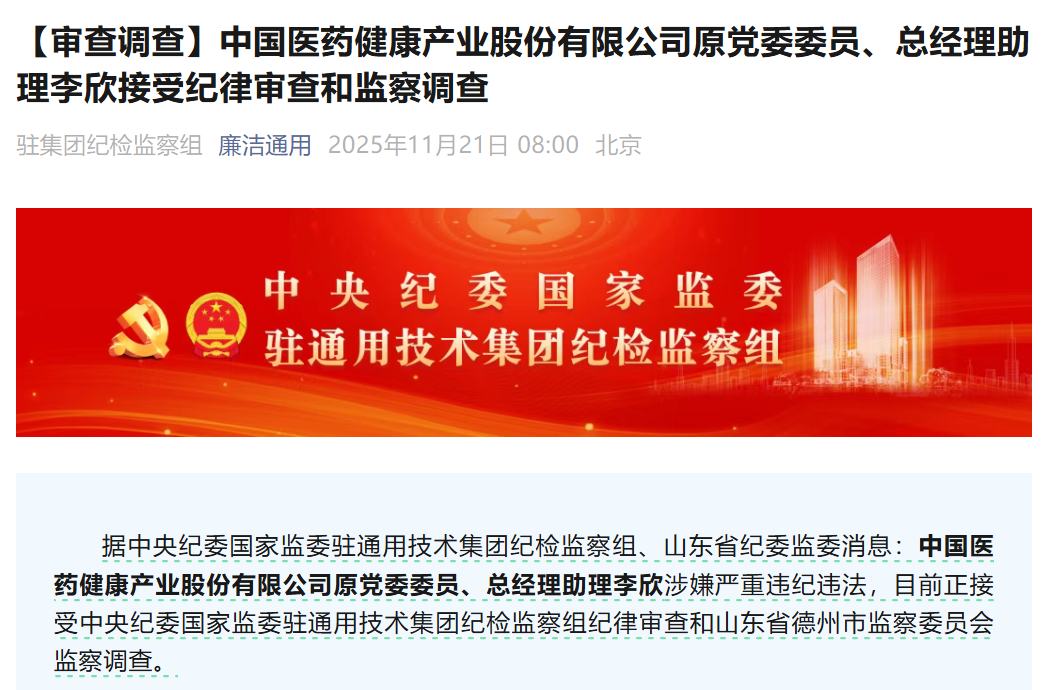
涉嫌严重违纪违法,李欣被查
Zhong Guo Ji Jin Bao· 2025-11-21 07:03
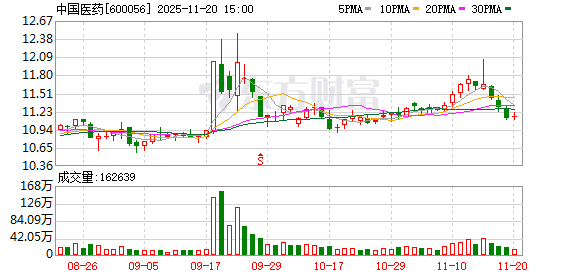
Core Viewpoint - The investigation of Li Xin, former assistant general manager of China National Pharmaceutical Group, highlights ongoing anti-corruption efforts within the pharmaceutical industry in China [1][4]. Group 1: Investigation Details - Li Xin is under investigation for serious violations of discipline and law, currently being reviewed by the Central Commission for Discipline Inspection and the Shandong Provincial Supervisory Committee [1]. - Li Xin has a long career in the pharmaceutical industry, having held various managerial positions since 1997, including roles at Beijing Yongzheng Pharmaceutical and China National Pharmaceutical [4]. Group 2: Company Background - China National Pharmaceutical Group, a publicly listed company, is controlled by the General Technology Group and serves as its sole platform for pharmaceutical and medical device production and operation [4]. - As of November 21, the stock price of China National Pharmaceutical was 10.87 yuan per share, with a total market capitalization of 16.3 billion yuan [4]. Group 3: Industry Context - The anti-corruption campaign in the pharmaceutical sector has intensified, with multiple individuals from China National Pharmaceutical facing investigations this year, including Wang Zhiguang, a deputy general manager [4]. - The Ministry of Health and 14 other ministries issued a notice in June to address corruption and misconduct in the pharmaceutical sales and medical services sectors, aiming for ongoing governance of unethical practices [5].

涉嫌严重违纪违法,李欣被查
中国基金报· 2025-11-21 07:00
Group 1 - The core point of the article is the investigation of Li Xin, former assistant general manager of China National Pharmaceutical Group, for serious violations of discipline and law [1][8]. - Li Xin was born in 1962, is a member of the Communist Party, holds a master's degree, and is a pharmacist [3]. - Li Xin has a long history in the pharmaceutical industry, having held various managerial positions in companies such as Beijing Yongzheng Pharmaceutical and Meikang Yongzheng before becoming assistant general manager at China National Pharmaceutical in December 2016 [5]. Group 2 - As of November 21, the stock price of China National Pharmaceutical was 10.87 yuan per share, with a total market capitalization of 16.3 billion yuan [6]. - There have been multiple reports of investigations involving individuals from China National Pharmaceutical, including Wang Zhiguang, a deputy general manager, who was also investigated earlier this year [8]. - The ongoing anti-corruption campaign in the pharmaceutical sector has intensified, with a joint notice issued by 14 ministries to address misconduct in the medical sales and service areas [8].

中国医药健康产业股份有限公司原党委委员、总经理助理李欣接受审查调查
Xin Lang Cai Jing· 2025-11-21 02:54
据中央纪委国家监委驻通用技术集团纪检监察组、山东省纪委监委消息:中国医药健康产业股份有限公 司原党委委员、总经理助理李欣涉嫌严重违纪违法,目前正接受中央纪委国家监委驻通用技术集团纪检 监察组纪律审查和山东省德州市监察委员会监察调查。 ...
中国医药:截至2025年9月30日,公司股东总数为139689户
Zheng Quan Ri Bao· 2025-11-20 13:44
(文章来源:证券日报) 证券日报网讯中国医药11月20日在互动平台回答投资者提问时表示,截至2025年9月30日,公司股东总 数为139,689户。 ...
中信建投:中国医药企业积极探索多元化出海 重点把握新增量及行业并购整合
智通财经网· 2025-11-20 04:40
Core Insights - The Chinese pharmaceutical industry is entering a critical phase characterized by "innovation realization + global layout," supported by population and domestic demand, as well as comprehensive manufacturing capabilities [1] - Companies are actively exploring diversified overseas paths while strengthening supply chain security and compliance domestically [1] Group 1: Global Perspective - The value of innovation is becoming prominent, with Chinese pharmaceutical assets demonstrating global cost-effectiveness and significant collaborative potential [1] - In the first three quarters of 2025, overseas licensing of innovative drugs from China surpassed the total for the previous year, indicating a strong trend towards internationalization [1] Group 2: Domestic Value Restructuring - Focus on high-quality development through policy optimization, including collection optimization and multi-payment systems [2] - The commercialization phase for innovative drugs is underway, emphasizing the importance of supply chain security [2] - Domestic medical devices are extending into mid-to-high-end markets, with optimism surrounding overseas expansion and the implementation of new technologies [2] Group 3: Overseas Value Restructuring - The industry is entering an internationalization 2.0 era, with business development (BD) becoming a norm for innovative drugs [3] - Both domestic and overseas demand are recovering, providing opportunities for growth [3] - The raw materials sector is transitioning towards specialty raw materials and Contract Development and Manufacturing Organizations (CDMO) [3] Group 4: Investment Outlook for 2026 - Key investment themes include innovative drugs (e.g., ADC, second-generation IO, small nucleic acids) and innovative medical devices (e.g., AI healthcare, brain-machine interfaces) [4] - Companies with global clinical data and international capabilities in innovative drugs, as well as those actively expanding overseas in the medical device sector, are expected to perform well [4] - Marginal changes are anticipated from policy benefits and improvements in supply-demand dynamics, particularly in the CXO sector [4] - Integration opportunities exist for leading companies in niche medical device segments, state-owned enterprises in traditional Chinese medicine reform, and pharmaceutical companies with strong integration capabilities [4]
金鹰基金:中国医药产业升级持续兑现 关注三方向投资机会
Xin Lang Ji Jin· 2025-11-19 02:59
Core Insights - The pharmaceutical sector reported a slight revenue growth of 0.20% year-on-year for Q3 2025, driven by innovative drugs and CXO benefiting from overseas orders and FDA approvals [1] - The medical device sector is experiencing slow recovery, with capital expenditures in hospitals remaining low, particularly in high-end imaging and IVD fields [1] - Traditional Chinese medicine saw a revenue increase of 1.60% year-on-year, but profits were pressured by adjustments in medical insurance catalogs and centralized procurement [1] - Pharmaceutical commercial revenue grew by 2.45%, although gross margins declined by 0.85 percentage points, indicating intensified price pressures in distribution channels [1] Short-term Outlook - The easing of centralized procurement policies for medical devices and steady progress in the innovative drug industry suggest stable operational performance in the pharmaceutical sector, with innovative drugs experiencing six consecutive quarters of high growth [1] - 2025 is anticipated to be a pivotal year for commercial insurance, benefiting innovative drugs and devices along with their supply chains [1] Long-term Outlook - The continuous upgrade of China's pharmaceutical industry is being realized, supported by a series of domestic policies favoring innovative drugs and the increasing clinical value of products [1] - Global pharmaceutical companies are accelerating their purchases of innovative drugs from China, surpassing the pace seen in the U.S. and other countries, indicating a collective globalization of China's innovative drug industry [1] Focus Areas - Future attention will be directed towards three main areas: 1. Innovative drugs with strong global competitiveness, benefiting from both domestic and Western markets [2] 2. The innovative drug supply chain, including CXO and life sciences services, expected to see a recovery in order growth as global investment and financing accelerate [2] 3. Medical devices and equipment, particularly companies focusing on self-sufficiency, domestic substitution, and high-end manufacturing for international markets, as procurement policies continue to improve [2]