
JINYU(600201)

Search documents
生物股份(600201.SH)子公司取得新兽药注册证书
智通财经网· 2025-08-14 07:42
该产品的成功获批是公司持续重视研发创新、不断丰富产品管线的体现,并且进一步丰富了公司猪用疫 苗产品矩阵,经过多年积累,公司已在猪用疫苗领域拥有丰富的产品储备,可满足市场多样化需求,并 为下游养殖客户提供多维度综合防疫解决方案,巩固公司在动物疫苗领域的行业地位,对提升公司研发 能力、市场竞争力和可持续发展等方面具有积极的促进作用。 智通财经APP讯,生物股份(600201.SH)发布公告,根据国家《兽药管理条例》和《兽药注册办法》规 定,经国家农业农村部审查,批准公司全资子公司扬州优邦生物药品有限公司(以下简称"扬州优邦")、 金宇保灵生物药品有限公司(以下简称"金宇保灵")和其他公司共同研制的猪细小病毒杆状病毒载体灭活 疫苗(rPP03株)为新兽药。 ...

生物股份子公司取得新兽药注册证书
Zhi Tong Cai Jing· 2025-08-14 07:41
Core Viewpoint - The approval of the inactivated vaccine for porcine parvovirus by the Ministry of Agriculture and Rural Affairs represents a significant achievement for the company, highlighting its commitment to research and development innovation in the animal vaccine sector [1] Group 1: Product Development - The newly approved vaccine, developed by the company's subsidiary Yangzhou Youbang Biological Pharmaceutical Co., Ltd. and Jin Yu Bao Ling Biological Pharmaceutical Co., Ltd., is classified as a new veterinary drug [1] - This product enhances the company's portfolio of swine vaccines, reflecting years of accumulated expertise in the field [1] Group 2: Market Position and Strategy - The successful approval of the vaccine strengthens the company's position in the animal vaccine industry and supports its ability to provide comprehensive disease prevention solutions to livestock customers [1] - The company aims to meet diverse market demands through its extensive product offerings, which contribute positively to its research capabilities, market competitiveness, and sustainable development [1]
动保行业研究框架:行业回归创新驱动,宠物药品及出海拓展成长空间
Guohai Securities· 2025-08-13 15:28
Investment Rating - The report does not explicitly state an investment rating for the animal health industry, but it highlights potential growth areas such as pet pharmaceuticals and international expansion [1]. Core Insights - The animal health industry is experiencing a slowdown in growth, with increasing competition leading to a "Matthew Effect" where larger companies gain more market share at the expense of smaller firms [3][39]. - The industry is shifting back to a research and development-driven model, with innovation becoming crucial for future growth [4][83]. - The pet pharmaceutical market and international expansion are identified as key areas for long-term growth, with pet medical consumption projected to reach approximately 84 billion yuan in 2024 [5][78]. Summary by Sections 1. Overview of the Animal Health Industry - The animal health industry, also known as the veterinary drug industry, includes a wide range of products such as vaccines, antibiotics, and feed additives [11][12]. - The market size has grown from 50.395 billion yuan in 2019 to 69.651 billion yuan in 2023, with a CAGR of 8.43% [3][12]. 2. Increasing Competition and Market Dynamics - The industry is facing a slowdown in growth, with sales increasing from 62.095 billion yuan in 2020 to 69.651 billion yuan in 2023, while average gross profit has decreased from 21.998 billion yuan to 21.297 billion yuan [3][39]. - The "Matthew Effect" is evident as larger companies leverage their product portfolios and R&D investments to capture more market share [3][52]. 3. Shift Towards R&D and Innovation - The industry is moving away from its cyclical nature, with a focus on integrated strategies and innovation to counteract competitive pressures [4][69]. - The average profit per head in self-breeding pig farming is expected to improve significantly in 2024, indicating potential for recovery in related sectors [4][62]. 4. Growth Opportunities in Pet Pharmaceuticals and Exports - The pet medical market is projected to grow rapidly, with a significant increase in demand for preventive care and treatment as pet owners become more health-conscious [5][78]. - The report highlights the successful export of domestic pet pharmaceuticals, marking a breakthrough in international markets [5][78]. 5. Key Companies to Watch - Companies such as 瑞普生物 (Reap Bio), 科前生物 (KQ Bio), and 回盛生物 (Hui Sheng Bio) are recommended for attention due to their innovative approaches and market positioning [6].



*ST四环: 江苏四环生物股份有限公司关于完成工商变更登记备案并换发营业执照暨变更办公地址的公告
Zheng Quan Zhi Xing· 2025-08-13 10:13
Core Viewpoint - Jiangsu Sihuan Biological Co., Ltd. has completed the registration of changes in business operations and has obtained a new business license, along with a change in its office address [1] Group 1: Company Information - The company held its 13th meeting of the 10th Board of Directors on June 4, 2025, where it approved the proposal to change the registered address and amend the Articles of Association [1] - The new registered information includes: - Company Name: Jiangsu Sihuan Biological Co., Ltd. - Unified Social Credit Code: 913202001381477183 - Type: Joint-stock Company (Listed) - Legal Representative: Qiu Weibing - Registered Capital: 1,029.556222 million RMB - Establishment Date: May 18, 1992 - Address: 2 Binhai East Road, Building 41, Jiangyin City, Rooms 05 and 06 [1] Group 2: Business Scope - The company's business scope includes the manufacturing of large-volume injectables, small-volume injectables (including anti-tumor drugs), tablets (including anti-tumor drugs), hard capsules, syrups, oral solutions, alcoholic solutions, raw materials, traditional Chinese medicine extraction, and the manufacturing of Class II psychotropic drugs [1] - Additional activities include the packaging of specific health products, pharmaceutical consulting, technology transfer services, and the manufacturing of pharmaceutical intermediates (excluding chemical hazardous products) [1] - The company is also involved in the manufacturing and sales of textiles, chemical products (excluding hazardous products), electronic products, and telecommunications equipment, as well as investment activities and import/export operations related to its products and technologies [1]

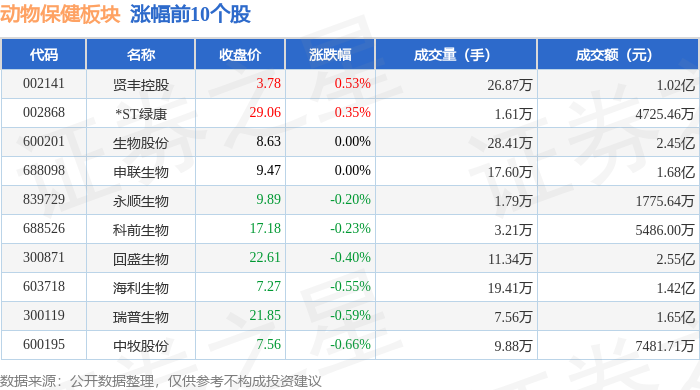
动物保健板块8月13日跌0.53%,大禹生物领跌,主力资金净流出1.75亿元
Zheng Xing Xing Ye Ri Bao· 2025-08-13 08:34
Market Overview - The animal health sector experienced a decline of 0.53% on August 13, with Dayu Biological leading the drop [1] - The Shanghai Composite Index closed at 3683.46, up 0.48%, while the Shenzhen Component Index closed at 11551.36, up 1.76% [1] Individual Stock Performance - Key stocks in the animal health sector showed varied performance, with Xianfeng Holdings closing at 3.78, up 0.53%, and Dayu Biological closing at 9.84, down 3.15% [2][1] - Other notable stocks included Jinhe Biological at 7.45, down 3.12%, and Zhongmu Co. at 7.56, down 0.66% [2][1] Trading Volume and Value - The trading volume for Xianfeng Holdings was 268,700 shares with a transaction value of 102 million yuan, while Dayu Biological had a trading volume of 46,200 shares and a transaction value of 45.92 million yuan [2][1] Capital Flow Analysis - The animal health sector saw a net outflow of 175 million yuan from institutional investors, while retail investors contributed a net inflow of 143 million yuan [2][3] - The capital flow for specific stocks indicated that Hai Li Biological had a net inflow of 2.28 million yuan from institutional investors, while Xianfeng Holdings experienced a significant net outflow of 11.02 million yuan [3][2]


武汉科前生物股份有限公司 关于拟与华中农大签订合作研发协议暨关联交易的自愿性披露公告
Zhong Guo Zheng Quan Bao - Zhong Zheng Wang· 2025-08-13 02:22
Core Viewpoint - Wuhan Keqian Biological Co., Ltd. plans to sign a cooperative research and development agreement with Huazhong Agricultural University, involving four vaccine projects, with a total payment of 4.9 million RMB [2][4][67]. Group 1: Overview of Related Transactions - The company has obtained cooperation for the development of four projects: "Canine Distemper, Canine Parainfluenza, Canine Adenovirus and Canine Parvovirus Quadrivalent Live Vaccine - Inactivated Canine Coronavirus Vaccine," "Porcine Gata Virus Inactivated Vaccine," "Porcine Proliferative Enteropathy Blocking ELISA Antibody Test Kit," and "NADC30-like Porcine Reproductive and Respiratory Syndrome Live Vaccine (GX2024 Strain)" [2][4][67]. - The total payment to Huazhong Agricultural University for these projects is 4.9 million RMB, with specific allocations of 1.5 million RMB, 2 million RMB, 400,000 RMB, and 1 million RMB for each project respectively [4][67]. - The transaction constitutes a related party transaction but does not qualify as a major asset restructuring under relevant regulations [2][4][67]. Group 2: Necessity and Impact of Related Transactions - The cooperative research aims to enhance the company's product portfolio and market competitiveness, although the success of the projects and their market introduction remain uncertain [67]. - The pricing and process of the transaction comply with legal regulations and do not harm the interests of the company or minority shareholders [67]. Group 3: Approval Procedures for Related Transactions - The board of directors and the supervisory board have approved the agreement, with related directors abstaining from voting [68][69]. - Independent directors have expressed that the agreement will enhance the company's core competitiveness in the biological products sector and that the transaction process is legal and fair [71][72]. Group 4: Research and Development Agreement Details - The agreement includes provisions for the rights and obligations of both parties, including the management of research funds and the ownership of intellectual property generated from the projects [8][37][52]. - The agreement is valid for 10 years, with provisions for extension and termination under certain conditions [20][36][66].
青岛蔚蓝生物股份有限公司关于获得新兽药注册证书的公告
Zhong Guo Zheng Quan Bao - Zhong Zheng Wang· 2025-08-13 02:20
Core Viewpoint - The company has successfully developed a new veterinary drug, Mirtazapine Ointment, which has been approved as a Class V new veterinary drug by the Ministry of Agriculture and Rural Affairs, indicating a significant advancement in the company's product offerings and innovation capabilities [1][9]. Group 1: New Veterinary Drug Information - New veterinary drug name: Mirtazapine Ointment [2] - Developed by: A collaboration of multiple companies including Qingdao Weilan Pet Biotechnology Co., Ltd., Qingdao Kangdian Animal Pharmaceutical Co., Ltd., and others [2]. - Registration certificate number: (2025) New Veterinary Drug Certificate No. 82 [3]. - Monitoring period: 3 years [3]. - Main ingredient: Mirtazapine [3]. - Indication: Used to control weight loss in cats [3]. - Dosage: Apply a 3.8 cm strip of ointment (equivalent to 2 mg of Mirtazapine) to the inner side of the cat's ear once daily for 14 days, alternating between ears [3]. Group 2: Research and Development - The development of Mirtazapine Ointment involved significant investment, totaling 1.8622 million yuan in research and development costs [4]. - The product has undergone laboratory research, clinical trials, and new veterinary drug registration processes, culminating in the recent issuance of the registration certificate [4]. Group 3: Market Background - Weight loss and decreased appetite in cats are significant clinical signs of potential diseases, which can lead to malnutrition, organ dysfunction, and weakened immunity if not addressed [5]. - The new veterinary drug aims to meet the clinical needs of the pet market, characterized by controllable quality, safety, efficacy, ease of administration, and high compliance [5]. Group 4: Future Procedures - Before the product can be marketed, it must obtain the veterinary product approval number from the Ministry of Agriculture and Rural Affairs, as per relevant regulations [7]. Group 5: Impact on the Company - The acquisition of the new veterinary drug certificate reflects the company's commitment to technological innovation and increased R&D investment, enhancing its product portfolio and potentially providing new growth opportunities for the business [9].

“今年暑期流行进厂游玩!”上市公司发力工业科技旅游|微视角·新气象——一线调研行
Zheng Quan Shi Bao· 2025-08-12 23:54
Core Viewpoint - The rise of industrial and technological tourism in China reflects the country's manufacturing prowess and innovation, with listed companies leading the development of these tourism projects, which are increasingly focused on asset revitalization, flow conversion, ESG practices, and business model innovation [1][5][7]. Group 1: Industrial and Technological Tourism Trends - Industrial tourism has gained popularity, with factories and industrial parks becoming new attractions for tourists, especially among youth interested in robotics and technology [2][3]. - The tourism landscape now includes a third category of resources that showcases contemporary technological innovations alongside cultural and natural heritage [2]. - Listed companies are at the forefront of this trend, leveraging their advanced technologies and products to enhance industrial tourism experiences [2]. Group 2: Company Initiatives and Developments - Companies like 福瑞达 (Furida) have seen significant increases in visitor numbers, with their beauty technology museum receiving over 5000 visitors during the summer, indicating a strong interest in beauty industry innovations [3]. - 宝钢 (Baosteel) has established the Baosteel Industrial Creative Park, which features various attractions and educational tours, catering to different audience segments [4]. - 福瑞达 aims to attract 100,000 visitors annually to its beauty industrial tourism project, showcasing the high standards of China's beauty industry [3][6]. Group 3: Challenges and Considerations - The development of industrial tourism must balance production safety with visitor experience, ensuring that both operational integrity and tourist engagement are maintained [7][8]. - There is a need for improvement in the presentation of industrial tourism content, expanding the depth and breadth of exhibitions related to manufacturing achievements [7]. - Companies are encouraged to innovate their operational mechanisms to overcome existing limitations in integrating tourism with industrial production [7].



成大生物: 辽宁成大生物股份有限公司第五届董事会第二十一次会议决议公告
Zheng Quan Zhi Xing· 2025-08-12 16:14
证券代码:688739 证券简称:成大生物 公告编号:2025-039 辽宁成大生物股份有限公司 第五届董事会第二十一次会议决议公告 本公司董事会及全体董事保证公告内容不存在任何虚假记载、误导性陈述或者 重大遗漏,并对其内容的真实性、准确性和完整性依法承担法律责任。 一、董事会会议召开情况 辽宁成大生物股份有限公司(以下简称"公司")第五届董事会第二十一次会议 通知已于 2025 年 8 月 8 日以电子邮件方式发出,会议于 2025 年 8 月 12 日以现场和 通讯相结合的方式召开并作出决议。公司应出席会议的董事 7 人,实际出席会议的董 事 7 人,会议由董事长李宁先生主持。本次会议的召集、召开和表决情况符合《中华 人民共和国公司法》(以下简称"《公司法》")等法律法规及《公司章程》的规定, 形成的决议合法有效。 二、董事会会议审议情况 (一)审议通过《关于补选公司董事的议案》 公司董事会于近日收到董事董丙建先生与董事崔建伟先生的书面辞职报告。为完 善公司治理,保证公司董事会的规范运作,根据《公司法》《上海证券交易所科创板 上市公司自律监管指引第 1 号——规范运作》《公司章程》等相关规定,依据公司控 ...

科前生物: 武汉科前生物股份有限公司关于2025年员工持股计划非交易过户完成的公告
Zheng Quan Zhi Xing· 2025-08-12 16:14
Core Viewpoint - The company has successfully completed the non-trading transfer of shares related to its 2025 employee stock ownership plan, with a total of 221.1573 million shares transferred at a price of 8 yuan per share, representing 0.4745% of the company's total share capital [3]. Group 1: Employee Stock Ownership Plan - The company held meetings on March 24, 2025, and April 11, 2025, where the 2025 employee stock ownership plan was approved, allowing for the implementation of the plan [2]. - A total of 55 employees participated in the stock ownership plan, contributing a total of 17.692584 million yuan, with the corresponding shares to be allocated [2]. - The duration of the employee stock ownership plan is set for 48 months, starting from the date of the last stock transfer to the plan's account [3]. Group 2: Share Transfer Details - The company has transferred 221.1573 million shares to the employee stock ownership plan's securities account, with the transfer price set at 8 yuan per share [3]. - The shares held in the employee stock ownership plan account will be subject to a lock-up period, which will be released upon meeting specific performance criteria [3]. - The company will continue to monitor the implementation of the employee stock ownership plan and fulfill its information disclosure obligations as required [3].