SHRC(600392)

Search documents
巨震之下!乱世“稀土+黄金”
格隆汇APP· 2025-10-13 10:27
Group 1: Rare Earths - The strategic value of rare earths is highlighted as an irreplaceable "countermeasure" in geopolitical conflicts, particularly in the context of US-China trade tensions [8][14]. - The recent announcement of strict export controls on rare earths by the Chinese government has significantly increased market expectations for potential export restrictions to the US, driving up the prices and interest in rare earth stocks [16][39]. - Demand for rare earths is expected to surge due to global energy transitions and technological advancements, particularly in electric vehicles, wind energy, and military applications [20][23][31]. - China dominates the global rare earth supply chain, controlling over 60% of production and 85% of refining capacity, creating a significant barrier for other countries attempting to establish their own supply chains [25][27]. - Recent price increases for rare earths have been substantial, with prices for certain elements like dysprosium and praseodymium skyrocketing, reflecting the supply-demand imbalance [32][34]. Group 2: Gold - Gold prices have reached historical highs, driven by increased demand for safe-haven assets amid geopolitical tensions and economic uncertainty [43][45]. - Factors supporting gold price increases include expectations of interest rate cuts by the Federal Reserve and a global trend towards "de-dollarization," leading central banks to diversify their reserves [44]. - The performance of gold ETFs, particularly the gold ETF (518680), has been strong, with significant net inflows and a high annual growth rate, making it an attractive investment option [48][50]. - The strategic role of gold in investment portfolios is emphasized, with recommendations for a substantial allocation to hedge against risks associated with credit assets [46]. Group 3: Investment Opportunities - Both rare earths and gold are identified as key strategic assets in the current market environment, offering unique investment opportunities amid ongoing geopolitical and economic uncertainties [51][53]. - The contrasting roles of rare earths as a growth asset and gold as a defensive asset provide investors with a balanced approach to navigating market volatility [51][52].



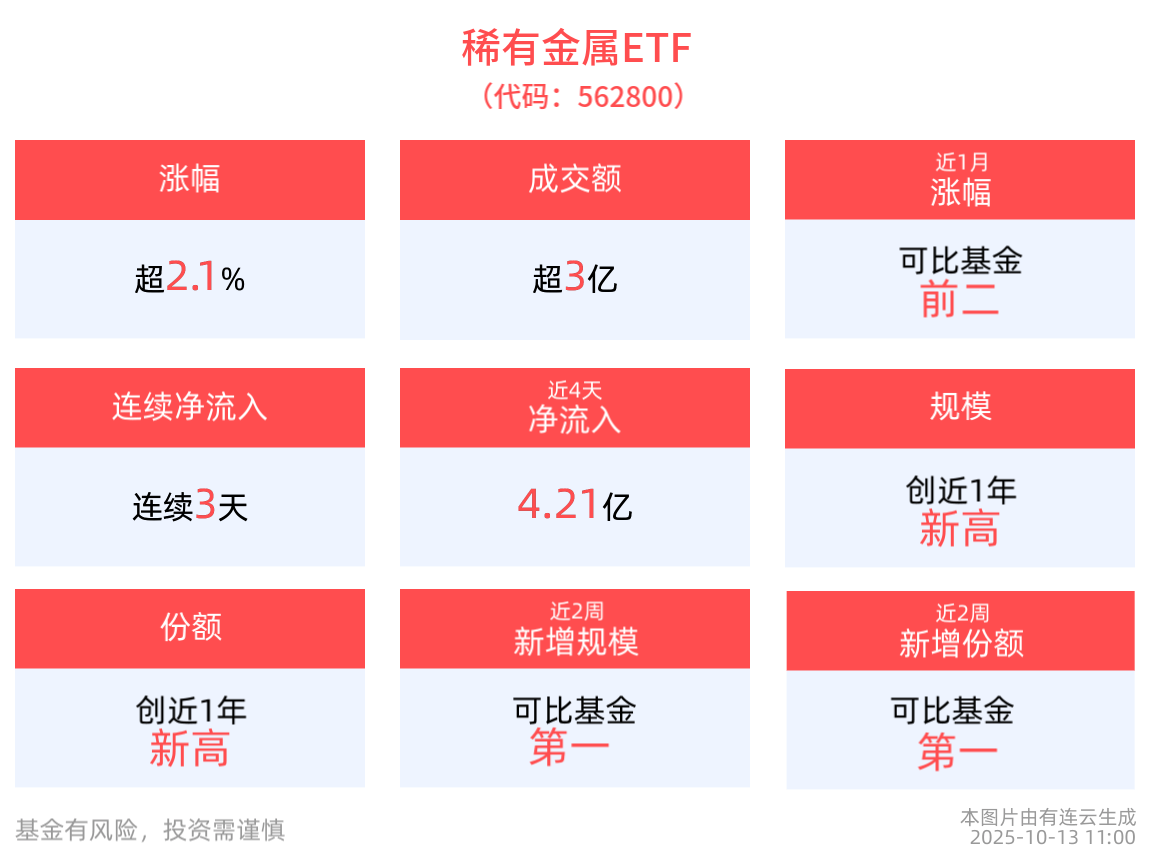
近3天获得连续资金净流入,稀有金属ETF(562800)盘中涨超2%,成分股银河磁体20cm涨停
Sou Hu Cai Jing· 2025-10-13 03:30
Group 1: Rare Metal ETF Performance - The Rare Metal ETF has a turnover rate of 11.57% during trading, with a transaction volume of 359 million yuan, indicating active market trading [3] - The latest scale of the Rare Metal ETF reached 3.08 billion yuan, marking a new high since its inception and ranking first among comparable funds [3] - The ETF's share reached 3.67 billion shares, also a new high since inception, and ranks first among comparable funds [3] - Over the past three days, the Rare Metal ETF has seen continuous net inflows, with a maximum single-day net inflow of 358 million yuan, totaling 551 million yuan [3] - As of October 10, the net value of the Rare Metal ETF has increased by 17.31% over the past three years [3] - The highest monthly return since inception is 24.02%, with the longest consecutive monthly increase being five months and a maximum increase of 66.25%, averaging a monthly return of 8.60% [3] Group 2: Cobalt Export Quotas and Market Dynamics - According to CITIC Construction Investment, cobalt export quotas for Congo (Kinshasa) have been finalized, with Luoyang Molybdenum, Glencore, and Eurasian Resources holding the top three shares at 35.9%, 27.3%, and 21.6% respectively [4] - The total quota for 2026 and 2027 is set at 96,600 tons, which includes a basic quota of 87,000 tons allocated to production enterprises and a strategic quota of 9,600 tons [4] - Under the quota system, only about 44% of production can be exported, resulting in a reduction of over 100,000 tons [4] - Based on estimates for 2024, with a supply of 270,000 tons and demand of 230,000 tons, the market is expected to shift from a surplus of about 70,000 tons to a shortage of about 30,000 tons, potentially driving cobalt prices higher [4] Group 3: Rare Earth Export Controls - The Ministry of Commerce has issued four documents to strengthen rare earth export controls, adding five categories of medium and heavy rare earths to the export control list [4] - The controls also extend to the entire industrial chain, including equipment, technology, and raw materials, with additional regulations on overseas military and high-end semiconductor demands [4] - The strategic position of rare earths has been further reinforced through these measures [4] Group 4: Rare Metal Index and Investment Opportunities - As of September 30, 2025, the top ten weighted stocks in the CSI Rare Metal Theme Index include Northern Rare Earth, Luoyang Molybdenum, Huayou Cobalt, and others, collectively accounting for 59.91% of the index [4] - Investors can also participate in the rare metal sector through the Rare Metal ETF linked fund (014111) [4]



两大稀土巨头宣布提价 稀土和磁材企业利润有望明显改善(附概念股)
Zhi Tong Cai Jing· 2025-10-13 02:45
Core Viewpoint - The Chinese Ministry of Commerce has tightened export licenses for rare earths, leading to price increases announced by major domestic players, Northern Rare Earth and Baotou Steel, indicating a shift in valuation logic from traditional cyclical stocks to a dual-driven model of "strategic resources + high-end manufacturing" [1] Group 1: Price Adjustments - Northern Rare Earth and Baotou Steel have both announced adjustments to their rare earth concentrate trading prices for Q4 2025, setting the price at 26,205 CNY/ton (dry weight, REO=50%), marking a 37.13% increase from Q3 [1] - The price of praseodymium-neodymium oxide averaged 562,000 CNY/ton on September 30, up 26.43% from 444,500 CNY/ton on June 30, indicating significant price movements in the rare earth market [2] - Over the past year, Northern Rare Earth's rare earth concentrate trading price has increased from 16,741 CNY/ton in Q3 2024 to 26,205 CNY/ton, reflecting a 56.53% increase [2] Group 2: Demand and Market Trends - Demand for rare earths is expected to grow, with a 10% increase in magnetic material demand anticipated due to developments in green low-carbon technologies and electric-driven applications [3] - The revenue and profit of related companies are projected to rise significantly due to increasing rare earth concentrate prices, with Northern Rare Earth expecting a net profit of 1.51 billion to 1.57 billion CNY for the first three quarters of the year, a year-on-year increase of 272.54% to 287.34% [3] Group 3: Industry Outlook - The tightening of the rare earth industry chain management is expected to enhance the strategic position of the industry, leading to improved valuations for listed companies in the sector [4] - Analysts predict significant profit improvements for rare earth and magnetic material companies in Q3 and Q4, with a continued bullish outlook on rare earth prices [4] - Companies such as Northern Rare Earth, Guangsheng Nonferrous, China Rare Earth, Baotou Steel, and Shenghe Resources are recommended for investment due to their strategic positions in the market [4] Group 4: Related Stocks Performance - Jinli Permanent Magnet expects a net profit of 505 million to 550 million CNY for the first three quarters of 2025, a year-on-year increase of 157% to 179% [5] - China Rare Earth, primarily engaged in the manufacturing and sales of rare earth products, is positioned to benefit from the rising demand and prices in the sector [5] - Minmetals Resources reported a revenue of 2.817 billion USD for the first half of the year, a 47% year-on-year increase, with a significant profit increase of 1511% [5]

稀土概念股早盘走强,稀土相关ETF涨超2%
Mei Ri Jing Ji Xin Wen· 2025-10-13 02:35
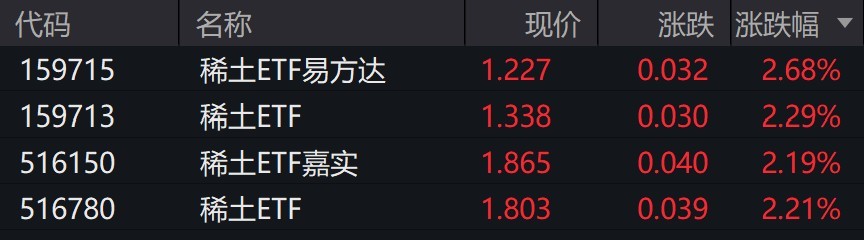
有券商表示,稀土出口限制新政策再次凸显稀土战略价值地位。基本面上看,供给端氧化物供应紧张,金属供应相对稳 定;需求端,磁材大厂订单较好,开工充足,原料需求稳定,多以长协为主,短期消耗库存居多。四季度是新能源车、风 电设备等下游领域的生产旺季,对稀土永磁材料的采购需求预计会集中释放,对价格仍有支撑。 (文章来源:每日经济新闻) | 代码 | 名称 | 现价 | 涨跌 涨跌幅 ▼ | | --- | --- | --- | --- | | 159715 | 稀土ETF易方达 | 1.227 | 0.032 2.68% | | 159713 | 稀土ETF | 1.338 | 0.030 2.29% | | 516150 | 稀土ETF嘉实 | 1.865 | 0.040 2.19% | | 516780 | 稀土ETF | 1.803 | 0.039 2.21% | 中证稀土产业指数选取涉及稀土开采、稀土加工、稀土贸易和稀土应用等业务相关上市公司证券作为样本,以反映稀土产 业上市公司证券的整体表现。 稀土概念股早盘走强,包钢股份涨停,北方稀土涨超7%,中国稀土、盛和资源涨超5%。 受盘面影响,跟踪中证稀土产业指数 ...

稀土:金属牛市旗手的潜力
2025-10-13 01:00
Summary of Rare Earth Industry Conference Call Industry Overview - The conference call focuses on the rare earth industry, particularly the implications of recent regulatory changes in China and the competitive landscape with the US and Europe [1][3][4]. Key Points and Arguments - **Chinese Regulatory Changes**: China has implemented stricter controls on rare earth exports through announcements 56 and 61, shifting from resource management to dual control over technology and supply chains to counter Western restrictions in the semiconductor and military sectors [1][3]. - **US and European Initiatives**: The US Department of Defense has partnered with MP Company and French firms to develop a self-sufficient rare earth supply chain, aiming to reduce reliance on Chinese pricing [3][4]. Goldman Sachs has released a report favoring neodymium prices, indicating a bullish outlook for the market [3]. - **Pricing Dynamics**: Rare earth prices are primarily influenced by supply and their strategic metal status rather than solely by demand. Historical data shows that price increases are not strictly limited by demand fluctuations [1][7]. The upcoming fourth quarter is expected to support price stability due to traditional consumption peaks and domestic demand recovery [7]. - **Market Demand**: There is a strong domestic demand for rare earth materials, particularly in the electric vehicle and optical communication sectors, which is expected to drive future growth [6]. Important but Overlooked Content - **Investment Recommendations**: Investors are advised to focus on traditional leading companies such as China Rare Earth, Northern Rare Earth, Shenghe Resources, and Guangsheng Nonferrous, as well as new entrants in the smelting sector like Huahong Technology [1][8]. Additionally, companies in the magnetic materials sector such as Jinli Permanent Magnet, Ningbo Yunsheng, Zhenghai Magnetic Materials, and Zhongke Sanhuan are highlighted as beneficiaries of increasing downstream orders [9]. - **Price Forecasts**: The price of heavy and medium rare earth oxides, such as dysprosium oxide, is projected to rise from approximately 7 million yuan per ton to around 10 million yuan per ton [2][9]. Conclusion - The rare earth industry is undergoing significant changes due to regulatory actions in China and strategic moves by the US and Europe. The focus on supply chain independence and the anticipated price increases present both opportunities and risks for investors in this sector.

中美贸易摩擦或再度升级,我国稀土出口管制趋严且首次覆盖半导体或对海外芯片制程产生约束
HUAXI Securities· 2025-10-12 13:29
Investment Rating - Industry rating: Recommended [3] Core Insights - The recent announcements from the Ministry of Commerce and the General Administration of Customs have implemented stricter export controls on rare earth elements, particularly affecting the semiconductor industry and potentially impacting overseas chip manufacturing processes [1][10][16] - China dominates global rare earth supply, holding approximately 48.41% of the world's rare earth reserves and producing 68.54% of the total output [12][14] - The new export controls cover all 12 types of medium and heavy rare earth elements, marking a significant expansion in the scope of regulation [2][4] Summary by Sections Export Control Measures - The recent announcements (2025 No. 56 and 57) include export controls on rare earth equipment and raw materials, specifically targeting key technologies in rare earth mining, refining, and manufacturing [1][2] - The controls also extend to any downstream products that utilize Chinese rare earth technologies, requiring export licenses for a wide range of applications [5][10] Strategic Importance of Rare Earths - Rare earth elements are critical in various industries, including defense and semiconductor manufacturing, where they enhance material properties and performance [6][7] - The military applications of rare earths are significant, with advanced weapon systems heavily reliant on these materials [6] Semiconductor Industry Impact - The new regulations are the first to explicitly cover the semiconductor sector, which may lead to increased scrutiny and delays in overseas chip production [10][11] - Rare earths are essential for high-performance materials in semiconductor manufacturing, particularly as technology advances towards smaller transistor sizes [7][10] Renewable Energy Sector - Rare earths play a crucial role in the renewable energy sector, particularly in electric vehicle motors and wind turbine generators, with rare earth permanent magnets accounting for over 80% of the electric motor market share [11][12] Global Supply Chain Dynamics - The report highlights that while the U.S. is attempting to rebuild its rare earth supply chain, China's control over the entire rare earth industry chain remains unchallenged in the short term [15][16] - The overall completeness of the rare earth supply chain in the West is still lacking, with many projects facing delays and challenges [14][15]

稀土!稀土!稀土!聚焦前三大成分股:北方稀土、卧龙电驱、领益智造!
Quan Jing Wang· 2025-10-12 11:49
Core Insights - The Ministry of Commerce has announced strengthened export controls on rare earth-related items, highlighting the strategic importance of rare earth resources and increasing market attention on the rare earth sector [1][2] - The rare earth ETF (516780) and its linked funds (Class A 014331, Class C 014332) are gaining investor interest as quality tools for exposure to the rare earth sector, with the underlying index showing a significant increase of 94.69% over the past year [1] Industry Overview - The export control measures require specific exporters to obtain licenses from the Ministry of Commerce before exporting rare earth items outside China, which is expected to tighten supply and enhance China's leverage in the rare earth supply chain [2] - The rare earth sector is experiencing a resonance of supply and demand, with China's quota management and export controls ensuring resources are directed towards high-end applications, while global green transformation and carbon neutrality goals are driving demand for key elements like praseodymium and neodymium [2] Market Performance - The top five constituents of the CSI Rare Earth Industry Index, which the rare earth ETF tracks, include North Rare Earth, Wolong Electric Drive, Lingyi iTech, China Rare Earth, and Shenghe Resources, collectively accounting for 41% of the index [1] - The strategic position of the rare earth industry is expected to strengthen further, providing long-term momentum for high-end manufacturing development [2]


中国扔下“稀土核弹”,向全世界发动稀土管辖,历史将记住这一天
Sou Hu Cai Jing· 2025-10-10 10:41
Core Viewpoint - China has significantly escalated its control over rare earth elements, extending restrictions from just metals and products to the entire industry chain and overseas derivatives, marking a qualitative leap in its regulatory approach [4][9][24]. Group 1: Policy Changes - On October 9, the Ministry of Commerce of China issued six announcements, with the 61st and 62nd being particularly impactful, as they broadened the scope of export restrictions to include the entire rare earth industry chain and related technologies [4][9]. - The new regulations introduce an "extraterritorial jurisdiction" mechanism, requiring permits for exports of rare earth items containing over 0.1% specific Chinese-origin rare earth metals or utilizing Chinese extraction and refining technologies [11][15]. Group 2: Industry Impact - China's rare earth production in 2023 reached 240,000 tons, accounting for 68.6% of global output, solidifying its position as the only country with a complete industry chain from mining to refining and manufacturing [9][26]. - The new policy has caused immediate concern among U.S. rare earth companies, particularly MP Materials, which has relied heavily on China for processing and lacks the capability to handle heavy rare earths [17][20]. Group 3: Strategic Implications - The policy shift signifies a transition from merely defending resources to establishing rule-making authority in the global rare earth trade, allowing China to define the game rules rather than just adhering to them [24][29]. - The new regulations are expected to disrupt previous strategies employed by other countries to circumvent Chinese controls, effectively closing loopholes that allowed for the processing of Chinese rare earths in third countries [13][15].

153.87亿元主力资金今日撤离有色金属板块
Zheng Quan Shi Bao Wang· 2025-10-10 09:58
Market Overview - The Shanghai Composite Index fell by 0.94% on October 10, with 18 out of the 28 sectors rising, led by construction materials and coal, which increased by 1.92% and 1.37% respectively [1] - The electronic and electrical equipment sectors experienced the largest declines, down by 4.71% and 4.46% respectively [1] - The non-ferrous metals sector dropped by 2.93% [1] Capital Flow - The net outflow of capital from the two markets reached 125.784 billion yuan, with 8 sectors seeing net inflows [1] - The construction materials sector had the highest net inflow of 418 million yuan, followed by the agriculture, forestry, animal husbandry, and fishery sector with a net inflow of 379 million yuan [1] - The electronic sector faced the largest net outflow of 38.319 billion yuan, followed by the electrical equipment sector with a net outflow of 25.535 billion yuan [1] Non-Ferrous Metals Sector - The non-ferrous metals sector saw a net outflow of 15.387 billion yuan, with 137 stocks in the sector, of which 30 rose and 104 fell [2] - The top three stocks with the highest net inflow were Antai Technology (22.3 million yuan), Silver Industry (19.5 million yuan), and Pengxin Resources (19.1 million yuan) [2] - The stocks with the largest net outflow included Northern Rare Earth (2.519 billion yuan), Huayou Cobalt (1.011 billion yuan), and Luoyang Molybdenum (920 million yuan) [2] Non-Ferrous Metals Capital Inflow - The top stocks in terms of capital inflow included: - Antai Technology: +9.99%, turnover rate 10.79%, net inflow 223.06 million yuan - Silver Industry: +9.96%, turnover rate 3.52%, net inflow 194.94 million yuan - Pengxin Resources: +10.06%, turnover rate 10.60%, net inflow 190.96 million yuan [2][4] Non-Ferrous Metals Capital Outflow - The stocks with the largest capital outflow included: - Northern Rare Earth: -1.22%, turnover rate 8.90%, net outflow 2.518 billion yuan - Huayou Cobalt: -7.74%, turnover rate 7.85%, net outflow 1.011 billion yuan - Luoyang Molybdenum: -3.18%, turnover rate 2.59%, net outflow 919.66 million yuan [4]



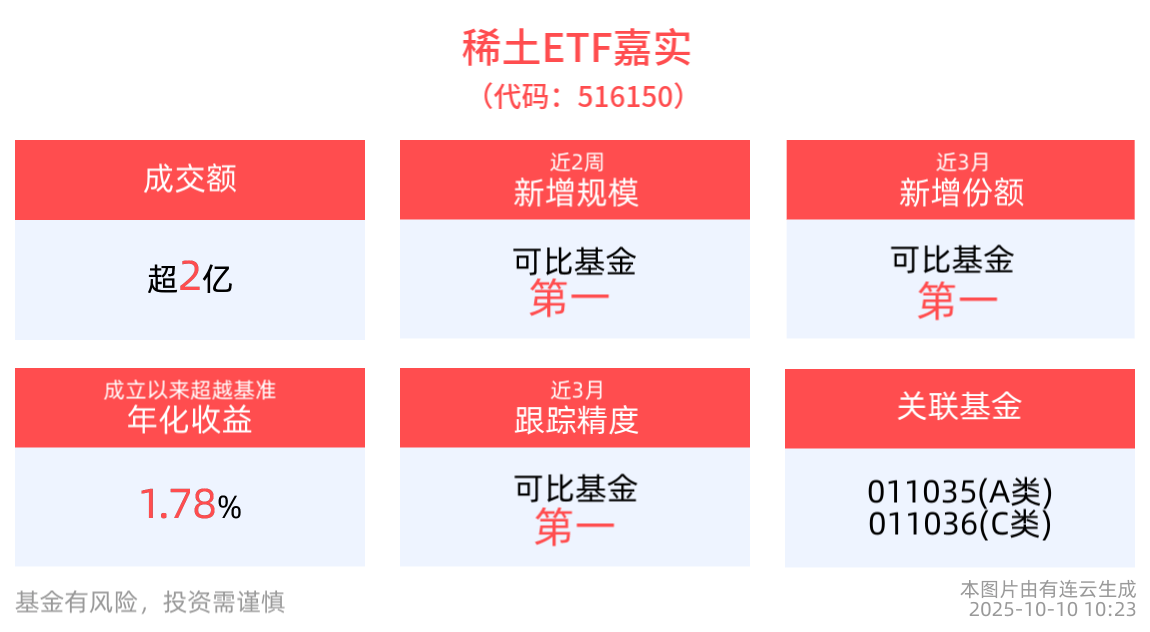
新一轮稀土出口管制政策发布,稀土ETF嘉实(516150)近2周新增规模同类居首,成分股安泰科技10cm涨停
Sou Hu Cai Jing· 2025-10-10 03:23
Group 1: Liquidity and Performance of Rare Earth ETF - The liquidity of the Rare Earth ETF managed by Jiashi has a turnover rate of 3.15% with a transaction volume of 251 million yuan [3] - Over the past week, as of October 9, the average daily transaction volume of the Rare Earth ETF reached 783 million yuan, ranking first among comparable funds [3] - The fund's scale increased by 386 million yuan in the past two weeks, also ranking first among comparable funds [3] - The number of shares increased by 2.131 billion in the past three months, marking significant growth and ranking first among comparable funds [3] - As of October 9, the net value of the Rare Earth ETF has risen by 93.31% over the past year, placing it in the top 0.16% of index equity funds [3] - The highest monthly return since inception was 41.25%, with the longest consecutive monthly increase being four months and a maximum increase of 83.89% [3] Group 2: Rare Earth Industry Policy and Supply Chain - The Ministry of Commerce has introduced a new round of export control policies for rare earths, aimed at strengthening management of the rare earth industry chain [4] - These policies include regulations on the recycling and utilization of secondary resources, with expectations that by 2025, secondary recovery will account for 27% of the rare earth supply chain [4] - The new regulations will strictly control the incremental supply of rare earths, making it difficult for the market to experience sudden increases in supply [4] - The focus of these controls is primarily on medium and heavy rare earths, including metals such as samarium, dysprosium, and terbium [4] - The tightening of policies may lead to frequent fluctuations in rare earth supply, potentially improving the overall supply-demand dynamics in the industry [4] Group 3: Top Weighted Stocks in Rare Earth Industry - The top ten weighted stocks in the Zhongzheng Rare Earth Industry Index account for a total of 61.96% of the index [3] - The leading stocks include Northern Rare Earth, Wolong Electric Drive, Lingyi Zhi Zao, China Rare Earth, Shenghe Resources, Greeenmei, Goldwind Technology, Baotou Steel, Xiamen Tungsten, and China Aluminum [3] - The performance of these stocks varies, with Northern Rare Earth showing a decline of 0.81% and China Rare Earth declining by 2.51% [6]