
CSICPCL(600482)

Search documents
1.29亿主力资金净流入,中船系概念涨3.24%
Zheng Quan Shi Bao Wang· 2025-11-21 12:25
Group 1 - The core viewpoint of the news is that the China Shipbuilding System concept has seen a significant increase of 3.24%, leading the concept sector in terms of growth [1][2] - Within the China Shipbuilding System concept, six stocks experienced gains, with Jiuzhiyang, China Ship Defense, and Kunshan Intelligent showing the highest increases of 15.63%, 6.37%, and 6.18% respectively [1][2] - Conversely, the stocks that faced the largest declines included China Ship Special Gas, China Power, and ST Emergency, which fell by 3.47%, 1.28%, and 0.68% respectively [1][2] Group 2 - The main funds flow into the China Shipbuilding System concept amounted to a net inflow of 129 million yuan, with significant contributions from stocks like China Ship Defense, which saw a net inflow of 199 million yuan [2][3] - The net inflow ratios for Jiuzhiyang, China Ship Defense, and China Ship Technology were 8.44%, 7.41%, and 5.84% respectively, indicating strong investor interest [3] - The trading volume and turnover rates for the leading stocks in the China Shipbuilding System concept were notable, with Jiuzhiyang having a turnover rate of 15.15% and China Ship Defense at 10.99% [3][4]




趋势研判!2025年中国燃气轮机发电机组行业产业链图谱、行业现状及未来发展趋势分析:AI算力引爆全球电力需求,中国燃机出海迎来窗口期[图]
Chan Ye Xin Xi Wang· 2025-11-21 01:13
Core Insights - The gas turbine generator set is a highly efficient power generation equipment driven by gas turbines, characterized by rapid start-stop, high efficiency, and clean emissions, making it a core device in key areas such as power peak regulation, industrial drive, and data centers [1][5] - In the context of China's energy structure transformation, the installed capacity of natural gas power generation is expected to grow from 90 million kW in 2019 to 144 million kW in 2024, with a compound annual growth rate of 9.8% [5][6] - The gas turbine market in China is projected to reach 75 billion yuan in 2024, with significant innovations achieved by companies like Dongfang Electric in hydrogen and split-shaft gas turbines [6][7] - The global data center electricity consumption is expected to increase from 415 TWh in 2024 to 945 TWh by 2030, with the U.S. accounting for 45% of this demand, creating significant export opportunities for China's gas turbine industry [8][10] Industry Overview - Gas turbine generator sets are categorized into heavy-duty, aeroderivative, and light-duty types, with heavy-duty turbines used in large power plants and light-duty turbines suitable for peak regulation [3][4] - The industry has established a complete product system covering 15-200 MW, with a focus on technological breakthroughs and market expansion [6][11] Market Dynamics - The gas turbine market in China is experiencing steady growth, driven by policies promoting natural gas utilization and the integration of renewable energy sources [5][6] - The market is characterized by a competitive landscape where international giants like GE and Siemens dominate the high-end market, while domestic companies like Dongfang Electric and Shanghai Electric are rapidly advancing [11][12] Future Trends - The gas turbine industry is expected to focus on self-sufficiency, green transformation, intelligent upgrades, and globalization [12][13][14] - There is a significant push towards the development of low-carbon and zero-carbon fuels, with ongoing research into hydrogen and ammonia combustion technologies [12] - The integration of digital and intelligent technologies is enhancing operational efficiency and extending service offerings in the gas turbine sector [13][14]




中船系概念下跌2.39%,主力资金净流出10股
Zheng Quan Shi Bao Wang· 2025-11-20 09:06
Group 1 - The China Shipbuilding sector experienced a decline of 2.39%, ranking among the top losers in the concept sector, with companies like China Shipbuilding Special Gas, China Marine Defense, and Kunshan Intelligent showing significant drops [1] - The main funds in the China Shipbuilding sector saw a net outflow of 617 million yuan, with ten stocks experiencing net outflows exceeding 10 million yuan, led by China Shipbuilding with a net outflow of 232 million yuan [2] - Other companies with notable net outflows include China Shipbuilding Defense, China Power, and China Marine Defense, with net outflows of 128 million yuan, 89.9 million yuan, and 49.7 million yuan respectively [2] Group 2 - The top gainers in the market included the Hainan Free Trade Zone with a rise of 2.20%, while the Silicon Energy sector fell by 2.66% [2] - The trading volume for China Shipbuilding stocks showed varying turnover rates, with China Shipbuilding Defense at 6.35% and Kunshan Intelligent at 7.20% [2] - The performance of individual stocks within the China Shipbuilding sector varied, with China Shipbuilding down by 1.63%, China Shipbuilding Defense down by 2.39%, and China Marine Defense down by 3.87% [2]


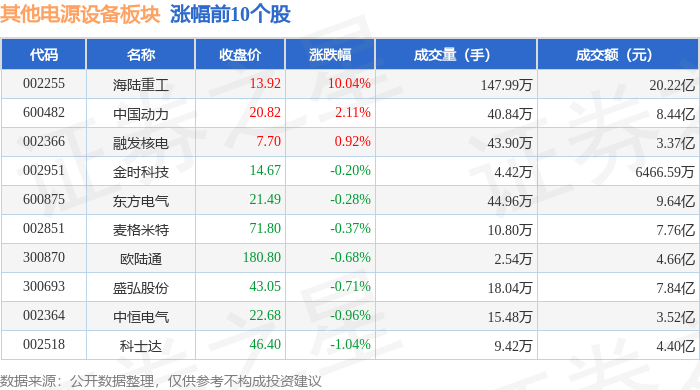
其他电源设备板块11月19日跌0.91%,优优绿能领跌,主力资金净流入2.06亿元


Zheng Xing Xing Ye Ri Bao· 2025-11-19 08:52
Market Overview - The other power equipment sector experienced a decline of 0.91% on the trading day, with Youyou Green Energy leading the drop [1] - The Shanghai Composite Index closed at 3946.74, up 0.18%, while the Shenzhen Component Index closed at 13080.09, unchanged [1] Stock Performance - HaLu Heavy Industry (002255) saw a significant increase of 10.04%, closing at 13.92 with a trading volume of 1.48 million shares and a transaction value of 2.02 billion [1] - China Power (600482) increased by 2.11%, closing at 20.82 with a transaction value of 844 million [1] - Youyou Green Energy (301590) led the declines with a drop of 5.84%, closing at 171.88 with a transaction value of 146 million [2] Capital Flow - The other power equipment sector had a net inflow of 206 million from institutional investors, while retail investors experienced a net outflow of approximately 89.9 million [2] - Major stocks like HaLu Heavy Industry and China Power attracted significant institutional investment, while Youyou Green Energy and others saw substantial retail outflows [3]
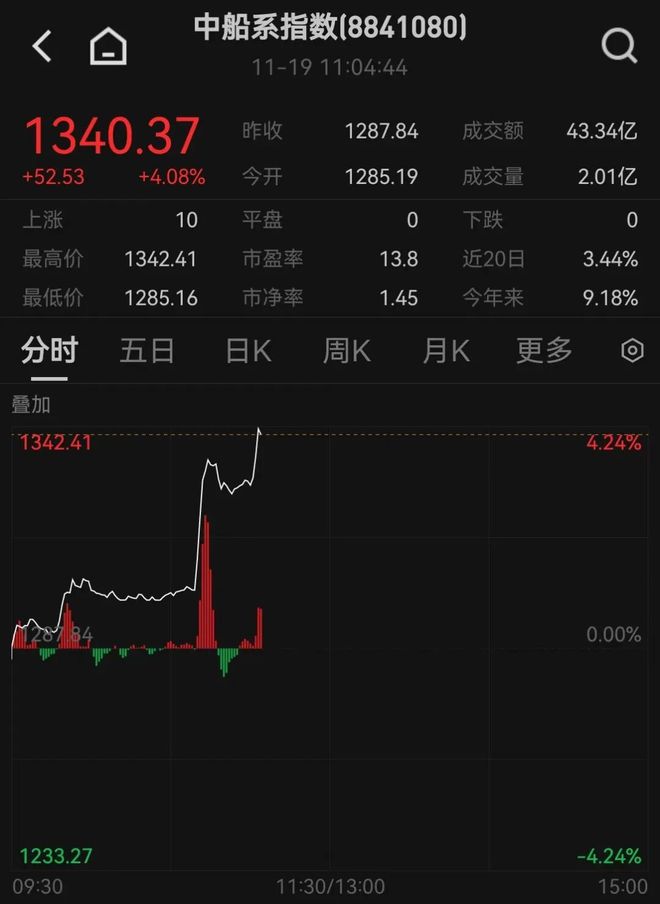
中船系概念涨4.60%,主力资金净流入10股
Zheng Quan Shi Bao Wang· 2025-11-19 08:46
Core Insights - The China Shipbuilding sector has seen a significant increase of 4.60%, leading the concept sectors in terms of growth, with notable stocks such as China Shipbuilding Defense hitting the daily limit up [1][2]. Group 1: Market Performance - The China Shipbuilding sector's stocks showed strong performance, with 10 stocks rising, including China Shipbuilding Defense, which reached a daily limit up, and others like China Shipbuilding Han Guang and Jiu Zhi Yang increasing by 6.75% and 6.07% respectively [1]. - The sector attracted a net inflow of 1.364 billion yuan from major funds, with China Shipbuilding receiving the highest net inflow of 518 million yuan [2][3]. Group 2: Fund Flow Analysis - The leading stocks in terms of net inflow rates include China Shipbuilding Defense at 30.22%, China Shipbuilding at 13.52%, and China Shipbuilding Technology at 13.15% [3]. - The trading volume and turnover rates for key stocks in the sector indicate robust investor interest, with China Shipbuilding Defense showing a turnover rate of 7.09% and China Shipbuilding at 1.47% [4].

国产航母概念涨1.24%,主力资金净流入23股
Zheng Quan Shi Bao Wang· 2025-11-19 08:46
Core Insights - The domestic aircraft carrier concept index rose by 1.24%, ranking 8th among concept sectors, with 23 stocks increasing in value, including Ya Xing Anchor Chain and China Shipbuilding Defense reaching their daily limit up [1][2] Group 1: Stock Performance - Stocks such as China Shipbuilding, China Shipbuilding Defense, and Ya Xing Anchor Chain saw significant gains, with increases of 2.82%, 10.00%, and 10.02% respectively [3][4] - The top gainers in the domestic aircraft carrier sector included Guorui Technology and Hailanxin, which rose by 8.71% and 4.32% respectively [1][4] Group 2: Capital Inflow - The domestic aircraft carrier sector experienced a net capital inflow of 1.743 billion yuan, with 23 stocks receiving inflows, and 9 stocks seeing inflows exceeding 50 million yuan [2][3] - China Shipbuilding led the inflow with 518.33 million yuan, followed by China Shipbuilding Defense and Ya Xing Anchor Chain with inflows of 494.24 million yuan and 337.25 million yuan respectively [2][3] Group 3: Capital Inflow Ratios - Stocks with the highest net inflow ratios included Ya Xing Anchor Chain at 33.15%, China Shipbuilding Defense at 30.22%, and Zhenxin Technology at 13.97% [3][4] - The overall performance of the domestic aircraft carrier sector indicates strong investor interest and confidence in the stocks within this category [1][2]


中国动力涨2.01%,成交额5.00亿元,主力资金净流入2077.25万元
Xin Lang Cai Jing· 2025-11-19 05:40
Group 1 - The core viewpoint of the news highlights the recent stock performance of China Power, which saw a 2.01% increase in share price, reaching 20.80 CNY per share, with a total market capitalization of 46.874 billion CNY [1] - As of September 30, the number of shareholders for China Power increased to 75,100, reflecting a 26.51% rise, while the average circulating shares per person decreased by 20.93% to 30,019 shares [2] - For the period from January to September 2025, China Power reported a revenue of 40.971 billion CNY, marking an 11.88% year-on-year growth, and a net profit attributable to shareholders of 1.208 billion CNY, which is a 62.50% increase compared to the previous year [2] Group 2 - The main business segments of China Power include diesel power (49.92%), chemical power (14.33%), marine platform and ship machinery (12.53%), and precious metals (7.59%), among others [1] - Since its A-share listing, China Power has distributed a total of 2.299 billion CNY in dividends, with 1.009 billion CNY distributed over the past three years [3]
这一板块,全线飘红
Di Yi Cai Jing Zi Xun· 2025-11-19 03:25
Core Viewpoint - The China Shipbuilding sector experienced a significant increase, with the sector index rising over 4% as of the report's publication [1]. Group 1: Stock Performance - China Shipbuilding Defense saw a peak increase of over 9%, currently up over 7% [3]. - Other stocks in the sector, including China Shipbuilding Han Guang and Jiu Zhi Yang, also reported gains exceeding 6% [3]. - All stocks within the sector showed positive performance, indicating a strong market sentiment [3]. Group 2: Individual Stock Details - China Shipbuilding Defense: Current price at 28.36, up 7.83% [4]. - China Shipbuilding Han Guang: Current price at 18.66, up 6.69% [4]. - Jiu Zhi Yang: Current price at 43.10, up 6.71% [4]. - Kunshan Intelligent: Current price at 20.00, up 3.95% [4]. - ST Emergency: Current price at 8.89, up 4.10% [4]. - China Marine Defense: Current price at 30.54, up 3.49% [4]. - China Shipbuilding Technology: Current price at 12.30, up 2.16% [4]. - China Shipbuilding: Current price at 34.73, up 2.09% [4]. - China Euro Marine Control: Current price at 15.25, up 1.87% [4]. - China Power: Current price at 20.67, up 1.37% [4].
中国动力:2025年半年度权益分派实施公告
Zheng Quan Ri Bao Zhi Sheng· 2025-11-18 13:39
Group 1 - The core point of the announcement is that China Power has declared a cash dividend of 0.08161 yuan per share (tax included) for the first half of 2025 [1] - The record date for the dividend is set for November 25, 2025, and the ex-dividend date is November 26, 2025 [1]
中国动力(600482) - 中国动力关于可转债转股价格调整暨转股复牌的公告
2025-11-18 09:31
| 证券代码:600482 | 证券简称:中国动力 公告编号:2025-076 | | --- | --- | | 债券代码:110808 | 债券简称:动力定 02 | 中国船舶重工集团动力股份有限公司 关于可转债转股价格调整暨转股复牌的公告 本公司董事会及全体董事保证本公告内容不存在任何虚假记载、误导性陈述 或者重大遗漏,并对其内容的真实性、准确性和完整性承担法律责任。 重要内容提示: 转股价格调整实施日期:2025 年 11 月 26 日; 本次转股价格调整的原因:公司实施 2025 年半年度利润分配。 一、可转债发行上市概况 经中国证券监督管理委员会《关于核准中国船舶重工集团动力股份有限公司向 中国华融资产管理股份有限公司等发行股份、可转换公司债券购买资产并募集配 套资金的批复》(证监许可[2019]2994 号)核准,公司于 2020 年 9 月 9 日定向发 行了 1,500 万张可转债,每张面值 100 元,发行总额 150,000 万元,期限 6 年, 具体初始转股信息如下: | 定向可转债 | 定向可转债 | | 定向可转债 | | | | 转股起止日期 | | | 公告索引 | | --- ...