XTC(600549)

Search documents
A股小金属涨势延续,钨、锑、钼、镁谁更胜一筹?
Di Yi Cai Jing· 2026-02-27 10:31
Core Viewpoint - The small metals sector in the A-share market has shown strong performance, with significant price increases and a notable divergence in price trends among different metals, driven by supply constraints and structural demand surges [2][3][4]. Group 1: Market Performance - The small metals sector has achieved a cumulative increase of nearly 50% year-to-date, leading all 124 secondary industries [3]. - Key stocks such as Xianglu Tungsten and Zhangyuan Tungsten have seen their prices double, with year-to-date increases of 187.41% and 186.32% respectively [3]. - The tungsten price has reached historical highs, with a projected increase of over 217% by 2025 [4]. Group 2: Price Divergence - Tungsten has emerged as the leading metal in this market rally, while magnesium prices have remained low, indicating a significant price divergence among small metals [4][6]. - Tantalum prices have surged by 78.57% over three months, reaching an average of 5000 yuan/kg [5]. - Antimony prices have also increased, with a recent average of 170,000 yuan/ton, reflecting a continuous upward trend since the end of the Spring Festival [5]. Group 3: Supply and Demand Dynamics - Supply constraints are a major factor supporting the high tungsten prices, with predictions of increasing global supply-demand gaps from 2026 to 2028 [4]. - The demand for key minerals is being driven by concerns over supply chain security, making these resources increasingly valuable [3]. - Despite the overall demand for metals, certain sectors like real estate and home appliances are facing weakening demand, while investments in power grids and energy storage are expected to remain strong [6]. Group 4: Cost Transmission and Corporate Responses - Rising raw material costs have led to several companies issuing price increase notices, indicating a shift in the cost transmission mechanism within the industry [7][8]. - Companies like Tiangong International and Xiangyuan Tungsten have announced price adjustments for their products due to increased production costs [7][8]. - Firms with resource advantages are expected to report strong earnings, while those in processing may face margin compression [8][9].





全球资源民族主义来袭,有色狂飙!
Ge Long Hui· 2026-02-27 08:09
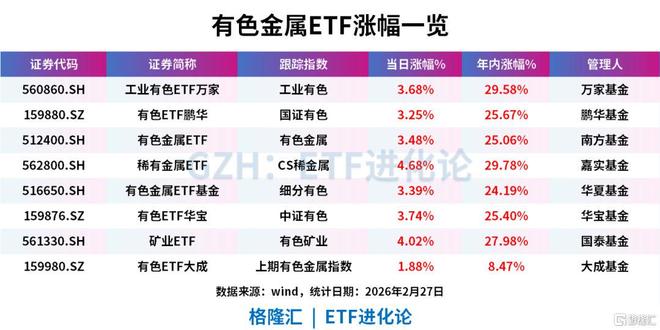
Core Viewpoint - The emergence of resource nationalism is reshaping global markets, particularly in the context of rising prices for metals like copper, aluminum, gold, and rare earths, as countries seek to maximize their benefits from natural resources [2][4][5]. Group 1: Resource Nationalism - Resource nationalism is characterized by countries implementing policies to strengthen control over their natural resources, increase local processing, and limit raw material exports to maximize national interests [4][5]. - Recent actions by countries like Zimbabwe and Indonesia reflect a broader trend of tightening resource policies globally, indicating a shift in how resources are managed and valued [4][5]. Group 2: Market Dynamics - The market has shifted focus from technology companies to upstream resources, with a notable increase in the prices of various metals, leading to a revaluation of mining and resource-rich countries [3][4]. - The surge in metal prices is driven by increased demand from emerging industries such as AI, electric vehicles, and renewable energy, prompting resource-rich nations to seek greater control and value from their resources [5][18]. Group 3: Performance of Metal ETFs - The performance of metal ETFs has been robust, with significant year-to-date gains; for instance, the Industrial Metal ETF has increased by 29.58% this year [8][10]. - Specific ETFs, such as the Rare Metal ETF and the Industrial Metal ETF, have seen substantial inflows, indicating strong investor interest in the sector [10][11]. Group 4: Price Trends and Data - Tungsten powder prices have surged to 1,800 RMB/kg, marking a 469.6% increase from last year and a 66.7% increase from the beginning of this year [6]. - The ammonium paratungstate (APT) price has reached 1.1 million RMB/ton, reflecting over a 400% increase from the previous year [6]. Group 5: Sector Classification - The non-ferrous metals sector is categorized into various segments, including precious metals (gold, silver), industrial metals (copper, aluminum), energy metals (lithium, cobalt), and rare metals [17][18]. - Each segment has distinct drivers; for example, copper demand is linked to electrification, while rare earths are increasingly important for strategic industries [17][18].


小金属板块领涨两市,东方锆业、厦门钨业等多股涨停
Huan Qiu Lao Hu Cai Jing· 2026-02-27 07:19
Group 1 - The small metals sector in A-shares continues to rise, with key subcategories such as tungsten, germanium, rare earths, and indium showing strong performance, as all 95 stocks in the sector increased in value [1] - The U.S. White House plans to use an AI model developed by the Department of Defense to establish reference prices for global critical mineral trade, initially covering germanium, gallium, antimony, and tungsten, signaling a potential restructuring of the global pricing system for critical minerals [1] - Supply constraints are a core driver of the recent strength in small metals, with major producing countries tightening resource controls, leading to a noticeable slowdown in the supply growth of tungsten, antimony, germanium, and gallium [1] Group 2 - The supply of tungsten remains tight, with black tungsten concentrate prices reaching a historical high of 777,500 yuan per ton, up 3.04% from the previous trading day, while indium and germanium also face limited supply due to concentrated global production [2] - The demand for small metals is experiencing rigid growth, driven by emerging industries such as new energy, semiconductors, artificial intelligence, and photovoltaic wind power, which further opens up upward price potential for small metals [2] - Multiple institutions have identified small metals as a key allocation direction for 2026, citing their cyclical elasticity and growth attributes, with strong profitability certainty amid economic recovery and industrial upgrades [2] Group 3 - According to Western Securities, the small metals sector is expected to encounter new opportunities by 2026 due to the rising demand from the AI industry, with strong resonance from supply-side policy constraints and demand-side recovery [3]
供给趋紧下稀土“涨价潮”持续,板块走强推动稀土ETF(516780)成交放量
Mei Ri Jing Ji Xin Wen· 2026-02-27 07:03
Group 1 - The core viewpoint of the articles highlights the recent surge in rare earth prices driven by supply constraints and downstream inventory replenishment, leading to a strong performance in the rare earth sector and increased trading volume in the rare earth ETF (516780) [1] - As of February 26, 2026, the average prices for praseodymium and neodymium oxide, praseodymium and neodymium metal, and neodymium metal were 886,100 CNY/ton, 1,081,000 CNY/ton, and 1,136,300 CNY/ton respectively, reflecting increases of 45,700 CNY/ton, 76,000 CNY/ton, and 96,300 CNY/ton compared to pre-holiday levels [1] - The continuous rise in rare earth prices is linked to the supply-side reforms and the upcoming supply-side documents for 2024-2025, indicating ongoing industry adjustments [1] Group 2 - The rare earth ETF (516780) is designed to closely track the CSI Rare Earth Industry Index, which includes companies involved in rare earth mining, processing, trading, and applications, with top constituents being Northern Rare Earth, Goldwind Technology, Xiamen Tungsten, China Aluminum, and Gree Environmental [2] - As of June 30, 2025, the number of holders of the rare earth ETF (516780) reached 32,100, making it the only rare earth-themed ETF with over 20,000 holders in the market during that period [2] - The fund manager of the rare earth ETF, Huatai-PB Fund, is among the first ETF managers in China, focusing on providing transparent, convenient, and low-cost index products for investors [2]

各国持续制定战略小金属政策,工业有色ETF鹏华(159162)涨超3.8%
Xin Lang Cai Jing· 2026-02-27 06:59
Group 1 - The U.S. plans to utilize an AI model developed by the Department of Defense to establish reference prices for critical mineral trades globally, starting with germanium, gallium, antimony, and tungsten [1] - Industrial metals are experiencing a rise due to strong demand signals, with the U.S. January SIM manufacturing PMI significantly rebounding to 52.6, well above the expected 48.5 [1] - Domestic inventory accumulation of copper and aluminum has slowed down ahead of the Spring Festival, with processing enterprises showing decent operating rates and strong downstream purchasing activity following price declines [1] Group 2 - The Zhongzheng Industrial Nonferrous Metals Theme Index (H11059) has surged by 3.78%, with component stocks such as Xiamen Tungsten rising by 10.00% [1] - The Zhongzheng Industrial Nonferrous Metals Theme Index tracks 30 large-cap listed companies involved in copper, aluminum, lead-zinc, and rare earth metals, reflecting the overall performance of the industrial nonferrous metals sector [2] - The top ten weighted stocks in the Zhongzheng Industrial Nonferrous Metals Theme Index account for 55.71% of the index, including companies like Luoyang Molybdenum and Northern Rare Earth [2]



稀缺资源板块走强 厦门钨业涨停
Xin Lang Zheng Quan· 2026-02-27 05:45
Core Viewpoint - The rare resources sector has shown strong performance, with several companies reaching their daily price limit increase [1] Group 1: Company Performance - Xiamen Tungsten Industry, Guizhou Research Institute of Nonferrous Metals, Zhong Rare Metals, Zhangyuan Tungsten Industry, Mindong Electric Power, and Yasheng Group all hit the daily limit increase [1] - Jinmoly Co., Xiyang Co., Baotai Co., and Yunnan Zinc Industry also experienced significant price increases [1]


刚刚 直线拉升 掀“涨停潮”!
Zhong Guo Ji Jin Bao· 2026-02-27 05:06
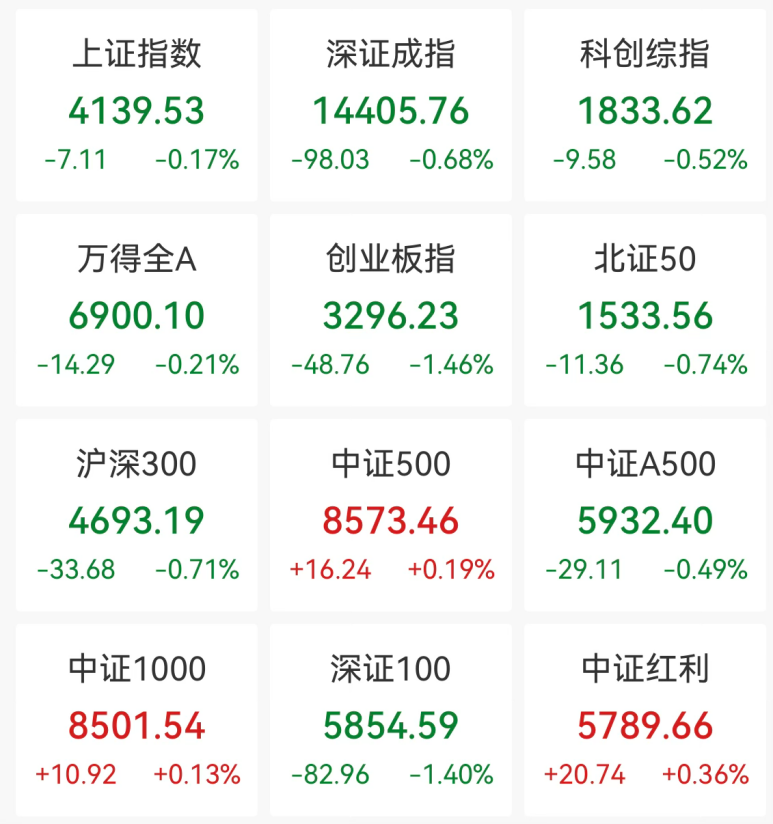
Market Overview - The A-share market experienced a collective pullback on February 27, with the Shanghai Composite Index closing at 4139.53 points, down 0.17% [1] - The semiconductor, communication equipment, electronic components, soft drinks, and building materials sectors saw the largest declines, while the non-ferrous metals sector showed strong gains [1][2] Non-Ferrous Metals Sector - The non-ferrous metals sector surged, particularly driven by rare metals and tungsten concept stocks, leading to a wave of stocks hitting the daily limit [4][5] - Notable performers included Dongfang Zirconium, Xianglu Tungsten, and Zhong Rare Metals, all recording limit-up gains [5][6] - The price of light rare earths increased, with praseodymium and neodymium metal prices rising to 1.08 million CNY/ton and 1.125 million CNY/ton respectively [7] Computing Power Leasing Sector - The computing power leasing sector continued its upward trend, with stocks like Capital Online and Qingyun Technology seeing significant gains of over 10% [8] - The sector's growth is supported by increasing demand for AI models, with Chinese models surpassing U.S. models in usage [9] - The rise in AI model usage is expected to benefit the domestic computing power industry, as companies with stable capabilities are likely to capture more market share [9] Technology Sector - The Hang Seng Technology Index rose over 1%, with notable increases in cloud computing stocks and tech companies like SenseTime and Bilibili [3][4] - The software development sector is also experiencing growth, with new AI programming solutions being launched by major companies like Huawei and Alibaba [9]


刚刚,直线拉升,掀“涨停潮”!
Zhong Guo Ji Jin Bao· 2026-02-27 05:03
Market Overview - The A-share market experienced a collective pullback on February 27, with the Shanghai Composite Index closing at 4139.53 points, down 0.17% [2][3] - The semiconductor, communication equipment, electronic components, soft drinks, and building materials sectors saw the largest declines, while the non-ferrous metals sector showed strong gains, particularly tungsten concept stocks [2][3] Sector Performance - The non-ferrous metals sector surged, with rare metals leading the charge and tungsten concept stocks experiencing significant increases [5][6] - The Hang Seng Technology Index rose over 1%, driven by strong performances in the cloud computing sector and tech stocks like SenseTime and Bilibili [4][5] Notable Stocks - Several stocks in the non-ferrous metals sector hit the daily limit, including Dongfang Zirconium, Xianglu Tungsten, and Zhong Rare Metals, all recording gains of 10% [6][7] - Capital Online saw a rise of over 15%, while other companies in the computing power leasing sector also performed well, with Qingyun Technology-U and Xinjun Network both increasing by over 10% [10][11] Price Movements - The domestic light rare earth market saw price increases, with praseodymium and neodymium metal prices rising to 1.08 million CNY/ton and 1.125 million CNY/ton, respectively [9] - The computing power leasing sector continued to rise, reflecting strong demand and growth potential in the AI model API market, where Chinese models surpassed U.S. models in usage [10][11] Industry Insights - Analysts suggest that the increase in domestic AI model usage and monetization expectations may accelerate growth in the data calling volume and model performance, benefiting the domestic computing power industry chain [11] - The software development sector is also experiencing upward momentum, with new AI programming solutions being launched by major cloud service providers [11]




有色金属ETF天弘(159157)标的指数大涨超3%,近10日净流入近12亿元
Mei Ri Jing Ji Xin Wen· 2026-02-27 02:50
Group 1 - The core viewpoint of the articles highlights the rising trend in the non-ferrous metals sector, particularly driven by the performance of the Tianhong Non-Ferrous Metals ETF, which has seen significant inflows and a record fund size [1][2] - The Tianhong Non-Ferrous Metals ETF (159157) has achieved a net inflow of 1.184 billion yuan over the last ten trading days, reaching a total fund size of 2.352 billion yuan, marking a new high since its inception [1] - The ETF closely tracks the CSI Industrial Non-Ferrous Metals Theme Index, with the top three sectors—copper (34.43%), aluminum (21.82%), and rare earths (13.60%)—accounting for nearly 70% of its holdings, indicating its market scarcity and investment value [1] Group 2 - The current PE-TTM for the industrial non-ferrous index stands at 28.26 times, which is at the 45.46% historical percentile, suggesting that the current price is lower than 54.54% of the historical time, indicating a reasonable valuation [2] - Geopolitical tensions in the Middle East have heightened concerns over the security of key resource supply chains, enhancing the strategic premium on industrial metals [2] - Domestic policies aimed at reducing competition and promoting stable growth are providing support for the demand fundamentals of non-ferrous metals [2]


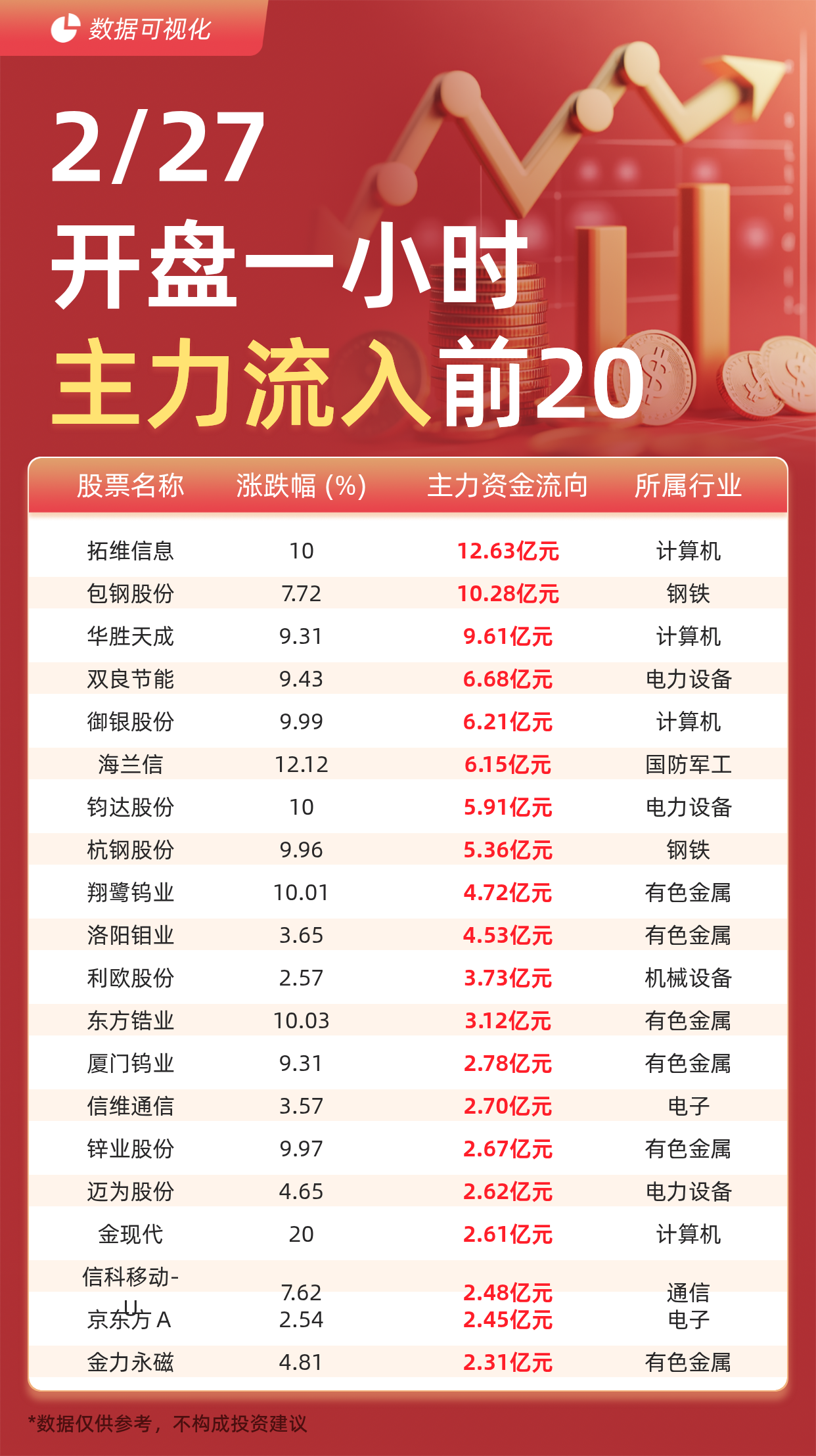
主力资金流入前20:拓维信息流入12.63亿元、包钢股份流入10.28亿元
Jin Rong Jie· 2026-02-27 02:49
Core Insights - The main focus of the news is on the significant inflow of capital into specific stocks, indicating strong investor interest and potential growth in these companies. Group 1: Stock Performance and Capital Inflow - Top stocks by capital inflow include: - Tuo Wei Information with 1.263 billion yuan and a 10% increase [1] - Baogang Co. with 1.028 billion yuan and a 7.72% increase [2] - Huasheng Tiancheng with 0.961 billion yuan and a 9.31% increase [2] - Shuangliang Energy with 0.668 billion yuan and a 9.43% increase [2] - Yuyin Co. with 0.621 billion yuan and a 9.99% increase [2] - Other notable stocks include: - Hailanxin with 0.615 billion yuan and a 12.12% increase [2] - Junda Co. with 0.591 billion yuan and a 10% increase [2] - Hangang Co. with 0.536 billion yuan and a 9.96% increase [2] - Xianglu Tungsten with 0.472 billion yuan and a 10.01% increase [2] - Luoyang Molybdenum with 0.453 billion yuan and a 3.65% increase [2] Group 2: Sector Analysis - The stocks are categorized into various sectors, including: - Computer sector: Tuo Wei Information, Huasheng Tiancheng, Yuyin Co., and Jinxi Modern [2][3] - Steel sector: Baogang Co. and Hangang Co. [2] - Power equipment sector: Shuangliang Energy, Junda Co., and Maiwei Co. [2][3] - Non-ferrous metals sector: Xianglu Tungsten, Luoyang Molybdenum, and Zinc Industry Co. [2][3] - Machinery equipment sector: Liou Co. [2] - Electronics sector: Xinwei Communication and BOE A [3]