ACC(600585)

Search documents
海螺水泥获FMR LLC增持332.25万股 每股作价约22.77港元
Xin Lang Cai Jing· 2026-03-20 00:21
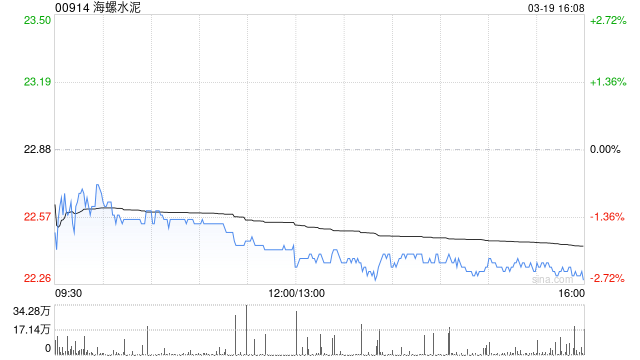
据香港联交所最新数据显示,3月16日,FMR LLC增持海螺水泥(00914)332.25万股,每股作价 22.7745港元,总金额约为7566.83万港元。增持后最新持股数目约为6617.32万股,持股比例为5.09%。 据香港联交所最新数据显示,3月16日,FMR LLC增持海螺水泥(00914)332.25万股,每股作价 22.7745港元,总金额约为7566.83万港元。增持后最新持股数目约为6617.32万股,持股比例为5.09%。 责任编辑:卢昱君 热点栏目 自选股 数据中心 行情中心 资金流向 模拟交易 客户端 责任编辑:卢昱君 热点栏目 自选股 数据中心 行情中心 资金流向 模拟交易 客户端 ...

FMR LLC增持海螺水泥332.25万股 每股作价约22.77港元
Zhi Tong Cai Jing· 2026-03-19 20:57
Group 1 - FMR LLC increased its stake in Conch Cement (600585) by acquiring 3.3225 million shares at a price of HKD 22.7745 per share, totaling approximately HKD 75.6683 million [1] - Following the acquisition, FMR LLC's total shareholding in Conch Cement reached approximately 66.1732 million shares, representing a 5.09% ownership stake [1]
海螺水泥(00914.HK)获FMR LLC增持332.25万股
Ge Long Hui· 2026-03-19 13:41
Group 1 - FMR LLC increased its stake in Conch Cement (00914.HK) by purchasing 3.3225 million shares at an average price of HKD 22.7745 per share, totaling approximately HKD 75.6683 million [1][2] - Following the acquisition, FMR LLC's total shareholding rose to 66.1732 million shares, increasing its ownership percentage from 4.84% to 5.09% [1][2]

FMR LLC增持海螺水泥(00914)332.25万股 每股作价约22.77港元
智通财经网· 2026-03-19 11:16
智通财经APP获悉,据香港联交所最新数据显示,3月16日,FMR LLC增持海螺水泥(00914)332.25万 股,每股作价22.7745港元,总金额约为7566.83万港元。增持后最新持股数目约为6617.32万股,持股比 例为5.09%。 ...
海螺水泥跌2.03%,成交额3.66亿元,主力资金净流出1147.13万元
Xin Lang Cai Jing· 2026-03-18 03:17
Core Viewpoint - Conch Cement's stock price has shown fluctuations, with a recent decline of 2.03%, while the company has experienced a year-to-date increase of 12.35% in stock value [1][5]. Financial Performance - For the period from January to September 2025, Conch Cement reported operating revenue of 61.298 billion yuan, a year-on-year decrease of 10.06%, while net profit attributable to shareholders increased by 21.28% to 6.305 billion yuan [2][6]. Shareholder Information - As of September 30, 2025, the number of shareholders for Conch Cement reached 251,400, an increase of 12.17% compared to the previous period [2][6]. - The company has distributed a total of 83.985 billion yuan in dividends since its A-share listing, with 17.922 billion yuan distributed over the last three years [3][7]. Stock Trading Activity - On March 18, Conch Cement's stock traded at 24.56 yuan per share, with a total transaction volume of 366 million yuan and a turnover rate of 0.37% [1][4]. - The net outflow of main funds was 11.4713 million yuan, with significant buying and selling activity observed in large orders [1][4]. Business Overview - Conch Cement, established on September 1, 1997, and listed on February 7, 2002, is primarily engaged in the production and sales of cement, clinker, and aggregates [5][6]. - The revenue composition of the company includes 57.81% from 45-grade cement, 15.63% from other sales, and smaller percentages from various construction materials [6]. Industry Classification - Conch Cement is classified under the building materials sector, specifically in cement manufacturing, and is associated with concepts such as prefabricated buildings, blue-chip stocks, and state-owned enterprise reforms [2][6].
Artisan Partners Holdings LP减持海螺水泥(00914)268.75万股 每股作价22.8536港元
智通财经网· 2026-03-16 11:15
智通财经APP获悉,香港联交所最新资料显示,3月11日,Artisan Partners Holdings LP减持海螺水泥 (00914)268.75万股,每股作价22.8536港元,总金额约为6141.91万港元。减持后最新持股数目约为 6384.83万股,最新持股比例为4.91%。 本交易涉及其他关联方:Artisan Partners Asset Management Inc.、Artisan Partners Limited Partnership. ...
Artisan Partners Holdings LP减持海螺水泥268.75万股 每股作价22.8536港元
Zhi Tong Cai Jing· 2026-03-16 11:15
香港联交所最新资料显示,3月11日,Artisan Partners Holdings LP减持海螺水泥(600585) (00914)268.75万股,每股作价22.8536港元,总金额约为6141.91万港元。减持后最新持股数目约为 6384.83万股,最新持股比例为4.91%。 本交易涉及其他关联方:Artisan Partners Asset Management Inc.、Artisan Partners Limited Partnership. ...
——建材行业事件点评:反内卷立法提上日程,行业竞争缓和可期
Shenwan Hongyuan Securities· 2026-03-16 07:26
Investment Rating - The report rates the construction materials industry as "Overweight" indicating that the industry is expected to outperform the overall market [2][9]. Core Insights - Legislative efforts to address "involution" competition are underway, which may lead to a more favorable competitive environment in the industry [4]. - Although cement demand has not significantly improved, excessive competition on the supply side is a core reason for the continuous price decline. In 2025, national cement production is projected to be 1.693 billion tons, a year-on-year decrease of 6.9% [4]. - The "anti-involution" legislation is expected to significantly improve the supply contraction situation in the cement industry, helping to curb low-price competition and overproduction [4]. - The cement industry is linked to carbon trading and energy-saving policies, which may further compress supply in the future [4]. - The report suggests that the "anti-involution" measures will help reduce competitive intensity and improve profitability in the domestic cement industry, with a focus on leading companies such as Conch Cement, Huaxin Cement, and Tianshan Cement [4]. Summary by Sections Legislative Developments - The Ministry of Justice has highlighted the importance of optimizing the business environment and addressing issues like local protectionism and "involution" competition in its legislative agenda for the year [4]. Supply and Demand Dynamics - Cement demand remains weak, with a projected decline in production and demand in 2025. The profitability of the cement industry is closely tied to competition dynamics [4]. Industry Policy Implications - The "anti-involution" legislation is anticipated to provide stronger institutional support to limit low-price competition and enhance effective supply contraction [4]. Investment Recommendations - The report emphasizes the potential for profitability recovery in the cement industry, recommending attention to leading companies such as Conch Cement (A/H), Huaxin Cement (A/H), Tianshan Cement, and others [4].



建材行业事件点评:反内卷立法提上日程,行业竞争缓和可期
Shenwan Hongyuan Securities· 2026-03-16 06:33
Investment Rating - The report rates the construction materials industry as "Overweight" indicating that the industry is expected to outperform the overall market [2]. Core Insights - Legislative efforts to address "involution" competition are underway, which may lead to a more favorable competitive environment in the industry [4]. - Although cement demand has not significantly improved, excessive competition on the supply side is a primary reason for the continued decline in prices. In 2025, national cement production is projected to be 1.693 billion tons, a year-on-year decrease of 6.9% [4]. - The "anti-involution" legislation is expected to significantly improve the supply contraction in the cement industry, providing stronger institutional support to curb low-price competition and overproduction [4]. - The cement industry is expected to see improved profitability due to enhanced cash flow and dividend attributes following the "anti-involution" measures [4]. Summary by Sections Legislative Developments - The Ministry of Justice has highlighted the importance of optimizing the business environment and addressing issues such as local protectionism and "involution" competition in its legislative agenda for the year [4]. Supply and Demand Dynamics - Cement demand remains weak, with a correlation between industry profitability and competition. Regions with better production coordination have shown relatively stronger pricing, while weaker regions continue to struggle with low prices [4]. Industry Policy and Future Outlook - The cement industry association has initiated measures to promote "anti-involution" and stabilize growth, focusing on verifying actual production capacity against registered capacity to combat disordered competition [4]. - The cement sector is linked to carbon trading and energy-saving initiatives, with expectations for stricter controls on inefficient production capacities post-2026 [4]. Investment Recommendations - The report suggests focusing on leading companies in the industry such as Conch Cement (A/H), Huaxin Cement (A/H), Tianshan Cement, Tapai Group, Shangfeng Cement, Western Cement (H), and China Resources Cement Technology (H) as potential investment opportunities [4].
建材行业事件点评:消费建材板块进一步提价,坚决传导成本压力
Shenwan Hongyuan Securities· 2026-03-16 03:03
Investment Rating - The report rates the construction materials industry as "Overweight" [2] Core Insights - The consumer building materials sector is experiencing strong price increases, with significant price hikes announced by major companies in the waterproofing and coatings industries [4] - The core contradiction for the consumer building materials sector in 2026 will be price transmission and profit improvement, driven by rising international oil prices affecting raw material costs [4] - Demand recovery is supported by the traditional peak construction season and active second-hand housing market, which aids companies in passing on costs [4] - The report highlights three major changes in demand: increased importance of non-housing scenarios, a significant rise in second-hand home transactions, and the anticipated growth of stock renovations [4] - The report emphasizes the importance of industry structure and company willingness to raise prices, with a focus on the waterproofing sector [4] Summary by Sections Price Increases - In March, the consumer building materials sector saw strong price increases, with companies like Nippon Paint and Skshu Paint announcing price hikes of 3-10% and 5-15% respectively [4][5] - Major companies in the waterproofing sector, such as Oriental Yuhong and Keshun, have also announced price increases for various products [5] Demand and Supply Dynamics - The report notes that the demand for building materials is expected to rise due to the peak construction season and increased activity in the real estate market [4] - The report suggests that the supply side has been constrained due to capacity reductions in cement and glass, which may lead to further price increases [4] Investment Recommendations - The report recommends focusing on the waterproofing sector, specifically companies like Keshun and Oriental Yuhong, which have demonstrated strong growth potential [4] - Other recommended companies include Hanhigh Group, Sanke Tree, and Weixing New Materials, which have stable cash flows and performance [4][6]