
ACC(600585)

Search documents
海螺水泥2025年度合计计提减值损失9.07亿元
Zhi Tong Cai Jing· 2026-03-24 21:01
Core Viewpoint - Conch Cement announced a significant impairment loss for the fiscal year 2025, reflecting a proactive approach to accurately represent its financial and operational status [1] Financial Performance - The company reported a total impairment loss of RMB 907 million for the year 2025, which includes a credit impairment loss of RMB 87.14 million and an asset impairment loss of RMB 820 million [1] - This impairment loss accounts for 11.18% of the audited net profit attributable to shareholders of the listed company for the year 2025 [1]
安徽海螺水泥股份有限公司
Shang Hai Zheng Quan Bao· 2026-03-24 19:19
公司是否通过访谈、座谈、问卷调查等方式开展利益相关方沟通并披露:√是 □否 ■ 4、双重重要性评估结果 ■ 注:公司依据《上海证券交易所上市公司自律监管指引第14号一一可持续发展报告(试行)》规定的议 题与要求开展双重重要性分析,其中,水资源利用、乡村振兴、社会贡献、科技伦理、供应链安全、平 等对待中小企业、利益相关方沟通、反不正当竞争、尽职调查议题对公司不具有重要性,已在报告中对 评估流程及结果进行展示说明。 证券代码:600585 证券简称:海螺水泥 公告编号:临2026-05 安徽海螺水泥股份有限公司 安徽海螺水泥股份有限公司("本公司"或"公司")第十届董事会第三次会议于二〇二六年三月二十四日 在本公司会议室召开,应到董事9人,实到董事9人。本次会议由公司董事长杨军先生主持,公司部分高 级管理人员列席了会议。本次会议的召开符合《公司法》和本公司《公司章程》的规定,会议程序及所 作决议合法有效。本次会议通过如下决议: 一、审议通过本公司2025年度总经理报告以及2026年度经营计划和目标。 表决情况:同意9票,反对0票,弃权0票。 二、审议通过本公司2025年度报告(包括董事会报告)及其摘要、业绩公告, ...
安徽海螺水泥股份有限公司2025年年度报告摘要
Shang Hai Zheng Quan Bao· 2026-03-24 18:55
Core Viewpoint - The company, Anhui Conch Cement Co., Ltd., has announced its annual report, highlighting its business operations, financial status, and future development plans, including a cash dividend distribution proposal and changes in share repurchase policies [1][9][46]. Company Overview - The main business of the company includes the production and sales of cement, clinker, aggregates, and concrete, with products used in large infrastructure projects and urban development [1][2]. - The company has established a comprehensive marketing network with over 500 market departments in China and overseas, focusing on direct sales and enhancing market control [2]. Financial Data and Indicators - The company reported a total of 5,299,302,579 shares as of the latest disclosure, with a proposed cash dividend of RMB 0.61 per share, amounting to a total distribution of approximately RMB 3.22 billion [46][49]. - The company has also reported a total of RMB 90.70 million in impairment losses for the year 2025, which includes credit impairment losses and asset impairment losses [55][60]. Shareholder Information - As of December 31, 2025, the company had 247,947 registered shareholders, with the top ten shareholders holding significant stakes, including Hong Kong Central Clearing Limited [4][5]. - The company plans to change the purpose of repurchased shares to cancellation and reduction of registered capital, following the completion of a share buyback of 22,242,535 shares [41][43]. Important Matters - The company has proposed to revise its articles of association to reflect changes in share repurchase policies and to ensure compliance with regulatory requirements [9][10]. - The company has also announced plans to provide guarantees for 22 subsidiaries and joint ventures, with a total expected guarantee amount of RMB 271.69 million [13][16].
去年归母净利润同比增长5.42% 海螺水泥:今年面临三方面风险
Mei Ri Jing Ji Xin Wen· 2026-03-24 14:57
Core Viewpoint - In 2025, Conch Cement reported a revenue of approximately 82.53 billion yuan, a year-on-year decrease of 9.33%, while achieving a net profit attributable to shareholders of approximately 8.11 billion yuan, a year-on-year increase of 5.42%, indicating a mixed performance against market expectations [2][5]. Financial Performance - Revenue for 2025 was 82.53 billion yuan, down from 91.03 billion yuan in 2024, reflecting a decline of 9.33% [3]. - Total profit for 2025 was approximately 10.42 billion yuan, showing a year-on-year increase of 3.90% [3]. - Net profit attributable to shareholders was approximately 8.11 billion yuan, up 5.42% from 7.70 billion yuan in 2024 [3]. - The net profit after deducting non-recurring gains and losses was approximately 7.59 billion yuan, a 3.03% increase from 7.36 billion yuan in 2024 [3]. - Basic earnings per share were 1.54 yuan, an increase of 5.42% compared to 1.46 yuan in 2024 [3]. Cost Management and Innovation - In 2025, Conch Cement improved cost control significantly, with the comprehensive cost of self-produced cement clinker decreasing by 11.12% year-on-year [4]. - The company expanded its business into aggregates and commercial concrete, adding 22 new concrete stations and launching 13 dry-mixed mortar and tile adhesive projects [4]. - Conch Cement achieved nearly 400 authorized patents and was recognized for its intelligent factory project, which optimizes the entire data process [4]. Environmental and Operational Metrics - As of the end of 2025, Conch Cement had an installed capacity of 1,377 megawatts for wind and solar energy storage [4]. - The company had 56 subsidiaries recognized as provincial and municipal "green factories," with 29 achieving national-level recognition [4]. Risk Factors - Conch Cement identified three main risk factors for 2026: demand fluctuation risk, intensified competition risk, and pressure from environmental policies [5]. - The company noted that the net cash flow from operating activities decreased by 9.92% to 16.64 billion yuan in 2025, despite a year-on-year increase in net profit [5].

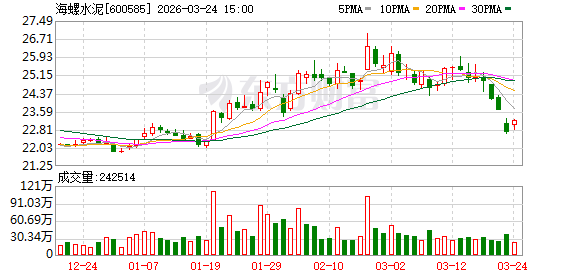
海螺水泥将于6月30日派发末期股息每股0.61元
Zhi Tong Cai Jing· 2026-03-24 13:36
Group 1 - The company, Conch Cement (00914), announced a final dividend of HKD 0.61 per share for the year ending December 31, 2025, to be distributed on June 30, 2026 [1]
海螺水泥(00914.HK)2025年度合计计提减值损失9.07亿元
Sou Hu Cai Jing· 2026-03-24 13:34
Core Viewpoint - Conch Cement (00914.HK) announced a significant impairment loss for the fiscal year 2025, reflecting its financial and operational status in accordance with accounting standards [1] Financial Summary - The company recognized a credit impairment loss of RMB 87.14 million for the year 2025 [1] - An asset impairment loss of RMB 820 million was also recorded, leading to a total impairment loss of RMB 907 million [1] - This total impairment loss represents 11.18% of the audited net profit attributable to shareholders for the year 2025 [1]
海螺水泥(00914)将于6月30日派发末期股息每股0.61元
Zhi Tong Cai Jing· 2026-03-24 13:33
Group 1 - The company, Conch Cement (00914), announced a final dividend of HKD 0.61 per share for the year ending December 31, 2025, to be distributed on June 30, 2026 [1]
海螺水泥(00914)2025年度合计计提减值损失9.07亿元
Zhi Tong Cai Jing· 2026-03-24 13:27
Group 1 - The core point of the article is that Conch Cement (00914) reported a total impairment loss of RMB 907 million for the fiscal year 2025, reflecting a significant impact on its financial performance [2] - The company conducted impairment tests on various assets as of December 31, 2025, in accordance with relevant accounting standards, leading to the recognition of credit impairment losses of RMB 87.14 million and asset impairment losses of RMB 820 million [2] - The total impairment loss of RMB 907 million accounts for 11.18% of the audited net profit attributable to shareholders of the listed company for the fiscal year 2025 [2]
海螺水泥(00914) - 於其他市场发佈的公告 (董事和高级管理人员离职管理制度)
2026-03-24 13:21
安徽海螺水泥股份有限公司 董事和高级管理人员离职管理制度 第一章 总则 第一条 为规范安徽海螺水泥股份有限公司(以下简称 "公司")董事、高级管理人员离职管理,根据《中华人民 共和国公司法》《中华人民共和国证券法》《上市公司治理准 则》《香港联合交易所有限公司证券上市规则》及《安徽海 螺水泥股份有限公司章程》(以下简称"《公司章程》")等有 关规定,特制定本制度。 第二条 本制度适用于公司全体董事、高级管理人员因 任期届满、辞任、被解除职务或其他原因离职的情形。 (二)审核委员会成员辞任导致审核委员会成员低于法 定人数,或者欠缺担任召集人的会计专业人士; (三)独立董事辞任导致董事会或其专门委员会中独立 董事所占比例不符合法律法规、《独立董事工作制度》、公司 股票上市的证券交易所颁布或适用的上市规则或《公司章程》 规定,或者独立董事中欠缺会计专业人士。 第六条 股东会可以决议解任非职工代表董事,解任自 决议通过之日起生效。 第二章 离职情形与生效条件 第三条 董事、高级管理人员可以在任期届满前提出辞 任。董事、高级管理人员辞任应当向公司提交书面辞职报告, 辞职报告中应说明辞职原因。 董事辞任的,自公司收到辞职 ...
海螺水泥(00914) - 2025年度环境、社会及管治报告
2026-03-24 13:20
安徽海螺水泥股份有限公司 00914.HK 600585.SH 環境、社會及管治報告 2025 目錄 關於本報告 董事長致辭 走進海螺水泥 7 3 21 5 2.1 公司簡介 2.2 公司業務 2.3 公司經營發展概況 03 數說 2025 3.1 ESG 目標及進展 / 亮點績效 3.2 榮譽與獎項 | | | | 01 | 39 | ESG | 管理 | 05 | | --- | --- | --- | --- | --- | | | 5.1 ESG 管理方針 | | | | | | 5.2 ESG 管理架構 | | | | | | 5.3 雙重重要性分析 | | | | | | 5.4 利益相關方溝通 | | | | | | | 管治篇: | | | 社會篇: | | | --- | --- | --- | --- | --- | --- | --- | | 04 | 47 | 精益治理, 築基正道之路 | 06 | 99 | 和諧共融, 助力民生福祉 | 08 | | | | 6.1 董事會聲明 | | | 8.1 員工發展 | | | | | 6.2 企業管治 | | | 8.2 卓越品質 | | ...