SNW(600628)

Search documents
马斯克:我想创立一个新世界
Sou Hu Cai Jing· 2025-12-28 09:35
Core Insights - The essence of Elon Musk's success lies in his intrinsic motivation, which he believes is crucial for self-growth and making meaningful contributions to the world [2][20]. Group 1: Personal Philosophy and Motivation - Musk emphasizes the importance of having a strong intrinsic drive to pursue meaningful endeavors that aim to improve the world [2][20]. - He reflects on his childhood curiosity about the meaning of life and the desire to create advanced technology that could be perceived as magic [4][5]. - Musk's conclusion about life's purpose is to enhance global knowledge and collective wisdom, striving for a higher level of civilization [5]. Group 2: Career Path and Key Decisions - Musk's academic journey in physics and business was driven by his ambition to impact humanity's future [7]. - He initially pursued research in energy density for electric vehicles but pivoted to internet entrepreneurship, co-founding PayPal after recognizing market interest in email payments [7][11]. - The sale of PayPal to eBay for $1.5 billion in stock marked a significant financial milestone for Musk, who held a 11.7% stake [11]. Group 3: Addressing Global Challenges - Musk identifies sustainable energy and the potential for human colonization of other planets as critical issues facing humanity [8][10]. - He founded Tesla and SolarCity to tackle sustainable energy challenges and SpaceX to address space transportation issues [10][11]. Group 4: Innovation and Product Development - The development of Tesla's Roadster aimed to change perceptions of electric vehicles, demonstrating that they could be fast, long-range, and stylish [12][13]. - Musk stresses the importance of creating tangible product prototypes rather than relying solely on theoretical plans [13]. Group 5: Resilience and Risk-Taking - Musk encourages embracing failure as a part of the innovation process, asserting that significant achievements often come from overcoming setbacks [18]. - He believes that individuals should not fear failure but rather view it as an opportunity for growth and learning [18][21]. Group 6: Vision for the Future - Musk's vision extends beyond personal wealth; he aims to contribute to humanity's advancement and address existential risks [19][20]. - He advocates for a future where children are motivated by intrinsic goals rather than external pressures, fostering resilience and ambition [21].



20170307-信达国际-新世界百货中国(0825.HK):Recovery+is++gathering+momentum
Ge Long Hui· 2025-12-27 08:49
Core Viewpoint - NWDS China has shown signs of recovery in same store sales growth (SSSG) after years of decline, driven by increased purchase volumes in key categories and external factors such as RMB depreciation [1][2] Group 1: Company Overview - NWDS China operates 42 department stores across 22 cities and has over 20 years of operating history, with 7 self-owned properties [1] - Revenue distribution in 1H17 was 46.1% from Northern China, 33.5% from Eastern China, and 20.4% from Central Western regions [1] Group 2: Sales Performance - SSSG was flat year on year in 1H17, marking a turnaround from negative growth since FY14, attributed to strong performance in cosmetics, sportswear, and jewelry [1] - Management noted that SSSG trends continued positively into January and February of the current year, with similar performance reported by other department stores [1] Group 3: Revenue Transformation - NWDS has diversified its revenue streams, increasing direct sales (including its own brand LOL and n+Natural Taste) by 24% over the past three years, which accounted for 31% of total revenue in 1H17 [2] - Rental income, primarily from restaurants, rose by 25% over the same period, contributing 19% to total revenue in 1H17 [2] - The share of concessionaire sales decreased from 66% in FY13 to 50% in 1H17, indicating a shift towards more direct sales and experiential retailing [2] Group 4: Valuation Insights - NWDS is currently trading at an annualized P/E ratio of 11X for FY17 and a distressed P/B valuation of 0.35x based on 1H17 results, with HK$640 million in net cash [3] - The department store sector is showing improvement in SSSG, suggesting potential investment opportunities, especially if self-owned properties are disposed of to unlock value [3]
全球首条千吨级氢化镁产线在榆林开工建设,富德金煜再次刷新世界纪录!
Sou Hu Cai Jing· 2025-12-25 03:28
Core Viewpoint - The construction of the world's first thousand-ton-level efficient magnesium-based solid hydrogen storage material demonstration project marks a significant milestone in addressing the core bottlenecks of hydrogen energy storage and transportation in China, paving the way for a self-controlled solid hydrogen storage industry chain [1][5][17]. Project Overview - The project, located in the Yuheng Industrial Zone of Yulin City, has a total investment of 248 million yuan and aims to establish a production facility with an annual output of 2,000 tons of magnesium hydride (MgH₂) [6]. - The project is based on advanced patented technologies accumulated by the Dalian Institute of Chemical Physics, Chinese Academy of Sciences, and involves collaboration with multiple research and engineering institutions [12]. Significance of Construction - The establishment of the thousand-ton production line is not merely an expansion of capacity but represents a strategic move to promote the commercial application of hydrogen energy from demonstration to large-scale implementation [17]. - The project aims to overcome global challenges related to hydrogen storage and transportation, providing a safe and efficient solution for various markets, including transportation, industry, and electricity [21]. Industry Outlook - The company, Fude Jinyu, is transitioning from an industry innovator to a leader, leveraging deep technical expertise and strategic planning [22]. - The successful implementation of magnesium-based solid hydrogen storage technology is expected to significantly reduce the comprehensive storage and transportation costs of hydrogen, facilitating the integration of renewable energy and hydrogen applications [22].
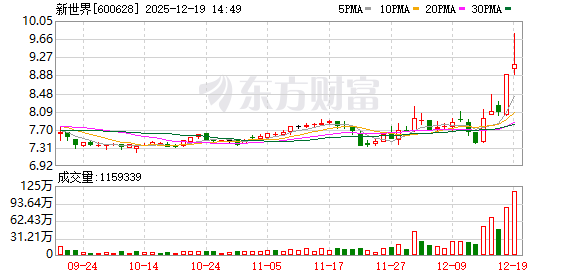
新世界涨2.12%,成交额1.31亿元,主力资金净流入240.97万元
Xin Lang Cai Jing· 2025-12-25 02:04
Core Viewpoint - New World has shown a mixed performance in stock price and financial metrics, with a recent increase in stock price but a decline in revenue and net profit year-on-year. Group 1: Stock Performance - On December 25, New World’s stock price increased by 2.12%, reaching 8.69 CNY per share, with a trading volume of 131 million CNY and a turnover rate of 2.35%, resulting in a total market capitalization of 5.621 billion CNY [1] - Year-to-date, New World’s stock price has risen by 6.89%, but it has decreased by 2.25% over the last five trading days, increased by 15.87% over the last 20 days, and increased by 16.96% over the last 60 days [1] Group 2: Financial Performance - As of September 30, New World reported a revenue of 791 million CNY for the first nine months of 2025, representing a year-on-year decrease of 1.90%, and a net profit attributable to shareholders of 64.48 million CNY, down 1.46% year-on-year [2] - Cumulative cash dividends since the A-share listing amount to 1.187 billion CNY, with 64.69 million CNY distributed over the past three years [3] Group 3: Shareholder Information - As of September 30, 2025, New World had 43,200 shareholders, a decrease of 9.22% from the previous period, with an average of 14,982 circulating shares per shareholder, an increase of 10.15% [2] - Among the top ten circulating shareholders, the China Securities Shanghai State-owned Enterprise ETF (510810) ranked as the ninth largest, holding 4.6278 million shares, a decrease of 595,000 shares compared to the previous period [3] Group 4: Business Overview - New World, established on November 8, 1996, and listed on January 19, 1993, is primarily engaged in the retail and pharmaceutical health sectors, with revenue contributions of 50.32% from the pharmaceutical industry, 22.40% from commercial activities, 18.23% from hotel services, and 6.86% from other sectors [1] - The company is classified under the Shenwan industry as retail trade - general retail - department stores, and is associated with concepts such as new retail, state-owned enterprise reform, and small-cap stocks [1]
新世界:自有物业主要用于公司百货板块、医药板块以及酒店板块的自主经营
Zheng Quan Ri Bao Zhi Sheng· 2025-12-22 13:48
Core Viewpoint - The company emphasizes its commitment to enhancing operational management and value management capabilities while leveraging its multi-business model across retail, pharmaceuticals, hospitality, culture, health, sports, and exhibitions [1] Group 1: Business Operations - The company's proprietary properties are primarily utilized for its retail, pharmaceutical, and hotel sectors [1] - The company aims to continuously improve its operational management to enhance overall market value [1] Group 2: Profit Distribution Policy - The company adheres to a profit distribution policy that aligns with relevant regulations, considering factors such as development stage and operational efficiency [1] - The company is committed to maintaining a relatively stable profit distribution policy and dividend plan to actively reward all investors [1]
新世界:公司将持续关注免税相关政策及动向
Zheng Quan Ri Bao Zhi Sheng· 2025-12-22 12:43
Group 1 - The core viewpoint of the article is that New World is monitoring the developments in the duty-free goods operating qualifications, which are subject to strict national approval processes [1] - The company indicated that the current application conditions for duty-free qualifications are not yet mature, and it will continue to pay attention to related policies and trends [1]
新世界成交额创2024年12月17日以来新高
Zheng Quan Shi Bao Wang· 2025-12-19 06:48
Core Viewpoint - The trading volume of Shanghai New World Co., Ltd. reached 1.012 billion RMB, marking the highest level since December 17, 2024, with the latest stock price increasing by 2.92% and a turnover rate of 16.84% [2] Company Summary - Shanghai New World Co., Ltd. was established on November 8, 1996, with a registered capital of 646.875384 million RMB [2]
安期货晨会纪要-20251219




Xin Yong An Guo Ji Zheng Quan· 2025-12-19 04:01
Core Insights - US core inflation unexpectedly eased to a four-year low, raising questions among economists about the reliability of the data due to a prior government shutdown [8][14] - ByteDance has signed an agreement to establish a joint venture in the US with majority ownership by American investors [8][14] Market Performance - The A-share market opened lower but closed higher, with the Shanghai Composite Index up 0.16% at 3876.37 points, while the Shenzhen Component fell 1.29% and the ChiNext Index dropped 2.17% [1] - The Hong Kong market also saw fluctuations, with the Hang Seng Index closing up 0.12% at 25498.13 points, while the Hang Seng Tech Index fell 0.73% [1][5] Economic Indicators - The US core Consumer Price Index (CPI) rose by 2.6% year-on-year in November, while the overall CPI increased by 2.7% [14] - The report indicated that core CPI only increased by 0.2% over the last two months, with declines in hotel, leisure, and clothing prices limiting the overall increase [14] Corporate Developments - TikTok announced the establishment of a joint venture with US investors, which will operate independently and manage US data protection and algorithm security [8][14] - China has reportedly ordered 7 million tons of US soybeans, achieving over half of the procurement target set during the Trump administration [8][14]
中国出口开AI新局:旧硬件打不开新世界
Di Yi Cai Jing· 2025-12-18 12:00
Core Viewpoint - The rise of AI technology is becoming essential for consumer electronics, particularly for Chinese manufacturers, as they prepare for the upcoming CES in Las Vegas, where AI-enabled products are expected to dominate the showcase [1][2]. Group 1: AI Integration in Consumer Electronics - AI has become an unavoidable trend for Chinese manufacturers, with most exhibitors at CES expected to present AI-capable products [2]. - MINISFORUM, a Shenzhen-based company, is focusing on AI integration across its product lines, including Mini PCs and AI workstations, with personal computers being its main revenue source [2]. - Major PC manufacturers like Lenovo and Dell are also embracing AI, but MINISFORUM leverages flexibility in niche markets like Mini PCs, targeting specific audiences with higher-end components [2][3]. Group 2: Market Dynamics and Competition - China's PC exports are under pressure, with a significant portion already featuring basic AI capabilities; Lenovo reported that 33% of its AI PCs were shipped in Q3, with expectations for continued double-digit growth [3]. - The global PC market is projected to grow by 8.1% year-on-year by Q3 2025, driven by the transition from Windows 10 and the demand for AI-capable PCs [3]. - The competitive landscape is shifting, with India and Vietnam emerging as strong contenders in the consumer electronics space, impacting China's export dynamics [6][7]. Group 3: Future Hardware Trends - Smart glasses are seen as a potential next-generation hardware, with companies betting on their ability to transform human-computer interaction [9][10]. - Humanoid robots are a focal point of competition between China and the U.S., with significant investments and advancements expected in manufacturing applications [11]. - The Mini AI workstation is anticipated to become a central computing hub for households, with MINISFORUM's latest model showcasing advanced AI capabilities [12]. Group 4: Export and Trade Insights - China accounts for 15% of global exports and maintains trade surpluses with 177 economies, with expectations to increase its market share to 16.5% by 2030 [13]. - The changing landscape of global trade, influenced by U.S. tariffs and competition from India and Vietnam, is prompting Chinese companies to diversify their markets [7][8].
中国出口开AI新局:旧硬件打不开新世界 | 海斌访谈
Di Yi Cai Jing· 2025-12-18 11:33
Core Viewpoint - The AI ecosystem in China and the US surpasses that of other countries, with AI expected to help strengthen China's manufacturing competitiveness globally [1] Group 1: AI Integration in Consumer Electronics - The upcoming CES in Las Vegas is a significant platform for Chinese consumer electronics, with AI becoming an essential trend for manufacturers [3] - MINISFORUM, a Shenzhen-based company, is fully integrating AI into its products, including Mini PCs and AI workstations, with a focus on niche markets [3][4] - Major PC manufacturers like Lenovo and Dell are also embracing AI, but companies like MINISFORUM leverage flexibility to target specific audiences [3] Group 2: Market Trends and Growth Projections - Lenovo's AI PC shipments reached 33% in Q3, with expectations for double-digit growth in the coming quarters [4] - MINISFORUM anticipates that 60% of its exported PCs will have AI capabilities, potentially reaching 100% within a year [4] - Counterpoint Research forecasts an 8.1% year-on-year growth in global PC shipments by Q3 2025, driven by the transition from Windows 10 [4] Group 3: Competitive Landscape - China's smartphone and computer exports are under pressure, with a notable decline in mobile exports to the US [7][8] - India and Vietnam are emerging as significant competitors in the consumer electronics space, with India becoming the largest source of mobile imports to the US [8][9] - The shift in global supply chains due to trade tensions is prompting Chinese companies to diversify their markets beyond the US [9][10] Group 4: Future Hardware Innovations - Smart glasses are seen as a potential next dominant hardware, with both Chinese and foreign companies investing heavily in this area [12][13] - Humanoid robots are a focal point of competition between China and the US, with significant investments and advancements expected in manufacturing applications [14] - The Mini AI workstation is positioned as a future computing center for households, with potential applications across various industries [15] Group 5: Export Market Dynamics - China accounts for 15% of global exports and maintains trade surpluses with 177 economies, with projections indicating an increase to 16.5% by 2030 [16]