换机潮

Search documents
粤产AI手机引领新消费,广东“手机天团”何以狂飙?
2 1 Shi Ji Jing Ji Bao Dao· 2026-01-20 10:49
Core Insights - Guangdong manufactures one out of every three smartphones sold globally, with five major brands dominating the market [1][3] - The smartphone industry in Guangdong has maintained its position as the largest in China for 35 consecutive years, with a projected combined global market share of 34.6% for major brands in 2024 [1][3] - The integration of AI technology into smartphones is expected to drive a new wave of consumer electronics innovation and a subsequent "upgrade wave" in the market [1][6] Industry Overview - Guangdong is the most significant hub for smartphone production in China, leading in scale, output, and export volume [2][3] - The city of Dongguan is a core area for smartphone manufacturing, accounting for 28.6% of Guangdong's smartphone output in 2024 [3] - The region has developed a complete supply chain for smartphone production, with over 90% of components sourced locally [3] Technological Advancements - Continuous R&D investment by major brands has led to significant technological innovations, including advancements in chip design, fast charging, and foldable screens [4][5] - Notable innovations include OPPO's 125W fast charging technology and Huawei's breakthrough in foldable phone hinge design [5][6] - The introduction of AI capabilities in smartphones is transforming them into intelligent assistants, enhancing user experience and functionality [6][7] Market Trends - The shift towards AI-integrated smartphones is expected to redefine market competition, moving beyond hardware performance to functional innovation [6][8] - Major brands are actively incorporating AI features into their flagship models, with Huawei's HarmonyOS enhancing user interaction through AI [6][7] - The emergence of AI Agent smartphones is anticipated to lead a new "upgrade wave" in the context of stagnant smartphone sales growth [6][8] Future Outlook - Guangdong plans to accelerate the development of high-quality action plans for AI terminal products, indicating a strategic focus on innovation and market leadership [7][8] - The ongoing evolution of smartphones in Guangdong reflects a broader trend of the manufacturing sector integrating advanced technologies and moving up the global value chain [8]


Omdia:世界杯带动换机潮 2026年全球电视出货量将突破2.1亿台
Zhi Tong Cai Jing· 2025-12-24 01:16
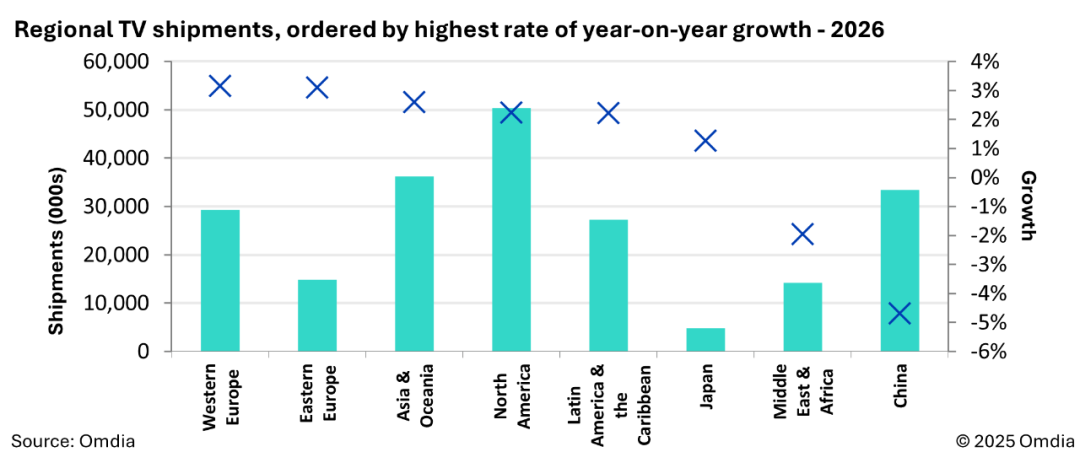
Core Insights - Global annual TV shipments are expected to exceed 210 million units by 2026, primarily driven by FIFA World Cup promotions, but overall growth will be tempered by declining demand in China and rising TV storage prices, leading to an estimated year-on-year growth of only about 1% [1] - By 2029, global TV shipments are projected to approach 212 million units [1] Regional Growth Trends - Europe is expected to be the fastest-growing market in 2026, with Western Europe TV shipments projected to grow by 3.2% and Eastern Europe by 3.1% [2] - The North American market, as the host of the event, is also anticipated to see steady growth, with an increase of approximately 2.2% [2] Contrast with China Market - In stark contrast, China's TV shipments are expected to decline by 4.7% in 2026, influenced by the end of national subsidies, which led to a 12% year-on-year drop in Q3 2025 [5] - The weakness in Chinese TV demand is expected to have profound implications for the global market, prompting Chinese brands to actively seek growth opportunities in international markets, potentially intensifying competition during periods of high demand [5] Emerging Opportunities in India and Asia-Pacific - India is projected to become a key market for Chinese brands, driving competition and enhancing consumer choices, supporting growth in the Asia-Pacific region, which is expected to see a year-on-year increase of 2.6% in 2026 [5] - From 2025 to 2029, the compound annual growth rate (CAGR) for the Asia-Pacific region is expected to be 2.2%, making it the fastest-growing area globally [5] Mini LED Backlight Technology - Mini LED backlight technology is anticipated to be the best-performing segment, with a projected year-on-year growth of 16.9% in 2026 and a CAGR of 9.2% from 2025 to 2029 [5] - RGB Mini LED is gradually being adopted in the high-end price segment, with expectations of price declines during the forecast period, leading to rapid market penetration [5]

中国出口开AI新局:旧硬件打不开新世界
Di Yi Cai Jing· 2025-12-18 12:00
Core Viewpoint - The rise of AI technology is becoming essential for consumer electronics, particularly for Chinese manufacturers, as they prepare for the upcoming CES in Las Vegas, where AI-enabled products are expected to dominate the showcase [1][2]. Group 1: AI Integration in Consumer Electronics - AI has become an unavoidable trend for Chinese manufacturers, with most exhibitors at CES expected to present AI-capable products [2]. - MINISFORUM, a Shenzhen-based company, is focusing on AI integration across its product lines, including Mini PCs and AI workstations, with personal computers being its main revenue source [2]. - Major PC manufacturers like Lenovo and Dell are also embracing AI, but MINISFORUM leverages flexibility in niche markets like Mini PCs, targeting specific audiences with higher-end components [2][3]. Group 2: Market Dynamics and Competition - China's PC exports are under pressure, with a significant portion already featuring basic AI capabilities; Lenovo reported that 33% of its AI PCs were shipped in Q3, with expectations for continued double-digit growth [3]. - The global PC market is projected to grow by 8.1% year-on-year by Q3 2025, driven by the transition from Windows 10 and the demand for AI-capable PCs [3]. - The competitive landscape is shifting, with India and Vietnam emerging as strong contenders in the consumer electronics space, impacting China's export dynamics [6][7]. Group 3: Future Hardware Trends - Smart glasses are seen as a potential next-generation hardware, with companies betting on their ability to transform human-computer interaction [9][10]. - Humanoid robots are a focal point of competition between China and the U.S., with significant investments and advancements expected in manufacturing applications [11]. - The Mini AI workstation is anticipated to become a central computing hub for households, with MINISFORUM's latest model showcasing advanced AI capabilities [12]. Group 4: Export and Trade Insights - China accounts for 15% of global exports and maintains trade surpluses with 177 economies, with expectations to increase its market share to 16.5% by 2030 [13]. - The changing landscape of global trade, influenced by U.S. tariffs and competition from India and Vietnam, is prompting Chinese companies to diversify their markets [7][8].

苹果(AAPL.US)时隔十余年重登全球手机王座 击败老劲敌三星
Zhi Tong Cai Jing· 2025-11-26 02:20
Group 1 - Apple is set to reclaim its title as the world's largest smartphone manufacturer after over a decade, driven by the successful launch of the iPhone 17 series and a wave of consumer upgrades [1] - The iPhone 17 series has seen significant success in both the U.S. and China, contributing to double-digit year-on-year growth in these key markets [1] - The easing of U.S.-China trade tensions and the depreciation of the dollar have boosted purchasing power in emerging markets, benefiting Apple [1] Group 2 - Counterpoint Research forecasts that Apple's iPhone shipments will grow by 10% in 2025, while Samsung's growth is projected at only 4.6% [1] - The global smartphone market is expected to grow by 3.3% in 2025, with Apple anticipated to capture a 19.4% market share, marking its first return to the top since 2011 [1] - The current upgrade cycle is reaching a turning point, with many consumers who purchased smartphones during the pandemic now entering the upgrade phase [2] Group 3 - An estimated 358 million second-hand iPhones are expected to be sold between 2023 and the second quarter of 2025, with these users likely to upgrade to new iPhone models in the coming years [2] - Future trends indicate that Apple's leading position will continue, with the upcoming foldable iPhone and a budget version of the iPhone 17 expected to boost sales [2] - Counterpoint predicts that Apple will maintain its top position in smartphone sales at least until 2029, supported by these favorable factors [2] Group 4 - Apple reported sales growth exceeding expectations, with holiday quarter revenues projected to approach a historic record of $140 billion [3]

iPhone 17 与小米 17 系列在中国上市首月热销
Counterpoint Research· 2025-11-20 04:14
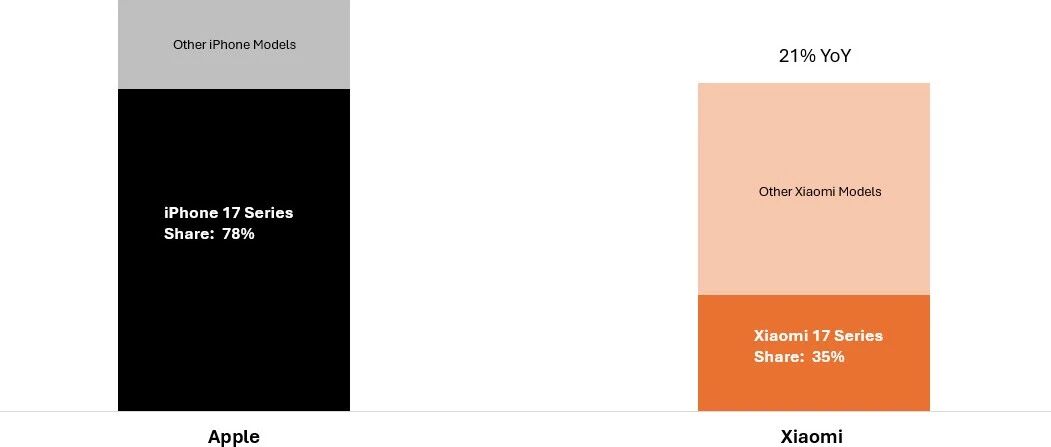
Core Insights - The iPhone 17 and Xiaomi 17 series are key drivers for growth in their respective brands during the first month of sales [4][5] - Both Apple and Xiaomi experienced similar overall sales growth, with Apple increasing by 22% and Xiaomi by 21% year-on-year [5] Sales Performance - The iPhone 17 series contributed significantly to Apple's sales in China, with nearly 80% of iPhones sold during the period coming from the new series [8] - Xiaomi's early launch of the 17 series effectively supported its smartphone sales, leading to a 21% year-on-year increase [8] Market Trends - The timing of the new product launches before the Mid-Autumn Festival boosted sales compared to the previous year [8] - Consumers are seeking high cost-performance products while also expecting innovative features, which the latest offerings from Apple and Xiaomi fulfill [8] Consumer Behavior - There is a strong demand for the new iPhone models, particularly the standard and Pro versions, driven by a wave of users upgrading from older models post-COVID [10] - Xiaomi's 17 Pro and 17 Pro Max have become the main sales drivers, indicating a shift in consumer preference towards higher-end models [10]

手机厂商密集发布新品产业链公司将受益
Zhong Guo Zheng Quan Bao· 2025-11-12 20:18
Core Insights - The recent launch of flagship AI smartphones by companies like Apple, Xiaomi, OPPO, vivo, and Honor is expected to enhance user experience and accelerate the high-end smartphone market and replacement cycle [1][2][3] Group 1: Market Trends - The introduction of AI features has become a major selling point for flagship smartphones, with 80% of high-end smartphone sales in the first half of the year featuring generative AI capabilities [2] - The smartphone market is anticipated to see improved performance in Q4, driven by the concentrated release of annual flagship products [3] - The global high-end smartphone market is projected to grow significantly, with AI smartphone market share expected to rise from 16% in 2024 to 54% by 2028 [4] Group 2: Company Performance - Apple’s iPhone 17 series is performing well due to its competitive pricing and user upgrade demand, while Xiaomi's sales have surged thanks to the early release of its 17 series [4] - Leading companies in the smartphone industry are expected to benefit from the increasing penetration of AI smartphones, which will accelerate the replacement cycle [4][5] - Luxshare Precision, a key player in Apple's supply chain, anticipates a net profit of 16.518 billion to 17.186 billion yuan in 2025, reflecting a year-on-year growth of 23.59% to 28.59% [4]
手机厂商密集发布新品 产业链公司将受益
Zhong Guo Zheng Quan Bao· 2025-11-12 20:11
Core Insights - The recent launch of flagship AI smartphones by major brands like Apple, Xiaomi, OPPO, vivo, and Honor is expected to enhance user experience and accelerate the high-end smartphone market and replacement cycle [1][3][4] - The integration of AI technology into smartphones is becoming a key differentiator, with over 80% of high-end smartphone sales in the first half of the year featuring generative AI capabilities [1][3] Group 1: Market Trends - The smartphone market is witnessing a surge in flagship AI smartphone releases, with brands focusing on AI and operating system integration as a primary selling point [1][2] - Research indicates that product innovation and differentiation will be crucial for attracting consumers, as the competition among smartphone manufacturers intensifies [2][3] - The Chinese smartphone market showed strong growth in early Q4, with a year-on-year increase of 11% in sales, driven by significant growth in iPhone and Xiaomi sales [3] Group 2: Future Projections - The global high-end smartphone market is projected to see a significant increase in AI smartphone market share, expected to rise from 16% in 2024 to 54% by 2028 [4] - IDC maintains an optimistic outlook for the smartphone market in 2025, anticipating sustained growth driven by strong promotional activities and diverse product offerings [5] Group 3: Company Benefits - Leading companies in the smartphone supply chain, such as Luxshare Precision (立讯精密), are expected to benefit from the rising penetration of AI smartphones, with projected net profits for 2025 ranging from 16.518 billion to 17.186 billion yuan, reflecting a year-on-year growth of 23.59% to 28.59% [6] - Luxshare Precision aims to capitalize on the demand for high-precision components and processing techniques as the market for AI-enabled devices expands [6]

巴菲特少赚500亿,iPhone 17成了苹果的“救星”?
Sou Hu Cai Jing· 2025-10-22 12:49
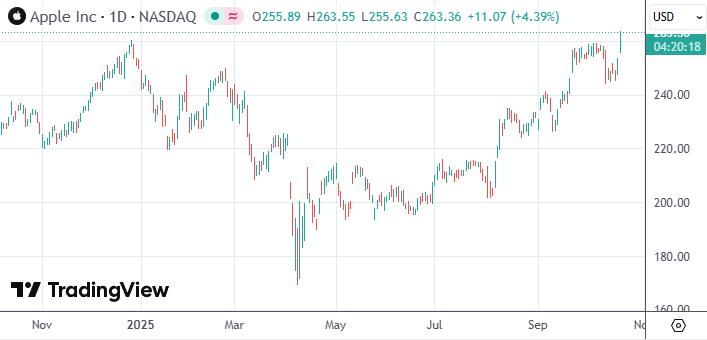
Core Insights - Apple's stock price reached a historic high of $262.24, marking the first such milestone since 2025, resulting in a market capitalization of $3.9 trillion and surpassing Microsoft as the second-largest company in the U.S. by market value [1][3] - The surge in stock price is attributed to strong sales of the iPhone 17 series, which saw a 14% increase in sales compared to the previous iPhone 16 within the first ten days of launch in both China and the U.S. [1][3] Sales Performance - The iPhone 17 series has shown robust performance, with the basic model in China selling nearly twice as much as the iPhone 16, and total sales in both markets increasing by 31% [3][4] - The sales growth in China is driven by a value-for-money strategy, with the iPhone 17 offering enhanced features at the same price as the iPhone 16 [4][3] Market Dynamics - In the U.S., the demand for high-end models, particularly the iPhone 17 Pro Max, has been strong, supported by a 10% increase in purchase subsidies from major retailers, reaching up to $100 [5][4] - Wall Street's sentiment has shifted positively, with Loop Capital upgrading Apple's rating from "hold" to "buy" and setting a target price of $315, indicating a potential upside of about 20% from the recent closing price [6][7] Investment Implications - Berkshire Hathaway's significant reduction of Apple shares from 906 million to 280 million has resulted in a missed opportunity of nearly $50 billion in potential gains, as the average selling price was around $185 per share [8][9] - Despite the strong sales of the iPhone 17, Apple faces challenges, particularly in AI applications, where it lags behind competitors like Samsung and Google [10][11] Valuation Concerns - Apple's current price-to-earnings ratio exceeds 32, significantly higher than its 10-year average of 22 and above the Nasdaq 100 average, making it one of the most expensive stocks among the "Big Seven" tech companies [11]
iPhone 17销量超预期:苹果股价创新高,市值超微软列全球第二
Xin Lang Cai Jing· 2025-10-21 04:49
Core Viewpoint - Apple has surpassed Microsoft to become the second-largest company by market capitalization, following Nvidia, with a market cap of $3.89 trillion as of October 20, 2023 [1][3]. Group 1: Stock Performance - Apple's stock price rose significantly, closing at $262.9 per share, a 3.94% increase, and reached a new high for the year, with intraday trading exceeding $264 [1]. - The stock surge is attributed to strong demand for the iPhone 17 series and upgrades in ratings and target prices by various institutions, leading to increased buying in the tech sector [3]. Group 2: iPhone 17 Demand - The iPhone 17 has seen a better-than-expected reception and upgrade cycle compared to its predecessor, with sales in the first ten days in the U.S. and China up approximately 14% from the iPhone 16 [4]. - In China, Apple achieved a shipment volume of 10.1 million units in Q3 2025, ranking among the top three smartphone manufacturers and being the only major player to show positive growth, while the overall smartphone market in China declined by 3% [4]. Group 3: Market Sentiment and Analyst Upgrades - Several brokerages, including Loop Capital and Evercore ISI, have updated their outlook on Apple, placing it on a more positive "buy" list and raising target prices, reflecting confidence in future hardware revenue and shipment growth [4]. - Analysts highlight that the successful launch of the iPhone 17, with demand trends leading the market, has significantly improved market sentiment towards Apple [4]. Group 4: Pricing Strategy - The iPhone 17 was launched at the same starting price as the iPhone 16, maintaining a price of $799 in the U.S. and 5,999 yuan in China, with discounts potentially lowering the price to around 5,000 yuan [5]. - Apple's upcoming Q4 2025 fiscal report, scheduled for October 30, will provide insights into the performance of the new iPhone and sales data from July to September [5].

沉睡巨头苏醒,苹果股价暴涨创新高
3 6 Ke· 2025-10-21 01:11
Core Viewpoint - Apple Inc. has seen its stock price rise over 4%, reaching a new all-time high of $263.59 per share, with a total market capitalization surpassing $3.9 trillion [1][3]. Stock Performance - The stock has accumulated a year-to-date increase of approximately 5.5%, rebounding over 50% since a significant drop of about 31% in April [3]. - The recent surge in stock price is attributed to better-than-expected sales of the latest iPhone, suggesting the onset of a long-awaited upgrade cycle [3]. Analyst Ratings and Price Targets - Loop Capital upgraded its rating on Apple from "Hold" to "Buy," raising the price target from $226 to $315, indicating a potential upside of about 25% from the previous closing price [4]. - Other firms, such as Evercore ISI and Seaport Global, have also shown optimism, with Evercore ISI raising its target to $290 based on strong iPhone demand data [4]. iPhone Sales Performance - Counterpoint Research reported that iPhone 17 sales in China and the U.S. exceeded those of the iPhone 16 series by 14% within the first 10 days of launch [5]. Market Sentiment and Valuation Concerns - Despite the positive sales momentum, some analysts express caution regarding Apple's current valuation, with a price-to-earnings ratio exceeding 32, significantly higher than the 10-year average of 22 [6]. - Only 58% of analysts recommend buying Apple, the lowest among the "Big Seven" tech companies, indicating a mixed sentiment in the market [6]. Competitive Landscape - Jefferies analyst Edison Lee, one of the few with a negative outlook, warned that the sales momentum for iPhone 17 may be cooling, citing concerns over the excitement surrounding foldable iPhones potentially impacting Pro Max sales [7].