
BANK OF XI'AN(600928)

Search documents
城商行板块10月24日跌0.76%,厦门银行领跌,主力资金净流出1.42亿元
Zheng Xing Xing Ye Ri Bao· 2025-10-24 08:27
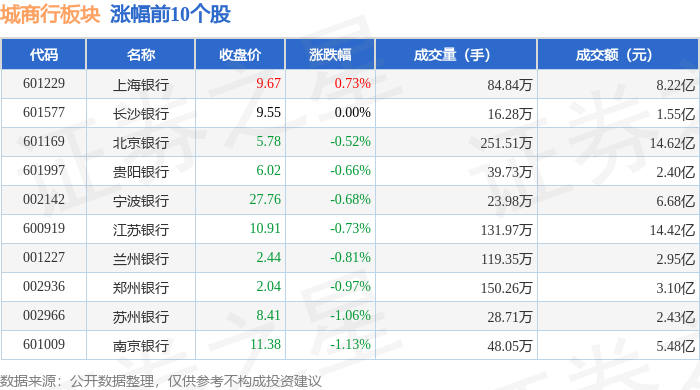
Core Insights - The city commercial bank sector experienced a decline of 0.77% on October 24, with Xiamen Bank leading the drop [1] - The Shanghai Composite Index closed at 3950.31, up 0.71%, while the Shenzhen Component Index closed at 13289.18, up 2.02% [1] Stock Performance - Shanghai Bank closed at 9.67, up 0.73% with a trading volume of 848,400 shares and a transaction value of 822 million [1] - Xiamen Bank closed at 6.68, down 1.76% with a trading volume of 153,100 shares and a transaction value of 103 million [2] - The majority of city commercial bank stocks showed negative performance, with notable declines in Beijing Bank (-0.52%) and Guizhou Bank (-0.66%) [1][2] Capital Flow - The city commercial bank sector saw a net outflow of 142 million from institutional investors, while retail investors contributed a net inflow of 55.9 million [2] - Jiangsu Bank had a net inflow of 70.84 million from institutional investors, while Shanghai Bank experienced a net outflow of 78.96 million from retail investors [3] Individual Stock Analysis - Chengdu Bank had a slight negative net flow from institutional investors of 19.75 million, but a positive inflow from retail investors of 596.99 million [3] - Lanzhou Bank saw a net inflow of 13.36 million from institutional investors, while it faced a net outflow of 1.48 million from retail investors [3]




A股银行股普跌,江阴银行跌超3%
Ge Long Hui A P P· 2025-10-24 03:12
Group 1 - The A-share market saw a general decline in bank stocks, with Jiangyin Bank dropping over 3%, and several other banks including Xi'an Bank, Chongqing Bank, and Yunnan Rural Commercial Bank falling more than 1% [1] - Agricultural Bank was an exception, experiencing a slight increase of 0.5% [1] - The year-to-date performance of various banks shows Jiangyin Bank with a 22.07% increase, while Xi'an Bank and Chongqing Bank have year-to-date increases of 17.17% and 14.57% respectively [2] Group 2 - Jiangyin Bank's market capitalization is reported at 12.5 billion, while Xi'an Bank's is at 18.4 billion, and Chongqing Bank's is at 35.4 billion [2] - Other banks such as Qingdao Bank and Su Nong Bank also experienced declines of nearly 1%, with market capitalizations of 30.2 billion and 10.7 billion respectively [2] - The overall trend indicates a mixed performance among bank stocks, with some showing significant year-to-date gains despite the recent declines [2]




陕西金融监管局核准朱博西安银行汉中分行行长助理任职资格
Jin Tou Wang· 2025-10-23 03:15
Core Viewpoint - The Shaanxi Financial Regulatory Bureau has approved the appointment of Zhu Bo as the Assistant Branch Manager of the Hanzhong Branch of Xi'an Bank, emphasizing the importance of compliance with financial regulations and ongoing education in economic and financial laws [1] Group 1 - The approval of Zhu Bo's qualification for the managerial position at Xi'an Bank has been officially documented [1] - Xi'an Bank is required to ensure that the approved personnel adhere to regulatory requirements and report their appointment status within three months [1] - Continuous learning and compliance awareness are mandated for the approved personnel to effectively fulfill their responsibilities [1]
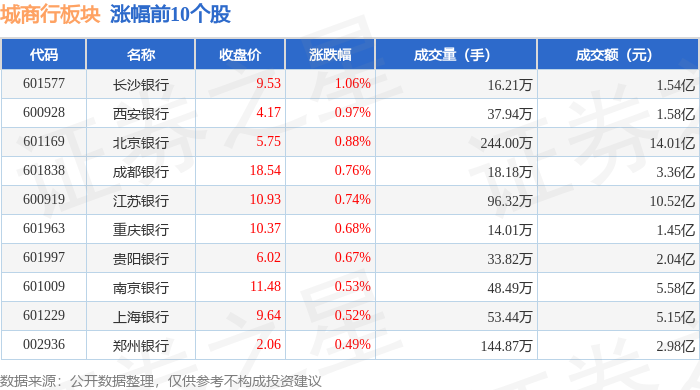
城商行板块10月22日涨0.48%,长沙银行领涨,主力资金净流出2.69亿元
Zheng Xing Xing Ye Ri Bao· 2025-10-22 08:20
Market Performance - The city commercial bank sector increased by 0.48% on October 22, with Changsha Bank leading the gains [1] - The Shanghai Composite Index closed at 3913.76, down 0.07%, while the Shenzhen Component Index closed at 12996.61, down 0.62% [1] Individual Stock Performance - Changsha Bank closed at 9.53, up 1.06% with a trading volume of 162,100 shares and a transaction value of 154 million [1] - Other notable performers include: - Xi'an Bank: closed at 4.17, up 0.97% [1] - Beijing Bank: closed at 5.75, up 0.88% [1] - Chengdu Bank: closed at 18.54, up 0.76% [1] - Jiangsu Bank: closed at 10.93, up 0.74% [1] Capital Flow Analysis - The city commercial bank sector experienced a net outflow of 269 million from institutional investors, while retail investors saw a net inflow of 165 million [2] - The overall capital flow indicates a mixed sentiment among different investor types [2] Detailed Capital Flow for Selected Banks - Shanghai Bank had a net outflow of 34.67 million from institutional investors, with a retail net inflow of 41.06 million [3] - Qilu Bank saw a net inflow of 22.48 million from institutional investors, while retail investors had a net inflow of 9.09 million [3] - Changsha Bank recorded a net inflow of 2.31 million from institutional investors and a net inflow of 1.55 million from retail investors [3]


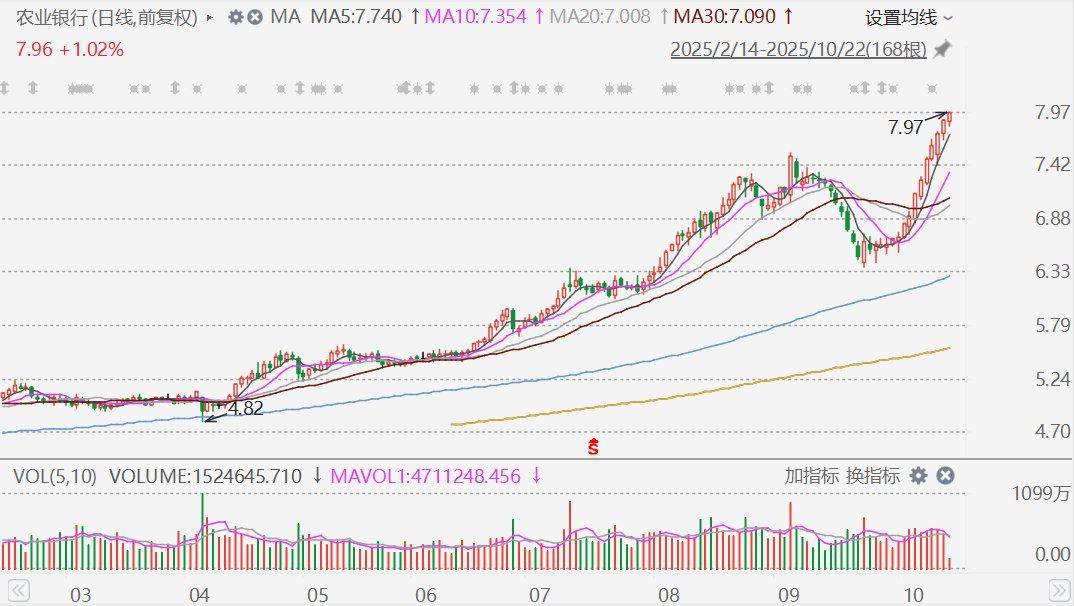
A股银行股逆势上涨,农业银行14连阳再创历史新高,年内累涨近56%!浙商银行、无锡银行、中信银行涨超1%
Ge Long Hui· 2025-10-22 02:16
Core Viewpoint - The A-share market is witnessing a counter-trend rise in bank stocks, with several banks showing significant gains, particularly Agricultural Bank of China, which has reached a historical high with a substantial year-to-date increase [1] Group 1: Bank Performance - Zhejiang Commercial Bank, Wuxi Bank, CITIC Bank, Xi'an Bank, Jiangyin Bank, Suning Bank, Agricultural Bank of China, Ningbo Bank, and Nanjing Bank have all risen over 1% [1] - Agricultural Bank of China has achieved a remarkable 14 consecutive days of gains, marking a new historical high and an approximate year-to-date increase of 56% [1]



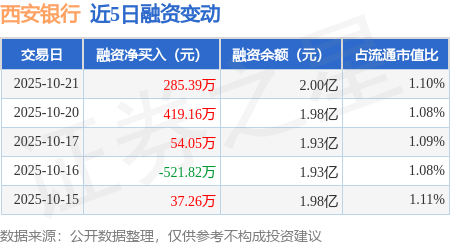
西安银行:10月21日融资净买入285.39万元,连续3日累计净买入758.6万元
Sou Hu Cai Jing· 2025-10-22 02:10
Core Insights - Xi'an Bank (600928) reported a net financing purchase of 2.85 million yuan on October 21, 2025, with a financing balance of 200 million yuan, indicating a positive investor sentiment towards the stock [1][4]. Financing Activity - On October 21, 2025, the financing buy amounted to 16.44 million yuan, while financing repayment was 13.58 million yuan, resulting in a net financing purchase of 2.85 million yuan [1]. - The financing balance has shown a consistent increase, with a total net purchase of 7.586 million yuan over the last three trading days and 11 out of the last 20 trading days recording net financing purchases [1][4]. Margin Trading - On the same day, the margin trading saw a short selling of 83,800 shares, with a net short selling of 72,300 shares, leaving a margin balance of 1.5062 million yuan [2][3]. - The margin trading balance increased to 202 million yuan, reflecting a rise of 3.1496 million yuan or 1.58% from the previous day [4].
银行“沉睡账户”迎集中清理,你的银行卡会受影响吗
Xin Lang Cai Jing· 2025-10-22 00:35
Core Viewpoint - The article discusses the recent initiative by banks in China to clean up long-dormant accounts, referred to as "sleeping accounts," which have become a significant concern due to their potential risks and operational inefficiencies [1][8]. Group 1: Overview of Sleeping Accounts - There are over 10 billion bank cards in China, with an average of about 7 cards per person, leading to many dormant accounts [1][9]. - "Sleeping accounts" are defined as those that have not been actively used for a long time, often forgotten by customers [3]. - Different banks have varying criteria for identifying sleeping accounts, typically based on "long-term inactivity" and "low balance" [3][5]. Group 2: Recent Cleaning Initiatives - Several banks, including Xiamen Bank and local rural banks, have announced plans to clean up dormant accounts, expanding the scope to include electronic accounts and mobile banking [5][6]. - For instance, Xiamen Bank has adjusted its criteria to include accounts with balances below 10 yuan and no transactions for over a year [3][5]. - The cleaning efforts are primarily led by local small and medium-sized banks, particularly in rural areas, where account management issues are more pronounced [6][8]. Group 3: Risks and Operational Efficiency - The cleaning of sleeping accounts is driven by the need to mitigate risks such as fund misappropriation and personal information leakage, as these accounts can be exploited for illegal activities [8][9]. - Approximately 30% of fraud cases are linked to dormant accounts, highlighting the security risks associated with them [8]. - Maintaining these accounts incurs hidden operational costs for banks, making the cleanup a necessity for optimizing resource allocation [9]. Group 4: Customer Guidance - Customers are advised to conduct regular checks on their accounts and can use the Yunshanfu app for inquiries [13]. - For accounts that are no longer in use, customers should promptly close them through official bank channels to avoid risks [15]. - If an account has been restricted, customers can reactivate it by visiting a bank branch with proper identification [11][15].

西安银行张成喆行长任职资格获批,系内部提拔
2 1 Shi Ji Jing Ji Bao Dao· 2025-10-21 03:49
Core Insights - Zhang Chengzhe has been approved as the new President of Xi'an Bank, filling the vacancy left by the former President Liang Banghai, who has been promoted to Chairman [2][4] - Zhang Chengzhe has extensive experience within Xi'an Bank, having held various positions since its inception, and has been the Vice President for nine years prior to his current appointment [4] Company Overview - Xi'an Bank was established in 1997, originally as Xi'an Commercial Bank, and was officially renamed in 2010. It was listed on the Shanghai Stock Exchange in March 2019, with the actual controller being the Xi'an Municipal Government [5] - As of June 30, 2025, Xi'an Bank's total assets reached 539.099 billion, a year-on-year increase of 12.23%. The total principal of loans and advances amounted to 291.687 billion, up 22.94% year-on-year, while total deposits reached 348.882 billion, increasing by 8.34% [5] - The non-performing loan ratio stands at 1.60%, a decrease of 0.12 percentage points from the previous year. In the first half of 2025, the bank achieved an operating income of 5.205 billion and a net profit attributable to shareholders of 1.452 billion, reflecting a year-on-year growth of 8.59% [5]
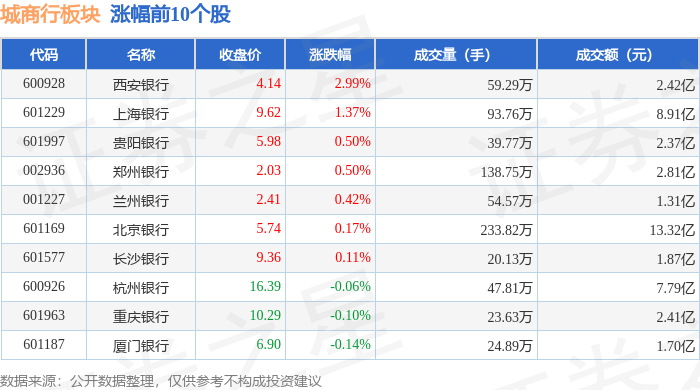
城商行板块10月20日跌0.32%,江苏银行领跌,主力资金净流入2317.93万元
Zheng Xing Xing Ye Ri Bao· 2025-10-20 08:27
Core Insights - The city commercial bank sector experienced a decline of 0.32% on October 20, with Jiangsu Bank leading the drop [1] - The Shanghai Composite Index closed at 3863.89, up 0.63%, while the Shenzhen Component Index closed at 12813.21, up 0.98% [1] Stock Performance - Xi'an Bank (600928) closed at 4.14, up 2.99% with a trading volume of 592,900 shares and a transaction value of 242 million [1] - Shanghai Bank (601229) closed at 9.62, up 1.37% with a trading volume of 937,600 shares and a transaction value of 891 million [1] - Jiangsu Bank (616009) closed at 10.79, down 1.82% with a trading volume of 1,603,000 shares and a transaction value of 173.3 million [2] Capital Flow - The city commercial bank sector saw a net inflow of 23.18 million from institutional investors, while retail investors contributed a net inflow of 52.95 million [2] - The sector experienced a net outflow of 76.12 million from speculative funds [2] Individual Stock Capital Flow - Qilu Bank (601665) had a net inflow of 63.84 million from institutional investors, while it faced a net outflow of 17.01 million from speculative funds [3] - Shanghai Bank (601229) saw a net inflow of 54.98 million from institutional investors, with a net outflow of 18.63 million from speculative funds [3] - Ningbo Bank (002142) recorded a net inflow of 51.83 million from institutional investors, while speculative funds had a net outflow of 45.06 million [3]



A股银行板块多股低开高走,西安银行涨超3%
Mei Ri Jing Ji Xin Wen· 2025-10-20 06:07
Core Viewpoint - The A-share banking sector experienced a rebound with multiple stocks opening low and then rising, indicating positive market sentiment towards banks [1] Group 1: Stock Performance - Xi'an Bank saw an increase of over 3% [1] - Agricultural Bank, Jiangyin Bank, Shanghai Bank, and Minsheng Bank also experienced upward movement in their stock prices [1]

