BANK OF XI'AN(600928)

Search documents
西安银行股份有限公司关于2024年度高级管理人员薪酬的补充公告
Shang Hai Zheng Quan Bao· 2025-12-22 20:00
Core Viewpoint - Xi'an Bank has disclosed the deferred compensation for senior management for the year 2024, which will be paid out from 2025 to 2027 based on business risk exposure [1] Group 1: Senior Management Compensation - The bank has provided a supplementary announcement regarding the deferred payment of senior management's pre-tax salary for 2024, which will be paid in three installments over three years [1] - The deferred compensation will be recognized in the bank's accounts and will be paid out at a rate of one-third each year from 2025 to 2027 [1] Group 2: Board Meeting Resolutions - The sixth board meeting of Xi'an Bank was held on December 22, 2025, with all 11 directors present, and the meeting's resolutions were deemed legal and effective [4][14] - The board approved several resolutions, including the write-off of non-performing loans, amendments to various management regulations, and the performance compensation clawback policy [5][6][7][8][9][12] - The resolutions regarding the amendments to the expected credit loss management measures and the financial statistics management measures were also unanimously approved [6][7] Group 3: Supervisory Board Meeting - The sixth supervisory board meeting was also held on December 22, 2025, with all 5 supervisors present, and the resolutions were confirmed as legal and effective [14] - The supervisory board approved the report on the special inspection of information technology outsourcing management and reviewed the comprehensive risk management assessment report for Q3 2025 [15][16]
西安银行:第六届董事会第三十三次会议决议公告
Zheng Quan Ri Bao Zhi Sheng· 2025-12-22 14:12
(编辑 丛可心) 证券日报网讯 12月22日晚间,西安银行发布公告称,公司第六届董事会第三十三次会议审议通过《西 安银行股份有限公司关于核销不良贷款的议案》《关于修订〈西安银行股份有限公司预期信用损失法实 施管理办法〉的议案》《关于修订〈西安银行股份有限公司金融统计管理办法〉的议案》等多项议案。 ...
西安银行:12月22日召开董事会会议
Mei Ri Jing Ji Xin Wen· 2025-12-22 10:45
每经AI快讯,西安银行(SH 600928,收盘价:3.76元)12月22日晚间发布公告称,公司第六届第三十 三次董事会会议于2025年12月22日在公司总部4楼第1会议室以现场方式召开。会议审议了《西安银行股 份有限公司关于绩效薪酬追索扣回的议案》等文件。 每经头条(nbdtoutiao)——新能源重卡爆单了,11月销量同比增长178%!两班倒都供不应求,客户直 接进厂催单,这情景十年难遇 (记者 曾健辉) 2025年1至6月份,西安银行的营业收入构成为:利息收入占比168.17%,非利息收入占比4.63%。 截至发稿,西安银行市值为167亿元。 ...
西安银行(600928) - 西安银行股份有限公司关于2024年度高级管理人员薪酬的补充公告
2025-12-22 10:30
证券代码:600928 证券简称:西安银行 公告编号:2025-064 西安银行股份有限公司关于 2024 年度高级管理人员薪酬的补充公告 注:1.上述高级管理人员 2024 年度税前递延支付薪酬实行延期 支付,将计提于公司账户并于 2025 至 2027 年视从事业务的风险暴露 单位:人民币万元 姓名 职务 2024 年度税前递 延支付薪酬 社会保险、企业年金、补充医疗保险及 住房公积金的单位缴存部分 梁邦海 董事长 83.20 26.13 张成喆 副董事长 行长 69.28 26.12 刘 强 副行长 62.88 25.02 赫 勇 副行长 15.85 23.48 陈 钦 首席信息官 26.72 20.82 管 辉 原副行长 61.89 15.14 王 星 原行长助理 9.07 14.37 等情况予以兑现,每年支付比例为 1/3。 2.管辉先生与王星女士因工作变动,于 2025 年 5 月 15 日辞去相 应职务。 特此公告。 西安银行股份有限公司董事会 2025 年 12 月 23 日 本公司董事会及全体董事保证本公告内容不存在任何虚假记载、 误导性陈述或者重大遗漏,并对其内容的真实性、准确性和完整性承 ...
西安银行(600928) - 西安银行股份有限公司第六届监事会第二十次会议决议公告
2025-12-22 10:30
西安银行股份有限公司(以下简称"公司")于 2025 年 12 月 12 日以电子邮件及书面方式发出关于召开第六届监事会第二十次会议 的通知,会议于 2025 年 12 月 22 日在公司总部 4 楼第 4 会议室以现 场方式召开,李超监事主持会议,本次会议应出席监事 5 名,实际出 席监事 5 名。本次会议的召开符合《中华人民共和国公司法》等法律 法规和《西安银行股份有限公司章程》的有关规定。会议所形成的决 议合法、有效。 会议审议通过了《西安银行股份有限公司监事会关于信息科技外 包管理专项检查的报告》 表决结果:同意 5 票,反对 0 票,弃权 0 票。 会议还听取了 2025 年三季度全面风险管理评估等报告。 特此公告。 西安银行股份有限公司监事会 2025 年 12 月 23 日 证券代码:600928 证券简称:西安银行 公告编号:2025-063 西安银行股份有限公司 第六届监事会第二十次会议决议公告 本公司监事会及全体监事保证本公告内容不存在任何虚假记载、 误导性陈述或者重大遗漏,并对其内容的真实性、准确性和完整性承 担法律责任。 ...
西安银行(600928) - 西安银行股份有限公司第六届董事会第三十三次会议决议公告
2025-12-22 10:30
证券代码:600928 证券简称:西安银行 公告编号:2025-062 西安银行股份有限公司 第六届董事会第三十三次会议决议公告 本公司董事会及全体董事保证本公告内容不存在任何虚假记载、 误导性陈述或者重大遗漏,并对其内容的真实性、准确性和完整性承 担法律责任。 西安银行股份有限公司(以下简称"公司")于 2025 年 12 月 12 日以电子邮件及书面方式发出关于召开第六届董事会第三十三次会 议的通知。会议于 2025 年 12 月 22 日在公司总部 4 楼第 1 会议室以 现场方式召开,梁邦海董事长主持会议,本次会议应出席董事 11 名, 实际出席董事 11 名。公司股东大唐西市文化产业投资集团有限公司 股权质押比例超过 50%,根据监管规定对其提名的胡军董事在董事会 上的表决权进行了限制。公司监事及高级管理人员列席了会议。本次 会议的召开符合《中华人民共和国公司法》等法律法规和《西安银行 股份有限公司章程》的有关规定。会议所形成的决议合法、有效。 会议对如下议案进行了审议并表决: 一、审议通过了《西安银行股份有限公司关于核销不良贷款的议 案》 表决结果:同意 10 票,反对 0 票,弃权 0 票。 二 ...
券商资管公募梦醒 发展岔路口重新导航
Zhong Guo Zheng Quan Bao· 2025-12-18 20:23
Core Viewpoint - The transition of large collective products to public fund management has reached a critical phase, with many asset management companies facing significant challenges due to regulatory changes and market dynamics [1][2][4]. Group 1: Industry Changes - The number of fund managers in the public fund department of companies has decreased from a peak of twenty to around seven or eight, indicating a contraction in the workforce [1]. - The final name of a broker's asset management company, "Guojin Asset Management," has been removed from the list of applicants for public fund management qualifications, signaling the end of the "public fund rush" among broker asset management firms [1]. - The deadline for transforming large collective products into public funds is approaching, with many firms either transferring products to affiliated public funds or opting for liquidation [1][2]. Group 2: Product Transition - Several asset management companies have successfully transferred their large collective products to public fund institutions with "blood relationship," such as Everbright Fund taking over products from Everbright Securities Asset Management [2]. - Some firms have also transferred products to public institutions without direct ownership ties, as seen with Wanlian Securities transferring its money market fund to Ping An Fund [2]. - Many broker asset management firms are choosing to convert non-compliant or smaller products into private asset management plans or liquidate them, with liquidation becoming a common outcome [2][3]. Group 3: Profitability and Future Strategies - The loss of large collective products represents a significant profit loss for broker asset management firms, which need to explore new profit growth points [3]. - Broker asset management firms are focusing on developing multi-strategy investments and creating quantitative products to provide a more stable investment experience [3]. - The competitive landscape is shifting, with licensed institutions leveraging their comprehensive resources to create differentiated offerings, while unlicensed firms may focus on private and customized solutions to build niche brands [4].





西安银行金丝路聚利盈系列净值型理财(悦享分红款)202504期12月17日起发行,业绩比较基准2.25%-3.05%
Cai Jing Wang· 2025-12-17 09:02
Core Insights - Xi'an Bank has launched a new closed-end wealth management product named "Jinsilu Juliying Series" with a fundraising period from December 17, 2025, to December 22, 2025 [1] Product Details - The minimum investment amount for individual investors is 10,000 yuan, while institutional investors must invest at least 500,000 yuan [1] - The upper limit for the fundraising scale is set at 1.5 billion yuan, with a lower limit of 10 million yuan [1] - The product is classified as a fixed-income investment type, with an internal risk rating of R2, indicating a medium-low risk level [1] - The product has a duration of 735 days and an annualized performance benchmark ranging from 2.25% to 3.05% [1]
银行净息差专题报告:负债管理能力成为业绩分化的关键
GUOTAI HAITONG SECURITIES· 2025-12-11 08:03
Investment Rating - The report assigns an "Overweight" rating for the banking sector [7]. Core Insights - The report emphasizes the significant improvement in the cost of liabilities for banks in 2025, with a notable decrease of 28 basis points (bp) in the first half of the year, compared to only 4 bp in the same period last year. This improvement is primarily driven by reductions in deposit and interbank liabilities costs, contributing 19 bp and 7 bp respectively [3][11]. - The net interest margin (NIM) is expected to decline by approximately 5 bp in 2026, with the downward pressure on margins continuing to ease marginally, suggesting that some banks may stabilize their NIMs [2][10]. Summary by Sections 1. Liability Cost Improvement in 2025 - The first half of 2025 saw a significant reduction in the cost of interest-bearing liabilities, with the cost rate dropping to 1.70%, a decrease of 28 bp from 2024. This was supported by improvements in both deposit and interbank liability costs [11]. 2. Liability Side: Deposit Maturity and Repricing Benefits 1) **Term Structure**: The proportion of long-term deposits entering the repricing cycle has increased, with the share of deposits with a remaining maturity of 1-5 years declining by 1.5 percentage points (pct) to 22.6% by the end of Q2 2025. Some banks, such as those in Ningbo and Chongqing, experienced declines exceeding 10 pct [4]. 2) **Price Factors**: Regulatory focus on maintaining reasonable NIM levels has increased, with expectations of further interest rate cuts. The maximum reduction for three-year deposits could exceed 100 bp, indicating substantial room for cost improvement [5]. 3. Asset Side: Yield Pressure Expected to be Better than 2025 1) **Loans**: The repricing pressure on loans is expected to ease, with the five-year Loan Prime Rate (LPR) declining by only 10 bp in 2025, significantly less than the 50 bp drop the previous year [6]. 2) **Debt Replacement**: The shift from high-interest to low-interest debt is anticipated to have a limited impact on net interest margins, estimated to drag down margins by about 4 bp [6]. 3) **Bond Maturity**: The widening gap between new bond issuance rates and existing bond yields is expected to exert downward pressure on investment yields, with an estimated drag of 6 bp on margins from the reallocation of bonds maturing within one year [6]. 4. NIM Projections - The report forecasts a 5 bp decline in NIM for 2026, with the downward trend continuing to converge. The asset yield is expected to decrease by 17 bp, while the cost of liabilities is projected to improve by 13 bp, with deposit costs improving by 17 bp [7][10].






城商行板块12月8日跌0.31%,上海银行领跌,主力资金净流入1.29亿元
Zheng Xing Xing Ye Ri Bao· 2025-12-08 09:09
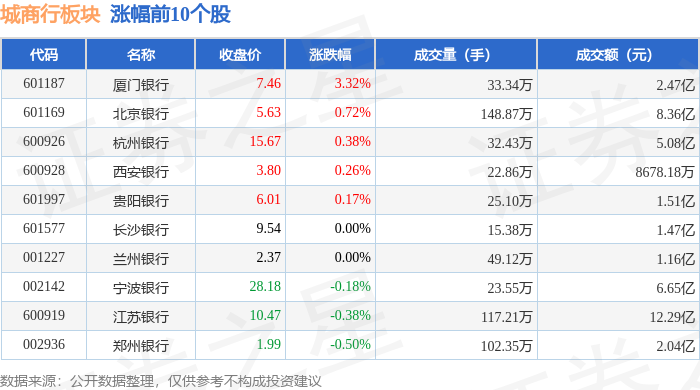
Group 1 - The city commercial bank sector experienced a decline of 0.31% on December 8, with Shanghai Bank leading the drop [1] - The Shanghai Composite Index closed at 3924.08, up 0.54%, while the Shenzhen Component Index closed at 13329.99, up 1.39% [1] - Key individual stock performances in the city commercial bank sector included Xiamen Bank rising by 3.32% and Shanghai Bank falling by 1.43% [1][2] Group 2 - The net inflow of main funds into the city commercial bank sector was 129 million yuan, while retail investors saw a net outflow of 156 million yuan [2] - The table of fund flows indicated that Jiangsu Bank had a net outflow of 56.86 million yuan from main funds, while Hangzhou Bank had a net inflow of 49.79 million yuan [3] - The overall trend showed that retail investors were withdrawing funds from several banks, with notable outflows from Suzhou Bank and Qingdao Bank [3]