
Chongqing Rural Commercial Bank(601077)

Search documents
“三种新动能”破局——重庆农商行重构增长逻辑
Di Yi Cai Jing· 2025-09-12 10:46
Core Viewpoint - Chongqing Rural Commercial Bank is undergoing a significant transformation driven by digitalization, industry chain integration, and scenario-based operations, aiming to reshape its growth logic and enhance its competitive advantage in the financial sector [1][7]. Financial Performance - As of June 2025, Chongqing Rural Commercial Bank reported operating income exceeding 14.741 billion yuan, net profit over 7.847 billion yuan, and total assets surpassing 1.6 trillion yuan, with deposits exceeding 1 trillion yuan and loans over 760 billion yuan, leading the city in all these metrics [1][2]. - The bank's operating income grew by 0.46% year-on-year, while net profit increased by 3.79%, with the net profit attributable to shareholders rising by 4.63%, maintaining the top position among A-share listed rural commercial banks [2]. Asset Quality - The non-performing loan ratio stood at 1.17%, a decrease of 0.01 percentage points from the previous year, marking four consecutive years of decline [3]. - The bank's provision coverage ratio was 355.58%, remaining above 340% for four years, indicating strong risk mitigation capabilities [3]. Strategic Development - The bank is focusing on a dual strategy of "rural leadership and urban catch-up," integrating its development with local economic strategies [4][5]. - Approximately 70% of the bank's personnel and 80% of its branches are located in rural areas, establishing a comprehensive service network to support rural finance [5][6]. Future Plans - The bank aims to become a world-class modern rural commercial bank within five years, emphasizing digital transformation, industry chain integration, and scenario-based operations as its three new growth drivers [7][9]. - A three-year development plan from 2025 to 2027 has been set, focusing on foundational reforms, capability breakthroughs, and establishing competitive advantages in key business areas [9][10].

央行:调整后的一级交易商考评办法将从2025年启用,考评期内行为不当的一级交易商将被暂停参与公开市场操作
Sou Hu Cai Jing· 2025-09-12 10:45
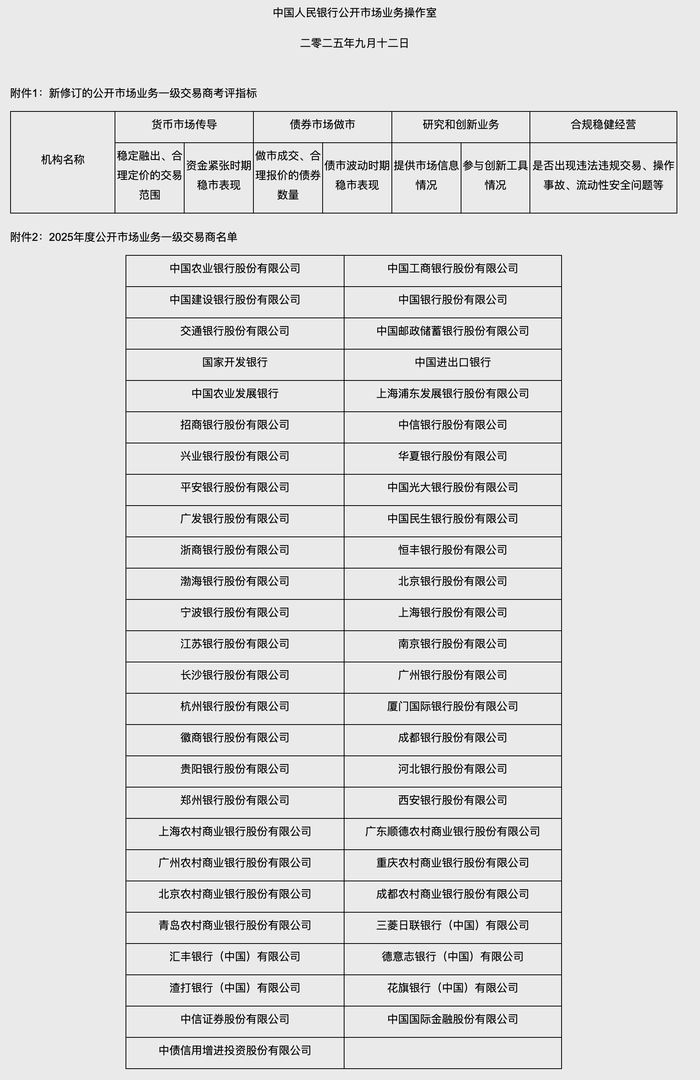
Core Viewpoint - The People's Bank of China (PBOC) has established a new evaluation mechanism for primary dealers in the open market, which will be implemented in 2025, aiming to enhance the transmission of monetary policy and adapt to the evolving financial market [1]. Group 1: Evaluation Mechanism - The PBOC's evaluation mechanism for primary dealers was first established in 2004 and adjusted in 2018 to support smooth open market operations [1]. - The new evaluation method will focus on optimizing and simplifying assessment indicators, categorizing institutions for evaluation, and strengthening the linkage with bond market makers [1]. - The list of primary dealers for the year 2025 will remain unchanged, and any dealer exhibiting inappropriate behavior during the evaluation period may be suspended from participating in open market operations [1]. Group 2: Institutions Involved - A comprehensive list of institutions that will be evaluated includes major banks such as Agricultural Bank of China, Industrial and Commercial Bank of China, China Construction Bank, and Bank of China, among others [3][4]. - The evaluation will consider factors such as stable lending, reasonable pricing, market performance during tight funding periods, and compliance with operational standards [3].







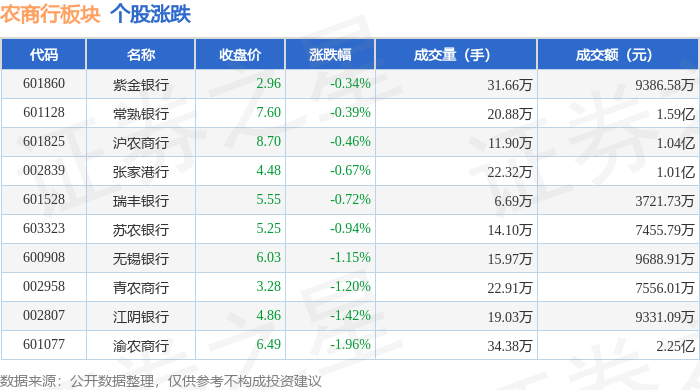
农商行板块9月12日跌1.2%,渝农商行领跌,主力资金净流出1.18亿元
Zheng Xing Xing Ye Ri Bao· 2025-09-12 08:38
Core Points - The rural commercial bank sector experienced a decline of 1.2% on September 12, with Yunnan Rural Commercial Bank leading the drop [1] - The Shanghai Composite Index closed at 3883.69, up 0.22%, while the Shenzhen Component Index closed at 12996.38, up 0.13% [1] Stock Performance - The closing prices and changes for key rural commercial banks are as follows: - Zijin Bank: 2.96, -0.34% - Changshu Bank: 7.60, -0.39% - Shanghai Rural Commercial Bank: 8.70, -0.46% - Zhangjiagang Bank: 4.48, -0.67% - Ruifeng Bank: 5.55, -0.72% - Sunong Bank: 5.25, -0.94% - Wuxi Bank: 6.03, -1.15% - Qingnong Bank: 3.28, -1.20% - Jiangyin Bank: 4.86, -1.42% - Yunnan Rural Commercial Bank: 6.49, -1.96% [1] Capital Flow - The rural commercial bank sector saw a net outflow of 118 million yuan from main funds, while retail investors contributed a net inflow of 108 million yuan [1] - Detailed capital flow for individual banks shows: - Ruifeng Bank: Main funds -189.46 thousand, Retail funds +66.01 thousand - Shanghai Rural Commercial Bank: Main funds -543.89 thousand, Retail funds +117.60 thousand - Zijin Bank: Main funds -740.49 thousand, Retail funds +762.08 thousand - Wuxi Bank: Main funds -831.59 thousand, Retail funds +881.56 thousand - Zhangjiagang Bank: Main funds -1087.07 thousand, Retail funds +1526.36 thousand - Qingnong Bank: Main funds -1198.02 thousand, Retail funds +899.30 thousand - Sunong Bank: Main funds -1200.33 thousand, Retail funds +764.96 thousand - Jiangyin Bank: Main funds -1627.70 thousand, Retail funds +850.10 thousand - Changshu Bank: Main funds -1722.64 thousand, Retail funds +2455.71 thousand - Yunnan Rural Commercial Bank: Main funds -2678.88 thousand, Retail funds +2524.52 thousand [2]



渝农商行跌2.11%,成交额2.34亿元,主力资金净流出2963.47万元
Xin Lang Cai Jing· 2025-09-12 06:28
Core Viewpoint - Chongqing Rural Commercial Bank's stock has experienced fluctuations, with a current price of 6.48 CNY per share and a market capitalization of 73.593 billion CNY, reflecting a year-to-date increase of 12.79% [1] Company Overview - Chongqing Rural Commercial Bank, established on June 27, 2008, and listed on October 29, 2019, primarily provides banking and related financial services [2] - The bank operates through three business segments: corporate banking (30.58% of revenue), personal banking (41.93%), and financial market operations (27.26%) [2] - As of June 30, the bank had 124,500 shareholders, a decrease of 9.71% from the previous period, with an average of 71,613 circulating shares per shareholder [2] Financial Performance - For the first half of 2025, Chongqing Rural Commercial Bank reported a net profit of 7.699 billion CNY, a year-on-year increase of 4.63% [2] - The bank has distributed a total of 17.819 billion CNY in dividends since its A-share listing, with 9.818 billion CNY distributed over the last three years [3] Shareholder Information - As of June 30, 2025, the largest circulating shareholder is Hong Kong Central Clearing Limited, holding 379 million shares, a decrease of 54.074 million shares from the previous period [3] - Huatai-PineBridge CSI 300 ETF is a new entrant among the top ten circulating shareholders, holding 109 million shares [3]
A股银行股走弱,浦发银行跌超3%
Ge Long Hui A P P· 2025-09-12 05:51
Group 1 - A-shares of bank stocks weakened, with notable declines in several banks including Shanghai Pudong Development Bank, which fell over 3% [1] - Qilu Bank experienced a decline of 2%, while other banks such as Chongqing Rural Commercial Bank, Chengdu Bank, and others saw drops exceeding 1% [1] - The overall market performance for these banks indicates a bearish trend in the banking sector [1] Group 2 - Shanghai Pudong Development Bank reported a decline of 3.68%, with a total market capitalization of 414.8 billion [2] - Qilu Bank's stock decreased by 2.07%, with a market value of 35 billion [2] - Other banks like Chongqing Rural Commercial Bank and Chengdu Bank also reported declines of 1.81% and 1.67% respectively, with market capitalizations of 73.8 billion and 77.6 billion [2]




中小行半年报:有银行房地产不良率超21%
Di Yi Cai Jing· 2025-09-11 12:52
Core Insights - The operating conditions of small and medium-sized banks in China have shown significant differentiation and competition, with new changes emerging in their performance during the first half of the year [2][5]. Group 1: Performance of Listed Banks - As of mid-2023, the total asset scale of 42 A-share listed banks reached approximately 321 trillion yuan, with 27 city commercial banks and rural commercial banks accounting for about 36 trillion yuan, an increase of over 3 trillion yuan compared to the end of last year [3]. - City and rural commercial banks have seen their share of total assets among listed banks rise from less than 11% at the end of last year to approximately 11.21% [4]. - Jiangsu Bank has overtaken Beijing Bank to become the new leader among city commercial banks, with an asset scale of 4.79 trillion yuan, growing at a rate of 21.16%, the highest among all listed banks [5][6]. Group 2: Financial Metrics - Jiangsu Bank reported revenue of 448.64 billion yuan and a net profit of 202.38 billion yuan for the first half of the year, with growth rates of 7.08% and 8.05% respectively, while Beijing Bank's revenue and net profit growth were only 1.02% and 1.12% [5][6]. - The net interest margin (NIM) among listed banks shows significant variation, with the highest being 2.58% for Changshu Bank and the lowest at 1.08% for Xiamen Bank [9][10]. - The overall NIM for commercial banks was reported at 1.42%, with city commercial banks at 1.37% and rural commercial banks at 1.58% [9]. Group 3: Asset Quality and Risks - The non-performing loan (NPL) ratio for city and rural commercial banks remains a critical risk factor, with the highest NPL ratio reported at 1.81% for Lanzhou Bank, and several banks exceeding 1.7% [10][12]. - Qingnong Bank's NPL ratio for real estate loans surged from 7.17% to 21.32%, indicating significant risk exposure in this sector [12][13]. - The report highlights that personal loans and loans to the real estate sector are primary areas of risk exposure for banks [12]. Group 4: Non-Listed Banks - Non-listed small and medium-sized banks have also experienced changes, with some rural commercial banks seeing significant declines in asset scale, such as Ningbo Yinzhou Rural Commercial Bank, which dropped by 15.45% [14]. - The reliance on financial investments has increased among banks, particularly rural commercial banks, with some reporting financial investments constituting over 45% of their total assets [14][15].



中小行半年报:有银行房地产不良率超21%
第一财经· 2025-09-11 12:23
Core Viewpoint - The article discusses the operational performance of small and medium-sized banks in the first half of the year, highlighting the ongoing differentiation and competitive landscape among these banks, as well as some new developments in the sector [3]. Group 1: Performance of Listed Banks - As of mid-2023, the total asset scale of 42 A-share listed banks reached approximately 321 trillion yuan, with 27 city commercial banks and rural commercial banks accounting for about 36 trillion yuan, an increase of over 3 trillion yuan compared to the end of last year [4]. - City and rural commercial banks have seen their share of total assets among listed banks rise from less than 11% at the end of last year to around 11.21% [5]. - Jiangsu Bank has overtaken Beijing Bank to become the new "leader" among city commercial banks, with an asset scale of 4.79 trillion yuan, while Beijing Bank has 4.75 trillion yuan [6][7]. - Jiangsu Bank's revenue and net profit for the first half of the year were 448.64 billion yuan and 202.38 billion yuan, respectively, with growth rates of 7.08% and 8.05%, while Beijing Bank's figures were 362.18 billion yuan and 150.53 billion yuan, with growth rates of 1.02% and 1.12% [6][8]. Group 2: Profitability and Asset Quality - The net interest margin (NIM) among listed city and rural commercial banks varies significantly, with the highest NIM at 2.58% for Changshu Bank and the lowest at 1.08% for Xiamen Bank [12]. - The overall NIM for commercial banks was reported at 1.42%, with city commercial banks at 1.37% and rural commercial banks at 1.58% [12]. - The article notes that the asset quality remains a critical factor affecting the risks of small and medium-sized banks, with several banks reporting high non-performing loan (NPL) ratios, particularly in the real estate sector [14][15]. - Qingnong Bank's real estate loan NPL ratio surged from 7.17% at the end of last year to 21.32%, indicating significant risk exposure in this area [15]. Group 3: Changes in Non-Listed Banks - Non-listed small and medium-sized banks have also experienced notable changes, with some rural commercial banks seeing significant declines in asset scale, such as Ningbo Yinzhou Rural Commercial Bank, which saw a decrease of 15.45% [16]. - The reliance on financial investments has increased among banks, particularly rural commercial banks, with some banks reporting financial investments accounting for over 45% of their total assets [16].

息差下滑趋势出现分化 零售不良走高再引关注
Jin Rong Shi Bao· 2025-09-11 03:21
Core Viewpoint - The performance of A-share listed rural commercial banks in the first half of 2025 shows overall profit growth despite a declining net interest margin, with asset quality improving amidst increasing uncertainties [1][9]. Group 1: Financial Performance - All 10 A-share listed rural commercial banks reported year-on-year growth in net profit for the first half of 2025, despite a general decline in net interest margins [1]. - Jiangyin Rural Commercial Bank led the growth with a revenue of 2.401 billion yuan and a net profit of 846 million yuan, representing increases of 10.45% and 16.63% respectively [2]. - Changshu Rural Commercial Bank achieved revenue and net profit growth rates of 10.1% and 13.51%, maintaining a relatively high net interest margin of 2.58% [2]. Group 2: Net Interest Margin Trends - The net interest margin for several banks has shown a slowing decline, with some banks like Ruifeng Rural Commercial Bank experiencing a minimal drop of only 0.08 percentage points [4]. - Chongqing Rural Commercial Bank had the smallest decline in net interest margin, reducing by just 0.03 percentage points, while still achieving a 5.98% increase in interest income [4]. - However, banks like Zhangjiagang and Suzhou Rural Commercial Banks faced larger declines in net interest margins, with drops of 0.19 and 0.16 percentage points respectively [5]. Group 3: Asset Quality Improvement - The non-performing loan (NPL) ratio for rural commercial banks improved overall, with the average NPL ratio at 2.77%, a decrease of 0.03 percentage points from the end of 2024 [9]. - Qingdao Rural Commercial Bank showed the most significant improvement, with its NPL ratio decreasing by 0.04 percentage points to 1.75% [10]. - Despite improvements, challenges remain in retail loan quality, with some banks experiencing rising NPL ratios in specific sectors [11]. Group 4: Strategic Adjustments - Banks are adjusting their business structures and pricing strategies to mitigate the impact of declining net interest margins, with Chongqing Rural Commercial Bank effectively managing interest costs [6][7]. - The focus on enhancing non-interest income has been a key strategy, with banks like Changshu Rural Commercial Bank integrating financial and non-financial services to strengthen their competitive edge [7]. - Digital tools and data analytics are being utilized by banks to enhance customer targeting and service delivery, particularly in small and micro-business financing [12][13].


小摩增持重庆农村商业银行1305.47万股 每股作价约5.93港元
Zhi Tong Cai Jing· 2025-09-10 11:26
Core Viewpoint - JPMorgan has increased its stake in Chongqing Rural Commercial Bank (03618) by acquiring 13.05 million shares at a price of HKD 5.9303 per share, totaling approximately HKD 77.42 million, resulting in a new holding of about 213 million shares, representing 8.48% of the bank's total shares [1] Summary by Category - **Investment Activity** - JPMorgan's acquisition of 13.05 million shares indicates a strategic investment move in Chongqing Rural Commercial Bank [1] - The total investment amount for this transaction is approximately HKD 77.42 million [1] - **Shareholding Details** - After the increase, JPMorgan's total shareholding in Chongqing Rural Commercial Bank is approximately 213 million shares [1] - The new shareholding percentage stands at 8.48% [1]
小摩增持重庆农村商业银行(03618)1305.47万股 每股作价约5.93港元
智通财经网· 2025-09-10 11:25
Group 1 - JPMorgan increased its stake in Chongqing Rural Commercial Bank (03618) by 13.05 million shares at a price of HKD 5.9303 per share, totaling approximately HKD 77.4183 million [1] - After the increase, JPMorgan's total shareholding in the bank is approximately 213 million shares, representing a stake of 8.48% [1]