
GZP(601228)

Search documents
广州黄沙水产新市场开业在即,旧市场搬了吗?记者实地探访
Nan Fang Du Shi Bao· 2025-09-02 07:50
Core Viewpoint - The Huangsha Aquatic Products Trading Market in Guangzhou is set to relocate to a new facility, the Huangsha Aquatic Center, which will officially open on September 8, 2025, marking a significant transition for the largest aquatic market in South China [1][3]. Group 1: Market Transition - The old market, established in 1994, continues to operate normally with merchants unaware of specific relocation dates, although the announcement has been made [2][3]. - Merchants in the old market express mixed feelings about the move, with some uncertain about the impact on their business and customer base [2][3]. - The relocation is part of a broader urban planning initiative aimed at reducing the environmental and traffic impact of the old market [3]. Group 2: New Market Features - The new market, located at 188 Sha Luo Long Wan Street, has been under development for five years and is nearing completion, with most facilities ready for operation [4][5]. - The new facility will cover approximately 110,000 square meters and aims to integrate trading, logistics, exhibition, e-commerce, and cultural tourism [5][6]. - Innovative features include a centralized cooling, oxygen supply, and seawater system, along with a digital management platform to enhance operational efficiency [5][6]. Group 3: Business Operations - The new market has achieved over 97% occupancy for wholesale operations, covering a full range of aquatic products, and is set to innovate in logistics and dining experiences [6]. - The market aims to become a new landmark for marine culture and tourism in Guangzhou, promoting the city's culinary identity [6].

上交所:广州港股份有限公司债券9月3日上市,代码243619
Jin Rong Jie· 2025-09-02 03:57
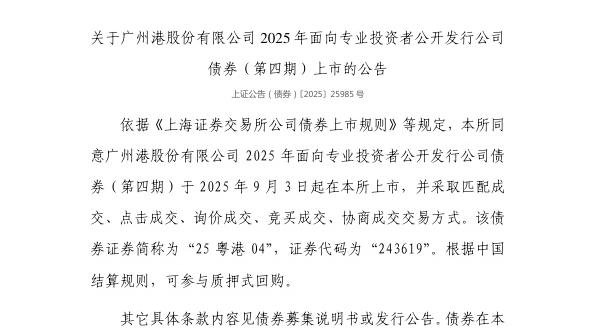
Core Viewpoint - The Shanghai Stock Exchange has approved the listing of Guangzhou Port Co., Ltd.'s fourth phase of corporate bonds aimed at professional investors, set to commence trading on September 3, 2025 [1][3]. Group 1 - The bonds will be publicly issued and are designated for professional investors [3]. - The bond is referred to as "25粤港04" with the security code "243619" [3]. - Trading methods for the bonds include matched transactions, click transactions, inquiry transactions, competitive bidding transactions, and negotiated transactions [3]. Group 2 - According to China Clearing rules, the bonds can participate in pledged repurchase transactions [3].

机器学习因子选股月报(2025年9月)-20250831
Southwest Securities· 2025-08-31 04:12
Quantitative Models and Construction Methods - **Model Name**: GAN_GRU **Model Construction Idea**: The GAN_GRU model combines Generative Adversarial Networks (GAN) for processing volume-price time-series features and Gated Recurrent Unit (GRU) for encoding time-series features to create a stock selection factor[4][13][41] **Model Construction Process**: 1. **GRU Component**: - Input features include 18 volume-price features such as closing price, opening price, turnover, and turnover rate[14][17][19] - Training data consists of the past 400 days of these features, sampled every 5 trading days, forming a 40x18 matrix to predict cumulative returns over the next 20 trading days[18] - Data preprocessing includes outlier removal and normalization at both time-series and cross-sectional levels[18] - Model architecture: Two GRU layers (128, 128) followed by an MLP (256, 64, 64), with the final output being the predicted return (pRet), which serves as the stock selection factor[22] - Training method: Semi-annual rolling training, with training conducted on June 30 and December 31 each year[18] - Optimization: Adam optimizer, learning rate of 1e-4, IC loss function, early stopping after 10 epochs, and a maximum of 50 training epochs[18] 2. **GAN Component**: - GAN consists of a generator (G) and a discriminator (D)[23] - Generator: Uses LSTM to preserve the time-series nature of the input features, transforming random noise into realistic data samples[33][37] - Loss function: $$ L_{G} = -\mathbb{E}_{z\sim P_{z}(z)}[\log(D(G(z)))] $$ where \( z \) represents random noise, \( G(z) \) is the generated data, and \( D(G(z)) \) is the discriminator's output probability[24][25] - Discriminator: Uses CNN to process the two-dimensional volume-price time-series features, distinguishing between real and generated data[33][37] - Loss function: $$ L_{D} = -\mathbb{E}_{x\sim P_{data}(x)}[\log D(x)] - \mathbb{E}_{z\sim P_{z}(z)}[\log(1-D(G(z)))] $$ where \( x \) is real data, \( D(x) \) is the discriminator's output for real data, and \( D(G(z)) \) is the output for generated data[27][29] - Training: Alternating updates of the generator and discriminator parameters until convergence[30] **Model Evaluation**: The GAN_GRU model effectively captures both time-series and cross-sectional features, leveraging the strengths of GAN and GRU for stock selection[4][13][41] --- Model Backtesting Results - **GAN_GRU Model**: - **IC Mean**: 11.36%[41][42] - **ICIR (Non-Annualized)**: 0.88[42] - **Turnover Rate**: 0.83[42] - **Recent IC**: -2.56%[41][42] - **1-Year IC Mean**: 8.94%[41][42] - **Annualized Return**: 38.09%[42] - **Annualized Volatility**: 23.68%[42] - **IR**: 1.61[42] - **Maximum Drawdown**: 27.29%[42] - **Annualized Excess Return**: 23.52%[41][42] --- Quantitative Factors and Construction Methods - **Factor Name**: GAN_GRU Factor **Factor Construction Idea**: Derived from the GAN_GRU model, this factor encodes volume-price time-series features to predict stock returns[4][13][41] **Factor Construction Process**: - The factor is generated using the output of the GAN_GRU model, which combines GAN-based feature generation and GRU-based time-series encoding[4][13][41] - The factor undergoes industry and market capitalization neutralization, as well as standardization, before being used for testing[22] **Factor Evaluation**: The GAN_GRU factor demonstrates strong predictive power across various industries, with consistent outperformance in recent years[4][13][41] --- Factor Backtesting Results - **GAN_GRU Factor**: - **IC Mean**: 11.36%[41][42] - **ICIR (Non-Annualized)**: 0.88[42] - **Turnover Rate**: 0.83[42] - **Recent IC**: -2.56%[41][42] - **1-Year IC Mean**: 8.94%[41][42] - **Annualized Return**: 38.09%[42] - **Annualized Volatility**: 23.68%[42] - **IR**: 1.61[42] - **Maximum Drawdown**: 27.29%[42] - **Annualized Excess Return**: 23.52%[41][42]



广州港2025年中报简析:增收不增利,公司应收账款体量较大
Zheng Quan Zhi Xing· 2025-08-29 22:59
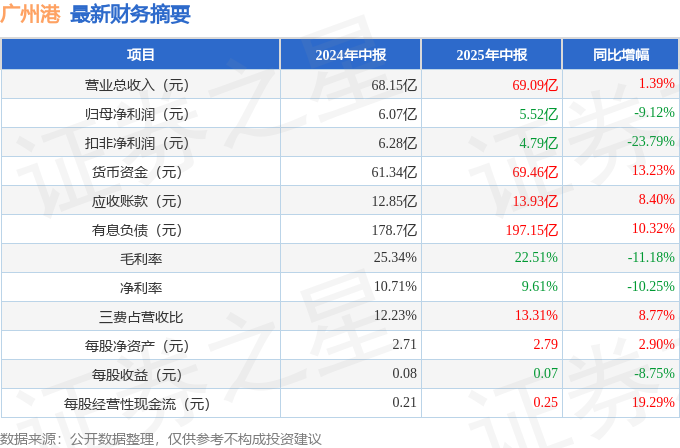
Core Viewpoint - Guangzhou Port (601228) reported mixed financial results for the first half of 2025, with a slight increase in total revenue but a decline in net profit compared to the previous year [1]. Financial Performance - Total revenue for the first half of 2025 reached 6.909 billion yuan, a year-on-year increase of 1.39% [1]. - Net profit attributable to shareholders was 552 million yuan, down 9.12% year-on-year [1]. - In Q2 2025, total revenue was 3.492 billion yuan, a decrease of 2.37% year-on-year, while net profit was 290 million yuan, slightly up by 0.14% [1]. - Gross margin was 22.51%, down 11.18% year-on-year, and net margin was 9.61%, down 10.25% year-on-year [1]. - Total operating expenses (selling, administrative, and financial) amounted to 919 million yuan, accounting for 13.31% of revenue, an increase of 8.77% year-on-year [1]. Balance Sheet and Cash Flow - Cash and cash equivalents increased to 6.946 billion yuan, up 13.23% year-on-year [1]. - Accounts receivable rose to 1.393 billion yuan, an increase of 8.40% year-on-year, with accounts receivable representing 144.48% of net profit [1][3]. - Interest-bearing liabilities increased to 19.715 billion yuan, up 10.32% year-on-year [1]. Business Model and Investment Returns - The company's performance is primarily driven by capital expenditures, necessitating careful evaluation of the profitability of these investments [2]. - The return on invested capital (ROIC) for the previous year was 3.64%, indicating historically weak capital returns, with a median ROIC of 5.8% since its listing [1][2].
广州港: 广州港股份有限公司2025年半年度报告
Zheng Quan Zhi Xing· 2025-08-29 17:02
Core Viewpoint - Guangzhou Port Company Limited reported a slight increase in revenue but a decline in net profit for the first half of 2025, reflecting challenges in the port industry amidst economic pressures and competition [2][3]. Company Overview and Financial Indicators - The company achieved an operating revenue of approximately 6.91 billion RMB, a 1.39% increase compared to the same period last year [2][11]. - Total profit decreased by 12.11% to approximately 852.96 million RMB, while net profit attributable to shareholders fell by 9.12% to about 551.73 million RMB [2][11]. - The net cash flow from operating activities increased by 19.29% to approximately 1.92 billion RMB [2][11]. - Total assets rose by 2.20% to approximately 53.62 billion RMB, and net assets attributable to shareholders increased by 0.67% to about 21.03 billion RMB [2][11]. Industry and Business Operations - The port industry showed resilience with a national cargo throughput growth of 4.0% in the first half of 2025, and container throughput increased by 6.9% [3][4]. - Guangzhou Port completed a cargo throughput of 287 million tons, a 2.9% increase, and container throughput of 13.4 million TEU, a 9.5% increase [3][4]. - The company expanded its foreign trade container routes, adding 7 new routes, with foreign trade containers growing by 21.4% [3][4]. - The company is focusing on enhancing its logistics services and optimizing its cargo structure to adapt to market demands [3][4]. Strategic Developments - The company is advancing key projects, including the Nansha Port Phase V project and the Nansha International General Terminal, which are crucial for future capacity expansion [4][5]. - Efforts are being made to improve operational efficiency and reduce costs through digital transformation and innovation in logistics services [5][6]. - The company is committed to building a green port, implementing various environmental initiatives and enhancing energy efficiency [6][7]. Competitive Position - Guangzhou Port is strategically located in the Guangdong-Hong Kong-Macao Greater Bay Area, providing significant logistical advantages and connectivity to major domestic and international markets [8][9]. - The port has established partnerships with major shipping companies and alliances, enhancing its service network and operational capabilities [9][10]. - The company aims to align with national strategies such as the Belt and Road Initiative and the development of a comprehensive transportation system, positioning itself for sustainable growth [7][8].
广州港: 广州港股份有限公司2025年半年度报告摘要
Zheng Quan Zhi Xing· 2025-08-29 17:02
Core Viewpoint - Guangzhou Port Co., Ltd. reported a slight increase in total assets and operating revenue for the first half of 2025, but experienced a decline in net profit and profit before tax compared to the previous year [1]. Financial Summary - Total assets at the end of the reporting period reached approximately CNY 53.62 billion, an increase of 2.20% from the previous year [1]. - Operating revenue for the period was approximately CNY 6.91 billion, reflecting a growth of 1.39% year-on-year [1]. - Total profit amounted to approximately CNY 853 million, a decrease of 12.11% compared to the same period last year [1]. - Net profit attributable to shareholders was approximately CNY 479 million, down 23.79% from the previous year [1]. - The net cash flow from operating activities was not specified in the provided data [1]. Shareholder Information - The total number of shareholders as of the reporting period was 68,873 [1]. - The largest shareholder, Guangzhou Port Group Co., Ltd., holds 75.59% of the shares, amounting to approximately 5.70 billion shares [2]. - Other notable shareholders include China National Transportation Holdings Co., Ltd. with 1.96% and various other institutional and individual investors [2]. Debt and Financial Ratios - The asset-liability ratio at the end of the reporting period was 53.55%, slightly up from 53.08% at the end of the previous year [4]. - The EBITDA interest coverage ratio was reported at 7.57, an increase from 7.27 in the previous year [4].
广州港: 广州港股份有限公司关于第四届董事会第二十九次会议决议的公告
Zheng Quan Zhi Xing· 2025-08-29 17:02
债券代码:137812.SH、115012.SH、240489.SH、243016.SH、243145.SH、243396.SH 证券代码:601228 证券简称:广州港 公告编号:2025-048 债券简称:22 粤港 04、23 粤港 01、24 粤港 01、25 粤港 01、25 粤港 02、25 粤港 03 广州港股份有限公司 关于第四届董事会第二十九次会议决议的公告 本公司董事会及全体董事保证本公告内容不存在任何虚假记载、误导性陈述 或者重大遗漏,并对其内容的真实性、准确性和完整性承担法律责任。 一、董事会召开情况 (一)本次会议的召集、召开符合《中华人民共和国公司法》《公司章程》 及相关法律、法规的要求。 (二)会议通知已于 2025 年 8 月 15 日以书面或电子邮件方式送交公司全体 董事。 (三)会议时间:2025 年 8 月 27 日 09:00 会议地点:广州市越秀区沿江东路 406 号港口中心 2706 会议室 会议召开方式:现场结合通讯方式表决 (四)本次会议应出席会议的董事 9 名,实际出席会议的董事 9 名。其中独 立董事吉争雄先生、朱桂龙先生以通讯方式出席会议。 (五)会议由公 ...
广州港: 广州港股份有限公司关于募集资金2025年上半年存放与使用情况的专项报告
Zheng Quan Zhi Xing· 2025-08-29 17:02
Summary of Key Points Core Viewpoint The report provides a detailed account of the fundraising activities and the utilization of raised funds by Guangzhou Port Co., Ltd. for the first half of 2025, ensuring compliance with regulatory requirements and transparency in fund management. Group 1: Fundraising Overview - The total amount raised through the non-public issuance of A-shares was approximately CNY 3.999 billion, with a net amount of CNY 3.991 billion after deducting various fees [1][2]. - The funds were deposited into a special account on August 30, 2022, following approval from the China Securities Regulatory Commission [1][3]. Group 2: Fund Utilization - As of June 30, 2025, the total amount utilized from the raised funds was CNY 181.01 million, all of which was allocated to investment projects [2][3]. - The remaining balance in the fundraising account as of June 30, 2025, was CNY 509.96 million, which includes interest income [2][3]. Group 3: Fund Management - The company has established specific regulations for the management and use of raised funds, ensuring compliance with relevant securities regulations [1][3]. - A tripartite supervision agreement was signed with the underwriting institution and the bank holding the funds to oversee the usage of the raised funds [1][3]. Group 4: Project Investment and Adjustments - The company approved the use of raised funds to replace pre-invested self-raised funds amounting to CNY 555.45 million, in compliance with regulatory guidelines [3][4]. - There were no significant changes in the feasibility of the investment projects, and all projects are progressing as planned [7][8]. Group 5: Disclosure and Compliance - The company has ensured timely and accurate disclosure of all relevant information regarding the use and management of the raised funds, with no violations reported [8].
广州港: 广州港股份有限公司关于广州港集团财务有限公司风险持续评估报告
Zheng Quan Zhi Xing· 2025-08-29 17:02
Core Viewpoint - The report assesses the ongoing risks associated with Guangzhou Port Financial Company, highlighting its financial status, internal controls, and risk management practices, indicating a stable operational environment and compliance with regulatory requirements [1][9]. Group 1: Basic Information of Guangzhou Port Financial Company - Guangzhou Port Financial Company was established on August 31, 2020, as a non-bank financial institution approved by the former China Banking and Insurance Regulatory Commission [1]. - The registered capital is 1 billion RMB, with Guangzhou Port Group contributing 510 million RMB, holding a 51% stake [1]. Group 2: Internal Control Situation - The company has established a governance structure involving a board of directors, supervisory board, and management, ensuring effective internal control [2]. - A comprehensive risk management system is in place, with separate departments for risk compliance and auditing to monitor business activities [2][5]. Group 3: Risk Identification and Assessment - Guangzhou Port Financial Company has developed specific risk control procedures tailored to different business activities, ensuring effective monitoring and assessment of various risks [2][4]. - The company emphasizes a proactive approach to risk management, integrating compliance and internal control requirements into business processes [2][4]. Group 4: Operational and Management Situation - As of June 30, 2025, the total assets of Guangzhou Port Financial Company amounted to 6.125 billion RMB, with owner’s equity at 1.142 billion RMB, and a net profit of 21 million RMB for the first half of 2025 [5][6]. - The company adheres to a prudent management principle, complying with relevant financial regulations and continuously improving internal management [6]. Group 5: Regulatory Indicators - As of June 30, 2025, all regulatory indicators met the required standards, including a capital adequacy ratio of 29.87%, a non-performing asset ratio of 0.00%, and a liquidity ratio of 67.74% [7]. Group 6: Loan and Deposit Situation - As of June 30, 2025, the company and its subsidiaries had a deposit balance of 2.786 billion RMB and a loan balance of 1.680 billion RMB with Guangzhou Port Financial Company [8]. Group 7: Continuous Risk Assessment Measures - The company has established a risk prevention regulation to ensure the safety and liquidity of funds, including a risk reporting system and emergency response plans [8]. Group 8: Risk Assessment Opinion - The company concludes that Guangzhou Port Financial Company operates within legal frameworks, has a sound internal control system, and maintains manageable risks in its financial services [9].
广州港: 广州港股份有限公司关于以协定存款等方式存放募集资金的公告
Zheng Quan Zhi Xing· 2025-08-29 17:02
Key Points - The company has authorized a fund storage limit of up to 500 million RMB, which can be used in a rolling manner within a 12-month authorization period [1][5] - The actual net amount raised from the non-public offering of shares is approximately 3.99 billion RMB after deducting issuance costs [2] - The raised funds are stored in a special account and managed under a tripartite supervision agreement with the sponsor and the commercial bank [2][5] - The company plans to use the raised funds for projects such as the Nansha Port grain and general cargo terminal silo phase III project, ensuring that the normal progress of these projects is not affected [6] - The company has established a sound fund management system to ensure the effective and standardized operation of deposit matters, with independent directors and the audit committee having the authority to supervise fund usage [5][6] - The sponsor has confirmed that the continued use of agreement deposits and notice deposits for part of the unused raised funds does not affect the normal progress of investment projects [6][7]