
GZP(601228)

Search documents
广州港(601228) - 广州港股份有限公司2026年1月份主要生产数据提示性公告
2026-02-02 08:00
2026 年 1 月份,广州港股份有限公司(以下简称"公司")预计完成集装箱 吞吐量 243.8 万标准箱,同比增长 14.5%;预计完成货物吞吐量 5,078.2 万吨, 同比增长 12.7%。 证券代码:601228 证券简称:广州港 公告编号:2026-002 债券代码:115012.SH、240489.SH、243016.SH、243145.SH、243396.SH、243619.SH、244653.SH 债券简称:23 粤港 01、24 粤港 01、25 粤港 01、25 粤港 02、25 粤港 03、25 粤港 04、26 粤港 01 广州港股份有限公司 2026 年 1 月份主要生产数据提示性公告 本公司董事会及全体董事保证本公告内容不存在任何虚假记载、误导性陈述 或者重大遗漏,并对其内容的真实性、准确性和完整性承担法律责任。 2026 年 2 月 3 日 本公告所载公司 2026 年 1 月份的业务数据属于快速统计数据,与最终实际 数据可能存在差异,敬请投资者注意投资风险。 特此公告。 广州港股份有限公司董事会 ...

广州港:1月预计完成集装箱吞吐量243.8万标准箱 同比增长14.5%
Zhi Tong Cai Jing· 2026-02-02 07:56
Group 1 - The company Guangzhou Port (601228.SH) announced an expected completion of container throughput of 2.438 million TEUs in January 2026, representing a year-on-year growth of 14.5% [1] - The company anticipates a total cargo throughput of 50.782 million tons, which indicates a year-on-year increase of 12.7% [1]
广州港(601228.SH):1月预计完成集装箱吞吐量243.8万标准箱 同比增长14.5%
智通财经网· 2026-02-02 07:54
Core Viewpoint - Guangzhou Port (601228.SH) is expected to achieve significant growth in container throughput and cargo throughput by January 2026, indicating a positive outlook for the company's operational performance [1] Group 1: Container Throughput - The company anticipates completing a container throughput of 2.438 million TEUs in January 2026, representing a year-on-year increase of 14.5% [1] Group 2: Cargo Throughput - The expected cargo throughput is 50.782 million tons in January 2026, which reflects a year-on-year growth of 12.7% [1]
广州港:1月集装箱和货物吞吐量同比双增长
Xin Lang Cai Jing· 2026-02-02 07:40
Core Viewpoint - The company anticipates significant growth in container throughput and cargo throughput by 2026, indicating a positive trend in operational performance [1] Group 1: Container Throughput - The company expects to achieve a container throughput of 2.438 million TEUs by January 2026, representing a year-on-year increase of 14.5% [1] Group 2: Cargo Throughput - The company projects a cargo throughput of 50.782 million tons by January 2026, reflecting a year-on-year growth of 12.7% [1] Group 3: Data Disclaimer - The announced business data is based on rapid statistical estimates and may differ from the final actual figures [1]
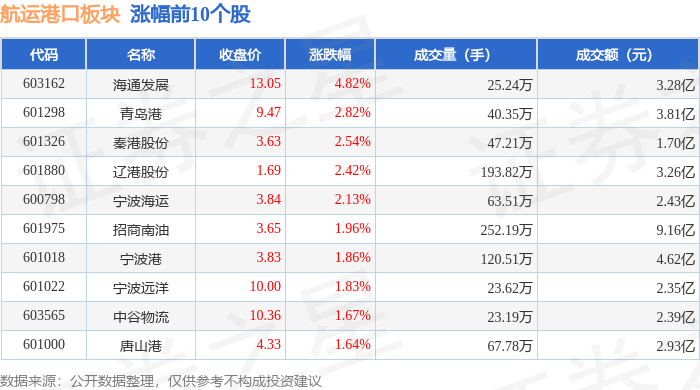
航运港口板块1月28日涨0.59%,海通发展领涨,主力资金净流出4.76亿元
Zheng Xing Xing Ye Ri Bao· 2026-01-28 09:04
Core Insights - The shipping and port sector experienced a rise of 0.59% on January 28, with Haitong Development leading the gains [1] - The Shanghai Composite Index closed at 4151.24, up 0.27%, while the Shenzhen Component Index closed at 14342.9, up 0.09% [1] Stock Performance - Haitong Development (603162) closed at 13.05, up 4.82% with a trading volume of 252,400 shares and a transaction value of 328 million yuan [1] - Qingdao Port (601298) closed at 9.47, up 2.82% with a trading volume of 403,500 shares and a transaction value of 381 million yuan [1] - Qin Port Co. (601326) closed at 3.63, up 2.54% with a trading volume of 472,100 shares and a transaction value of 170 million yuan [1] - Liaoning Port Co. (601880) closed at 1.69, up 2.42% with a trading volume of 1,938,200 shares and a transaction value of 326 million yuan [1] - Ningbo Shipping (600798) closed at 3.84, up 2.13% with a trading volume of 635,100 shares and a transaction value of 243 million yuan [1] Capital Flow - The shipping and port sector saw a net outflow of 476 million yuan from institutional investors, while retail investors contributed a net inflow of 88.99 million yuan [2] - The sector's overall capital flow indicates a mixed sentiment, with institutional investors withdrawing funds while retail investors showed interest [2][3] Individual Stock Capital Flow - Zhonggu Logistics (603565) experienced a net outflow of 41.62 million yuan from institutional investors, while retail investors had a net outflow of 11.08 million yuan [3] - Liaoning Port Co. (601880) saw a net inflow of 34.01 million yuan from institutional investors, indicating strong interest [3] - Haitong Development (603162) had a net inflow of 22.27 million yuan from institutional investors, but a net outflow of 24.31 million yuan from retail investors [3]


中国内贸第一大港如何成功转型“双循环枢纽”?|粤讲粤明
2 1 Shi Ji Jing Ji Bao Dao· 2026-01-27 07:57
Core Insights - The Guangdong provincial government aims to strengthen its port construction and enhance the international hub status of Guangzhou Port, with a target of achieving over 6.96 billion tons in cargo throughput and over 28 million TEUs in container throughput by 2025, maintaining its position among the top six global ports [3][4] Port Development - Guangzhou Port's foreign trade container throughput is expected to grow by nearly 20% in 2025, indicating a shift from network expansion to operational efficiency and higher value per container [4] - The number of foreign trade liner routes from Guangzhou Port will expand to 182 by 2025, with a focus on enhancing coverage and density to major economies and emerging markets [3][4] Export Growth - Guangzhou's foreign trade export value reached 7.56 trillion yuan from January to November 2025, with a year-on-year increase of 20.1%, significantly outpacing the growth of liner routes [4] - High-value products such as new energy vehicles, lithium batteries, and photovoltaic products are driving the increase in export value density, reflecting a shift towards higher-value international trade [4] Strategic Transformation - Guangzhou Port is transitioning from a logistics channel focused on throughput to a strategic node that supports regional industrial upgrades and higher-value international trade [4] - The port is actively constructing a hidden port network to gather inland cargo sources and has established 39 sea-rail intermodal routes and 73 shuttle barge routes, enhancing its service network across 11 provinces [4][5] High-End Shipping Services - The development of high-end shipping services is proposed to follow a two-step strategy, starting with domestic services and gradually expanding to international markets [5] - Policy support for high-end shipping services includes tax incentives and the establishment of a high-end shipping service development zone in Nansha [5] Digital and Smart Port Infrastructure - The construction of a digital infrastructure for ports is emphasized, including the integration of key technologies and the establishment of a unified data platform for port logistics [6] - The aim is to lead the development of standards and rules for green and smart ports, leveraging automation and digital technologies [6]
中国内贸第一大港如何成功转型“双循环枢纽”?
2 1 Shi Ji Jing Ji Bao Dao· 2026-01-27 07:53
Core Viewpoint - The strong momentum of Guangzhou's foreign trade is driven by the proactive advancement of ports and deep integration into the industrial hinterland, creating a closed loop of "cargo organization - efficient channels - value enhancement" [1][5]. Group 1: Port Development and Performance - The Guangdong Provincial Government's report emphasizes the enhancement of port construction and the elevation of Guangzhou Port's status as an international hub [2]. - In 2025, Guangzhou Port is projected to handle over 696 million tons of cargo and exceed 28 million TEUs in container throughput, maintaining its position among the top six global ports [2]. - A significant change is noted as the proportion of foreign trade containers at Guangzhou Port surpasses 50%, marking its successful transformation into a "dual circulation hub" [2]. Group 2: Growth in Trade and Export - The number of foreign trade liner routes from Guangzhou Port is expected to expand to 182 by 2025, with a year-on-year increase of 10.73% in foreign trade cargo throughput and nearly 20% growth in foreign trade container throughput, indicating improved cargo structure and shipping efficiency [3]. - Guangzhou's foreign trade export value reached 7.56 trillion yuan from January to November 2025, reflecting a year-on-year increase of 20.1%, significantly outpacing the growth in the number of routes and container throughput [4]. - The export of high-value products such as new energy vehicles, lithium batteries, and photovoltaic products has surged, enhancing the overall export value density [4]. Group 3: Strategic Development Model - The strong dynamics of Guangzhou's foreign trade stem from the proactive establishment of an invisible port network and the expansion of high-value shipping routes, which enhance export capabilities [5]. - The port has opened 39 sea-rail intermodal routes and 73 shuttle barge routes, effectively gathering inland cargo and transforming from "cargo from the port" to "port gathering cargo" [5]. - The logistics flow around the Nansha Port area has led to the emergence of nearly 2,500 enterprises in the port industry cluster, creating a complete value closed loop that supports regional economic development [5]. Group 4: Future Directions and Recommendations - The next steps involve shifting from "hardware expansion" to "software empowerment" by developing shipping soft power, including a two-step strategy for upgrading high-end shipping services [7]. - A combination of policies is recommended to support the development of high-end shipping services, including tax incentives and the establishment of offshore accounts for high-end shipping service enterprises [8]. - Accelerating the construction of digital smart port infrastructure is crucial, focusing on integrating key technologies and establishing a unified data platform for port logistics [9].
2025年广州航空客运量超1.1亿人次 同比增长5.0%
Zhong Guo Xin Wen Wang· 2026-01-24 05:31
Group 1 - In 2025, Guangzhou's transportation sector showed stable growth, with both passenger and freight volumes exceeding the previous year's levels [1] - Baiyun Airport's passenger throughput surpassed 83 million, marking a year-on-year increase of 9.5%, and it joined the global "80 million passenger club" [1] - The total passenger volume in Guangzhou reached 338 million, a 1.8% increase from the previous year, with rail and air transport growing by 3.0% and 5.0% respectively [1] Group 2 - Guangzhou's total freight transport volume for 2025 was 959 million tons, reflecting a 0.9% year-on-year growth, with freight turnover increasing by 10.1% [1] - The port's total cargo throughput reached 699 million tons, with container throughput at 28.05 million TEUs, representing year-on-year growth of 1.6% and 6.0% respectively [2] - In 2025, Guangzhou Port's foreign trade container volume surpassed domestic trade for the first time, becoming a key driver of port growth, with foreign trade cargo throughput increasing by 11.4% [2]

连跌十年的中国大港,还能止住颓势吗?
Xin Lang Cai Jing· 2026-01-24 03:13
Core Viewpoint - The outlook for Hong Kong's port in 2025 is not optimistic, with a projected container throughput of 12.91 million TEU, representing a year-on-year decline of 5.7% [1][5]. Group 1: Container Throughput Trends - Hong Kong's container throughput has been declining for nearly a decade, with a significant drop of 13.7% in 2023 [1][5]. - In contrast, Guangzhou Port's foreign trade container volume reached 14 million TEU in 2023, marking the first time it has surpassed Hong Kong [1][5]. Group 2: Comparative Analysis of Major Ports - In 2015, the foreign trade container volumes for Shenzhen, Hong Kong, and Guangzhou were 23.09 million TEU, 20.07 million TEU, and 5.76 million TEU, respectively, with a combined total of 48.92 million TEU [2][6]. - By 2025, the projected volumes are 33.12 million TEU for Shenzhen, 12.90 million TEU for Hong Kong, and 14 million TEU for Guangzhou, leading to a total of 60 million TEU [2][6]. - The new foreign trade container volume ratios for the three ports will be 55:22:23, indicating Shenzhen's significant lead and Guangzhou's recovery [3][7]. Group 3: Factors Contributing to Decline - Hong Kong currently operates 168 weekly shipping routes, but the number of routes for Europe and North America is limited to 3 and 7, respectively, which is significantly lower than Shenzhen's daily operations [4][8]. - Higher handling fees in Hong Kong compared to mainland ports have led to a decrease in cargo that previously required transshipment through Hong Kong, as goods can now be directly loaded in Shenzhen and Nansha [4][9]. - The removal of Hong Kong from the direct shipping list by the Twin Star Alliance and other factors contribute to the ongoing decline in throughput [4][9].
从“内贸冠军”转型“双循环枢纽” 广州港“十五五”怎么拼?
2 1 Shi Ji Jing Ji Bao Dao· 2026-01-20 05:00
Core Viewpoint - Guangzhou Port is positioning itself as a high-level international shipping service hub, focusing on integrating port development into the core agenda of the marine economy, marking a significant transformation in its operational strategy [1]. Group 1: Port Development and Performance - Guangzhou Port achieved a cargo throughput of over 696 million tons and a container throughput exceeding 28 million TEUs during the 14th Five-Year Plan period, ranking among the top six ports globally [1]. - The proportion of foreign trade containers surpassed 50%, indicating a successful transition to a dual-circulation hub that balances domestic and international trade [1]. Group 2: Expansion of Shipping Network - By 2025, Guangzhou Port is expected to rank 12th globally and second in China, following Shanghai and Hong Kong, according to the Xinhua-Baltic International Shipping Center Development Index [2]. - The launch of the WSA3 shipping route to South America's west coast marks a significant milestone, facilitating the export of Chinese manufactured goods and the import of high-quality products from Latin America [2]. - Guangzhou Port plans to add 10 new foreign trade routes by the end of 2025, bringing the total to 182, with a focus on the Belt and Road Initiative and RCEP countries [2]. Group 3: Multi-Modal Transport System - The sea-rail intermodal transport volume is projected to exceed 700,000 TEUs by 2025, reflecting a year-on-year growth of 15.7% [3]. - The port has established 39 sea-rail intermodal routes connecting 11 provinces and 38 inland ports, enhancing its domestic logistics capabilities [3]. Group 4: Infrastructure Investment and Upgrades - During the 14th Five-Year Plan, Guangzhou Port Group invested 26 billion yuan in key projects, including the fully automated Nansha Phase IV terminal, increasing port capacity by 12 million tons [3]. - The establishment of the Nansha headquarters signifies a strategic shift towards enhancing the port's operational capabilities and global competitiveness [4]. Group 5: Future Goals and Strategic Initiatives - Guangzhou Port aims to become a world-class strong port by investing 20 billion yuan in top-tier port facilities and enhancing cargo and container throughput capacities [4]. - The port is focusing on digitalization, intelligence, and green transformation, aiming to create a low-carbon demonstration port area and improve the business environment [4]. - The local government plans to attract more shipping companies and enhance logistics services, particularly in emerging markets like Southeast Asia, the Middle East, and Latin America [5].