Workflow
AGRICULTURAL BANK OF CHINA(601288)
icon
Search documents
A股缩量调整银行板块“五连阳”,机构:牛市会抚平每一处“洼地”
Hua Xia Shi Bao· 2025-10-16 12:36
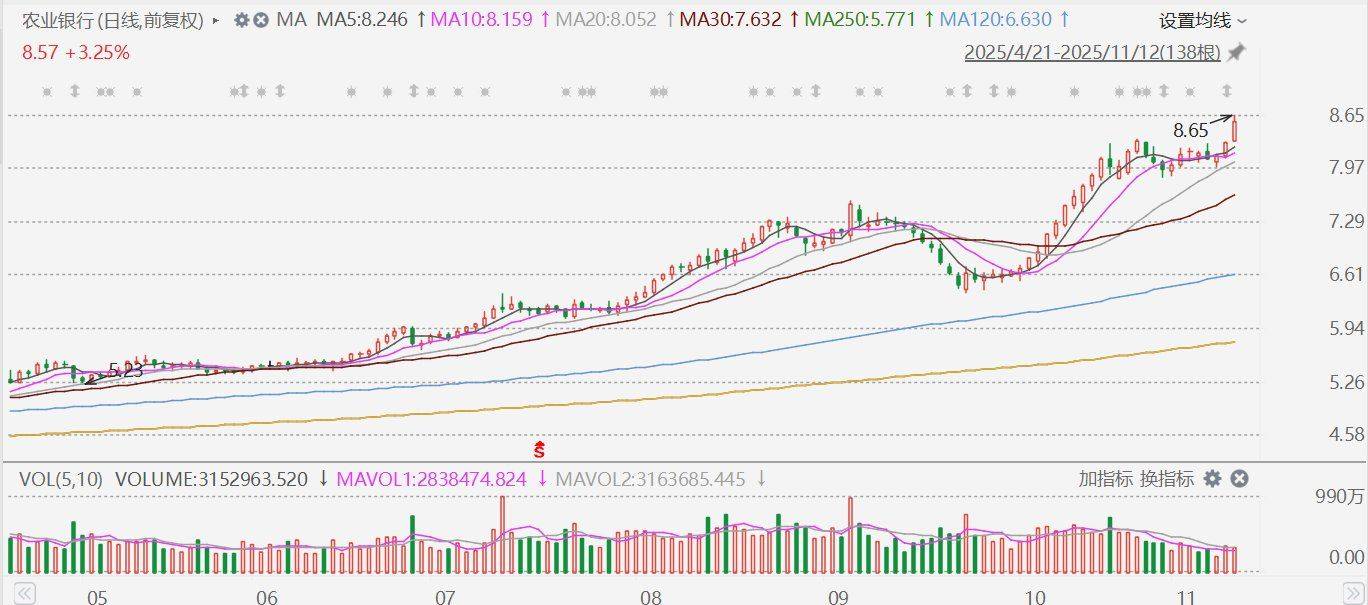
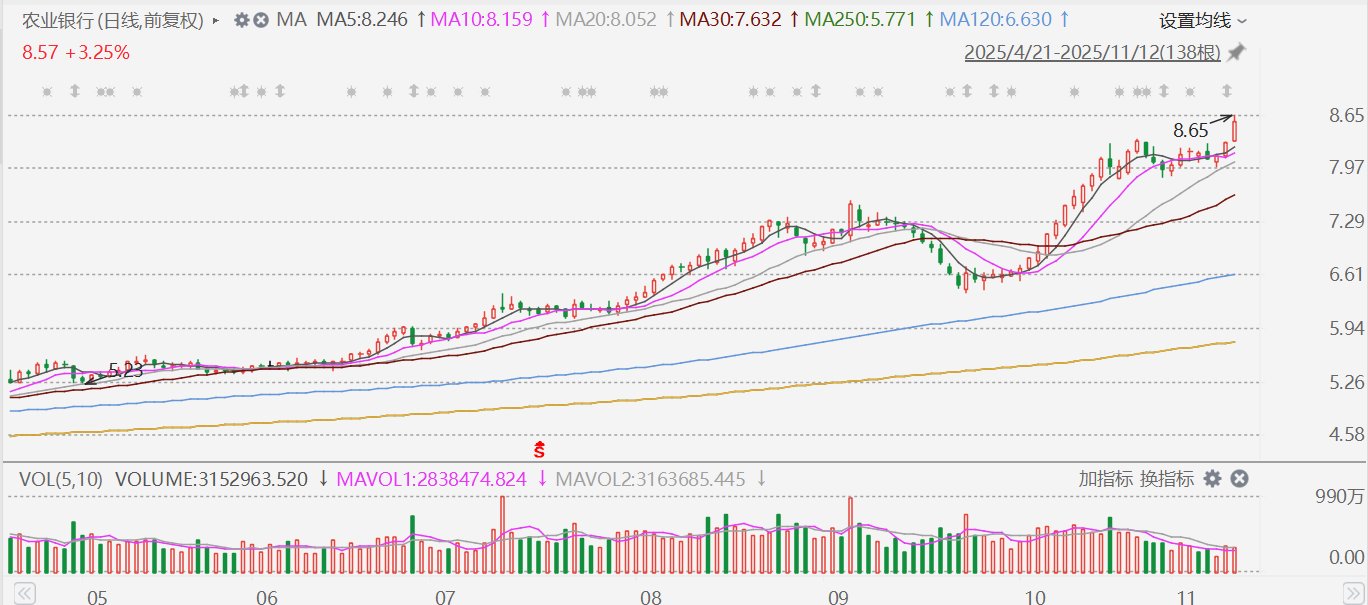
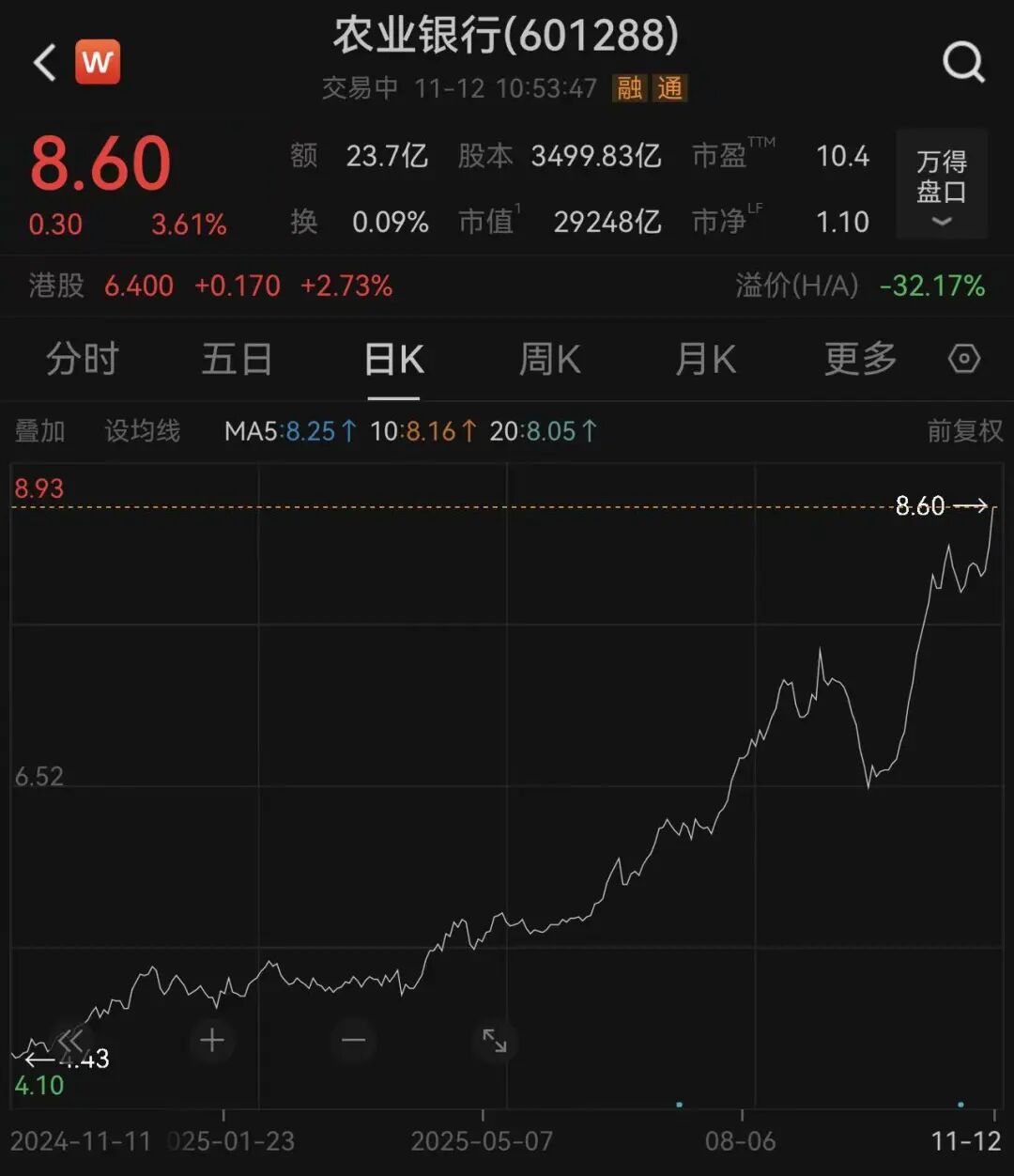
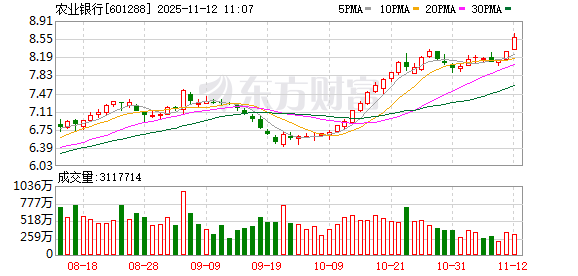
Core Viewpoint - The A-share market showed mixed performance on October 16, with the Shanghai Composite Index slightly up by 0.1% while the Shenzhen Component Index fell by 0.25%. The overall market sentiment is cautious, with a significant drop in trading volume, marking the first time in two months that total trading volume fell below 2 trillion yuan [2][3][4]. Market Performance - The Shanghai Composite Index closed at 3916.23 points, having briefly dipped below 3900 points during the day. The Shenzhen Component Index ended at 13086.41 points, while the ChiNext Index rose by 0.38% to 3037.44 points [3][4]. - The total trading volume for the day was approximately 1.95 trillion yuan, a decrease of over 140 billion yuan from the previous day, marking the lowest daily trading volume since August 13 [3][4]. Sector Analysis - The banking sector experienced a "five consecutive days of gains," with Agricultural Bank of China’s stock price nearing its historical high, reflecting a shift in investor preference towards safer assets amid rising market uncertainty [6][8]. - Among the 31 primary industry sectors, coal, banking, and food and beverage sectors saw the most significant gains, while steel, non-ferrous metals, and construction materials faced the largest declines [4][6]. Fund Flow - The top three sectors for net inflows were communication equipment, automotive, and banking, with net inflows of 1.458 billion yuan, 1.172 billion yuan, and 939 million yuan, respectively. Conversely, the sectors with the highest net outflows included small metals, semiconductors, and software development [4][6]. Market Sentiment and Future Outlook - Analysts suggest that the current market is in a phase of adjustment, with external trade uncertainties contributing to increased risk aversion among investors. Despite this, the overall sentiment remains that the bull market is still in its early stages, with potential for further growth in technology and traditional blue-chip stocks [7][8][9]. - The upcoming third-quarter earnings reports are expected to show a rebound in profitability across most industries, which could bolster market confidence [9].
银行黄金定投进入“千元时代”,多家大行提示投资风险
Hua Er Jie Jian Wen· 2025-10-16 12:08
热潮之下亦须警惕追高风险,近期已有多家银行密集发布贵金属投资风险提示。 10月15日,光大银行提示,国内外贵金属价格波动加剧,应合理控制仓位,理性投资; 国内市场,上海黄金交易所Au9999价格亦从年初每克614元一路跃升,接连突破多个整数关口,至10月16日报收968.14元/克,年内涨幅亦在5成以上。 更早之前,建行亦提示消费者合理控制仓位,及时关注持仓和保证金变化。 风险提示外,多家银行已将积存金起购金额上调至千元左右,确保起购金额随金价波动的同时,降低投资者非理性小额频繁交易的可能性。 10月15日起,中行积存金最小购买金额已由850元调整为950元,追加购买金额维持200元整数倍不变; 全球黄金市场已再度迎来历史性时刻。 北京时间10月16日16时,伦敦现货黄金价格报4204.6美元/盎司,10月以来,伦敦现货黄金价格已经由3800美元/盎司一路高升,月度涨幅在8%左右,年内累 计上涨超5成; 例如9月26日,农行调整金市通(金交所代理)业务合约涨跌停板,Au(T+D)、mAu(T+D)合约下一交易日起涨跌幅度限制从13%调整为15%,Ag (T+D)从16%调整为18%。 两日前,工行如意金积存业 ...
银行连续走强,风格切换真的来了?39亿资金加码百亿银行ETF,创新药强催化,高纯度520880上探4%
Xin Lang Ji Jin· 2025-10-16 11:56
Market Overview - On October 16, the market experienced a pullback after an initial rise, with the three major indices briefly turning negative. The Shanghai Composite Index closed up 0.1% at 3916.23 points, with total trading volume in the two markets dropping below 2 trillion yuan to 1.93 trillion yuan [1] - The banking sector showed strength, with Agricultural Bank of China rising over 3%, approaching historical highs. The top-performing bank ETF (512800) continued to rise, gaining 1.48% and marking a strong six-day upward trend [1][11] Banking Sector Insights - The latest scale of the bank ETF (512800) reached 18.4 billion yuan, setting a new historical high, with an average daily trading volume exceeding 700 million yuan this year, making it the largest and most liquid among the 10 bank ETFs in A-shares [1][18] - In the past five days, the banking sector attracted a net inflow of 15.125 billion yuan from major funds, leading all sectors in the Shenwan first-level industry classification [1][16] - Major banks such as Industrial and Commercial Bank of China and China Construction Bank saw significant gains, with several banks reporting increases of over 2% [11][12] Food and Beverage Sector Performance - The food and beverage sector, represented by the food ETF (515710), saw a notable increase of over 1% at the close, with key stocks in the liquor segment performing well, including Guizhou Moutai and Shanxi Fenjiu [1][20] - The food ETF has attracted significant capital inflows, with a net subscription of 32.91 million yuan over the past five trading days and over 180 million yuan in the last 20 trading days [20] - The valuation of the food sector remains low, with the food ETF's underlying index trading at a price-to-earnings ratio of 20.58, indicating a favorable long-term investment opportunity [20][21] Innovation Drug Sector Highlights - The Hong Kong stock market saw a pullback, but the innovative drug sector led gains, with the Hong Kong Stock Connect Innovative Drug ETF (520880) rising by 2.42% [3][4] - The upcoming European Society for Medical Oncology (ESMO) annual meeting is expected to be a significant event for the Chinese innovative drug sector, potentially leading to new business development (BD) authorizations [3][8] - The innovative drug ETF covers 37 companies, with a strong performance from major stocks like Innovent Biologics and CanSino Biologics, which saw increases of 3.68% and 4.75%, respectively [6][9]
机构:四季度银行深蹲起跳!各路资金掉头加码,百亿银行ETF(512800)放量6连阳,农业银行涨超3%
Xin Lang Ji Jin· 2025-10-16 11:56
Group 1 - The banking sector in A-shares has shown strong performance, particularly as it rose against the market trend, indicating its defensive nature [1] - As of the market close, 39 out of 42 banking stocks increased, with notable gains from CITIC Bank and Agricultural Bank exceeding 3% [1][2] - The banking ETF (512800) saw a price increase of 1.48%, marking a six-day consecutive rise, with a trading volume of 2.419 billion yuan [2] Group 2 - Recent data indicates that insurance capital has been actively purchasing bank stocks, with Ping An Life increasing its holdings in China Merchants Bank and Postal Savings Bank [4] - There have been significant share buybacks from bank shareholders and executives, with Suzhou Bank reporting a total of 36.22 million shares bought back, amounting to approximately 298 million yuan [4] - The overall outlook for the banking sector remains positive, with expectations of revenue and profit growth in the third quarter, driven by narrowing declines in net interest income and increasing fee income [4] Group 3 - Market conditions, including geopolitical tensions, are expected to lead to a shift in investor preference towards defensive assets, benefiting the banking sector [6] - The banking ETF has experienced substantial inflows, totaling 3.893 billion yuan over the past five days, reaching a record high in size at 18.496 billion yuan [6][8] - The banking sector is anticipated to outperform the market in the fourth quarter, as investors seek safer investment options amid rising geopolitical risks [6]
传统板块连日上涨,农业银行逼近历史新高,A股风格大反转?
Core Insights - A-shares are experiencing a divergence in performance, with traditional sectors like banking and coal leading gains while high-growth sectors such as semiconductors and artificial intelligence are declining [1][4] Sector Performance - The coal sector has seen a rise of 9.53% in October, while the banking sector has increased by 5.53% [5] - Traditional sectors such as banking, coal, ports, and liquor are showing strong performance, contrasting with the significant pullback in technology-related sectors like electronics and communications [4][5] - The banking sector (881155.TI) has a median price-to-book (PB) ratio of 0.73 and a dividend yield of 4.22%, indicating its defensive characteristics [3] Market Trends - The current market environment is influenced by the Federal Reserve's shift to a rate-cutting cycle, which is expected to enhance liquidity and improve market risk appetite [6] - Analysts suggest that high-dividend and consumer sectors may be more attractive for investors in the short term, while technology and manufacturing sectors could become focal points in the medium term [6]
票据冲量诉求减弱,M1与M2剪刀差稳步收窄:——2025年9月金融数据点评
Investment Rating - The industry investment rating is "Overweight" indicating a positive outlook compared to the overall market performance [3][27]. Core Insights - The report highlights a decrease in new social financing (社融) in Q3 2025, with a total of 7.23 trillion yuan, a year-on-year decrease of 335.2 billion yuan. The M1 growth rate reached 7.2%, the highest since March 2021, indicating improved business activity [3][4][7]. - The report notes a shift from "scale priority" to "efficiency-oriented" lending, with banks focusing on quality over quantity in credit issuance. This trend is expected to create a divergence in performance among banks, particularly benefiting those in economically developed regions or those with strong local government financing needs [3][4]. - The report emphasizes the need to monitor the sustainability of M1 growth and the impact of retail deposit trends on overall liquidity [3][4]. Summary by Sections Social Financing and Credit Growth - In September, new social financing amounted to 3.53 trillion yuan, a year-on-year decrease of 229.7 billion yuan, with total social financing growing at 8.7% year-on-year [3][4][6]. - New loans in September were 1.83 trillion yuan, down 920 billion yuan year-on-year, with corporate loans showing a mixed performance [3][4][14]. Monetary Indicators - M1 growth increased by 1.2 percentage points to 7.2%, while M2 growth decreased by 0.4 percentage points to 8.4% [7][12]. - The M1-M2 spread narrowed to -1.2 percentage points, the lowest since 2021, indicating a shift towards more liquid deposits [3][4]. Bank Performance and Valuation - The report includes a comparative analysis of listed banks, highlighting their market capitalization, P/E ratios, and ROE metrics, indicating varying levels of performance and valuation across the sector [19]. - Banks with strong fundamentals and favorable policy environments, such as Chongqing Bank and Suzhou Bank, are expected to outperform [3][4].
9.39亿元主力资金今日抢筹银行板块
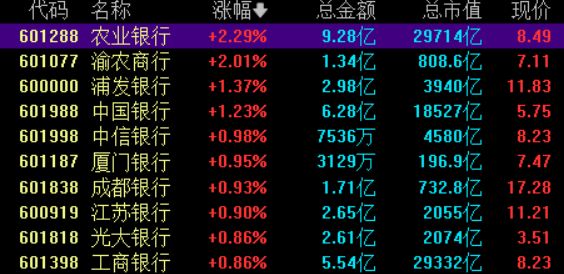
Core Points - The Shanghai Composite Index rose by 0.10% on October 16, with the coal and banking sectors leading the gains at 2.35% and 1.35% respectively [1] - A total of 7 sectors experienced an increase, while 26 sectors saw a decline, with steel and non-ferrous metals facing the largest drops of 2.14% and 2.06% respectively [1] - The banking sector saw a net inflow of 9.39 billion yuan, making it the top sector for capital inflow, while the non-ferrous metals sector had the largest outflow at 9.24 billion yuan [1][2] Industry Summary - The banking sector increased by 1.35% with 39 out of 42 listed banks experiencing gains [2] - Major banks with significant net inflows included Agricultural Bank (5.53 billion yuan), Industrial and Commercial Bank (4.41 billion yuan), and China Construction Bank (2.02 billion yuan) [2] - The top three banks with the highest net outflows were Industrial Bank (1.40 billion yuan), China Merchants Bank (1.21 billion yuan), and Huaxia Bank (723.92 million yuan) [2][3] Capital Flow Analysis - The banking sector had a total of 16 stocks with net inflows, while 5 stocks experienced outflows exceeding 50 million yuan [2] - The capital flow data indicates a strong interest in the banking sector, contrasting with the significant outflows in the non-ferrous metals and electronics sectors [1][2]
2025年9月金融数据点评:融资需求仍待改善,资金活化延续
Yin He Zheng Quan· 2025-10-16 09:10
Investment Rating - The report maintains a "Recommended" rating for the banking industry [1]. Core Insights - The demand for financing remains to be improved, with a continuation of fund activation [3]. - Social financing (社融) has shown a year-on-year decrease, with September's new social financing at 3.53 trillion yuan, a decrease of 229.8 billion yuan compared to the previous year [3]. - The growth rate of social financing stock is at +8.68% year-on-year, with a slight decline of 0.13 percentage points month-on-month [3]. - The issuance of government bonds continues to weaken its support for social financing growth, with new government bonds in September amounting to 1.19 trillion yuan, a decrease of 347.1 billion yuan year-on-year [3]. - The report highlights a marginal improvement in residents' medium and long-term loans, while corporate financing demand remains weak [3]. - The report suggests that the activation of funds is increasing, with M1 and M2 growth rates at +7.2% and +8.4% year-on-year, respectively [3]. - The report emphasizes the need for recovery in credit demand and suggests monitoring the effectiveness of new policy financial tools [3]. Summary by Sections Banking Industry - The banking sector's fundamentals are accumulating positive factors, with a marginal improvement in mid-term performance expected [3]. - The report recommends specific banks, including Industrial and Commercial Bank of China (601398), Agricultural Bank of China (601288), and others, indicating their potential for value [3].
银行OCI账户储备大盘点:下半年银行还会大幅卖债吗?
ZHESHANG SECURITIES· 2025-10-16 08:48
Investment Rating - The industry investment rating is maintained as "Positive" [3] Core Insights - It is expected that large banks will increase their bond purchases while small banks will sell bonds to improve performance [3] - The behavior of banks in the secondary bond market is influenced by three main factors: passive allocation behavior, active allocation behavior, and risk indicator constraints [3][9][10] - In the first half of 2025, the core revenue growth rates for different types of banks varied, with state-owned banks showing a slight decline while city commercial banks experienced growth [18][24] Summary by Sections 1. Factors Influencing Bank Bond Trading Behavior - Passive allocation behavior involves using remaining liquidity to participate in the secondary market, enhancing fund utilization [9] - Active allocation behavior is driven by performance pressures, leading banks to adjust positions to enhance revenue or mitigate risks [10] - Risk indicator constraints require banks to adjust their bond maturity structure based on liquidity and interest rate risks [11] 2. Reasons for Significant Bond Selling in March to June 2025 - The primary reason for the significant bond selling was the performance pressure on small banks, which needed to realize gains from OCI/AC accounts to improve earnings [12] - Remaining liquidity did not significantly decrease during this period, indicating that the selling behavior was more related to active management rather than passive allocation [13] - The performance pressure was particularly acute for small banks, which had to sell older bonds to support their revenue [17][18] 3. Different Motivations for Bond Trading Among Bank Types - State-owned banks are primarily constrained by remaining liquidity and are expected to focus on buying bonds [3] - Joint-stock banks are experiencing significant performance pressure, leading to a reduction in AC account sizes [3] - City and rural commercial banks are also facing performance pressures, resulting in a contraction of both AC and OCI account sizes [3] 4. Future Expectations for Bank Bond Selling - In the coming months, large banks are expected to focus on buying bonds, while small banks may continue to sell older bonds to improve their performance [3] - The passive allocation behavior is anticipated to remain strong due to increased remaining liquidity, while small banks may increase their selling activities [4] - Risk indicator pressures are expected to ease as supply pressures diminish, leading to a reduction in bond selling by state-owned banks [4] 5. Investment Recommendations - The report recommends focusing on small banks in economically developed regions and stable high-dividend large banks, with specific recommendations for banks such as Shanghai Pudong Development Bank and Nanjing Bank [4]
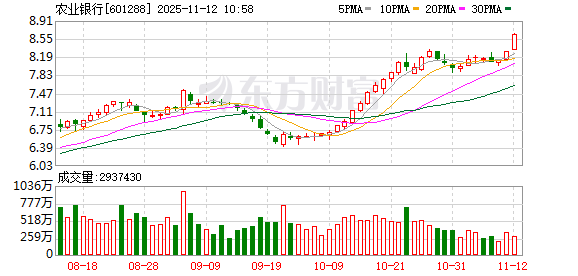
A股新变化,成交低于2万亿元,601288罕见10连阳
Zheng Quan Shi Bao· 2025-10-16 08:46
Market Overview - A-shares experienced fluctuations with major indices switching between gains and losses, ultimately resulting in a slight increase for the Shanghai Composite Index and the ChiNext Index, while the Shenzhen Component Index and the STAR Market Index saw minor declines [1] - The trading volume reached 1.95 trillion yuan, ending a streak of 40 consecutive trading days with over 2 trillion yuan [1] Index Performance - Shanghai Composite Index: 3916.23 (+0.10%) [2] - Shenzhen Component Index: 13086.41 (-0.25%) [2] - ChiNext Index: 3037.44 (+0.38%) [2] - STAR Market Index: 1416.57 (-0.94%) [2] - The banking, coal, and liquor sectors showed strong performance, while rare metals and wind power equipment sectors faced declines [2] Capital Flow - The electronics sector saw a net inflow of over 5.5 billion yuan, while power equipment attracted over 3.8 billion yuan [2] - The banking and food & beverage sectors each received over 2 billion yuan in net inflows, with transportation, coal, communication, and automotive sectors also seeing over 1 billion yuan [2] - Mechanical equipment and basic chemicals experienced net outflows exceeding 3 billion yuan, with non-ferrous metals and defense industries also facing significant outflows [2] Earnings Outlook - Central China Securities anticipates a rebound in earnings growth for most industries in the upcoming Q3 reports due to a low base from the previous year, which is expected to bolster market confidence [3] - Investment opportunities are suggested in consumer electronics, automotive, chemical pharmaceuticals, and semiconductors [3] Investment Sentiment - Guotai Junan highlights a strong demand for quality assets in China, suggesting that recent asset price declines due to external conflicts present buying opportunities [3] - The banking sector has shown resilience, with Agricultural Bank of China experiencing a rare 10-day consecutive rise, nearing historical highs [3] Sector Analysis - The banking sector is favored due to stable performance, high dividends, and low valuations, with projected revenue growth of 0.4% year-on-year for Q3 2025 [5] - The coal sector remains strong, with significant gains observed, particularly in leading stocks like Yanzhou Coal Mining Company, which has seen multiple trading days of gains [5][7] - The coal industry is expected to maintain a balanced supply-demand dynamic, with potential price increases anticipated due to seasonal demand and policy support [7]