
AGRICULTURAL BANK OF CHINA(601288)

Search documents
落实个人消费贷款最新财政贴息政策,六大行集体公告
Feng Huang Wang· 2026-01-22 11:01
Core Viewpoint - Major Chinese banks have announced the implementation of an optimized personal consumption loan subsidy policy, extending its duration and expanding its scope to support consumer spending [1] Group 1: Policy Implementation - The implementation period for the personal consumption loan subsidy policy has been extended to December 31, 2026 [1] - The scope of support has been expanded to include credit card installment payment services [1] Group 2: Subsidy Expansion - The subsidy field has been broadened by removing the restriction on single transactions of 50,000 yuan and above [1] - The subsidy standard has been improved by eliminating the cap of 500 yuan on single transaction subsidies and the previous limit of 1,000 yuan for cumulative subsidies under 50,000 yuan per borrower at a single institution [1] Group 3: Existing Agreements - For loans that have already signed the personal consumption loan subsidy service agreement, any consumption occurring after January 1, 2026, will automatically apply the latest subsidy policy without the need to re-sign the agreement [1]



多家银行发文明确信用卡账单分期贴息细节,开启补申请通道
Bei Jing Shang Bao· 2026-01-22 09:37
Core Viewpoint - The Chinese government has introduced a new personal consumption loan interest subsidy policy, which aims to enhance consumer spending and stimulate the economy by providing financial incentives through interest subsidies on personal loans and credit card installments [1][3]. Group 1: Policy Implementation - The new subsidy policy will be effective from September 1, 2025, to December 31, 2026, for personal consumption loans, while the credit card installment subsidy period will be from January 1, 2026, to December 31, 2026 [3]. - The policy expands the support scope by including credit card installment payments for the first time, with a subsidy rate of 1% per annum, and removes previous restrictions on consumption areas [3][4]. Group 2: Bank Responses - Major banks such as ICBC, ABC, BOC, CCB, and others have quickly responded by issuing operational guidelines and clarifications regarding the implementation of the subsidy policy [2][3]. - Banks have confirmed that customers who have already signed consumption loan subsidy agreements will automatically benefit from the new policy without needing to re-sign agreements [4][5]. Group 3: Customer Guidance - Customers are required to sign a supplementary agreement for credit card installment subsidies, with each card needing a separate agreement to benefit from the subsidy during the policy period [5][6]. - Banks are advised to streamline the process for customers to access the subsidy, including online application portals and clear communication of interest rates and subsidy limits [6][7]. Group 4: Market Impact - The minimum execution interest rate for consumption loans remains at 3%, but with the subsidy, the effective interest rate for eligible borrowers could potentially drop to the "2% range" [7].



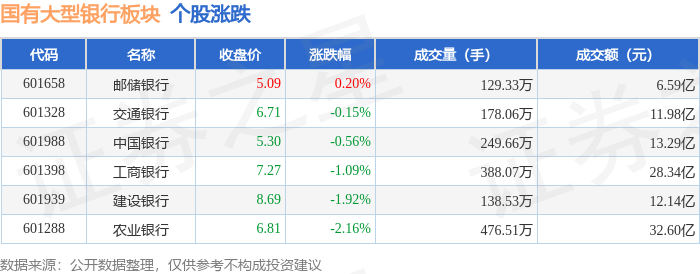
国有大型银行板块1月22日跌1.3%,农业银行领跌,主力资金净流出2.09亿元
Zheng Xing Xing Ye Ri Bao· 2026-01-22 09:01
Group 1 - The core viewpoint of the article indicates that the state-owned large bank sector experienced a decline of 1.3% on January 22, with Agricultural Bank leading the drop [1] - The Shanghai Composite Index closed at 4122.58, up 0.14%, while the Shenzhen Component Index closed at 14327.05, up 0.5% [1] - The trading volume and turnover for major state-owned banks are detailed, showing varying performance among individual banks [1] Group 2 - Agricultural Bank's stock price fell by 2.16% to 6.81, with a trading volume of 476.51 million shares and a turnover of 32.60 billion [1] - The net outflow of main funds from the state-owned large bank sector was 209 million, while retail investors saw a net inflow of 38.81 million [1] - The table shows the net inflow and outflow of funds for individual banks, highlighting the performance of each bank in terms of main, retail, and speculative funds [2]


数字人民币2.0:从M0到M1的质变
GF SECURITIES· 2026-01-22 05:07
Investment Rating - The report provides a "Buy" rating for all major banks analyzed, indicating a positive outlook for the banking sector [7]. Core Insights - The digital renminbi has entered its 2.0 era, transitioning from a central bank liability (M0) to a commercial bank liability (M1), allowing it to earn interest and be included in deposit insurance and reserve requirements [6][14]. - This transformation positions China as the first economy to offer interest on its central bank digital currency (CBDC), fundamentally altering its monetary attributes and creating a new financial paradigm in the digital economy [27]. - The digital renminbi's interest-bearing feature enhances user motivation to hold it, shifting its perception from a mere payment tool to a viable store of value, thus promoting its integration into everyday financial activities [27][28]. Summary by Sections 1. Digital Renminbi 2.0 Era - The digital renminbi (e-CNY) is now classified as a digital deposit currency, which can earn interest and is managed under a new regulatory framework [14]. - Major state-owned banks have begun offering interest on digital renminbi wallet balances, marking a significant shift in its utility and appeal [14][27]. 2. Development Progress and Application Status - The development of the digital renminbi began in 2014, with significant milestones including pilot tests in various cities and the establishment of a comprehensive operational framework by 2025 [32][33]. - As of November 2025, the digital renminbi has processed 34.8 billion transactions amounting to 16.7 trillion yuan, with extensive coverage across multiple provinces and cities [37]. 3. Global CBDC Development Trends - The report identifies three main trends in global CBDC development: active retail CBDC initiatives, innovation in payment systems, and cautious approaches in some countries like the U.S. [6]. - China's proactive stance in developing its CBDC positions it favorably in the global digital economy landscape, particularly in cross-border trade applications [30].



农行浙江分行880万罚单揭贷管漏洞 浦发杭州分行475万处罚显“三查”短板
Jing Ji Guan Cha Bao· 2026-01-22 04:34
Core Insights - The regulatory authority in Zhejiang has issued administrative penalties against China Agricultural Bank and Shanghai Pudong Development Bank for deficiencies in credit management, signaling a strict enforcement of compliance in the banking sector during a critical economic transition [2][6]. Group 1: Penalties and Violations - China Agricultural Bank's Zhejiang branch was fined 8.8 million yuan for imprudent management of personal and corporate loans, with 18 responsible individuals receiving warnings [2][3]. - Shanghai Pudong Development Bank's Hangzhou branch faced a fine of 4.75 million yuan due to inadequate execution of the "three checks" for working capital loans and deficiencies in managing personal business loans, with 5 individuals held accountable [2][5]. Group 2: Regulatory Context - The penalties reflect a broader regulatory trend emphasizing compliance throughout the entire credit process, indicating that any bank, regardless of size, will face substantial penalties for failing to adhere to prudent lending principles [2][6]. - The regulatory actions are part of the National Financial Supervision Administration's focus on "penetrating supervision" and prioritizing substance over form, especially in the context of increasing credit risk amid economic adjustments [7][8]. Group 3: Industry Implications - The total fines of 13.55 million yuan and 23 warnings serve as a calibration of the credit culture within the banking industry, highlighting the risks associated with superficial compliance and the potential for systemic financial instability if internal controls weaken [8]. - The incidents reveal a tendency among banks to prioritize loan issuance over risk management, which could lead to vulnerabilities during economic transitions, emphasizing the need for a shift in focus towards precise risk management and compliance resilience [7][8].


拓展离岸贸易新场景,农行上海市分行精准赋能企业“出海”
Zhong Guo Jin Rong Xin Xi Wang· 2026-01-22 03:53
Group 1 - The core viewpoint of the articles highlights the challenges and solutions faced by Shanghai Xafei Cosmetics Co., Ltd. as it shifts its production to Southeast Asia while ensuring the safety of its cross-border supply and capital chains [1][2] - Shanghai Xafei Cosmetics Co., Ltd. has been in operation since 1985, primarily engaged in the wholesale and sales of chemical products, with a market presence in the US, Europe, East Asia, and Southeast Asia [1] - The company is transitioning its production to Southeast Asia to optimize its industrial chain layout, which has led to a need for financial services that can ensure capital safety and align with its new business model [1] Group 2 - Agricultural Bank of China Shanghai Branch has established a "Service Trade Innovation Business Base" in the Lingang New Area in 2023, and a "Cross-Border Offshore Business Center" in September 2025 to explore advanced financial services and institutional innovations [2] - The bank focuses on institutional openness and aims to convert policy opportunities into practical development, particularly in promoting cross-border offshore business in the Lingang New Area [2] - The bank has successfully implemented the first digital RMB cross-border settlement business under capital items in Shanghai and participated in various pilot projects related to offshore trade and financial services [2]
固收专题报告:银行自营债券投资有何特征?
Hua Yuan Zheng Quan· 2026-01-22 03:37
1. Report Industry Investment Rating No relevant content provided. 2. Core Viewpoints of the Report - In 2025, the bond market may mainly rely on increased allocation by bank self - operations. The balance of China's bond market increased by 19.7 trillion in the first 11 months of 2025, and the incremental investment in self - operated bonds by the banking industry in the same period reached 14.3 trillion, accounting for 72.7% of the bond scale increment [2][31]. - Bank self - operated bond investment is mainly in interest - rate bonds, which have a significant impact on the pricing of interest - rate bonds. As of Q3 2025, the proportion of interest - rate bond holdings in bank self - operated bonds was 80.7% [36]. - The bond investment behavior of banks is mainly affected by three types of indicators: capital adequacy ratio requirements, liquidity regulatory indicators, and bank book interest rate risk indicators [3][45]. - Joint - stock banks are the main players in the secondary trading of interest - rate bonds, while the trading scale of large - state - owned banks and policy banks is relatively small. Since Q1 2023, the overall market trading activity has increased, especially significantly after 2025 [3][52]. 3. Summary by Relevant Catalogs 3.1 Bank Self - Operated Financial Investment Composition, Scale Changes, and Structural Characteristics - **Composition and Scale Changes**: As of Q3 2025, the total financial investment scale of 42 listed banks was 101.5 trillion yuan. By statement account, the FVTPL account was 13.23 trillion yuan (13.0%), the FVOCI account was 29.87 trillion yuan (29.4%), and the AC account was 58.40 trillion yuan (57.5%). By asset category as of Q2 2025, bond investment was 79.08 trillion yuan (84.46%), equity investment was 0.86 trillion yuan (0.91%), and funds and other investments were 13.07 trillion yuan (13.96%). From Q4 2023 to Q3 2025, the investment scale of the FVOCI account increased significantly, mainly due to the growth of bond investment [8]. - **Structural Characteristics**: Credit bonds are mainly placed in the FVOCI account, and interest - rate bonds are mainly placed in the AC account. Among different types of banks, the proportion of the three accounts of large - state - owned banks and joint - stock banks is relatively stable, while the proportion of the AC category of city and rural commercial banks has decreased, and the FVOCI category of city commercial banks has increased, indicating a shift from allocation to trading thinking [2][14]. 3.2 Bond Market in 2025 - In 2025, the bond market may rely on increased allocation by bank self - operations. The government issued more bonds in 2025, and the weak credit demand led banks to significantly increase their bond investment. The year - on - year growth rate of the bond investment balance of various types of banks has increased significantly, and bond investment may become the main driving force for the expansion of bank asset scale [31][33]. 3.3 Bank Bond Investment Characteristics - **Investment Portfolio**: As of Q3 2025, bank self - operated bond holdings were 96.5 trillion yuan, mainly interest - rate bonds. Interest - rate bonds accounted for 80.7%, credit bonds accounted for 11.7%, negotiable certificates of deposit accounted for 5.7%, and other bonds accounted for 1.8%. Among interest - rate bonds, treasury bonds accounted for 33.3%, local government bonds accounted for 48.3%, and policy - bank bonds accounted for 17.8% [36]. - **Pricing Influence**: As of Q3 2025, bank self - operated bond holdings accounted for 48.21% of the total bond custody, having a significant impact on the bond market pricing, but the degree of influence varies by bond type. Bank self - operated interest - rate bond holdings accounted for 63.6% of the total interest - rate bond custody, having a significant impact on pricing [44]. 3.4 Bank Bond - Allocation Indicator Constraints - **Capital Adequacy Ratio Requirements**: The risk weights of treasury bonds and policy - bank bonds are 0, the risk weights of local general bonds and special bonds are 10% and 20% respectively, and the risk weights of general corporate bonds and non - bank financial institution ordinary bonds are 75% - 100% [3][47]. - **Liquidity Regulatory Indicators**: The liquidity coverage ratio is relatively relevant to bank self - operated bond investment behavior. Treasury bonds are included in qualified high - quality liquid assets at market price, while credit bonds are given a discount coefficient according to credit ratings [47]. - **Bank Book Interest Rate Risk Indicators**: For large - state - owned banks, joint - stock banks, and Postal Savings Bank, when the maximum economic value change exceeds 15% of their Tier - 1 capital (ΔEVE > 15%), regulatory attention will be drawn [47]. 3.5 Bank Self - Operated Secondary Trading Characteristics - **Interest - Rate Bond Secondary Trading**: Joint - stock banks are the main players in the secondary trading of interest - rate bonds. The trading activity of the whole market has increased since Q1 2023, especially significantly after 2025. The trading scale of large - state - owned banks and policy banks is relatively small [3][52]. - **Credit Bond Secondary Trading**: The trading scale of credit bonds is relatively limited, and the single - quarter trading amount of bank self - operations is generally below 1 trillion yuan [54]. - **Ultra - Long - Term Interest - Rate Bond Secondary Trading**: The secondary trading of ultra - long - term interest - rate bonds in the banking system shows the characteristics of "net reduction trend remains unchanged, and selling pressure converges marginally". Different types of banks have different trading behaviors [56].
财政金融促内需一揽子政策点评:财政金融六项政策落地,关注结构调优和息差改善
Yin He Zheng Quan· 2026-01-22 02:47
Investment Rating - The report maintains a "Recommended" rating for the banking industry [1] Core Insights - The implementation of six fiscal and financial policies aims to stimulate domestic demand, focusing on structural optimization and interest margin improvement [3] - The fiscal interest subsidies, typically between 1-1.5 percentage points, are designed to lower overall financing costs, boost investment and consumption demand, and guide financial resources towards key areas such as technology innovation and support for small and micro enterprises [3] - The report highlights that the fiscal policies will positively support banks in optimizing their structures and stabilizing interest margins, with expectations of a narrowing decline in interest margins due to the upcoming maturity of high-interest fixed deposits in 2026 [3] - The establishment of a 500 billion yuan special guarantee plan for private investment and the optimization of risk-sharing mechanisms for corporate bonds are expected to enhance banks' asset quality and increase their willingness to issue long-term loans [3] - The report suggests that the collaborative fiscal and financial policies will directly benefit credit growth, structural optimization, and risk expectation improvement, while the stable interest margin guidance remains unchanged [3] Summary by Sections Banking Industry - The report emphasizes the positive impact of fiscal policies on credit growth and structural optimization, with a focus on improving risk expectations and stabilizing interest margins [3] - Specific recommendations for individual banks include Industrial and Commercial Bank of China, Agricultural Bank of China, Postal Savings Bank of China, Jiangsu Bank, Hangzhou Bank, and China Merchants Bank [3]



金融服务有温度 百姓生活有盼头
Jin Rong Shi Bao· 2026-01-22 02:03
Group 1 - The article highlights the significance of traditional food items like cured duck, which are integral to the cultural identity of the people from Fujian Mingxi, especially during the Lunar New Year [1] - The founder of a cured duck business, Ma Jinquan, faced financial difficulties during the peak season for orders but received a timely loan of 200,000 yuan from Agricultural Bank's Fujian Mingxi branch, enabling him to fulfill overseas orders [1] - The cured duck has become a symbol of nostalgia for overseas Chinese, representing a connection to their hometown and family [1] Group 2 - Wu Ruiqing, the president of a flower cooperative in Qingliu County, represents resilience and leadership among local disabled individuals, having transformed her cooperative's operations with the help of a 100,000 yuan loan from Agricultural Bank [2][3] - The loan allowed Wu to implement a comprehensive business model that includes planting, processing, and sales, while also creating job opportunities for disabled individuals [3] - The article also mentions the cultivation of mountain vegetables, which contribute to local economic development, showcasing the diverse agricultural initiatives supported by financial institutions [3][4] Group 3 - Sun Jiaqing, a Taiwanese entrepreneur, faced financing challenges but received a loan of 300,000 yuan from Agricultural Bank's Fujian Sanming Ninghua branch, which facilitated the expansion of his mountain vegetable planting base from 40 acres to over 100 acres [4][5] - The increased planting area has led to a direct increase in production value, surpassing 1.6 million yuan, and the introduction of Taiwanese aquaculture projects [5] - Agricultural Bank's financial support is portrayed as a vital resource for local farmers, enhancing their livelihoods and contributing to the overall economic prosperity of the region [5]
因个人贷款管理不审慎等,农行浙江省分行被罚880万元
Bei Jing Shang Bao· 2026-01-22 01:03
(责任编辑:易薇) 1月21日,据国家金融监督管理总局浙江监管局公布的行政处罚信息公开表,农业银行浙江省分行因"个 人贷款管理不审慎;对公贷款管理不审慎等"违法违规行为,被罚款880万元;另有多位相关责任人被警 告。 ...