
BANK COMM(601328)

Search documents
工、农、中、建、交、邮储,六大行集体发布重要公告→
第一财经· 2025-09-26 08:49
2025.09. 26 本文字数:563,阅读时长大约1分钟 来源 | 央视财经 微信编辑 | 格蕾丝 第 一 财 经 持 续 追 踪 财 经 热 点 。 若 您 掌 握 公 司 动 态 、 行 业 趋 势 、 金 融 事 件 等 有 价 值 的 线 索 , 欢 迎 提 供 。 专 用 邮 箱 : bianjibu@yicai.com (注:我们会对线索进行核实。您的隐私将严格保密。) 推荐阅读 捷豹路虎3.3万名员工被告知"停工停产" 9月25日晚间, 工商银行、农业银行、中国银行、建设银行、交通银行、邮储银行发布公告,宣布 不再设立监事会 。 公告显示,工商银行、农业银行、中国银行、建设银行、交通银行五家国有大行于近日收到国家金融 监督管理总局的有关批复,核准修订后的公司章程,银行监事会及监事依法撤销。银行表示,相关人 员不再担任该行监事,已确认与银行无不同意见,亦无任何其他相关事项需要通知银行股东及债权 人。邮储银行同日发布的《2025年第二次临时股东大会会议资料》也表示,该行拟不再设立监事会 及下设专门委员会。 据悉,监事会是股份公司的监督机构,主要负责监督检查公司的财务会计活动、管理人员执行职务时 ...








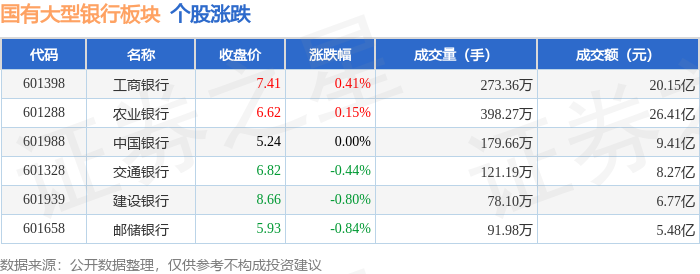
国有大型银行板块9月26日涨0.11%,工商银行领涨,主力资金净流入3.38亿元
Zheng Xing Xing Ye Ri Bao· 2025-09-26 08:48
| 代码 | 名称 | 主力净流入(元) | 主力净占比 游资净流入 (元) | | 游资净占比 散户净流入 (元) | | 散户净占比 | | --- | --- | --- | --- | --- | --- | --- | --- | | 601288 农业银行 | | 2.00亿 | 7.58% | -1.74亿 | -6.60% | -2580.26万 | -0.98% | | 601398 工商银行 | | 8962.28万 | 4.45% | -1.48亿 | -7.34% | 5826.47万 | 2.89% | | 601328 交通银行 | | 2646.71万 | 3.20% | -6353.29万 | -7.68% | - 3706.58万 | 4.48% | | 601658 邮储银行 | | 2153.66万 | 3.93% | -552.23万 | -1.01% | -1601.43万 | -2.92% | | 601939 建设银行 | | 294.89万 | 0.44% | -190.64万 | -0.28% | -104.25万 | -0.15% | | 601988 中国 ...
工农中建交等国有大行集体宣布:“不再设立监事会”获监管核准!
Mei Ri Jing Ji Xin Wen· 2025-09-26 08:18
每经记者|张寿林 每经编辑|陈旭 9月25日晚,工商银行、农业银行、建设银行、中国银行和交通银行集体发布公告,近日收到监管相关 核准批复,自核准之日起,不再设立监事会。 《每日经济新闻》记者注意到,新修订的公司法于2024年7月1日正式实施,对监事会、职工董事设置等 方面提出新的要求。有限责任公司可在董事会中设置由董事组成的审计委员会,行使监事会职权,不设 监事会或者监事。 五大行撤销监事会已获监管核准 9月25日晚,工商银行披露,中国工商银行股份有限公司于2025年6月27日召开的2024年度股东年会审议 批准了《关于审议<中国工商银行股份有限公司章程(2025年版)>及撤销监事会相关事项的议案》。 近日收到《国家金融监督管理总局关于工商银行修改公司章程的批复》(金复〔2025〕564号)。国家 金融监督管理总局已核准该行修订后的公司章程。 同日,建设银行披露,该行2025年6月27日召开的2024年度股东大会审议批准了《关于不再设立监事会 的议案》和《关于修订<中国建设银行股份有限公司章程>的议案》。近日,国家金融监督管理总局已 核准修订后的公司章程。该行自2025年9月23日起,按照公司章程规定,不再设 ...
工行、农行、中行、建行、交行、邮储银行同日公告!
Jin Rong Shi Bao· 2025-09-26 07:32
Core Viewpoint - The six major banks in China have decided to abolish their supervisory boards, opting for their audit committees to assume the supervisory functions, which is seen as a move to enhance corporate governance efficiency and reduce governance costs [1][2]. Group 1: Announcement Details - On September 25, the Industrial and Commercial Bank of China, Agricultural Bank of China, Bank of China, China Construction Bank, and Bank of Communications announced they would no longer establish supervisory boards [1]. - These banks indicated that the decision was approved at the 2024 annual shareholders' meeting held on June 27, 2025, and they have received approval from the National Financial Regulatory Administration for the amendments to their articles of association [1]. - The current supervisors will no longer hold their positions, and the audit committee of the board will take over the responsibilities previously held by the supervisory board [1]. Group 2: Industry Implications - Experts suggest that the functions of the supervisory board overlap with those of the board of directors, particularly the audit committee, which can lead to reduced governance costs and increased flexibility in corporate governance [2]. - The recent revision of the Company Law allows companies to establish audit committees composed of directors to exercise the powers of the supervisory board, which supports the decision to eliminate supervisory boards [2]. - Other banks, including several nationwide joint-stock banks and local commercial banks, have also announced plans to abolish their supervisory boards, indicating a broader trend in the banking industry [2].
鑫闻界|提升治理效率,超20家上市银行撤销监事会
Qi Lu Wan Bao· 2025-09-26 07:25
Core Points - Major Chinese banks, including Industrial and Commercial Bank of China, Agricultural Bank of China, Bank of China, China Construction Bank, and Bank of Communications, have announced the approval of amendments to their articles of association, eliminating the supervisory board [2] - The trend of abolishing supervisory boards is also seen in city commercial banks, with Qilu Bank recently voting to no longer establish a supervisory board [2] - Over 20 of the 42 listed banks have either announced the cancellation or are in the process of abolishing their supervisory boards, including several joint-stock banks and local banks [2] - The removal of supervisory boards is driven by the new Company Law effective from July 1, 2024, allowing companies to set up an audit committee within the board of directors to exercise the powers of the supervisory board [2] - The China Securities Regulatory Commission has indicated that listed companies must establish an audit committee by January 1, 2026, to replace the supervisory board [3] - The industry believes that replacing supervisory boards with audit committees will enhance corporate governance efficiency and reduce operational costs, while ensuring independence and professionalism in supervision [3]


6年被收3万息费 信用卡账单藏利息“刺客”
Bei Ke Cai Jing· 2025-09-26 01:24
Core Viewpoint - The article highlights the issues faced by credit card holders regarding high interest rates and unclear fee structures imposed by banks, leading to significant financial burdens for consumers [3][4][14]. Group 1: Consumer Experiences - A consumer named He Lin experienced unexpected interest charges despite repaying a significant portion of her credit card debt, leading to a refund agreement with the bank contingent on future payments [3][4]. - Another consumer, Jiang Hua, reported accumulating over 36,000 yuan in fees over six years, primarily due to interest and penalties, indicating a lack of clarity in fee calculations [5][9]. - A third consumer, Xue Jun, faced similar issues with over 20,000 yuan in fees despite never missing a payment, highlighting widespread dissatisfaction among credit card users [11][12]. Group 2: Bank Practices - Most banks, except for a few products from Industrial and Commercial Bank of China, employ a full interest calculation method, which has been a point of contention among consumers [4][25]. - The article notes that banks typically provide a grace period of three days for repayments, but this does not alleviate the burden of interest for those who do not pay the full amount [30][32]. - Banks like China Merchants Bank and Ping An Bank have been criticized for their lack of transparency in fee disclosures, with consumers often unaware of the interest calculations until they review their statements [9][10][13]. Group 3: Regulatory and Industry Insights - The article discusses the ongoing debate about the fairness of full interest calculations, with some experts arguing that it deviates from actual costs of capital and may constitute unfair contractual terms [26][27]. - Regulatory bodies have previously indicated that banks must justify their interest rates and fees in relation to the actual losses incurred, aiming to protect consumer rights [27][28]. - There is a call for improved transparency and standardization in fee disclosures, with suggestions for banks to enhance communication regarding interest calculations and potential fees [35][38].


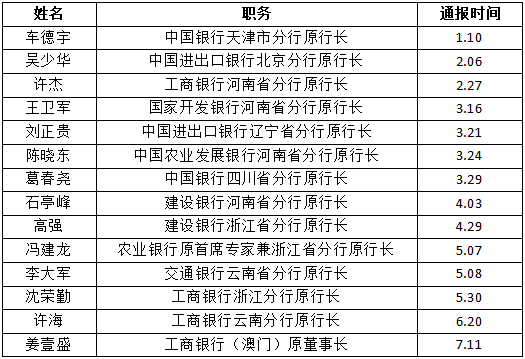
银行地方“一把手”密集落马!10家金融机构公布巡视整改情况,多方强调对“一把手”监督
Xin Lang Cai Jing· 2025-09-26 01:11
Group 1: Central Bank and Financial Regulatory Authority Actions - The Central Bank and the Financial Regulatory Authority are focusing on long-term rectification measures, including enhancing financial infrastructure, advancing information technology reforms, and promoting financial legislation [1][2] - The Financial Regulatory Authority has implemented multiple measures to prevent financial risks, such as strict market access regulations and enhancing administrative penalties to protect consumer rights [1][2] Group 2: Supervision of Leadership - Emphasis on the supervision of "one leaders" in financial institutions, with a focus on accountability and responsibility among top executives [2][9] - At least 32 financial unit officials have been investigated this year, with 23 in the first half alone, highlighting ongoing anti-corruption efforts [2][10] Group 3: Bank-Specific Initiatives - The Export-Import Bank is reinforcing its policy-oriented banking role and enhancing monitoring of policy-related business [3] - The Industrial and Commercial Bank is developing a high-quality growth strategy and improving internal governance and risk management [3] - The Agricultural Bank is focusing on supporting rural revitalization and agricultural development through increased financing [4] Group 4: Global Strategy and Regional Development - The Bank of China is continuing its global strategy by enhancing overseas operations and supporting enterprises in international expansion [5] - The Construction Bank is committed to regional development strategies, including support for the Guangdong-Hong Kong-Macao Greater Bay Area [5] Group 5: Insurance Sector Actions - China Life is addressing the negative impacts of the Wang Bin case and is implementing measures to ensure accountability among its leadership [6][7] - China Pacific Insurance is focusing on strengthening its talent pool and enhancing the political and organizational functions of its party committees [8]
工行、农行、中行、建行、交行、邮储等六大行集体宣布:这一机构 不再设立!
Zhong Guo Ji Jin Bao· 2025-09-26 00:37
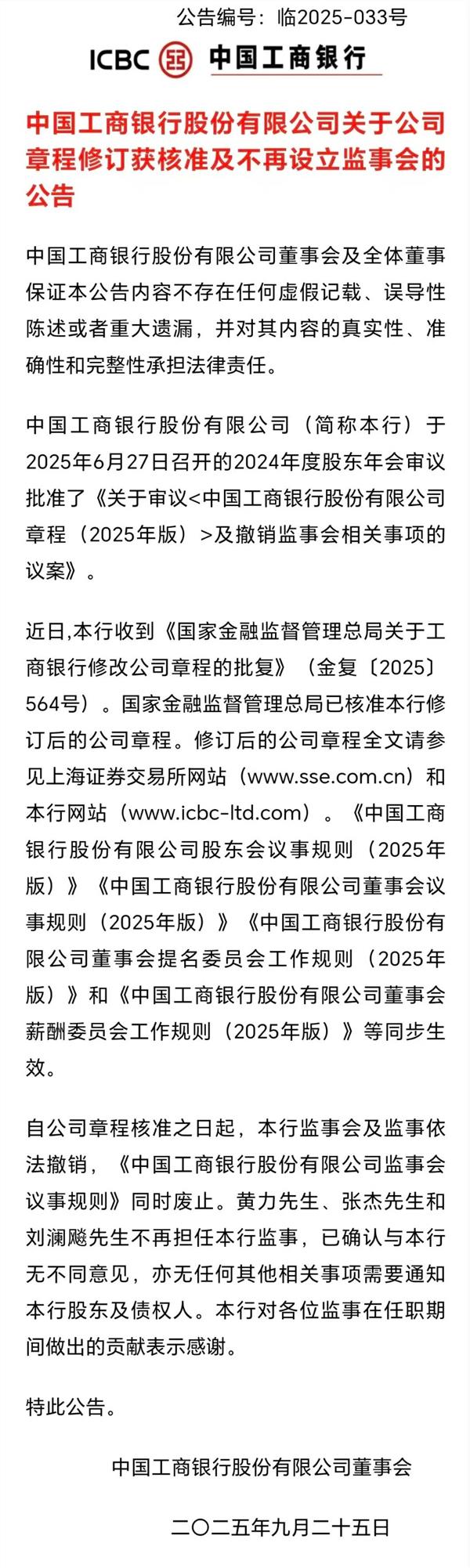
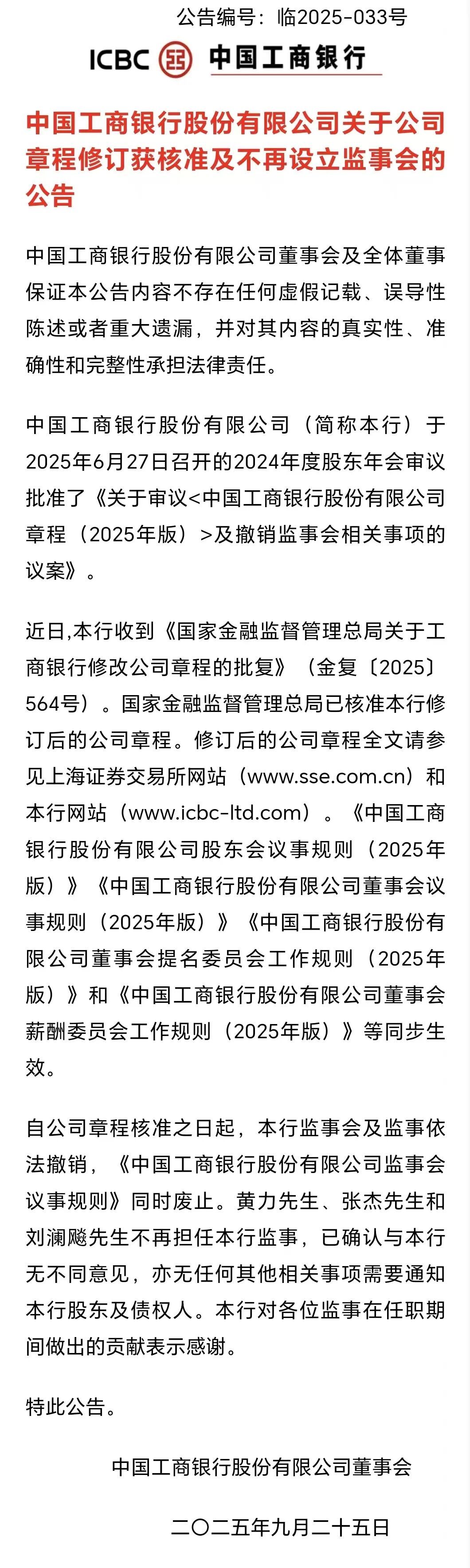
【导读】国有六大银行同日官宣,不再设立监事会 9月25日晚间,工商银行、中国银行、农业银行、建设银行、交通银行相继发布公告,宣布公司章程修 订已获得监管核准,不再设立监事会。 具体来看,工商银行公告显示,该行于2025年6月27日召开的2024年度股东年会审议批准了《关于审议 及撤销监事会相关事项的议案》,并于近日收到《国家金融监督管理总局关于工商银行修改公司章程的 批复》,核准该行修订后的公司章程。 工商银行表示,自公司章程核准之日起,该行监事会及监事依法撤销,《中国工商银行股份有限公司监 事会议事规则》同时废止。黄力、张杰和刘澜飚不再担任该行监事,已确认与该行无不同意见,亦无任 何其他相关事项需要通知该行股东及债权人。 564号)。国家金融监督管理总局已核准本行修 订后的公司章程。修订后的公司章程全文请参 见上海证券交易所网站(www.sse.com.cn)和 本行网站(www.icbc-ltd.com)。《中国工商 银行股份有限公司股东会议事规则(2025年 版) 》《中国工商银行股份有限公司董事会议 事规则(2025年版)》《中国工商银行股份有 限公司董事会提名委员会工作规则(2025年 版) 》和《 ...
大消息!工、农、中、建、交、邮储等六大行集体宣布
Zhong Guo Ji Jin Bao· 2025-09-25 22:45
商银行修改公司章程的批复》(金复〔2025〕 564号)。国家金融监督管理总局已核准本行修 订后的公司章程。修订后的公司章程全文请参 见上海证券交易所网站(www.sse.com.cn)和 本行网站(www.icbc-ltd.com)。《中国工商 银行股份有限公司股东会议事规则(2025年 版)》《中国工商银行股份有限公司董事会议 事规则(2025年版)》《中国工商银行股份有 限公司董事会提名委员会工作规则(2025年 版)》和《中国工商银行股份有限公司董事会 薪酬委员会工作规则(2025年版)》等同步生 效。 自公司章程核准之日起,本行监事会及监事依 法撤销,《中国工商银行股份有限公司监事会 议事规则》同时废止。黄力先生、张杰先生和 刘澜飚先生不再担任本行监事,已确认与本行 无不同意见,亦无任何其他相关事项需要通知 本行股东及债权人。本行对各位监事在任职期 9月25日晚间,工商银行、中国银行、农业银行、建设银行、交通银行相继发布公告,宣布公司章程修订已获得监管核准,不再设立监事会。 具体来看,工商银行公告显示,该行于2025年6月27日召开的2024年度股东年会审议批准了《关于审议及撤销监事会相关事项的议案 ...
银行取消监事会 治理改革面临新挑战
Zhong Guo Zheng Quan Bao· 2025-09-25 22:16
由新公司法驱动的银行治理变革正加速落地。近日,齐鲁银行、兴业银行等上市银行纷纷宣布不再设立 监事会。 业内人士认为,以审计委员会取代监事会可以提升公司治理效率、降低运营成本,但需解决监督的独立 性与专业性问题。此外,如何将原则性规定转化为可行的具体方案,也是银行需要面对的挑战。 纷纷取消监事会 9月23日,齐鲁银行召开股东大会,表决通过了《关于不再设立监事会的议案》。议案表示,根据相关 法律法规、监管制度的规定,结合实际情况,该行拟不再设立监事会及其下设专门委员会,由董事会审 计委员会行使公司法和监管制度规定的监事会职权。 齐鲁银行并非是取消监事会的唯一一家银行。4月29日,工商银行、农业银行、建设银行、中国银行、 交通银行五家国有大行集体宣布撤销监事会,招商银行、兴业银行、北京银行等股份行和城商行也陆续 跟进。 银行取消监事会需要从去年7月1日起施行的新公司法说起。根据法律规定,公司可以在董事会中设置由 董事组成的审计委员会,行使监事会的职权,不设监事会或者监事。此后,国家金融监督管理总局发布 相关通知称,金融机构可以按照公司章程规定,在董事会中设置由董事组成的审计委员会,行使公司法 和监管制度规定的监事会 ...
