BANK COMM(601328)

Search documents
工行、农行、中行、建行、交行、邮储银行同日公告
Jing Ji Wang· 2025-09-28 09:19
Core Viewpoint - Major banks in China have decided to abolish their supervisory boards, transferring their functions to the audit committee of the board of directors, which is seen as a move to optimize corporate governance and reduce costs [7][8][9] Group 1: Decision and Implementation - The five major banks have announced that they will no longer establish supervisory boards, a decision approved at the 2024 annual general meeting held on June 27, 2025, and recently sanctioned by the National Financial Regulatory Administration [7] - Postal Savings Bank has also proposed to abolish its supervisory board and related committees, with the audit committee of the board taking over these responsibilities, pending shareholder approval [8] Group 2: Rationale and Expert Opinions - Industry experts suggest that the functions of supervisory boards overlap with those of the audit committee, particularly the independent directors, making the abolition a strategic choice to enhance governance flexibility and efficiency [8] - The decision to eliminate supervisory boards is viewed as a way to maintain effective corporate governance while lowering governance costs, according to a leading expert from the Shanghai Financial and Development Laboratory [8] Group 3: Regulatory Framework - The revised Company Law allows companies to establish audit committees within the board of directors to perform the functions of supervisory boards, a change that has been recognized by the National Financial Regulatory Administration [9] - Besides the six major banks, several other national joint-stock banks and local commercial banks have also announced the abolition of their supervisory boards [9]



固收深度报告20250927:从42家上市银行半年报解读银行债券投资“攻守道”





Soochow Securities· 2025-09-27 14:32
1. Report Industry Investment Rating No information about the report industry investment rating is provided in the given content. 2. Core Viewpoints of the Report - External environment factors such as interest rate fluctuations, bond supply - demand, and policy orientation jointly impact bond investment returns. In H1 2025, the bond investment of 42 listed banks showed certain characteristics in scale, structure, and profit and loss, but there are still challenges in maintaining stable returns in the future [1]. - The overall bond investment scale of 42 listed banks expanded steadily in H1 2025. There were differences in the investment structure among different types of banks, with state - owned banks and city commercial banks having stable growth in the bond allocation portfolio, while joint - stock banks and rural commercial banks increased their efforts in the bond trading portfolio. The bond investment portfolio generally presented a pattern of "stable foundation and flexible gain" [1]. - The coupon income of 42 listed banks was generally stable in H1 2025 but showed a slight year - on - year decline. The fair value change loss was significant, and the investment income increased. However, the bond investment of the banking industry still faces pressure to maintain stable returns [1]. 3. Summary According to the Table of Contents 3.1 42 Listed Banks' Bond Investment Volume - **Overall Bond Investment Scale: Steady Expansion**: In H1 2025, the total scale of the three types of bond - type financial assets of 42 listed banks showed a steady expansion trend. The growth of debt investment - type financial assets measured at amortized cost was relatively slow, while the growth of trading financial assets measured at fair value and included in current profits and losses was relatively large, indicating that banks increased the proportion of trading positions [9]. - **Differentiated Bond Investment Distribution Structures among Different Bank Types**: In H1 2025, state - owned banks and city commercial banks showed stable growth in the bond allocation portfolio, which may be related to their participation in the primary - market issuance of important national and regional bond varieties. Joint - stock banks and rural commercial banks slightly weakened their bond allocation power but significantly increased their efforts in the bond trading portfolio, showing a differentiated feature of "stable allocation by large banks and prominent trading flexibility by small and medium - sized banks" [13]. - **Bond Investment Allocation Tilted towards Government - Related Bonds**: In H1 2025, commercial banks increased their allocation of government - related bonds, with an average month - on - month increase of about 10% for state - owned banks, joint - stock banks, and city commercial banks, and a slightly smaller increase for rural commercial banks. The allocation of financial bonds and other bonds was differentiated. All banks held a relatively large scale of government - related bonds, followed by financial bonds and credit - related bonds [18]. - **Correlation between Financial Asset Types and Bond Variety Structures**: The banking industry maintained a stable growth of interest - rate bonds in the bond allocation portfolio and increased the allocation of credit bonds, while the allocation of financial bonds was relatively weak. In the bond trading portfolio, interest - rate bonds and financial bonds were the core varieties, with a more significant increase than credit bonds, showing a "stable foundation and flexible gain" pattern [22]. 3.2 42 Listed Banks' Bond Investment Profit and Loss - **Coupon Income: Generally Stable and Still the Main Source of Income**: In H1 2025, the total coupon income of 42 listed banks decreased slightly year - on - year. Although the scale of held - to - maturity bonds increased, the decline in the coupon rate of newly issued bonds led to a decrease in coupon income. In the future, coupon income is still expected to be the main source of bond investment income for commercial banks [26]. - **Fair Value Change Loss: Losses in the Trading Level**: In H1 2025, the total fair value change loss of 42 listed banks decreased significantly year - on - year, indicating that it was difficult to obtain capital gains through short - term trading in the volatile bond market, and there were floating losses in bond trading [28]. - **Investment Income: Growth in All Bank Types**: In H1 2025, the actual investment income of 42 listed banks in the bond field increased significantly year - on - year. Although the book value appreciation of bond - type trading financial assets and other debt investment - type financial assets was not as good as that of the previous year, banks could still increase their investment income by selling floating - profit old bonds and waiting for the maturity of high - coupon bonds [31]. 3.3 Attribution and Summary - **External Environment Driving Factors: Interest Rate Fluctuations, Bond Supply - Demand, and Policy Orientation Jointly Impact Bond Investment Returns**: In H1 2025, the "more adjustments and fewer opportunities" bond market environment led to a general decline in the prices of existing bonds, resulting in a significant year - on - year decline in the fair value change loss of listed banks' bond investment. The supply of national bonds, local government bonds, and policy - based financial bonds increased, but the coupon rate of newly issued bonds decreased, leading to a decline in coupon income. Regulatory policies indirectly affected bond investment performance [35]. - **Banking Industry's Bond Investment Pressure and Future Outlook** - Overall Income Shows a Positive Trend but There Are Still Hidden Concerns: In H1 2025, the actual bond investment income of 42 listed banks increased slightly year - on - year, but the coupon income faced downward pressure in the interest - rate downward cycle, and it was more difficult to obtain spread income through band trading. Since H2 2025, the "stock - strong and bond - weak" pattern has emerged, and the loss caused by fair value change will be more obvious [3]. - Different Bank Types Show Differentiated Performance, and State - owned Banks' Pressure Is Relatively Controllable: State - owned banks can maintain a certain profit - making ability in the low - interest - rate volatile bond market due to their advantages in bond allocation and trading portfolios. Joint - stock banks, city commercial banks, and rural commercial banks are more vulnerable, and they may increase their capital allocation in the equity market, commodity market, and related structured fixed - income products in the future [3].
迎战“十一”黄金周 金融助力服务消费升温
Zhong Guo Jing Ying Bao· 2025-09-26 18:31
Group 1 - The tourism market is experiencing a peak in bookings ahead of the National Day holiday, with significant increases in reservations for flights, hotels, and attractions compared to last year [1][3] - Financial institutions are actively launching diverse services and support measures related to transportation, accommodation, and cultural tourism consumption, aided by government policies such as consumption loan interest subsidies [1][3][4] - The combination of financial support and promotional activities is expected to stimulate consumer spending, contributing to economic growth [2][6] Group 2 - Various travel platforms report a substantial rise in bookings for travel-related products during the holiday period, driven by strategies like taking extended leave [3][4] - Banks are implementing marketing activities to convert interest subsidy policies into increased consumer spending, with a notable rise in inquiries and applications for consumer loans [3][4][5] - The introduction of targeted financial products and services is aimed at enhancing service consumption and expanding domestic demand [5][9] Group 3 - The government is emphasizing the importance of service consumption in driving high-quality economic development, with policies aimed at increasing consumer credit support [7][8] - A report indicates that there is significant potential for service consumption growth in China, supported by rising income levels and structural economic changes [7][8] - Collaborative efforts among multiple departments are enhancing the effectiveness of policies aimed at boosting service consumption across various sectors [8][9] Group 4 - The banking sector is focusing on expanding financial services in key consumption areas such as cultural tourism, healthcare, and education, while also innovating financial products to meet diverse consumer needs [5][10] - There is a growing emphasis on creating a comprehensive ecosystem that integrates financial services with consumer experiences, particularly in the tourism and hospitality sectors [9][10] - The overall loan balance in key service consumption areas has shown a year-on-year increase, indicating a positive trend in financial support for service consumption [9]
五大行同日官宣!银行监事会“谢幕”
Guo Ji Jin Rong Bao· 2025-09-26 13:10
Core Viewpoint - The major state-owned banks in China are abolishing their supervisory boards, transitioning to a governance structure led by audit committees, which is expected to enhance management professionalism and independence [1][2][3]. Group 1: Announcement of Supervisory Board Abolishment - On September 25, five major state-owned banks, including Industrial and Commercial Bank of China, China Construction Bank, Agricultural Bank of China, Bank of China, and Bank of Communications, announced the receipt of regulatory approval to abolish their supervisory boards [2]. - This decision has been in the works for some time, with proposals to eliminate supervisory boards appearing in board resolutions as early as April 29 [2]. - Other banks, such as Shanghai Rural Commercial Bank and China Merchants Bank, are also expected to follow suit, with nearly 20 institutions planning to abolish their supervisory boards this year [1][3]. Group 2: Legal and Regulatory Framework - The new Company Law allows limited liability companies to establish audit committees within the board of directors to exercise the functions of supervisory boards, providing a legal basis for banks to abolish their supervisory boards [3]. - The National Financial Regulatory Administration has indicated that financial institutions can choose to replace supervisory boards with audit committees, aligning regulatory policies with legal revisions [3][4]. Group 3: Internal Governance Structure Post-Abolishment - The banks will adopt a single-tier governance structure led by audit committees, which will be composed mainly of independent directors, enhancing supervisory efficiency through professional division of labor [4]. - The transition to audit committees is expected to improve the professionalism and independence of oversight functions, although it will depend on the effective operation of these committees [5].

交通银行蚌埠分行巧用资金流信息平台精准赋能实体经济
Zhong Guo Jin Rong Xin Xi Wang· 2025-09-26 12:25
Core Insights - The article highlights the successful collaboration between the Bank of Communications Bengbu Branch and a local environmental technology company, which received a mid-term loan approval of 10 million yuan in just two working days to alleviate short-term cash flow pressures due to increased sales [1][2] Group 1: Company Overview - The environmental technology company has been established for six years, focusing on resource recycling technology research and waste metal recycling, contributing significantly to local economic development and resource circularity [1] - In 2024, the company was approved for a short-term loan of 9 million yuan from the Bank of Communications [1] Group 2: Financial Support and Impact - Since 2025, the company has experienced significant sales growth, leading to an extended accounts receivable turnover period and increased short-term funding needs [1] - The Bank of Communications initiated a renewal of credit after understanding the company's challenges, utilizing the People's Bank of China’s fund flow information platform to efficiently access the company's financial data from multiple banks [1] - The bank completed the approval process quickly, converting the existing short-term loan into a more flexible mid-term loan, providing 10 million yuan in credit support, which the company has fully utilized to relieve its financial pressure [1] Group 3: Technological Integration - The use of the fund flow information platform represents a practical implementation of integrating technology finance with inclusive finance, enhancing the dynamic tracking of the company's operational status, income and expenditure, and performance capabilities [2] - The platform has significantly improved information symmetry between banks and enterprises, providing a reliable basis for credit financing for small and micro enterprises [2] - As of now, the Bank of Communications Bengbu Branch has completed 182 inquiries through the platform, resulting in 85 credit approvals totaling 222.3 million yuan, including 85.024 million yuan in credit loans [2]
核准!国有大行,集体公告!
证券时报· 2025-09-26 10:14
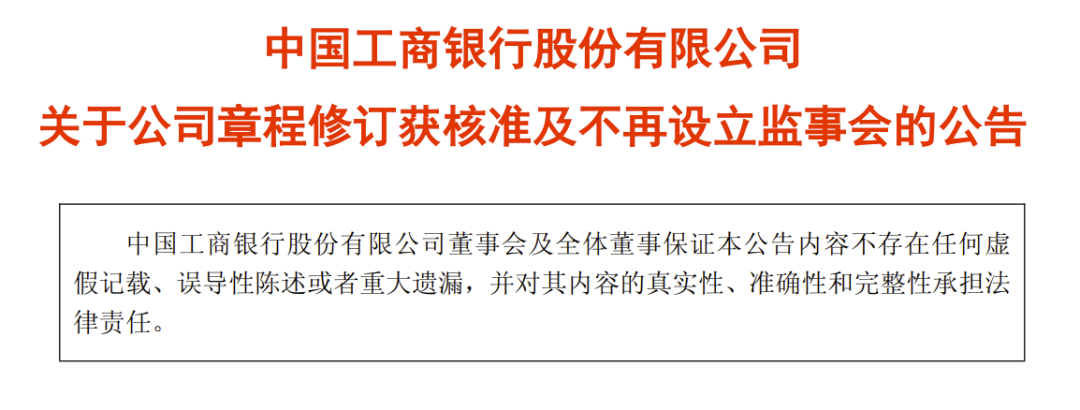
国有大行集体公告 日前,中国银行、工商银行、农业银行、建设银行和交通银行均公告宣布,其公司章程修订已获得国家金 融监督管理总局核准,并据此正式不再设立监事会,转由董事会下设的审计委员会承接原属监事会的法定 职责。 9月25日,中国银行、农业银行、工商银行、建设银行、交通银行均发布关于不再设立监事会的公告 称,公司章程修订已获监管核准,不再设立监事会。 日前,邮储银行发布关于召开2025年第二次临时股东大会的通知显示,将于10月9日上午召开的股东大会 上审议关于该行不再设立监事会的议案。 这意味着,六大国有行全部取消监事会。 具体来看,各家银行的改革步骤高度一致。中国银行、工商银行、农业银行、建设银行和交通银行均于 2025年6月27日召开的2024年度股东大会上,审议批准了关于修订公司章程以及不再设立监事会的相关 议案。各家银行表示,陆续于近日收到了国家金融监督管理总局同意章程修订的批复文件。 随着新章程获得监管核准,相关调整正式生效。中国银行、农业银行在章程核准之日起即不再设立监事 会;建设银行和交通银行则明确了具体的生效日期,分别为2025年9月23日和9月25日。改革的核心内容 是,原由监事会行使的、依 ...

“百县万店”聚合力 交行信用卡点燃县域消费新引擎
Mei Ri Jing Ji Xin Wen· 2025-09-26 09:28
Core Insights - The article highlights the importance of county-level economies as key areas for expanding domestic demand and promoting consumption, particularly through the "Hundred Counties, Ten Thousand Stores for People's Livelihood" initiative launched by Bank of Communications credit cards [2][3]. Group 1: Consumer Engagement and Benefits - The "Hundred Counties, Ten Thousand Stores for People's Livelihood" initiative focuses on enhancing consumer experience by offering diverse benefits, including discounts and special offers in various sectors such as dining, supermarkets, and home appliances [3][6]. - The initiative aims to activate consumer potential by providing substantial discounts and flexible payment options, such as "installment discounts + interest subsidies," particularly for large purchases [3][6]. - New users are incentivized with exclusive benefits, including immediate discounts and purchase coupons, which lower the barriers for trying new financial services [3][6]. Group 2: Cultural and Economic Integration - The initiative also promotes the integration of local cultural heritage and consumption, exemplified by the collaboration with local businesses like the "Chicken Feather Exchange for Sugar" in Yiwu, enhancing the cultural vibrancy of county economies [4][6]. - The program supports the revitalization of traditional businesses, contributing to the economic dynamism of counties by merging cultural elements with modern consumption [4][6]. Group 3: Financial Services Expansion - The initiative extends the bank's financial services by integrating various retail banking products, including debit cards and social security cards, to provide comprehensive financial solutions [6][7]. - The program addresses the "last mile" challenge in financial services, ensuring that credit cards serve as a vital link between the bank and the community, facilitating efficient access to financial services [7]. - The focus on consumer education and protection enhances financial literacy and security awareness among county residents, promoting a dual effect of benefits and consumer rights [6][7]. Group 4: Economic Impact and Responsibility - The article emphasizes the role of the initiative in stimulating county-level consumption and enhancing the overall economic vitality, aligning with national goals for economic circulation [7]. - The collaboration among various stakeholders, including local governments and businesses, creates a synergistic effect that fosters a thriving commercial ecosystem in counties [7].
交通银行中层人事调整涉及多家省分行
Xin Lang Cai Jing· 2025-09-26 09:06
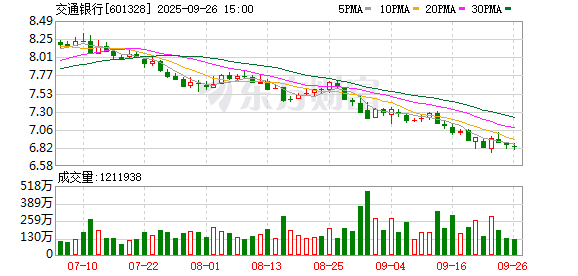
Core Viewpoint - The five major state-owned banks in China, including the Bank of Communications, have announced the approval of amendments to their articles of association, which will eliminate the supervisory board and transfer its responsibilities to the audit committee of the board of directors [1] Group 1: Corporate Governance Changes - Starting from September 25, 2025, the Bank of Communications will no longer have a supervisory board, with its functions being taken over by the audit committee [1] - Current supervisors will no longer hold their positions, and the audit committee will consist of members with financial expertise [1] Group 2: Personnel Changes - In September, the Bank of Communications approved the appointments of seven vice presidents for provincial branches, all promoted from within the system, with several moving to central and western regions [1][2] - Specific appointments include Chen Xing as vice president of the Qinghai branch, Li Xiaoming for the Jiangsu branch, and Fan Daohu for the Ningxia branch, among others [1][2][3] Group 3: Employee Distribution and Financials - As of June 30, 2025, the Bank of Communications had 38 provincial and direct branches, totaling 2,886 branches, an increase of 2 from the previous year [3] - The total number of employees in the group was 95,267, with 88,935 in domestic banks and 2,585 in overseas local institutions [3] - The proportion of employees in the Yangtze River Delta region decreased to 27.91% from 29.94% year-on-year [3] Group 4: Financial Performance - In the first half of 2025, the Bank of Communications reported business and management expenses of 39.933 billion yuan, a year-on-year increase of 0.79% [3] - Employee costs amounted to 15.592 billion yuan, reflecting a year-on-year increase of 2.16 billion yuan [3] - The average cost per employee for the first half of 2025 was approximately 163,700 yuan [3] Group 5: Compensation Structure - The total compensation and benefits for key management personnel in the first half of 2025 was 9 million yuan, a decrease of 1 million yuan or 10% year-on-year [5] - The bank continues to refine its compensation system based on strategic goals, emphasizing performance and accountability [5]
核准!国有大行,集体公告!
券商中国· 2025-09-26 09:02
Core Viewpoint - The six major state-owned banks in China have collectively announced the abolition of their supervisory boards, transitioning the responsibilities to the audit committees under the board of directors, which is seen as a move to enhance governance efficiency and effectiveness [3][4][6]. Group 1: Announcement of Abolishment - On September 25, major banks including Bank of China, Agricultural Bank of China, Industrial and Commercial Bank of China, China Construction Bank, and Bank of Communications announced that they will no longer establish supervisory boards following regulatory approval for their articles of association [1][4]. - Postal Savings Bank is set to discuss a similar proposal at its upcoming shareholder meeting on October 9, indicating a trend among banks to eliminate supervisory boards [2][6]. Group 2: Implementation Details - The reform steps taken by the banks are consistent, with all five major banks approving the abolishment of supervisory boards during their 2024 annual shareholder meetings held on June 27, 2025 [4]. - The new governance structure will take effect immediately for Bank of China and Agricultural Bank, while China Construction Bank and Bank of Communications will implement it on September 23 and September 25, 2025, respectively [4]. Group 3: Personnel Changes - With the abolishment of the supervisory boards, the positions of existing supervisors will be terminated, including notable figures from each bank [5]. - The announcement from ICBC also indicated updates to various governance documents, including the abolishment of the supervisory meeting rules [5]. Group 4: Broader Industry Trends - Analysts suggest that the simultaneous cancellation of supervisory boards by major banks aligns with modern corporate governance trends, aiming to enhance decision-making efficiency and strengthen board accountability [6]. - Other banks, including China Merchants Bank and Huaxia Bank, have also moved to abolish their supervisory boards, indicating a wider industry shift [7]. Group 5: Regulatory Context - The new provisions in the Company Law, effective from July 2024, allow companies to establish audit committees within the board of directors to perform the functions of supervisory boards, reflecting a regulatory shift towards more flexible governance structures [8]. - The China Banking and Insurance Regulatory Commission has stated that these changes will help financial institutions create governance frameworks that suit their specific needs, reduce management costs, and enhance operational flexibility [8].

工、农、中、建、交、邮储,六大行集体发布重要公告→
第一财经· 2025-09-26 08:49
2025.09. 26 本文字数:563,阅读时长大约1分钟 来源 | 央视财经 微信编辑 | 格蕾丝 第 一 财 经 持 续 追 踪 财 经 热 点 。 若 您 掌 握 公 司 动 态 、 行 业 趋 势 、 金 融 事 件 等 有 价 值 的 线 索 , 欢 迎 提 供 。 专 用 邮 箱 : bianjibu@yicai.com (注:我们会对线索进行核实。您的隐私将严格保密。) 推荐阅读 捷豹路虎3.3万名员工被告知"停工停产" 9月25日晚间, 工商银行、农业银行、中国银行、建设银行、交通银行、邮储银行发布公告,宣布 不再设立监事会 。 公告显示,工商银行、农业银行、中国银行、建设银行、交通银行五家国有大行于近日收到国家金融 监督管理总局的有关批复,核准修订后的公司章程,银行监事会及监事依法撤销。银行表示,相关人 员不再担任该行监事,已确认与银行无不同意见,亦无任何其他相关事项需要通知银行股东及债权 人。邮储银行同日发布的《2025年第二次临时股东大会会议资料》也表示,该行拟不再设立监事会 及下设专门委员会。 据悉,监事会是股份公司的监督机构,主要负责监督检查公司的财务会计活动、管理人员执行职务时 ...