
BANK COMM(601328)

Search documents
小摩:中国银行股下半年料迎估值修复,收入与利润均有望改善
智通财经网· 2025-08-19 03:58
Group 1 - The core viewpoint of the report is that Chinese bank stocks are expected to experience valuation recovery opportunities in the second half of the year, making them a focus for investors seeking stable returns [1][4] - The potential upside for A-share bank stocks is estimated at 15%, while H-share bank stocks may rise by 8%. The average dividend yield for covered mainland bank stocks is projected to be around 4.3% this year, which is attractive in the current market environment [1][4] - The report emphasizes that the current ample liquidity environment and relatively weak macroeconomic backdrop will continue to drive funds towards yield-generating assets, positioning Chinese bank stocks as a "safe haven" for investors [1] Group 2 - The trend is reflected in market performance, with the key index tracking Hong Kong-listed Chinese banks showing a cumulative increase of approximately 25% this year, partly due to institutional investors seeking higher returns amid declining bond yields [4] - The report anticipates that bank sector revenue and profit growth will improve quarter-on-quarter in the second half of the year, benefiting from stabilized net interest margins and a moderate recovery in fee income [4] - Based on these assessments, the company has upgraded the ratings of certain bank stocks, raising the ratings of Bank of Communications A-shares and H-shares from "Neutral" to "Overweight," and upgrading Ping An Bank from "Underweight" to "Neutral" [4] Group 3 - China Merchants Bank is identified as the top pick among mainland-listed bank stocks, noted for its stable dividend yield and high sensitivity to capital market fluctuations, making it more resilient in changing market conditions [4] - The investment logic for Chinese bank stocks is supported by stable net interest margins, growing fee income, and relatively reasonable valuation levels [4]




2025年上半年,银行净利润1.2万亿
3 6 Ke· 2025-08-19 03:02
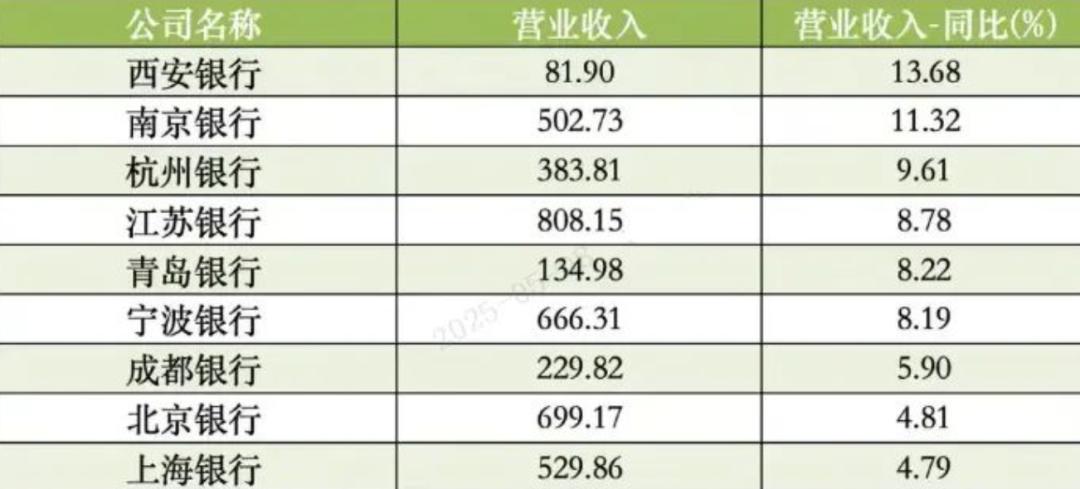
近日,国家金融监管总局公布 2025年商业银行二季度主要监管指标。 数据显示,2025年上半年,商业银行累计实现净利润1.2万亿元。2025年二季度末,平均资本利润率为8.19%。平均资产利润率为0.63%。 1 上半年净息差1.42% 从净息差来看,商业银行依然承压。截至二季度末,商业银行的净息差为1.42%。较一季度末下降0.01个百分点。 具体来看,大型商业银行、股份制商业银行和民营银行的净息差分别为1.31%、1.55%、3.91%,分别较一季度末下降0.02个百分点、0.01个百分点和0.04个 百分点。 | 公司名称 | 营业收入 | 营业收入-同比(%) | | --- | --- | --- | | 西安银行 | 81.90 | 13.68 | | 南京银行 | 502.73 | 11.32 | | 杭州银行 | 383.81 | 9.61 | | 江苏银行 | 808.15 | 8.78 | | 青岛银行 | 134.98 | 8.22 | | 宁波银行 | 666.31 | 8.19 | | 成都银行 | 229.82 | 5.90 | | 北京银行 | 699.17 | 4.81 | | ...




执金融之笔 绘绿色画卷
Jin Rong Shi Bao· 2025-08-19 02:43
Group 1 - The article highlights the transformation of Yucun village in Zhejiang, which shifted from a polluted area relying on stone sales to a thriving eco-tourism destination, embodying the "Two Mountains" theory proposed by Xi Jinping 20 years ago [2][3] - The village's collective income has significantly increased, with an expected 11 million tourists in 2024 and an average collective operating income of 2.54 million yuan per village [3] - The financial support from Agricultural Bank of China has been crucial in facilitating this transformation, marking the issuance of the first rural tourism project loan in the country [3] Group 2 - In Ningxia, the introduction of "Goji Berry Loans" by China Bank has enabled local farmers to expand their goji berry cultivation, contributing to ecological restoration and economic growth [4] - Agricultural Bank of Zhejiang has also launched "Reed Loans" to support local farmers in upgrading their production capabilities, demonstrating the role of innovative financial products in promoting green development [5] Group 3 - The National Development Bank has provided 270 million yuan in loans for ecological restoration projects along the Fenghe River in Xi'an, enhancing wastewater treatment capabilities and improving local environmental conditions [6] - The arrival of the endangered bird species, the crested ibis, in Hunan has led to increased rice prices, showcasing the economic benefits of maintaining a healthy ecosystem [7] Group 4 - The introduction of a heavy-duty electric truck replacement program in Tangshan, supported by the National Development Bank with an 88.05 million yuan loan, aims to reduce carbon emissions and improve clean transportation [8] - The Shanghai Municipal Financial Office has implemented a financial directory to support the transformation of the water transport industry, with the first methanol dual-fuel vessel loan issued by the Bank of Communications [9][10]

推动全区旅游业繁荣发展
Jin Rong Shi Bao· 2025-08-19 02:39
Group 1 - The People's Bank of China Guangxi Autonomous Region Branch has issued measures to support the high-quality development of the cultural tourism and sports industry in Guangxi, focusing on expanding financial supply, innovative financial services, strengthening government-bank-enterprise connections, and enhancing security measures [1][3] - As of the end of Q2 2025, the loan balance for Guangxi's cultural and sports industry reached 201.33 billion yuan, with a year-on-year growth of 6.63% [1] - In the first seven months of this year, the total loan issuance for the cultural and sports industry in Guangxi reached 45.94 billion yuan [1] Group 2 - Guangxi banks are innovating by incorporating "soft" indicators such as profitability, development prospects, and social welfare into customer ratings and credit approvals, addressing the issue of lack of fixed asset collateral in the cultural and sports industry [2] - Guangxi Rural Commercial Bank has introduced a loan secured by the right to charge for sightseeing vehicles, providing 50 million yuan for the Beihai Weizhou Island tourism project [2] - As of the end of Q2, the balances of credit loans, future income rights pledge loans, and trademark pledge loans in Guangxi's cultural and sports industry were 44.4 billion yuan, 3 billion yuan, and 0.875 million yuan, respectively, with growth rates of 17.7%, 11.5%, and 414.7% [2] Group 3 - The People's Bank of China Guangxi Branch has established a financing demand list for key cultural and sports enterprises and a bank list to enhance financing service efficiency [3] - In the first half of the year, Guangxi banks facilitated the issuance of 2.12 billion yuan in loans for cultural and sports projects, benefiting 347 enterprises [3] - A total of 46,800 cultural and sports industry entities were connected by Guangxi banks this year, an increase of 2,266 compared to the same period last year [3] Group 4 - The People's Bank of China Guangxi Branch is enhancing payment services in key cultural and sports consumption areas, improving the acceptance environment for bank cards [4] - As of the end of May, the proportion of key merchants in Guilin accepting foreign cards increased from 51.04% to 97.17% [4] - Various banks in Guangxi are launching themed debit and credit cards, providing financial services such as installment loans and low-threshold small credit loans to enhance consumer experience [4]
宿迁联盛科技股份有限公司 关于使用部分闲置募集资金进行现金管理的进展公告
Zhong Guo Zheng Quan Bao - Zhong Zheng Wang· 2025-08-19 00:06
本公司董事会、全体董事保证本公告内容不存在任何虚假记载、误导性陈述或者重大遗漏,并对其内容 的真实性、准确性和完整性承担法律责任。 重要内容提示: ●现金管理受托方:交通银行股份有限公司宿迁分行 ●现金管理产品名称:交通银行蕴通财富定期型结构性存款128天(挂钩汇率看跌) ●现金管理金额:2,000.00万元 ●现金管理期限:128天 ●履行的审议程序:宿迁联盛科技股份有限公司(以下简称"公司")于2025年4月27日分别召开了第三届 董事会第三次会议和第三届监事会第三次会议,审议通过《关于使用部分闲置募集资金进行现金管理的 议案》,同意公司使用不超过2,000.00万元(含2,000.00万元)的闲置募集资金进行现金管理,用于购买 安全性高、流动性好、期限不超过12个月(含)的投资产品(包括但不限于银行固定收益型或保本浮动 收益型的理财产品、协议存款、结构性存款、定期存款、通知存款、大额存单及证券公司保本型收益凭 证等),决议有效期自第三届董事会第三次会议审议通过之日起至12个月,在上述期限内可以循环滚动 使用。 ●特别风险提示:公司本次投资的产品为保本浮动收益型产品,属于安全性高、流动性好的投资品种, 但 ...

信用卡业务转向精耕细作 多家银行关停旗下分中心
Zheng Quan Shi Bao· 2025-08-18 18:30
Core Viewpoint - The recent approval for the termination of the Zhengzhou branch of the Bank of Communications' Pacific Credit Card Center reflects a broader trend in the credit card industry, where banks are shifting from a rapid expansion model to a more focused and efficient operational strategy [1][2][3] Group 1: Company Actions - The Bank of Communications' Pacific Credit Card Center has been authorized to cease operations at its Zhengzhou branch and must return its license within 15 working days [1] - This year, nearly 42 branches across major cities such as Beijing, Shanghai, and Shenzhen have been approved for closure, indicating a significant acceleration in institutional adjustments [1] - The bank's management has acknowledged the limitations of its previous centralized operating model for credit card services, which is being replaced by a localized branch-based approach [2] Group 2: Industry Trends - The shift in operational strategy is not unique to the Bank of Communications; other banks like China Minsheng Bank and Guangfa Bank are also closing their credit card centers, indicating a trend towards consolidating operations [2] - The credit card industry is transitioning from a "land grab" phase to a "refined cultivation" phase, focusing on efficiency and resource sharing [2] - As of the first quarter of 2024, the total number of credit cards and combined credit and debit cards issued in China has decreased by 5.14% year-on-year, highlighting a potential contraction in the market [3]
国检集团: 国检集团关于使用闲置募集资金进行现金管理进展的公告
Zheng Quan Zhi Xing· 2025-08-18 16:17
证券代码:603060 证券简称:国检集团 公告编号:2025-041 转债代码:113688 转债简称:国检转债 中国国检测试控股集团股份有限公司 关于使用闲置募集资金进行现金管理进展的公告 本公司董事会及全体董事保证本公告内容不存在任何虚假记载、误导性陈述 或者重大遗漏,并对其内容的真实性、准确性和完整性承担法律责任。 重要内容提示: 履行的审议程序:2024 年 12 月 17 日,公司召开第五届董事会第十次会议、 第五届监事会第九次会议,审议通过了《关于使用闲置募集资金进行现金管理额 度的议案》,同意公司在确保不影响募集资金项目建设和募集资金使用的情况下, 使用额度不超过人民币 3 亿元(含本数)的闲置募集资金进行现金管理,该额度 自公司董事会审议通过之日起 12 个月内有效,公司可在使用期限、额度范围内 滚动使用。公司董事会授权法定代表人或其指定的授权代理人行使相关投资决策 权与签署相关法律文件,公司财务部门负责具体实施。公司保荐机构对本事项发 表了同意意见。具体内容详见公司于 2024 年 12 月 18 日在上海证券交易所网站 (www.sse.com.cn) 披露的《国检集团关于使用闲置募集资 ...

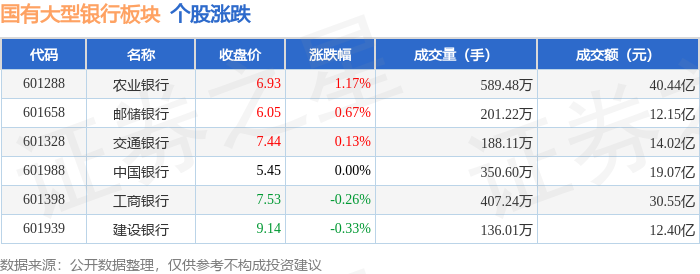
国有大型银行板块8月18日涨0.37%,农业银行领涨,主力资金净流入8.33亿元
Zheng Xing Xing Ye Ri Bao· 2025-08-18 08:39
从资金流向上来看,当日国有大型银行板块主力资金净流入8.33亿元,游资资金净流出5.18亿元,散户资 金净流出3.14亿元。国有大型银行板块个股资金流向见下表: | 代码 | 名称 | 主力净流入 (元) | 主力净占比 游资净流入 (元) | | 游资净占比 散户净流入 (元) | | 散户净占比 | | --- | --- | --- | --- | --- | --- | --- | --- | | 601288 农业银行 | | 6.17亿 | 15.27% | -3.19亿 | -7.88% | -2.99亿 | -7.38% | | 601658 邮储银行 | | 9437.61万 | 7.77% | 1972.98万 | 1.62% | -1.14亿 | -9.39% | | 601398 工商银行 | | 6526.64万 | 2.14% | -7533.77万 | -2.47% | 1007.12万 | 0.33% | | 601939 建设银行 | | 5018.50万 | 4.05% | -8510.98万 | -6.86% | 3492.47万 | 2.82% | | 601988 中 ...
发卡不行了,信用卡改“拼”分期了
3 6 Ke· 2025-08-18 07:14
Core Insights - The credit card industry is undergoing significant changes, with banks shifting focus from acquiring new customers to competing for existing ones, leading to a rise in installment payment options and a reduction in credit card branches [1][2][4][6]. Group 1: Market Trends - Many banks are actively promoting installment payment options, with some offering discounted rates around 4% annualized [1][5]. - Over 40 banks have closed credit card branches this year, indicating a trend towards consolidation and efficiency in the credit card sector [1][5]. - The total number of credit cards issued in China has decreased, with a drop of approximately 4 million cards year-on-year, marking a 5.14% decline [6]. Group 2: Financial Performance - Credit card delinquency rates have increased for several banks, with Minsheng Bank reporting a delinquency rate of 3.28%, up 30 basis points from the previous year [3]. - Credit card consumption amounts have also declined, with major banks like China Construction Bank and Industrial and Commercial Bank of China reporting decreases in transaction volumes [8]. Group 3: Strategic Shifts - Banks are focusing on high-value customers and enhancing product offerings to improve customer retention and profitability [7][9]. - The industry is moving towards integrating various financial services, such as savings, investments, and loans, to provide a more comprehensive service to high-end clients [9].


国家电网60亿元22电网MTN006将于8月30日付息172800000元
Sou Hu Cai Jing· 2025-08-18 07:01
Group 1 - The core point of the announcement is that State Grid Corporation of China will pay interest on its sixth tranche of medium-term notes for the year 2022, amounting to RMB 172.8 million on August 30, 2025 [1] - The bond, referred to as "22电网MTN006," has a total issuance amount of RMB 6 billion and a maturity period of 5 years, with an interest rate of 2.88% [1] - The main underwriters for this bond issuance are Huaxia Bank Co., Ltd. and Bank of Communications Co., Ltd., with Huaxia Bank also serving as the management institution for the bond's duration [1]
