BANK COMM(601328)

Search documents
交通银行:刘瑞霞获批担任独立董事
Jin Rong Jie· 2026-01-04 11:07
此外,交通银行指出,根据决议,刘瑞霞的独立董事任职资格获核准后,石磊不再担任该行独立董事、 董事会风险管理与关联交易控制委员、人事薪酬委员会委员。 银行频道更多独家策划、专家专栏,免费查阅>> 责任编辑:小讯 1月4日,交通银行发布公告称,该行近日收到《国家金融监督管理总局关于刘瑞霞交通银行独立董事任 职资格的批复》(金复〔2025〕776号),刘瑞霞任该行独立董事的任职资格已获国家金融监督管理总 局核准生效。 交通银行表示,根据该行第十届董事会第二十四次会议决议,刘瑞霞自国家金融监督管理总局核准其董 事任职资格之日起,担任该行董事会风险管理与关联交易控制委员会委员、人事薪酬委员会委员。 公开资料显示, 刘瑞霞,女,1961 年生,中国国籍,高级经济师。目前担任中国银行业协会绿色信贷 专业委员会首席专家,中国银行业支持实现碳达峰碳中和目标专家工作组首席专家。荣获国务院政府特 殊津贴。曾任金融稳定理事会气候相关财务信息披露工作组(TCFD)成员,中国工商银行风险管理部 总经理、资深风险管理专家、副总经理,信贷评估部副总经理、评估咨询部副总经理,评估咨询部信用 评估处处长、基金托管部核算管理处处长、业务发展部综合 ...
交通银行:刘瑞霞获批担任独立董事 原独立董事石磊辞任
Xin Lang Cai Jing· 2026-01-04 10:11
登录新浪财经APP 搜索【信披】查看更多考评等级 1月4日金融一线消息,交通银行今日发布公告称,该行近日收到《国家金融监督管理总局关于刘瑞霞交 通银行独立董事任职资格的批复》(金复〔2025〕776 号),刘瑞霞任该行独立董事的任职资格已获国 家金融监督管理总局核准生效。 交通银行表示,根据该行第十届董事会第二十四次会议决议(下称"决议"),刘瑞霞自国家金融监督管 理总局核准其董事任职资格之日起,担任该行董事会风险管理与关联交易控制委员会委员、人事薪酬委 员会委员。 公开资料显示, 刘瑞霞,女,1961 年生,中国国籍,高级经济师。目前担任中国银行业协会绿色信贷 专业委员会首席专家,中国银行业支持实现碳达峰碳中和目标专家工作组首席专家。荣获国务院政府特 殊津贴。曾任金融稳定理事会气候相关财务信息披露工作组(TCFD)成员,中国工商银行风险管理部 总经理、资深风险管理专家、副总经理,信贷评估部副总经理、评估咨询部副总经理,评估咨询部信用 评估处处长、基金托管部核算管理处处长、业务发展部综合处处长等职务。1989年于西南财经大学获经 济学硕士学位。 此外,交通银行指出,根据决议,刘瑞霞的独立董事任职资格获核准后, ...

交通银行温州分行助力书写楠溪江文旅融合诗画新篇章
Zhong Guo Jin Rong Xin Xi Wang· 2026-01-04 09:21
Core Viewpoint - The article highlights the collaboration between the Bank of Communications Wenzhou Branch and the Yongjia County government to support the development of the cultural and tourism integration project in the Nanxi River basin, emphasizing the importance of financial support in promoting local tourism and rural revitalization [1][3]. Group 1: Project Overview - The "Yongjia County Nanxi River Basin Cultural and Tourism Integration Demonstration Project" aims to create a distinctive leisure and vacation destination by integrating natural landscapes and cultural resources [3]. - The project will develop a comprehensive tourism demonstration area that includes ecological sightseeing, cultural experiences, and rural leisure, contributing to the rural revitalization strategy [3]. Group 2: Financial Support - The Bank of Communications Wenzhou Branch responded quickly to the project's financing needs, organizing a professional team to understand the project planning, operation, and construction progress [3]. - The bank successfully approved project financing exceeding 400 million yuan, with nearly 300 million yuan in loans disbursed by the end of 2025, demonstrating efficient financial support [3]. - The rapid approval process, taking only two days from application to loan disbursement, highlights the bank's commitment to meeting the funding needs of the project [3]. Group 3: Strategic Impact - The financial support for the Nanxi River cultural tourism project serves as a model for how financial services can effectively support rural revitalization and enhance the cultural value of the region [3]. - The Bank of Communications Wenzhou Branch plans to continue strengthening its financial support for rural revitalization efforts, aiming to contribute to the creation of a picturesque Wenzhou [3].

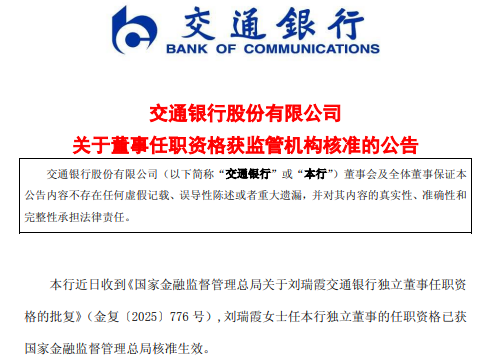
交通银行(601328) - 交通银行关于董事任职资格获监管机构核准的公告
2026-01-04 08:00
刘瑞霞女士的简历,详见本行 2025 年 8 月 29 日在上海证券交易所网站 (www.sse.com.cn)发布的《交通银行股份有限公司第十届董事会第二十四次会 议决议公告》。根据本行第十届董事会第二十四次会议决议(下称"决议"),刘 瑞霞女士自国家金融监督管理总局核准其董事任职资格之日起,担任本行董事会 风险管理与关联交易控制委员会委员、人事薪酬委员会委员。 根据决议,刘瑞霞女士的独立董事任职资格获核准后,石磊先生不再担任本 行独立董事、董事会风险管理与关联交易控制委员、人事薪酬委员会委员。石磊 先生已确认与本行董事会无不同意见,也没有任何与其不再担任本行独立董事有 关而需要通知本行股东和债权人的事项。石磊先生在本行董事会任职 6 年期间, 勤勉敬业、恪尽职守,为本行改革发展事业做出了重要贡献。董事会谨此对石磊 股票代码:601328 股票简称:交通银行 编号:临 2026-001 交通银行股份有限公司 关于董事任职资格获监管机构核准的公告 交通银行股份有限公司(以下简称"交通银行"或"本行")董事会及全体董事保证本 公告内容不存在任何虚假记载、误导性陈述或者重大遗漏,并对其内容的真实性、准确性和 完整 ...
交通银行(601328) - 交通银行H股公告
2026-01-04 07:45
FF301 股份發行人及根據《上市規則》第十九B章上市的香港預託證券發行人的證券變動月報表 截至月份: 2025年12月31日 狀態: 新提交 呈交日期: 2026年1月2日 I. 法定/註冊股本變動 | 1. 股份分類 | 普通股 | 股份類別 | H | | | 於香港聯交所上市 (註1) | | 是 | | | --- | --- | --- | --- | --- | --- | --- | --- | --- | --- | | 證券代號 (如上市) | 03328 | 說明 | H股 | | | | | | | | | | 法定/註冊股份數目 | | | 面值 | | | 法定/註冊股本 | | | 上月底結存 | | | 35,011,862,630 | RMB | | 1 | RMB | | 35,011,862,630 | | 增加 / 減少 (-) | | | | | | | RMB | | | | 本月底結存 | | | 35,011,862,630 | RMB | | | 1 RMB | | 35,011,862,630 | | 2. 股份分類 | 普通股 | 股份類別 | A | | ...
工农中建交邮储六大行集体公告!数字人民币实名钱包余额计付利息,计结息规则与活期存款一致
Sou Hu Cai Jing· 2026-01-04 06:55
Core Viewpoint - Major Chinese banks, including ICBC, ABC, BOC, CCB, BOCOM, and PSBC, will start paying interest on the balances of digital RMB wallets at the rate of their respective demand deposit rates from January 1, 2026 [1][2][4][5][8][9]. Group 1: Bank Announcements - ICBC will pay interest on digital RMB wallet balances according to its demand deposit rate, with interest calculation rules consistent with those for demand deposits [1]. - ABC will also apply the same interest payment policy for digital RMB wallet balances starting January 1, 2026 [2]. - BOC will follow the same approach, paying interest on digital RMB wallet balances at its demand deposit rate from January 1, 2026 [4]. - CCB will implement interest payments on digital RMB wallet balances based on its demand deposit rate, with relevant service agreement updates [5]. - BOCOM will pay interest on digital RMB wallet balances according to its demand deposit rate, effective January 1, 2026 [8]. - PSBC will also apply the same interest payment policy for digital RMB wallet balances starting January 1, 2026 [9].




年终奖理财怎么投?银行力推“一站式”稳健配置
Huan Qiu Wang· 2026-01-04 03:41
Core Insights - The focus of investors is on how to effectively plan their year-end bonuses in the current market environment, aiming for safety while upgrading returns [1] - Financial institutions like Postal Savings Bank, Guangfa Bank, and Everbright Wealth Management are launching targeted "one-stop" year-end bonus investment plans [1][2] - The core theme for year-end bonus investments this year is "steady and low volatility," with institutions providing diversified asset allocation solutions for different risk preferences [1][4] Group 1: Investment Strategies - Guangfa Bank offers a tiered asset allocation strategy categorized as "Conservative - Steady - Aggressive," matching different investors' risk tolerance and return expectations [1] - The conservative allocation focuses on pure bond funds to create a "safety cushion" for asset growth, while the steady allocation suggests "fixed income+" products to enhance yield [1] - The aggressive allocation recommends broad-based index funds for higher returns through long-term holding [1] Group 2: Product Offerings - Everbright Wealth Management suggests splitting the year-end bonus into three segments: short-term living expenses, medium-term expenditures, and long-term compounding growth, each corresponding to different types of fixed-income products [1] - Postal Savings Bank and Bank of Communications are also actively participating in the year-end bonus investment market, offering low-risk or medium-low-risk products tailored to various scenarios [2] - Bank of Communications has enhanced its offerings by adding insurance and precious metals to its "one-stop" investment product matrix [2] Group 3: Risk and Financial Planning - The main risk levels of products are concentrated in PR1 to PR2 categories, with few products rated PR3 or higher appearing in fund recommendations [4] - Analysts recommend that investors analyze their financial situation, risk tolerance, and funding needs before customizing their year-end bonus investment plans [4] - A combined approach of "earmarked funds" and "diversified allocation" is suggested, with cash or daily-opening investment products for short-term needs and insurance products for long-term planning [4][5]


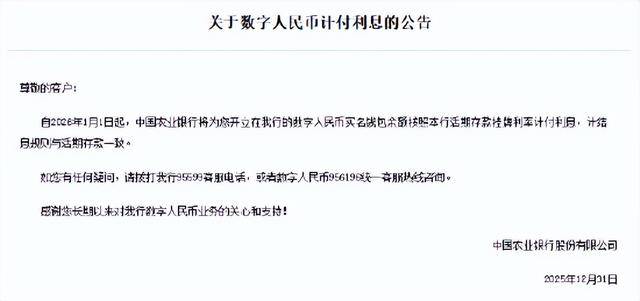
交通银行发布关于数字人民币计付利息的公告
Jin Tou Wang· 2026-01-04 02:30
Core Viewpoint - From January 1, 2026, Bank of Communications will pay interest on the balances of digital RMB real-name wallets (including Class 1, Class 2, Class 3 personal wallets and corporate wallets) at the current deposit benchmark interest rate. Balances in Class 4 personal wallets will not earn interest [1] Summary by Category Interest Payment Policy - Digital RMB wallets will earn interest based on the current deposit benchmark interest rate starting January 1, 2026 [1] - Class 4 personal wallets will not receive any interest on their balances [1] Customer Information - Customers can check the specific interest rate standards through the Bank of Communications official website, mobile banking app, or at physical branches [1] - For inquiries, customers can contact the Bank of Communications customer service hotline at 95559 or the unified digital RMB customer service hotline at 956196 [1]
交e通同业财富管理平台终止服务
Jin Tou Wang· 2026-01-04 02:23
2026年1月1日,交通银行(601328)发布关于交e通同业财富管理平台终止服务的公告,公告称,交通 银行已于2025年12月31日完成交e通同业财富管理平台(简称交e通平台,网址jyty.bankcomm.cn)与交 通银行企业网银同业专版功能融合、系统切换和客户迁移。 交通银行计划于2026年2月7日0:00终止交e通平台对客服务。服务终止后,未按照交通银行2025年9月30 日发布的《交e通特色服务渠道切换公告》向交通银行申请系统切换的同业客户将无法登录、使用交e通 平台,由交e通平台办理的同业代销基金、同业定期存款等业务可通过企业网银同业专版、营业网点柜 面等渠道继续办理。 如有疑问,可咨询专属客户经理或致电交通银行全国客服热线95559。 ...
工农建交邮储等大行宣布数字人民币余额计息点评:数币余额开始付息,供需双向促规模增长
GUOTAI HAITONG SECURITIES· 2026-01-03 11:07
Investment Rating - The report assigns an "Overweight" rating for the industry, indicating a projected performance that exceeds the Shanghai and Shenzhen 300 Index by more than 15% [4][10]. Core Insights - Major banks, including ICBC, ABC, CCB, BOC, and PSBC, announced that starting January 1, 2026, digital RMB wallets will earn interest based on the current deposit rate, which is expected to enhance the promotion of digital RMB and drive its growth [2][4]. - The introduction of interest on digital RMB wallets marks a transition from a cash-like version (1.0) to a deposit currency version (2.0), addressing previous limitations that hindered user adoption and bank promotion [4]. - The interest policy is anticipated to activate both supply and demand sides of the digital RMB ecosystem, enhancing banks' willingness to promote digital RMB and increasing user interest due to the potential for earning interest on idle funds [4]. Summary by Sections Industry Overview - The report highlights the shift in digital RMB from a non-interest-bearing currency to an interest-bearing asset, which is expected to attract more users and expand the ecosystem [4]. Policy Implications - The interest payment policy aligns with the central bank's action plan, facilitating the integration of digital RMB into the banking system and allowing banks to utilize wallet balances for lending, thus generating interest income [4]. User Engagement - The report notes that the interest incentive will likely increase user retention of funds in digital RMB wallets, encouraging merchants to expand acceptance scenarios and promoting the continuous growth of the digital RMB ecosystem [4]. Investment Recommendations - The report suggests that digital RMB is transitioning into a digital deposit currency era, with banks likely to actively participate in its development. Companies providing compatible digital RMB terminal devices and services, such as Lakala, Yika, and Lianlian Digital, are recommended for investment [4][5].