BANK COMM(601328)

Search documents
工农建交邮储等大行宣布数字人民币余额计息点评:数币余额开始付息,供需双向促规模增长
GUOTAI HAITONG SECURITIES· 2026-01-03 11:07
Investment Rating - The report assigns an "Overweight" rating for the industry, indicating a projected performance that exceeds the Shanghai and Shenzhen 300 Index by more than 15% [4][10]. Core Insights - Major banks, including ICBC, ABC, CCB, BOC, and PSBC, announced that starting January 1, 2026, digital RMB wallets will earn interest based on the current deposit rate, which is expected to enhance the promotion of digital RMB and drive its growth [2][4]. - The introduction of interest on digital RMB wallets marks a transition from a cash-like version (1.0) to a deposit currency version (2.0), addressing previous limitations that hindered user adoption and bank promotion [4]. - The interest policy is anticipated to activate both supply and demand sides of the digital RMB ecosystem, enhancing banks' willingness to promote digital RMB and increasing user interest due to the potential for earning interest on idle funds [4]. Summary by Sections Industry Overview - The report highlights the shift in digital RMB from a non-interest-bearing currency to an interest-bearing asset, which is expected to attract more users and expand the ecosystem [4]. Policy Implications - The interest payment policy aligns with the central bank's action plan, facilitating the integration of digital RMB into the banking system and allowing banks to utilize wallet balances for lending, thus generating interest income [4]. User Engagement - The report notes that the interest incentive will likely increase user retention of funds in digital RMB wallets, encouraging merchants to expand acceptance scenarios and promoting the continuous growth of the digital RMB ecosystem [4]. Investment Recommendations - The report suggests that digital RMB is transitioning into a digital deposit currency era, with banks likely to actively participate in its development. Companies providing compatible digital RMB terminal devices and services, such as Lakala, Yika, and Lianlian Digital, are recommended for investment [4][5].






近30笔千万级罚单!2025年银行业罚单大盘点
证券时报· 2026-01-03 05:27
Core Viewpoint - In 2025, the Chinese banking industry is undergoing significant regulatory scrutiny characterized by "strict regulation, strong accountability, and zero tolerance," leading to a notable increase in both the quantity and severity of penalties imposed on banks [1]. Group 1: Regulatory Environment - The number of penalties exceeding 10 million yuan in the banking sector reached nearly 30, affecting various types of institutions including state-owned banks, policy banks, joint-stock banks, city commercial banks, private banks, and bank-affiliated wealth management subsidiaries [2]. - Regulatory focus has expanded beyond traditional areas like credit management to include corporate governance, related party transactions, anti-money laundering, data security, and wealth management business oversight [2][4]. Group 2: Major Penalties - Major state-owned banks such as Bank of China, Industrial and Commercial Bank of China, and Agricultural Bank of China received substantial fines, with Bank of China facing a fine of 97.9 million yuan for issues related to corporate governance and asset quality management [4]. - In December 2025, China Communications Bank was fined 68.07 million yuan for violating multiple regulations, including account management and anti-money laundering obligations [4][5]. Group 3: Compliance and Risk Management - The penalties highlight a trend of inadequate compliance and risk management across various banking operations, including loan management, interbank transactions, and wealth management [7][10]. - The regulatory environment has intensified scrutiny on compliance with anti-money laundering regulations, with significant fines imposed for failures in customer identity verification and transaction reporting [8][9]. Group 4: Emerging Business Areas - New banking business models, such as wealth management subsidiaries and direct banks, are also facing strict regulatory penalties, indicating that the regulatory environment is not limited to traditional banking practices [13]. - For instance, Jiaoyun Wealth Management was fined 17.5 million yuan for non-compliance in product information disclosure and post-investment management [13]. Group 5: Double Penalty System - The implementation of a "double penalty system" has become prevalent, where not only institutions are fined but also individual responsible parties face penalties, enhancing accountability within financial institutions [15]. - This system links the career prospects of involved personnel directly to the compliance performance of their institutions, thereby increasing regulatory pressure [15]. Group 6: Future Outlook - The ongoing trend of strict regulation and accountability is expected to continue, prompting banks to improve their internal governance structures and compliance management systems [16]. - The adjustments in business processes and increased technological investments are anticipated to have a profound impact on the operational models and competitive landscape of the banking industry [16].



重拳出击!近30笔千万级罚单!2025年银行业罚单大盘点
券商中国· 2026-01-03 03:33
Core Viewpoint - In 2025, the Chinese banking industry is undergoing significant regulatory scrutiny characterized by "strict regulation, strong accountability, and zero tolerance," leading to a notable increase in both the quantity and amount of penalties imposed on various banking institutions [1]. Regulatory Penalties Overview - The number of penalties exceeding ten million yuan has reached nearly 30, affecting a wide range of institutions including state-owned banks, policy banks, joint-stock banks, city commercial banks, private banks, and bank-affiliated wealth management subsidiaries [1]. - Penalties are not limited to traditional areas like credit management but also extend to corporate governance, related party transactions, anti-money laundering, data security, and wealth management [2]. Corporate Governance and Compliance - Major state-owned banks such as Bank of China, Industrial and Commercial Bank of China, and Agricultural Bank of China have received substantial fines for issues related to corporate governance and business management [3]. - The largest penalty of the year was imposed on Bank of China, amounting to 97.9 million yuan for various management issues [3]. - Regulatory focus has shifted to deeper issues such as the effectiveness of board responsibilities and the integrity of internal control processes [3]. Compliance and Anti-Money Laundering - There has been an intensified crackdown on compliance, particularly in the anti-money laundering sector, with significant fines imposed on banks for failing to adhere to basic financial management regulations [4]. - For instance, China Merchants Bank was fined 68.07 million yuan for violating 11 regulations related to account management and anti-money laundering [4]. Business Management Issues - The primary reasons for penalties in the banking sector include: - Inadequate management across various business areas such as loans, interbank transactions, and wealth management [6]. - Non-compliance with anti-money laundering responsibilities, including failure to identify customers and report suspicious transactions [7]. - Violations in foreign exchange and investment operations, including illegal currency transactions and improper investment disclosures [8]. - Insufficient implementation of regulatory requirements, leading to non-compliance in data reporting and employee management [9]. Emerging Business Areas - New banking business models, including wealth management subsidiaries and direct banks, have also faced penalties, indicating strict regulatory oversight in these emerging sectors [11]. - For example, a wealth management subsidiary was fined 17.5 million yuan for non-compliance in product information disclosure and post-investment management [12]. Double Penalty System - The implementation of a "double penalty system" has become a significant aspect of regulatory actions, where both institutions and responsible individuals face penalties [13]. - This system aims to link the career prospects of involved personnel directly to the compliance performance of their institutions, thereby enhancing accountability [14]. Summary of Penalties - A detailed overview of penalties reveals that various banks have faced significant fines for a range of compliance failures, with amounts often exceeding ten million yuan [15][16].



国有六大行集团宣布:数字人民币实名钱包余额按活期利率计息
Huan Qiu Wang· 2026-01-03 01:39
Group 1 - The six major state-owned banks in China will start paying interest on the balances of real-name digital RMB wallets at the same rate as current deposit rates, effective January 1, 2026 [1][3] - The current interest rate for current deposits is set at 0.05%, and only real-name wallets (categories one, two, and three) will earn interest, while anonymous wallets (category four) will not [1][3] - The People's Bank of China has introduced a new action plan to enhance the management and service system for digital RMB, which will officially launch on January 1, 2026 [3] Group 2 - The action plan allows banks to manage the assets and liabilities of digital RMB wallet balances independently, while ensuring the same level of security as traditional deposits through deposit insurance [3]

交通银行(03328) - 月报表 - 截至二零二五年十二月三十一日止股份发行人的证券变动月报表
2026-01-02 08:30
FF301 股份發行人及根據《上市規則》第十九B章上市的香港預託證券發行人的證券變動月報表 截至月份: 2025年12月31日 狀態: 新提交 致:香港交易及結算所有限公司 公司名稱: 交通銀行股份有限公司 呈交日期: 2026年1月2日 I. 法定/註冊股本變動 | 1. 股份分類 | 普通股 | 股份類別 | H | | | 於香港聯交所上市 (註1) | | 是 | | | --- | --- | --- | --- | --- | --- | --- | --- | --- | --- | | 證券代號 (如上市) | 03328 | 說明 | H股 | | | | | | | | | | 法定/註冊股份數目 | | | 面值 | | | 法定/註冊股本 | | | 上月底結存 | | | 35,011,862,630 | RMB | | 1 | RMB | | 35,011,862,630 | | 增加 / 減少 (-) | | | | | | | RMB | | | | 本月底結存 | | | 35,011,862,630 | RMB | | | 1 RMB | | 35,011,862,630 ...
农行涨幅领跑 6家上市银行2025年A股股价涨超20%
Zheng Quan Shi Bao Wang· 2026-01-02 06:10
Core Viewpoint - In 2025, the A-share banking sector index increased by 12%, with significant fluctuations throughout the year, including a strong performance in the first half, a pullback in the third quarter, and a recovery in the fourth quarter [1] Group 1: Overall Market Performance - The A-share banking sector index saw a cumulative increase of 12% in 2025 [1] - Agricultural Bank of China (ABC) stood out with a stock price increase of over 52.66%, making it the highest-performing bank in terms of stock price growth [1] - By the end of 2025, six banks had stock price increases exceeding 20%, including ABC, Xiamen Bank, Shanghai Pudong Development Bank, Chongqing Bank, Industrial and Commercial Bank of China (ICBC), and Ningbo Bank [1] Group 2: Market Capitalization - By the end of 2025, ABC's A-share market capitalization surpassed that of ICBC, making it the highest market capitalization bank in A-shares, although ICBC still held a higher total market capitalization when including H-shares [1] - The total market capitalization rankings of the six major state-owned banks were led by ICBC (2.63 trillion yuan), followed closely by ABC (2.61 trillion yuan) [3] Group 3: Valuation Metrics - ABC's price-to-book (PB) ratio exceeded 1 for the first time, breaking the long-standing trend of state-owned banks trading below book value, which contributed to the overall valuation recovery of A-share listed banks [3] - The PB ratio for ABC was reported at 1.00, indicating a significant improvement in its market valuation [2] Group 4: Growth Drivers - The recovery of ABC's PB ratio is attributed to the potential release of county-level business opportunities amid urban-rural integration, which is expected to drive credit growth more significantly than its peers [4] - The bank benefits from lower liability costs and superior asset quality in the county financial sector, supporting steady growth in asset scale and profitability [4]


每周股票复盘:交通银行(601328)交行拟派中期股息每股1.563元
Sou Hu Cai Jing· 2026-01-01 18:53
Group 1 - The core stock price of Bank of Communications (601328) closed at 7.22 yuan on December 26, 2025, down 2.83% from the previous week's closing price of 7.43 yuan [1] - The highest intraday price for the bank on December 23 was 7.47 yuan, while the lowest intraday price on December 26 was 7.16 yuan [1] - The current total market capitalization of Bank of Communications is 640.637 billion yuan, ranking 6th among state-owned large banks and 22nd among 5,181 A-shares in the market [1] Group 2 - Bank of Communications announced a proposed interim dividend of 1.563 yuan per share for the six months ending June 30, 2025, equivalent to 1.729253 Hong Kong dollars [2][3] - The approval date for shareholders was December 12, 2025, with the ex-dividend date set for December 17, 2025, and the record date on December 24, 2025 [2][3] - The dividend payment date is scheduled for January 28, 2026, with a tax rate of 20% for Hong Kong Stock Connect investors and 10% for non-resident enterprises and non-individual residents [2][3]
六大行明年起为数字人民币钱包余额计息,利率0.05%
Sou Hu Cai Jing· 2026-01-01 09:10
Group 1 - The six major state-owned banks in China announced that starting from January 1, 2026, they will pay interest on the balances of real-name digital RMB wallets at the same rate as current deposit rates, which is currently set at 0.05% [1] - This move makes China the first economy to offer interest on central bank digital currency [1]
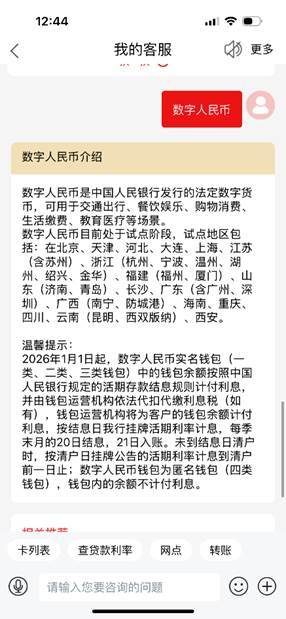
财经观察|今日起,数字人民币开始计息!对你我生活有何影响?
Sou Hu Cai Jing· 2026-01-01 08:59
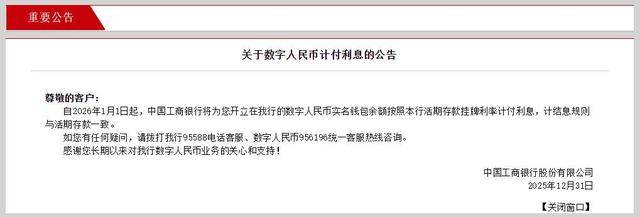
今天,数字人民币正式迈入"计息"时代,用户实名钱包里的余额能"钱生钱"了。 图片截取自工商银行官方网站 六大行集体官宣 图片截取自农业银行官方网站 2025年12月31日,工商银行、农业银行、中国银行、建设银行、交通银行、邮储银行集体发布关于数字 人民币重磅公告。公告称,自2026年1月1日(含)起,将为客户开立在该行的数字人民币实名钱包余 额,按照活期存款挂牌利率计付利息,计结息规则与活期存款一致。 这意味着,存放在这些钱包里的数字人民币,将和传统银行活期存款一样,开始产生收益。目前,几家 大行官网显示的活期存款挂牌利率为0.05%。 图片截取自工商银行官方网站 值得注意的是,并非所有数字人民币钱包都能享受计息。 数字人民币现金型1.0版迈入存款货币型2.0版,一大变化点是由央行对客户负债,变成了商业银行对客 户负债。为何会出现这一变化? 中国人民银行党委委员、副行长陆磊在撰文中指出,数字现金作为中央银行对公众的负债,理论上不需 要商业银行等金融机构参与运营维护。但是在研发试点中,数字现金与流通中纸币的权责关系存在明显 差异。商业银行是数字钱包开立、场景开发和技术维护不可或缺的运营者,其服务伴随数字现金流通 ...
六大国有行官宣:今日起,实施!
券商中国· 2026-01-01 07:51
Core Viewpoint - Starting from January 1, 2026, six major state-owned banks in China will pay interest on the balances of real-name digital RMB wallets at the same rate as current deposit rates, marking China as the first economy to offer interest on central bank digital currency [1][2][5]. Group 1: Announcement from Major Banks - The six major state-owned banks include Industrial and Commercial Bank of China, Agricultural Bank of China, Bank of China, China Construction Bank, Bank of Communications, and Postal Savings Bank of China [1][3]. - The current interest rate for current deposits is 0.05% [3]. - Only real-name digital RMB wallets (categories one, two, and three) will earn interest, while category four wallets, which are non-real-name and used for anonymous payments, will not [3][4]. Group 2: Digital RMB Usage and Statistics - As of November 2025, digital RMB has processed 3.48 billion transactions with a total transaction amount of 16.7 trillion yuan [4]. - There are 230 million personal digital RMB wallets and 18.84 million unit wallets opened [4]. - The cross-border payment business using digital RMB has processed 4,047 transactions, amounting to approximately 387.2 billion yuan, with digital RMB accounting for about 95.3% of the transaction volume in various currencies [4]. Group 3: Expansion of Digital RMB Scenarios - The People's Bank of China has introduced an action plan to enhance the management and service system for digital RMB, which will officially start on January 1, 2026 [5]. - The plan allows banks to manage digital RMB wallet balances similarly to deposits, providing the same level of security as traditional deposits [5][6]. - The interest payment on digital RMB wallets is expected to increase user willingness to adopt digital RMB and expand its usage scenarios, reinforcing China's leading position in the global exploration of central bank digital currencies [5][6]. Group 4: Implications for Users and Banks - Users will benefit from interest on their digital RMB wallets, similar to current deposits, which is expected to enhance their holding willingness [6]. - The interest incentive and improved ecosystem will encourage more merchants to accept digital RMB, enriching payment scenarios [6]. - For commercial banks, digital RMB deposits can become a source of usable funds, enhancing their promotional efforts and allowing for the development of new financial products [6].