
Shanghai Pharma(601607)

Search documents
上海医药(601607) - 上海医药集团股份有限公司关于芪苓颗粒获得临床试验批准通知书的公告
2026-01-29 08:15
上海医药集团股份有限公司 关于芪苓颗粒获得临床试验批准通知书的公告 本公司董事会及全体董事保证本公告内容不存在任何虚假记载、误导性陈述 或者重大遗漏,并对其内容的真实性、准确性和完整性承担个别及连带责任。 近日,上海医药集团股份有限公司(以下简称"上海医药"或"公司")下 属正大青春宝药业有限公司(以下简称"青春宝")自主研发的"芪苓颗粒"(以 下简称"该项目")收到国家药品监督管理局(以下简称"国家药监局")核准 签发的《药物临床试验批准通知书》,现将有关情况公告如下: 一、该项目基本信息 药物名称:芪苓颗粒 剂型:颗粒剂 申请事项:境内生产药品注册临床试验 证券代码:601607 证券简称:上海医药 编号:临2026-009 1 受理号:CXZL2500071 通知书编号:2025LP03031 审批结论:根据《中华人民共和国药品管理法》及有关规定,经审查,2025 年 9 月 1 日受理的芪苓颗粒临床试验申请符合药品注册的有关要求,在进一步完 善临床试验方案的基础上,同意开展用于痛风发作间歇期湿浊瘀阻证的临床试验。 二、该项目研发及注册情况 芪苓颗粒处方源自杭州市中医院的临床验方。人用经验研究表明本品可 ...
上海医药(601607) - 上海医药集团股份有限公司关于七味防己黄芪颗粒获得临床试验批准通知书的公告
2026-01-29 08:15
证券代码:601607 证券简称:上海医药 编号:临2026-008 申请事项:境内生产药品注册临床试验 受理号:CXZL2500097 通知书编号:2025LP03576 上海医药集团股份有限公司 关于七味防己黄芪颗粒获得临床试验批准通知书的公告 本公司董事会及全体董事保证本公告内容不存在任何虚假记载、误导性陈述 或者重大遗漏,并对其内容的真实性、准确性和完整性承担个别及连带责任。 近日,上海医药集团股份有限公司(以下简称"上海医药"或"公司")下 属正大青春宝药业有限公司(以下简称"青春宝")研发的"七味防己黄芪颗粒" (以下简称"该项目")收到国家药品监督管理局(以下简称"国家药监局")核 准签发的《药物临床试验批准通知书》,现将有关情况公告如下: 一、该项目基本信息 药物名称:七味防己黄芪颗粒 剂型:颗粒剂 二、该项目研发及注册情况 七味防己黄芪颗粒处方由天津中医药大学结合中医经典理论和临床实践,在 "防己黄芪汤"基础上进行配伍化裁而来。该项目由青春宝与天津中医药大学等 单位合作研发,并拥有核心知识产权。截至本公告披露日,该项目已累计投入研 发费用约 1,380 万元人民币。 1 三、同类药物市场情况 ...
上海医药:七味防己黄芪颗粒获临床试验批准
Xin Lang Cai Jing· 2026-01-29 08:10
上海医药公告,下属正大青春宝药业有限公司研发的"七味防己黄芪颗粒"收到国家药品监督管理局核准 签发的《药物临床试验批准通知书》。该药物为颗粒剂型,用于慢性心力衰竭的临床试验。项目由青春 宝与天津中医药大学等合作研发,累计投入研发费用约1380万元人民币。该产品尚未在国内外上市。 ...
上海医药:芪苓颗粒获得临床试验批准通知书
Xin Lang Cai Jing· 2026-01-29 08:10
上海医药公告,下属正大青春宝药业有限公司自主研发的"芪苓颗粒"收到国家药品监督管理局核准签发 的《药物临床试验批准通知书》。芪苓颗粒为颗粒剂,用于痛风发作间歇期湿浊瘀阻证的临床试验。芪 苓颗粒处方源自杭州市中医院的临床验方,由青春宝自主研发,拥有核心知识产权。截至本公告披露 日,该项目已累计投入研发费用约1142万元人民币。 ...
医药商业板块1月28日跌1%,人民同泰领跌,主力资金净流出5.28亿元
Zheng Xing Xing Ye Ri Bao· 2026-01-28 08:58
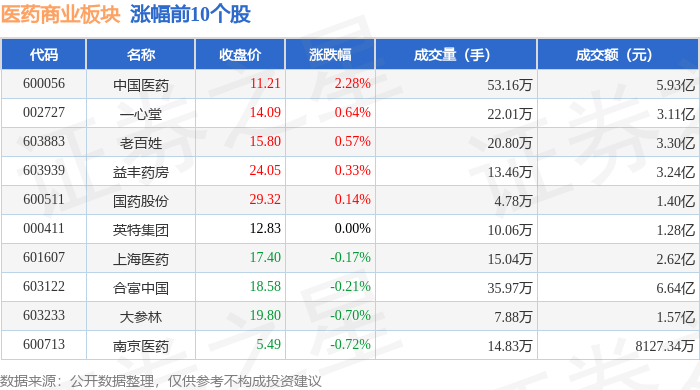
Market Overview - The pharmaceutical commercial sector declined by 1.0% on January 28, with Renmin Tongtai leading the drop [1] - The Shanghai Composite Index closed at 4151.24, up 0.27%, while the Shenzhen Component Index closed at 14342.9, up 0.09% [1] Stock Performance - Notable gainers in the pharmaceutical sector included: - China Medicine (600056) with a closing price of 11.21, up 2.28% and a trading volume of 531,600 shares, totaling 593 million yuan [1] - Yixin Pharmacy (002727) closed at 14.09, up 0.64% with a trading volume of 220,100 shares, totaling 311 million yuan [1] - Major decliners included: - Renmin Tongtai (600829) closed at 12.35, down 4.93% with a trading volume of 432,700 shares, totaling 537 million yuan [2] - Saili Medical (603716) closed at 23.29, down 4.71% with a trading volume of 157,600 shares, totaling 374 million yuan [2] Capital Flow - The pharmaceutical commercial sector experienced a net outflow of 528 million yuan from institutional investors, while retail investors saw a net inflow of 603 million yuan [2] - The capital flow for key stocks showed: - China Medicine had a net inflow of 32.15 million yuan from institutional investors, but a net outflow of 15.57 million yuan from retail investors [3] - Shanghai Pharmaceutical (601607) had a net inflow of 9.01 million yuan from institutional investors, with a significant net outflow of 32.51 million yuan from retail investors [3]




2026年中国心脑血管药物行业市场政策汇总、产业链图谱、市场规模、竞争格局及发展趋势分析:需求群体庞大[图]
Chan Ye Xin Xi Wang· 2026-01-26 01:40
Core Insights - The aging population in China is leading to an increase in cardiovascular diseases, with rising prevalence of chronic conditions such as hypertension and hyperlipidemia, driving demand for cardiovascular drugs [1][8] - There is a significant increase in health awareness among residents, leading to earlier screening and treatment of cardiovascular diseases, which expands the applicable population for cardiovascular medications [1][8] - The implementation of centralized drug procurement policies is causing a downward trend in drug prices, putting pressure on the overall market size, which is projected to decline to 954.1 billion yuan for traditional Chinese medicine and 1,415.8 billion yuan for chemical drugs by 2025 [1][8] Market Overview - Cardiovascular diseases encompass both cardiovascular and cerebrovascular diseases, primarily caused by conditions like hyperlipidemia, blood viscosity, atherosclerosis, and hypertension [2] - Cardiovascular drugs are classified into two main categories: cardiovascular system drugs and cerebrovascular system drugs, targeting various heart and brain-related conditions [2] Policy Environment - The pharmaceutical manufacturing industry, including cardiovascular drugs, is a key focus of national policy support, with various regulations aimed at correcting malpractices and promoting industry development [3][4] Industry Chain - The upstream of the cardiovascular drug industry includes chemical raw materials, traditional Chinese medicinal materials, and pharmaceutical packaging materials, while the midstream involves research, production, and registration processes [4][5] Demand Dynamics - Cardiovascular diseases are the leading cause of death in China, with hypertension cases expected to reach 370 million and coronary heart disease cases at 30 million by 2025, indicating a growing demand for cardiovascular medications [6][8] Competitive Landscape - The market has developed a dual competitive structure, with foreign companies dominating the chemical drug sector and local companies leading in traditional Chinese medicine, creating a competitive environment [10] - Notable domestic players include Shijiazhuang Pharmaceutical Group and Shandong Buchang Pharmaceutical, which have established strong market positions through unique products and effective distribution networks [10][11] Development Trends - The industry is shifting from reliance on generic drugs to innovation, focusing on high-value drug development, including targeted and biological drugs [12] - There is a growing integration of chronic disease management with digital tools, enhancing patient adherence and treatment precision [13] - Policy reforms are reshaping market dynamics, emphasizing high clinical value drugs and expanding the market for basic medications in primary healthcare [14] - The industry is moving towards a collaborative ecosystem, with increased internationalization efforts and participation in global clinical trials [15]




上海医药(601607.SH):普瑞巴林胶囊获得新加坡药品注册证书
Ge Long Hui· 2026-01-23 22:33
Core Viewpoint - Shanghai Pharmaceuticals (601607.SH) has received a drug registration certificate from the Health Sciences Authority (HSA) of Singapore for its Pregabalin capsules, allowing the product to be marketed [1] Group 1: Product Approval and Indications - Pregabalin capsules are primarily used for the treatment of postherpetic neuralgia, diabetic peripheral neuropathy, fibromyalgia, spinal cord injury-related neuropathic pain, and as an adjunctive treatment for epilepsy [1] - The product's research and development were completed by Changzhou Pharmaceutical Factory in October 2019, and it received approval from the U.S. Food and Drug Administration in July 2021 [1] Group 2: Market Expansion and Investment - The drug has also been approved for market entry in Thailand by June 2025, indicating a strategic expansion into Southeast Asian markets [1] - The company has invested approximately RMB 2.19 million in research and development for the product's launch in Southeast Asia, which includes Thailand, Singapore, Malaysia, and the Philippines [1]
上海医药集团股份有限公司关于马来酸阿伐曲泊帕片获得批准生产的公告
Shang Hai Zheng Quan Bao· 2026-01-23 19:25
Group 1 - Shanghai Pharmaceuticals has received approval for the production of Avatrombopag Maleate Tablets from the National Medical Products Administration [1][2] - The drug is indicated for adult patients with chronic liver disease-related thrombocytopenia undergoing elective diagnostic procedures or surgery, and for adults with chronic primary immune thrombocytopenia (ITP) who have had inadequate responses to previous treatments [3] - The company has invested approximately RMB 9.8961 million in the research and development of this drug as of the announcement date [3] Group 2 - The drug's approval is expected to enhance market share and competitiveness, benefiting from greater support in medical insurance and procurement due to its new registration classification [5] - The total procurement amount for Avatrombopag Maleate Tablets in hospitals in mainland China is projected to be RMB 566.56 million in 2024 [4] Group 3 - Shanghai Pharmaceuticals' subsidiary, Changzhou Pharmaceutical Factory, has received a drug registration certificate for Pregabalin Capsules from the Health Sciences Authority of Singapore, allowing it to market the drug in Singapore [8][9] - Pregabalin Capsules are indicated for the treatment of neuropathic pain and as an adjunct therapy for epilepsy, with a total investment of approximately RMB 2.19 million in R&D for the Southeast Asian market [9] - The sales revenue for Pregabalin Capsules in Singapore is estimated to be USD 2 million in 2024 [11]
上海医药:关于普瑞巴林胶囊获得新加坡药品注册证书的公告
Zheng Quan Ri Bao· 2026-01-23 12:16
Core Viewpoint - Shanghai Pharmaceuticals announced that its subsidiary, Changzhou Pharmaceutical Factory, received a drug registration certificate from the Health Sciences Authority (HSA) of Singapore for the drug Pregabalin capsules, which has been approved for market launch [1]. Group 1 - The drug Pregabalin capsules have been officially approved for sale in Singapore [1]. - The approval was granted by the Health Sciences Authority (HSA) of Singapore [1].
上海医药普瑞巴林胶囊获新加坡药品注册证书
Bei Jing Shang Bao· 2026-01-23 11:04
Core Viewpoint - Shanghai Pharmaceuticals has received approval from the Singapore Food and Drug Administration for the marketing of Pregabalin capsules, indicating a significant milestone for the company in expanding its product offerings in the international market [1]. Group 1 - The approved Pregabalin capsules are primarily used for treating postherpetic neuralgia, diabetic peripheral neuropathy, fibromyalgia, and neuropathic pain due to spinal cord injury, as well as for adjunctive treatment of epilepsy [1].