CNCB(601998)

Search documents
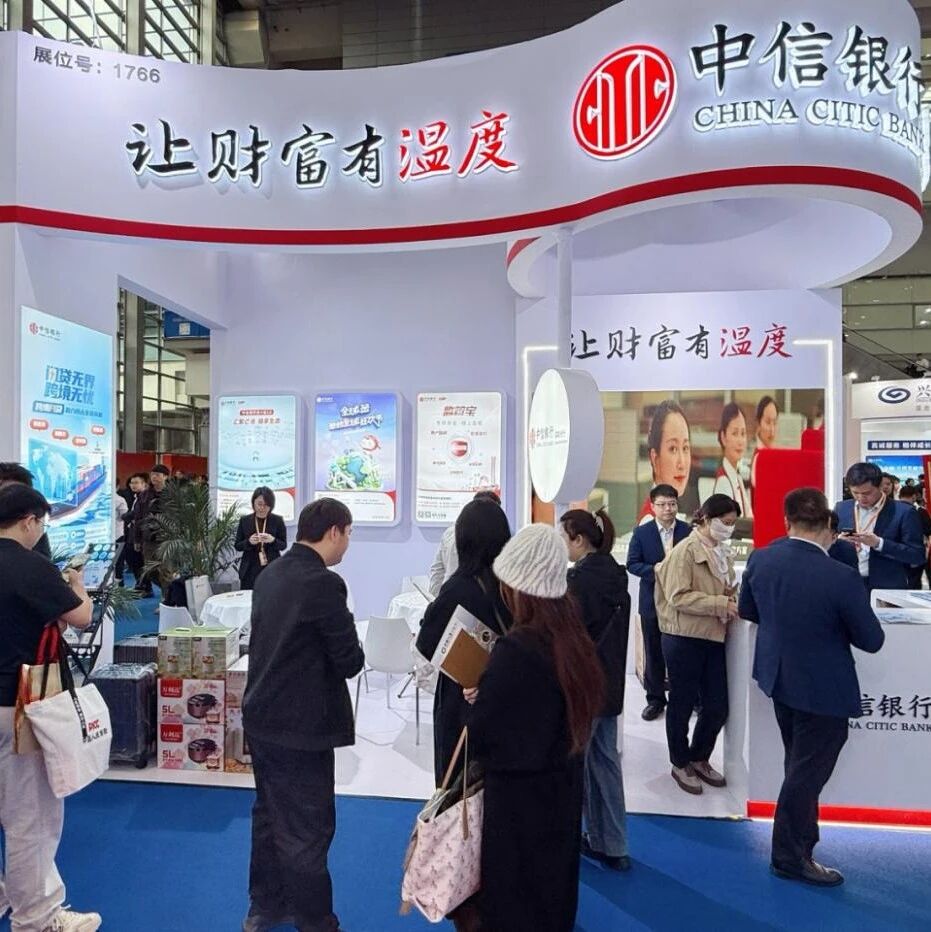
中信银行深圳分行亮相第十九届金博会 加速赋能新质生产力
中国基金报· 2025-11-28 08:21
Core Viewpoint - The 19th Shenzhen International Financial Expo showcases the financial services and products of CITIC Bank Shenzhen Branch, highlighting its commitment to supporting the local economy and community needs [1][3]. Group 1: Event Overview - The Shenzhen International Financial Expo, hosted by the Shenzhen Municipal Government, opened on November 19, featuring over 200 institutions from various countries and regions [1][3]. - The theme of this year's expo is "New Heights in Industrial Finance, Empowering the Future with Science and Technology," with an exhibition area of 15,000 square meters [3]. Group 2: CITIC Bank's Participation - CITIC Bank Shenzhen Branch presented several key financial products, including Xiaotianyuan, Sci-Tech E-Loan, Cross-Border Flash Loan, and Overseas Financial Services, which attracted significant public interest [3][4]. - The bank has been rooted in Shenzhen for 37 years and emphasizes its mission of "serving the country through finance and serving the people" [3][4]. Group 3: Strategic Focus - CITIC Bank aims to leverage its participation in the expo to enhance its focus on the political and people-oriented aspects of financial work, continuing to deepen its commitment to five key areas: technology finance, green finance, inclusive finance, pension finance, and digital finance [4]. - The bank plans to utilize the synergistic advantages of CITIC Group's comprehensive financial services to support the real economy and contribute to the development of Shenzhen as a leading city in the Guangdong-Hong Kong-Macao Greater Bay Area [4].


A股超4100股上涨,福建股多股涨停,锂矿股反弹
21世纪经济报道· 2025-11-28 07:41
Market Overview - The A-share market ended November with a cumulative decline of 1.67%, marking the end of a six-month upward trend after reaching a ten-year high mid-month [1] - On November 28, all major A-share indices closed in the green, with the Shanghai Composite Index at 3888.60, up 0.34% [2] Sector Performance - The Fujian sector showed significant activity, with stocks like Haixia Innovation rising over 16% and several others hitting the daily limit [3] - The Hainan sector also rebounded, with Hainan Ruize achieving three consecutive daily limits and Shennong Agriculture and Hainan Rubber both rising over 8% [5] - Lithium mining stocks experienced a strong rebound, with major players like Dazhong Mining and Shengxin Lithium Energy seeing gains of over 7% and 6%, respectively [6][7] Stock Specifics - The Two Straits Integration Index increased by 5.41%, with notable performers including Haixia Innovation (16.05), Pingtan Development (10.73), and Fujian Cement (7.49) [4] - In the lithium sector, Dazhong Mining (31.47), Shengxin Lithium Energy (35.26), and Yahua Group (22.59) were highlighted for their performance [7] Declines and Adjustments - Banking stocks collectively adjusted, with Postal Savings Bank down nearly 2% and others like Bank of China and CITIC Bank falling over 1% [9] - The pharmaceutical sector faced a pullback, with stocks like Guangji Pharmaceutical and Zhongsheng Pharmaceutical hitting the daily limit down, and Yue Wannianqing dropping over 10% [9] - AI application stocks also struggled, with companies like Yaowang Technology and Yidian Tianxia declining over 4% [9]






当还不起房贷的人变多,银行如何“甩包袱”?
Jing Ji Guan Cha Wang· 2025-11-28 06:49
Core Viewpoint - The issuance of non-performing asset-backed securities (ABS) is becoming a normalized practice among banks, serving as a crucial tool for managing non-performing assets and mitigating systemic risks in the current economic environment [3][4][5]. Group 1: Non-Performing Asset Management - Non-performing asset securitization is increasingly recognized as an important institutional tool for commercial banks to revitalize existing assets and prevent systemic risks [3][4]. - Several banks, including Bohai Bank, China Construction Bank, and China Merchants Bank, have recently issued ABS backed by non-performing personal housing loans, indicating a trend towards structured financial products [3][4][5]. - The structure of these ABS typically includes a priority/subordinate tier, fixed interest rates, and relies on the realization of collateral to support cash flows, despite the underlying assets being classified as "non-performing" [3][5][6]. Group 2: Asset Quality and Recovery - The weighted average overdue period for the underlying assets in the recent Bohai Bank ABS issuance is 15.95 months, with a loss loan ratio of 56.60%, indicating a higher risk exposure compared to similar projects from other banks [6][10]. - The expected recovery rate for the underlying assets is 40.26%, with a total market value of collateral estimated at 1.184 billion yuan, but the realizable value is projected to be only 459 million yuan due to various factors [5][10]. - The current economic backdrop, including high household leverage and a slow increase in mortgage delinquency rates, is pressuring banks to actively manage their non-performing assets [4][10]. Group 3: Systemic Risk and Future Outlook - The current issuance of non-performing housing loan ABS is accompanied by common risks, including potential higher-than-expected issuance rates and limitations in due diligence that may leave some asset flaws unidentified [11][12]. - While securitization helps banks offload risks, it does not eliminate them, as risks may transfer to non-bank investors who may lack the expertise to manage these assets effectively [11][12]. - Historical data suggests that existing provisions could release at least 800 billion yuan in net profit for listed banks over the next few years, supporting the stability of overall net profits despite potential challenges [2][12].




中信银行(601998.SH):2025年\"三农\"专项金融债券(债券通)发行完毕
Ge Long Hui· 2025-11-28 05:41
Core Viewpoint - CITIC Bank has successfully issued a 2025 "Three Rural" special financial bond with a total scale of RMB 6 billion, aimed at supporting agricultural loans [1] Group 1: Bond Issuance Details - The bond was recorded on November 25, 2025, and fully issued on November 27, 2025, in the national interbank bond market [1] - The bond has a maturity of 3 years with a floating interest rate, where the initial interest rate adjustment period is set at 1.87% [1] - The fixed interest spread for this bond is -1.13% [1] Group 2: Fund Utilization - The funds raised from this bond issuance will be used specifically for agricultural loans, subject to applicable laws and regulatory approvals [1]
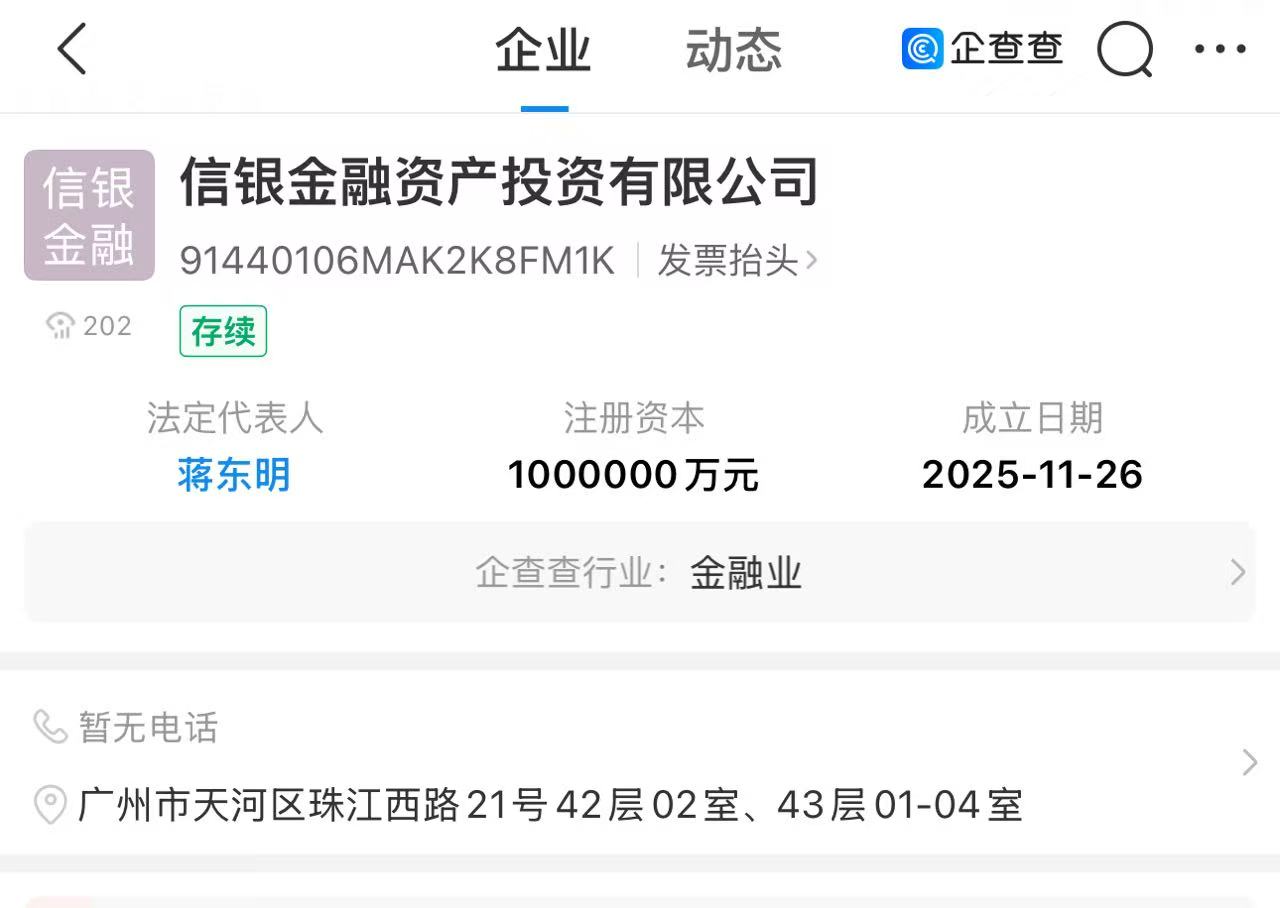
中信系百亿AIC正式落子广州 中信 “老将”出任法定代表人
2 1 Shi Ji Jing Ji Bao Dao· 2025-11-28 01:08
Core Points - The establishment of Xinyin Financial Asset Investment Co., Ltd. has been officially announced, with the company being a wholly-owned subsidiary of CITIC Bank [2][3] - The company was registered on November 26, 2025, with a registered capital of 10 billion yuan, located in Tianhe District, Guangzhou [1][2] - Jiang Dongming, who has a long tenure at CITIC Bank, is the legal representative of the new company [2][3] Company Information - Jiang Dongming has held various positions within CITIC Bank, including Deputy General Manager of the Shenzhen Branch and President of the Guiyang Branch since 2021 [2][3] - As of the report date, Jiang Dongming still holds the position of President at the Guiyang Branch [2] - CITIC Bank's announcement on November 23 confirmed that Xinyin Financial Asset Investment Co., Ltd. has been approved to commence operations, making it the second AIC (Asset Investment Company) among joint-stock banks in China [2][3] Industry Context - There are currently nine approved AICs in China, which include six state-owned banks (Agricultural Bank, Industrial and Commercial Bank, China Construction Bank, Bank of China, China Postal Savings Bank, and China Everbright Bank) and three joint-stock banks (CITIC Bank, Industrial Bank, and China Merchants Bank) [2][3]
中信银行股份有限公司 关于2025年“三农”专项金融债券(债券通)发行完毕的公告
Zhong Guo Zheng Quan Bao - Zhong Zheng Wang· 2025-11-28 00:35
Core Points - The announcement details the completion of the issuance of the 2025 "Three Rural" special financial bonds by CITIC Bank, with a total issuance scale of RMB 60 billion [1] - The bonds are 3-year floating rate bonds with an initial interest rate of 1.87% and a fixed spread of -1.13% [1] - The funds raised from this bond issuance will be specifically used for agricultural loans, in accordance with applicable laws and regulatory approvals [1] Summary by Sections - **Bond Issuance Approval** - CITIC Bank has been authorized by the People's Bank of China to issue financial bonds, with a new balance not exceeding RMB 60 billion for 2025 and a year-end balance not exceeding RMB 400 billion [1] - **Bond Details** - The bonds were recorded on November 25, 2025, and fully issued on November 27, 2025, in the national interbank bond market [1] - The bonds are categorized as 3-year floating rate bonds, with the first interest adjustment period set at 1.87% [1] - **Use of Proceeds** - The proceeds from the bond issuance will be allocated specifically for agricultural loans, subject to legal and regulatory approvals [1]
我国将采取针对性举措做好信用修复; 多家银行年末加码推广个人养老金缴存业务 | 金融早参
Sou Hu Cai Jing· 2025-11-28 00:02
Group 1 - The National Development and Reform Commission of China will enhance credit repair measures, simplifying application materials and improving efficiency, while no longer publicly disclosing minor credit violations [1] - The credit repair system is essential for safeguarding the legal rights of credit subjects, allowing them to restore their credit status after correcting mistakes and fulfilling obligations [1] Group 2 - Several banks are intensifying the promotion of personal pension deposit services, offering exclusive incentives such as cash rewards to attract customers as the year-end approaches [2] - The maximum annual contribution limit of 12,000 yuan can yield up to 600 yuan in subsidies for customers, indicating a shift from merely increasing account numbers to enhancing deposit amounts [2] - With the personal pension system having been implemented for three years, banks are focusing on increasing customer engagement and loyalty as market competition stabilizes [2] Group 3 - Many banks are expanding their distribution channels for wealth management products, with a rapid increase in the weight of agency sales [3] - Some small and medium-sized banks are exploring cooperative models like "joint creation of wealth management" to retain certain investment research capabilities within regulatory frameworks [3] - The wealth management business of small and medium-sized banks is evolving towards a "light asset management, light investment research" model, reflecting changes in regulatory guidance and operational environments [3] Group 4 - Citic Bank has completed the issuance of 60 billion yuan in 2025 "Three Rural" special financial bonds, enhancing its financing capabilities and market competitiveness [4] - The issuance aligns with national strategies to support the "Three Rural" sectors and aims to improve the rural financial environment, contributing to rural revitalization [4] - The total new balance of financial bonds for 2025 is capped at 600 billion yuan, with an end-of-year balance not exceeding 4 trillion yuan [4]
银行上调代销公募基金风险等级 对投资者影响几何?
Nan Fang Du Shi Bao· 2025-11-27 23:14
Core Viewpoint - Recently, China Construction Bank announced an increase in the risk levels of 87 mutual fund products, following similar actions by Postal Savings Bank and Citic Bank. This move is seen as a response to regulatory requirements aimed at enhancing investor protection rather than an indication of an overall rise in market risk [2][4]. Summary by Sections Risk Level Adjustments - China Construction Bank adjusted the risk levels of 87 mutual fund products, with 32 moving from "R2—Medium-Low Risk" to "R3—Medium Risk" and 55 from "R3—Medium Risk" to "R4—Medium-High Risk" [3]. - Postal Savings Bank also made similar adjustments, changing the risk levels of 80 products on October 29, with 52 moving to "Medium-High Risk" and others adjusted accordingly. Another adjustment on November 6 affected 6 products [3]. - Citic Bank made adjustments to its asset management products in October, emphasizing compliance with regulatory requirements and the need for appropriate investor management [3]. Regulatory Compliance and Market Conditions - The adjustments are primarily driven by regulatory compliance pressures, the need to reflect the actual risk levels of certain funds, and to mitigate potential legal and reputational risks [5]. - Experts indicate that the changes focus on high-volatility products, particularly equity funds, and are a response to increased market fluctuations and asset valuation pressures [4][5]. Long-term Benefits for Investors - While investors may face limited choices in the short term, the long-term benefits include clearer risk warnings and more rational investment decisions, particularly for low-risk preference groups [6]. - The adjustments are expected to promote a shift in the wealth management industry from product selling to service selling, encouraging fund companies to enhance their research capabilities and fostering a healthier market ecosystem [6].


多家银行下架中长期存款产品
Zheng Quan Ri Bao· 2025-11-27 15:49
Core Viewpoint - Major state-owned banks and some joint-stock banks in China have recently suspended the sale of 5-year large-denomination time deposits, with current offerings primarily focused on 1-month to 3-year products [1] Group 1: Bank Actions - Six major state-owned banks, including ICBC, ABC, BOC, CCB, BOCOM, and PSBC, along with several joint-stock banks, have withdrawn long-term deposit products [1] - Many small and medium-sized banks have also announced the suspension of 3-year and 5-year fixed deposit products while simultaneously lowering interest rates across various deposit terms [1] - The remaining large-denomination time deposits are mostly concentrated in 1-month, 3-month, and 3-year terms, with 3-year products becoming the primary long-term offering [1] Group 2: Interest Rate Trends - The interest rates for 3-year large-denomination time deposits generally range from 1.5% to 1.75%, with reports of "tight quotas" and "sold out" situations being common [1] - The average net interest margin for commercial banks has dropped to a historical low of 1.42% in Q3, reflecting the pressure on bank profitability [2] Group 3: Strategic Adjustments - The adjustments in long-term deposit products are a response to the narrowing net interest margin, aimed at alleviating profitability pressures [2][3] - The shift indicates a transition from a focus on scale expansion to a more refined approach that emphasizes the quality of liabilities [3] Group 4: Future Outlook - There is potential for further reductions in deposit rates as banks continue to adjust high-cost deposit products [4] - Investors are advised to monitor market dynamics closely, including LPR adjustments and regulatory changes, while diversifying their asset allocation based on risk preferences [4]


超2600亿“红包”落地!13家银行中期分红,六大行贡献七成
Xin Jing Bao· 2025-11-27 12:05
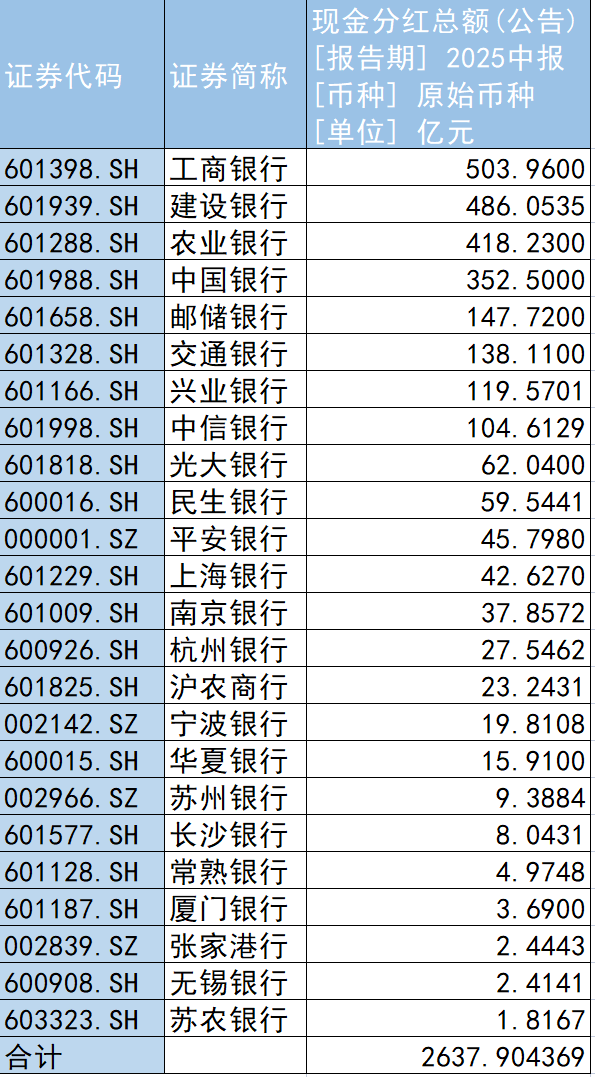
Core Viewpoint - The mid-term dividends of listed banks have exceeded 260 billion yuan, reflecting a trend towards enhancing shareholder returns and stabilizing market confidence [1][2][5]. Group 1: Dividend Distribution - As of November 26, 2025, 42 A-share listed banks have distributed a total of 263.79 billion yuan in mid-term dividends, with 13 banks having completed their distributions [1][2]. - The six major state-owned banks contributed over 70% of the total mid-term dividends, amounting to 204.66 billion yuan, with Industrial and Commercial Bank of China leading at 50.40 billion yuan [2][3]. - Several banks, including Shanghai Bank and Nanjing Bank, have also participated in mid-term dividends, with total distributions from city commercial banks reaching 3.10 billion yuan [2][4]. Group 2: Market Impact and Investor Confidence - The implementation of mid-term dividends is seen as a signal of stable operations, enhancing market confidence and attracting long-term capital [1][5][9]. - First-time dividend issuers have experienced positive short-term stock performance, indicating that dividends can boost shareholder confidence and improve capital efficiency [5][9]. - The trend of mid-term dividends is aligned with regulatory encouragement for banks to optimize dividend policies and improve shareholder returns [1][6]. Group 3: Future Outlook and Strategic Considerations - The decision to implement mid-term dividends reflects banks' strong financial performance and stable profit models, which provide a solid foundation for such distributions [6][9]. - Analysts suggest that banks should balance short-term dividend payouts with long-term growth strategies, ensuring that capital is adequately retained for future development [9]. - The ongoing trend of mid-term dividends is viewed as a sign of the maturation of China's capital markets and a shift towards greater emphasis on investor returns [9].