
XfmGroup(603225)

Search documents
主流厂商协同,长丝价格上升 | 投研报告
Zhong Guo Neng Yuan Wang· 2025-08-25 01:37
Group 1 - The domestic key refining project price difference this week is 2579 yuan/ton, an increase of 18 yuan/ton (up 1%) compared to the previous week [2] - The average prices for POY, FDY, and DTY this week are 6789, 7100, and 7986 yuan/ton respectively, with week-on-week increases of 61, 57, and 57 yuan/ton [2] - The average profit for the POY, FDY, and DTY industries this week is 35, -25, and -34 yuan/ton respectively, with week-on-week changes of +18, +16, and +16 yuan/ton [2] Group 2 - The inventory levels for POY, FDY, and DTY are 13.8, 22.7, and 27.8 days respectively, showing week-on-week decreases of 2.3, 0.6, and 0.4 days [2] - The operating rate for long filaments is 90.7%, an increase of 0.1 percentage points compared to the previous week [2] - The operating rate for weaving machines this week is 60.1%, an increase of 2.1 percentage points compared to the previous week [2] Group 3 - Domestic refined oil prices for gasoline, diesel, and aviation kerosene have decreased this week [2] - The average PX price this week is 841.1 USD/ton, an increase of 9.0 USD/ton compared to the previous week [2] - The PX operating rate is 84.6%, an increase of 1.4 percentage points compared to the previous week [2]


大炼化周报:主流厂商协同,长丝价格上升-20250824
Soochow Securities· 2025-08-24 13:28
Price Trends - Domestic refining project price spread this week is 2579 CNY/ton, up by 18 CNY/ton (1%) week-on-week[2] - International refining project price spread this week is 1077 CNY/ton, down by 33 CNY/ton (-3%) week-on-week[2] Polyester Sector - Average prices for POY, FDY, and DTY are 6789, 7100, and 7986 CNY/ton respectively, with week-on-week increases of 61, 57, and 57 CNY/ton[2] - Weekly average profits for POY, FDY, and DTY are 35, -25, and -34 CNY/ton respectively, with week-on-week changes of +18, +16, and +16 CNY/ton[2] - Inventory days for POY, FDY, and DTY are 13.8, 22.7, and 27.8 days respectively, with week-on-week changes of -2.3, -0.6, and -0.4 days[2] - Operating rate for polyester filament is 90.7%, up by 0.1 percentage points week-on-week[2] Refining Sector - Domestic gasoline, diesel, and aviation fuel prices have decreased this week[2] - US aviation fuel prices have also decreased this week[2] Chemical Sector - PX average price is 841.1 USD/ton, up by 9.0 USD/ton week-on-week, with a price spread against crude oil of 353.3 USD/ton, up by 5.3 USD/ton week-on-week[2] - PX operating rate is 84.6%, up by 1.4 percentage points week-on-week[2] Risks - Project implementation progress may fall short of expectations[2] - Macroeconomic growth slowdown could lead to weaker-than-expected demand recovery[2] - Geopolitical risks may cause fluctuations in raw material prices[2] - Significant changes in industry capacity may occur[2] - Statistical discrepancies and calculation errors may arise[2]
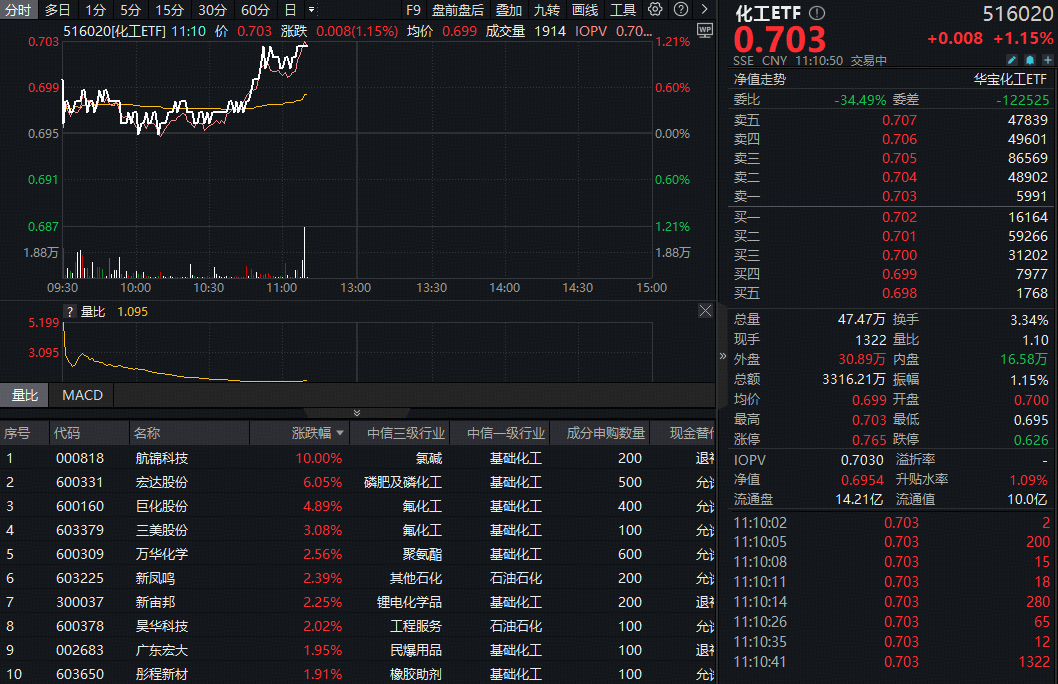
ETF盘中资讯|从“吞金兽”到“摇钱树”?反内卷重塑化工格局,化工ETF(516020)涨超1%,资金20日扫货超2.7亿!
Sou Hu Cai Jing· 2025-08-22 03:25
Group 1 - The chemical sector experienced a sudden surge, with stocks such as Hangjin Technology hitting the daily limit, and Hongda Co. and Juhua Co. seeing significant increases of over 6% and 4% respectively, while the chemical ETF (516020) rose by 1.15% [1] - The recent "anti-involution" trend has benefited the chemical sector, attracting substantial capital inflows, with the chemical ETF (516020) seeing a net subscription of nearly 140 million yuan over the last five trading days [1][3] - As of August 21, the social security fund held 129 stocks with a total market value of 33.2 billion yuan, with the chemical sector being the largest holding at 6 billion yuan [3] Group 2 - The chemical industry is expected to see a phase of improvement as the "anti-involution" measures are implemented, alleviating issues of overcapacity and excessive competition [3][4] - The chemical ETF (516020) is currently at a relatively low price-to-book ratio of 2.17, indicating a favorable long-term investment opportunity [3] - Analysts suggest that the "anti-involution" trend will be a key policy focus through 2025, leading to a more orderly competitive environment in the chemical sector and potential recovery in profitability [4] Group 3 - The chemical ETF (516020) tracks the CSI segmented chemical industry index, covering various sub-sectors, with nearly 50% of its holdings in large-cap leading stocks [4] - The ETF has shown strong performance, with significant net subscriptions indicating investor confidence in the sector's recovery [3][4] - The potential for increased dividend yields and improved cash flow in the chemical sector is highlighted, suggesting a shift from being a "cash-consuming" industry to a "cash-generating" one [4]





期货工具筑牢聚酯产业风控防线
Qi Huo Ri Bao Wang· 2025-08-21 00:51
Group 1: Industry Trends and Risk Management - The polyester industry is focusing on risk management as a vital aspect of modern enterprises, emphasizing the importance of a closed-loop management system that includes prevention, control, and hedging [1] - The Zhengzhou Commodity Exchange has developed a comprehensive futures market for polyester, providing industry players with a rich toolbox for risk management and enhancing operational resilience [1] - PTA (Purified Terephthalic Acid) is highlighted as the most established polyester chain futures product, with a hedging efficiency exceeding 98% [1] Group 2: Company Strategies and Innovations - Rongsheng Petrochemical has adapted its risk management strategies for PX (Para-Xylene) by dynamically adjusting product flows and managing PX inventory to mitigate risks [2] - New Fengming Group has established a comprehensive dynamic risk control system across its supply chain, utilizing futures markets to optimize procurement and hedge against price volatility [2] - Wan Kai New Materials Co., Ltd. benefits from the flexibility provided by futures tools to manage market risks associated with bottle sales, which often involve long-term orders and "pulse-like" sales patterns [3] Group 3: Market Developments and Future Outlook - The liquidity of PX futures is increasing, and the Zhengzhou Commodity Exchange is promoting the opening of related products, which will expand market participation opportunities for companies [3] - Trade merchants are playing a crucial role in managing inventory pressures within the polyester industry, especially during accumulation phases, leveraging financial tools for effective inventory management [3]
反内卷,化工慢牛的宏大叙事
Tebon Securities· 2025-08-20 13:36
Investment Rating - The report maintains an "Outperform" rating for the chemical industry [2] Core Insights - The chemical industry is expected to benefit from anti-involution policies aimed at curbing disorderly competition and eliminating outdated production capacity, which may lead to a recovery in industrial product prices and positively impact PPI and CPI [6][11][17] - The report highlights the significant influence of the energy and chemical sectors on PPI, with their price fluctuations directly affecting overall industrial inflation levels [16] - The industry is under pressure from declining product prices and reduced capacity utilization, leading to a strong demand for anti-involution measures [17] - The current valuation of the chemical industry is at a historical low, providing substantial upside potential as the sector is expected to recover from its cyclical bottom [17][19] Summary by Sections 1. Importance of Inflation Recovery - The report emphasizes that the chemical sector is a crucial lever for inflation recovery, as evidenced by the PPI's continuous decline and the need for policy intervention to combat deflationary pressures [6][11] 2. Reasons to Focus on Chemicals - The energy and chemical sectors account for 25%-30% of PPI, making their price recovery vital for overall inflation [16] - The industry faces significant profitability challenges, with nearly 25% of chemical companies reporting losses in 2024 [17] 3. Paths for Anti-Involution in Chemicals 3.1. Active Approach: Industry Self-Regulation - Certain sub-industries, such as polyester filament and sucralose, are attempting to improve profitability through supply-side collaboration, benefiting from high concentration and low profitability [27][29] - The report identifies key chemical products likely to benefit from self-regulation, including polyester filament, polyester bottle chips, and organic silicon [29][31] 3.2. Passive Approach: Policy-Driven Industry Improvement - The report outlines a dual-track policy framework focusing on optimizing existing capacity and strictly controlling new projects to enhance the competitive landscape [27][31] - Historical experiences suggest that effective policy measures will include phasing out outdated facilities and enforcing stricter environmental regulations [27][31]


化学纤维板块8月20日涨2.77%,吉林碳谷领涨,主力资金净流入4.53亿元
Zheng Xing Xing Ye Ri Bao· 2025-08-20 08:37
Market Overview - On August 20, the chemical fiber sector rose by 2.77% compared to the previous trading day, with Jilin Carbon Valley leading the gains [1] - The Shanghai Composite Index closed at 3766.21, up 1.04%, while the Shenzhen Component Index closed at 11926.74, up 0.89% [1] Stock Performance - Jilin Carbon Valley (836077) closed at 16.23, up 11.16% with a trading volume of 281,100 shares and a transaction value of 444 million yuan [1] - Suzhou Longjie (603332) closed at 15.83, up 10.01% with a trading volume of 337,700 shares and a transaction value of 515 million yuan [1] - Jilin Chemical Fiber (000420) closed at 4.64, up 9.95% with a trading volume of 1,309,800 shares and a transaction value of 602 million yuan [1] - Other notable stocks include 聚合顺 (605166) at 13.00, up 7.17%, and 南京化纤 (600889) at 16.77, up 6.68% [1] Capital Flow - The chemical fiber sector saw a net inflow of 453 million yuan from main funds, while retail funds experienced a net outflow of 316 million yuan [2] - The main funds' net inflow for Jilin Chemical Fiber (000420) was 200 million yuan, accounting for 33.27% of its total [3] - Suzhou Longjie (603332) had a main fund net inflow of 119 million yuan, representing 23.14% of its total [3]


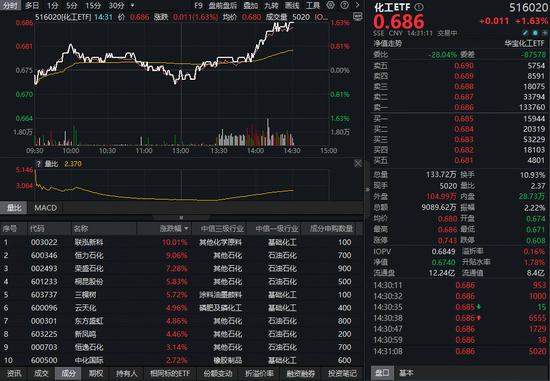
政策“反内卷”+海外产能退出,化工板块午后暴力拉升!联泓新科涨停,主力抢筹超44亿!
Xin Lang Ji Jin· 2025-08-20 06:43
Group 1 - The chemical sector experienced a significant surge on August 20, with the chemical ETF (516020) rising by 1.63% [1][2] - Key stocks in the sector saw substantial gains, including Lianhong Xinke reaching the daily limit, Hengli Petrochemical increasing over 9%, and Rongsheng Petrochemical rising over 7% [1][2] - The basic chemical sector attracted over 4.4 billion yuan in net inflows, ranking fifth among 30 sectors in terms of net capital inflow [1][3] Group 2 - Analysts suggest that supply-side structural optimization is expected, with domestic policies frequently addressing supply-side requirements [3] - The chemical industry in China is poised to fill gaps in the international supply chain due to its competitive advantages in cost and technology [3] - The valuation of the chemical ETF (516020) is at a low point, with a price-to-book ratio of 2.1, indicating a favorable long-term investment opportunity [4] Group 3 - Recommendations include identifying stocks with strong performance in Q2 and those benefiting from AI capital investments and U.S. tariff conflicts [5] - The chemical ETF (516020) provides a diversified investment approach, covering various sub-sectors and focusing on large-cap stocks [6]

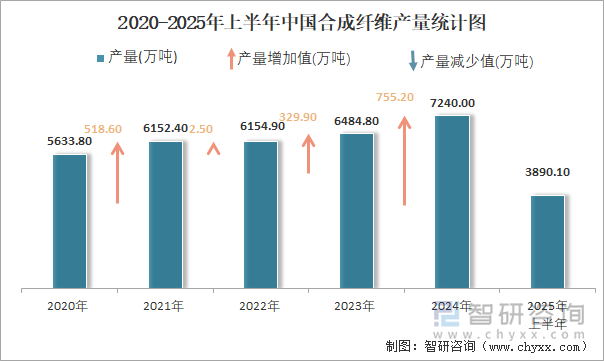
2025年上半年中国合成纤维产量为3890.1万吨 累计增长5%
Chan Ye Xin Xi Wang· 2025-08-20 03:40
Group 1 - The core viewpoint of the article highlights the growth potential of China's synthetic fiber industry, with a projected production increase of 4.5% year-on-year by June 2025, reaching 6.75 million tons [1] - In the first half of 2025, China's cumulative synthetic fiber production is expected to reach 38.901 million tons, reflecting a cumulative growth of 5% [1] - The article references several listed companies in the synthetic fiber sector, including Hengyi Petrochemical, Rongsheng Petrochemical, and Xin Fengming, indicating a focus on key players in the industry [1] Group 2 - The report titled "2025-2031 China Synthetic Fiber Industry Market Status Survey and Development Trend Analysis" by Zhiyan Consulting provides insights into the market dynamics and future trends of the synthetic fiber industry [1] - Zhiyan Consulting is recognized as a leading industry consulting firm in China, specializing in comprehensive industry research and providing tailored consulting services [2] - The data utilized in the article is sourced from the National Bureau of Statistics and organized by Zhiyan Consulting, ensuring reliability and accuracy [3]
钢铁长龙舞江淮,赋能经济新脉动
Xin Hua Ri Bao· 2025-08-20 00:56
Group 1: Infrastructure Development - Jiangsu's railway construction investment reached 35 billion yuan in the first half of the year, achieving over half of the annual target [1] - Key projects like the Chongqi-Public Railway Bridge and the Ningshu Intercity Railway are progressing ahead of schedule, with significant completion rates reported [2] - The Suzhou East Tunnel of the Tongsujiayong High-Speed Railway is a critical project, with plans to complete 45% of the second shield section by the end of 2025 [3] Group 2: Economic Impact and Connectivity - The "High-Speed Rail +" initiative is enhancing connectivity and transforming lifestyles, making cross-city travel as convenient as commuting [5][6] - The introduction of special trains for sports events has successfully transported nearly 20,000 fans, showcasing the integration of transportation and tourism [5][6] - Jiangsu's railway passenger volume has seen record highs, with over 9.47 million passengers during a peak week, indicating strong demand for rail services [6] Group 3: International Trade and Logistics - The launch of the Xuzhou to Central Asia international freight train has simplified logistics and customs processes, significantly reducing costs and time [7] - The new rail lines at the Khorgos dry port in Kazakhstan enhance operational efficiency for international freight, supporting the growth of the China-Central Asia trade corridor [8] - Jiangsu's international freight trains have expanded to 25 routes, with a total of 1,217 trains operated in the first half of the year, marking a 68.3% year-on-year increase in June [8]

让“郑州方案”成为全球大宗商品定价体系中的“中国印记”
Qi Huo Ri Bao· 2025-08-18 03:02
Core Viewpoint - The article emphasizes the increasing international influence of the "Zhengzhou Price" in the global commodity market, particularly through the opening of China's futures market and the introduction of foreign participants in various futures contracts, enhancing price transparency and risk management for domestic and international enterprises [1][21][25]. Group 1: Development of Zhengzhou Futures Market - Since 2018, the Zhengzhou Commodity Exchange (ZCE) has made significant strides in internationalizing its futures market, particularly with PTA futures, which has become a key pricing reference for cross-border trade [5][21]. - The introduction of foreign participants has led to the establishment of a more transparent pricing mechanism, allowing companies to lock in prices and manage risks more effectively [6][10][12]. - The ZCE's initiatives, such as the introduction of bonded delivery and export-type delivery systems, have facilitated smoother cross-border transactions and enhanced the efficiency of international trade [9][23]. Group 2: Impact on Industries - The PTA industry in China has transformed from a reliance on foreign technology to becoming a globally competitive sector, with annual production capacity projected to increase from over 49 million tons in 2020 to 86 million tons by 2024 [3][4]. - The "Zhengzhou Price" has gained recognition among global traders, with significant percentages of international trade in commodities like palm oil and peanuts now referencing Zhengzhou futures prices [7][8]. - The shift from fixed pricing models to futures-based pricing has improved price transparency and reduced negotiation times in international contracts [7][8][18]. Group 3: Future Prospects - The ZCE aims to expand its international influence by introducing more futures products and enhancing its delivery mechanisms, which will further integrate the Chinese futures market into the global trading system [15][26]. - The ongoing development of the "Zhengzhou Plan" is seen as a pathway for establishing a new global pricing paradigm, leveraging China's position as a major consumer and trader of various commodities [21][22]. - The collaboration between domestic and international enterprises is expected to deepen, with the futures market serving as a critical tool for risk management and price discovery in the evolving global trade landscape [25][30].

